You can’t cut your way to growth. You can’t automate your way to innovation.
AI is forcing every organization to reveal what it really believes about people.
Do leaders see AI as a way to shrink the company into a more efficient version of yesterday? Or do they see it as a way to expand the organization’s capacity to learn, imagine, decide, create, and grow?
That is the fork in the road.
I call this moment AI Darwinism: the new competitive reality where advantage goes to the most adaptive, not the most automated. The winners will not be the companies that replace people fastest. They will be the companies that learn faster, augment better, and use human + artificial intelligence to create new value before the market forces them to.
That is why the real ROI of AI is no longer just Return on Investment. It is Return on Intelligence.
Return on Investment asks: What did we spend, and what did we save?
Return on Intelligence asks: What did we learn? What did we unlock? What new capacity did we create? What new value can we now deliver that was impossible, impractical, or invisible before?
You cannot automate your way to innovation and growth.
Automation can make yesterday more efficient.
Augmentation is how we invent what comes next.
Automation is Useful, Automation as Strategy is a Trap
Let’s get this out of the way: automation is not the enemy. It is necessary. It is just not absolute.
Some work should absolutely be automated. Manual drudgery should be reduced. As ServiceNow CEO Bill McDermett says, we need to take the soul crushing work out of our day-to-day potential.
Employees should not spend their best cognitive hours copying, pasting, reconciling systems, searching for information, formatting decks, summarizing meetings, or navigating workflows that should have been redesigned years ago. Customers should not wait in a queue for answers a system can responsibly deliver in seconds. AI can and should remove friction from work.
I think we can all agree here.
But automation becomes dangerous when it graduates from tactic to strategy.
That is when the boardroom conversation narrows, and as a result, the strategy and what good looks like narrows. The imagination collapses into a spreadsheet. AI becomes a cost-cutting mechanism: fewer people, fewer hours, fewer costs, fewer steps, fewer “inefficiencies.” The organization looks more productive on paper, but it may also become less capable, and more so, less competitive in practice.
Harvard Business Review recently framed the choice directly: CEOs are deciding whether their AI strategy is primarily about improving the bottom line through automation and headcount reduction, or growing the top line through augmentation and innovation. The authors argue that automation may produce faster early gains, but augmentation has greater long-term potential because it builds capability, trust, learning, and new productive capacity.
Yet, the 2025 Indeed Workforce Insights Report, which surveyed ~80,000 workers across eight countries, found that the time saved with AI was largely spread across “more of same tasks.” Any potential for augmentation, for example, innovation/creative work and relationship management, didn’t even break the top five use cases.
As the others of the Havard Business Review observed,” It’s easier for executives to imagine using AI to streamline what people already do than to reimagine how it might be used to produce entirely new value.”
That is the strategic conversation leaders should be having.
Not “How many jobs can AI replace?” But “How much more value can our people create because AI exists?”
Not “How do we use AI to do the same work with fewer people?” But “What work should exist now that intelligence is becoming abundant?”
That is the difference between using AI to optimize the past and using AI to invent the future. The challenge is that executives may not know the difference.
Jensen Huang’s Lesson: Tasks Are Not Jobs
Jensen Huang offered one of the clearest executive explanations of this distinction on SCSP’s Memos to the President podcast.
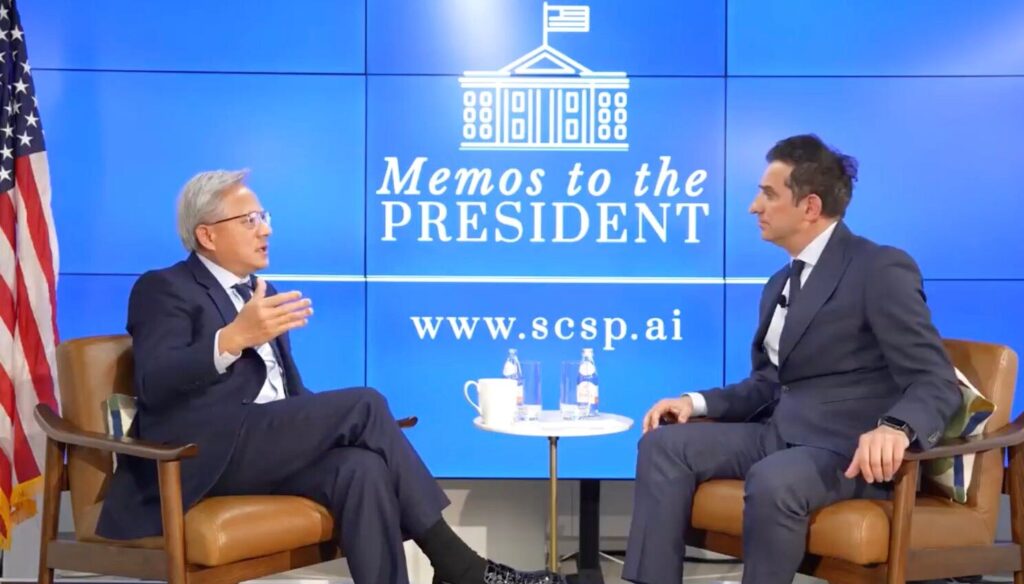
He warned against the kind of fear-based AI rhetoric that tells young people not to become radiologists, software engineers, or knowledge workers because AI will allegedly erase those professions. His point was that if society convinces people not to enter fields where we will actually need more human capability, not less, that pessimism becomes self-defeating.
The task of a job and the purpose of a job are related, but they are not the same.
If you define a software engineer as someone who types code, then yes, AI looks like a replacement technology. If you define a software engineer as someone who solves problems, designs systems, translates possibility into functionality, and turns imagination into infrastructure, then AI becomes a force multiplier.
https://www.x.com/briansolis/status/2050617352681922577
Huang used the example of code. If we assume the economy only needs a fixed amount of software, then AI writing code seems to imply fewer engineers. But Huang challenged the premise itself. Why assume we only need the same amount of software? Why assume the world only needs one billion lines of code when we could need a trillion…across healthcare, science, manufacturing, retail, energy, education, and entirely new domains of human possibility?
At NVIDIA, Huang said AI now does much of the coding, yet the company is hiring more engineers than ever. The reason is not paradoxical. Well, it may seem counterintuitive in this
It is the point. When AI takes on more tasks, the ceiling for ambition rises. More problems become addressable. More experiments become feasible. More ideas become buildable.
That is Return on Intelligence.
The goal is not to preserve or even optimize every task. The goal is to elevate the purpose of the work.
The Hidden Cost of a Replacement Signal
AI strategy is not just an operating decision. It is a signal.
Employees are watching how leadership talks about AI. They are listening for whether AI is being introduced to help them become more valuable or to make them more disposable. They are reading between the lines of every pilot, every reorg, every “efficiency initiative,” every platitude that promises AI will “free people up” without explaining what they will be freed to do.
HBR’s research found that only 44% of surveyed employees said their organization had formally announced AI plans. Overall, 62% believed their organization was using AI to augment employee capabilities, while 34% believed AI was being used to automate work and reduce costs. The gap grows more revealing by level: 81% of senior leaders believed their organization was all-in on augmentation, while only 53% of individual contributors perceived augmentation and 40% suspected automation.
The perception gap is breathtaking. To be honest, it’s business as usual. And, I call it the iteration gap. It’s the gap between maximizing the past and imagining the future. Coming from Silicon Valley, the past wasn’t even in the conversation. We weren’t ever asking, what are we doing that can be better tomorrow? We were always saying, not really asking, “WTF!?” aka “What’s the future…!?” It was always a directive.
We weren’t ever asking, what are we doing that can be better tomorrow? We were always saying, not really asking, “WTF!?” aka “What’s the future…!?” It was always a directive.
Leaders may think they are driving transformation, but they are instead using AI to optimize the past…without first assessing whether or not the past was worthy of bringing forward to the future. It’s the difference between iteration and innovation. Iteration makes yesterday less expensive, faster, more efficient. Innovation is doing what you didn’t do yesterday, to create new value.
In that same vein, automation is using AI to optimize yesterday. Augmentation is collaborating with AI to do what was not possible without AI and what AI couldn’t do without people. Simple said, using AI to do yesterday’s work is not augmentation. But in both cases, iteration and automation, can appear as innovation and augmentation because you’re using new technology to work in new ways. If the workflow and outcome are optimized, it’s not innovation or augmentation. And to be clear, that’s cool. You need iteration. You need automation. You just can’t innovate or create new value without using AI or any technology and/or mindset to explore the unknown and unlock what wasn’t visible or possible before.
If you do not communicate this vision or intent and purpose or goals, you do not achieve anything other than a better yesterday. Then there’s the narrative that AI is a replacement engine, that people matter less than AI’s capacity to replace headcount, salaries, and all other employee costs. For the record, that is an unproductive, and basic, narrative. Come on. Are we talking status quo here or leadership?
When employees believe AI is being deployed to replace them, trust erodes. Adoption becomes a metric. People may comply, but they do not commit. They use AI because they are told to, not because they believe it according to a vision. But they believe it will help them grow. HBR describes this as the difference between employees becoming “pilots” of AI and becoming passengers along for the ride. When people are passengers, engagement remains shallow, guidance is unclear, and AI output can devolve into “workslop,” low-effort, low-quality AI-generated work that adds noise instead of value.
This is one of the great overlooked risks in enterprise AI. Poor AI strategy does not just produce bad outputs. It produces defensive humans. And defensive humans do not transform companies.
The same HBR article points to three dynamics that CEOs and boards need to hear…
First, the threat of layoffs undermines well-being, which in turn affects productivity, retention, and talent attraction. Second, poorly integrated AI workflows create confusion, shallow adoption, and more workslop. Third, cost-cutting AI strategies can hollow out junior roles and future innovation.
A company can look efficient in the short term while becoming less capable over time.
The Leadership Mandate: Turn Automation Savings into Augmentation Capital
This is where AI strategy has to graduate from pilots, dashboards, and efficiency conversations into a new operating discipline.
If automation creates savings, time, money, resources, leaders have to decide where those savings go. Do they fall straight to the bottom line? Do they disappear into the machinery of more meetings, more output, more dashboards, more pressure, and fewer people? Or are they intentionally reinvested into new capabilities, new customer value, new roles, new skills, new services, and new business models?
Think of it this way…if you invest in automation, which frees up people’s time, where will the ROI of AI come from? The easy answer is to cut costs. In a world where AI automation threatens to become the new status quo, companies can hinder competitiveness. Augmentation, on the other hand, represents an opportunity to reinvest resources into new competitiveness that creates new value?
Are you taking away jobs or are you creating them?
That is the question every CEO, board, CIO, CFO, COO, and CHRO should be asking now. Because the true measure of AI is not just what it removes from the business. It is what the business becomes capable of because AI is now part of the work.
This is the missing metric in most AI strategies: reinvested capacity.
Companies are already tracking hours saved, tickets deflected, cycle time reduced, costs avoided, code generated, content produced, and tasks automated. Those numbers matter. But they mostly tell us what AI took out of the system. They do not tell us what intelligence, creativity, judgment, trust, and value were put back in.
That is the difference between efficiency and innovation, productivity and progress.
A company can save 100,000 hours and become no more innovative. It can generate more content and say less. It can move faster and still move in the wrong direction. It can automate customer service and still never understand the customer. It can eliminate junior work and accidentally eliminate the apprenticeship layer where future leaders learn judgment, context, taste, and accountability.
This is the part of the AI conversation that remains dangerously underdeveloped or under. We are measuring activity because activity is easy to count. But in AI Darwinism, activity is not the advantage…it is adaptability.
Harvard Business Review’s research shows why augmentation is not just a nicer version of automation. It is a different performance path. Automation tends to create faster, more visible gains because it substitutes AI for well-defined work. Augmentation requires deeper upfront investment in workflow redesign, capability-building, data infrastructure, management practices, and human-AI coordination. But that investment is what shifts the organization’s productive frontier.
It’s the difference between automating the past and inventing the future.
That is the strategic discipline leaders need now. Do not just ask, “How much time did AI save?” Ask, “What can we do with the time?”
Did we use it to get closer to customers?
Did we use it to experiment with new offerings?
Did we use it to improve decisions?
Did we use it to reskill people into higher-value roles?
Did we use it to redesign workflows around outcomes rather than departments?
Did we use it to make work more meaningful, or simply more demanding?
IKEA gives us an important operating example of what reframing looks like. When the company deployed it’s AI chatbot Billie to serve customers and deflect escalations, it was so successful, that it handled 47% of initial engagements. The company could have fallen into an automation trap. Deflecting almost 50% of service inquires demands a review of resources. After all, it represented 3.2 million interactions and nearly €13 million in savings. That alone would have been enough for most companies to declare victory and move on.
So the question becomes, do you cut headcount for short-term ROI gains? It’s easy to stop there. But IKEAs move went beyond efficiency. IKEA turned that efficiency into capacity.
The company did not just ask, “How many inquiries can AI handle?” It asked, implicitly, “What can our people now do that creates more value?” Ingka Group says 8,500 call-center co-workers were reskilled into areas such as remote interior design, digital retail sales, relationship-building, and complex customer inquiries; Reuters also reported that Ingka’s remote interior design channel generated €1.3 billion, or 3.3% of total revenue, with a target to reach 10% by 2028.
That is Return on Intelligence in practice.
Human + AI Collaboration = Augmented Capacity
The AI chatbot was not the transformation. The transformation was the redeployment of human capability into work that was more consultative, more relational, more creative, and more commercially meaningful.
This leadership toward augmentation: automate the work that no longer deserves human limitation, then move people toward the work where human capability matters more.
That sounds simple, but it requires a very different kind of executive vision and courage. It requires leaders to stop treating technology and people as costs trapped inside workflows and start treating them as capacity waiting to be amplified. It requires leaders to ask whether the current operating model deserves optimization or reinvention. It requires leaders to redesign work before they reduce people. It requires the CFO to see savings as investment capital, the CIO to see AI as workflow architecture, the CHRO to see skills, roles, and trust as strategic infrastructure, and the CEO to make the intent unmistakable.
Remember, employees are being todld to adopt AI. They’re trained to increase AI fluency, and that fluency is measured. So they are not just adopting AI, there are also interpreting it.
They’re asking: Is this here to help me grow, or to make me disappear? Am I being invited to become a pilot of the future, or am I a passenger in someone else’s cost-reduction plan? Is leadership using AI to build a better company, or just a smaller one?
Trust is now part of the AI stack.
HBR found that when employees believe AI is being introduced to make their work better, adoption rises through curiosity and agency rather than compliance. The organization cultivates pilots over passengers. The opposite path is just as instructive: when AI is associated with replacement, layoffs, and forced adoption, well-being declines, workslop rises, attrition increases, employer brand suffers, and leadership pipelines erode.
This is why “AI adoption” is the wrong finish line. Adoption without belief is compliance. Compliance without trust becomes status quo. Status quo at scale becomes a loss of competitiveness. And no company can transform with a workforce that is quietly defending itself from its own strategy.
The alternative is to make augmentation visible.
Like IKEA, show employees where AI is helping people move into better roles. Show how automation savings are funding training, experimentation, customer innovation, and new services. Show how exceptions are being studied as signals. Show how frontline teams are helping redesign work. Show how junior employees will still build judgment in an AI-shaped workplace. Show how leadership is protecting the learning architecture of the company even as tasks change.
This is especially important for early-career talent. If AI drafts the first analysis, writes the first version, summarizes the meeting, generates the code, answers the routine customer question, or prepares the report, then leaders have to redesign how people learn. Apprenticeship has to be built into the new workflow.
The next generation of talent should not be trained to compete with AI at the task level. They should be trained to think with AI, challenge AI, supervise AI, improve AI, and use AI to get closer to problems that matter. They need to learn judgment, context, taste, ethics, empathy, and systems thinking in new ways. If leaders fail here, they may not feel the damage immediately. But years from now, they will wonder why the organization has fewer people capable of leading through ambiguity.
This is the danger of short-term automation thinking…you’re essentially mortgaging the future.
Improve the Past While Visualizing a New Future
Automate and optimize what deserves to live in the future, not because it’s the way that things have always been done. Explore where to augment work to compete for the future, today.
That’s the mindshift.
For example, starting with pain points can trap people in a “loss minimization mindset,” where teams look for time lost, money lost, and friction reduced. The better frame is to use AI to reason, reframe, and reinvent work itself.
In our Business Transformation Mindset report, Dave Wright, Alexis Walker, and I explored distinction between the iteration mindset and the transformation mindset.
The iteration mindset asks how to do today’s work faster, cheaper, with less effort, and with greater efficiency.
The transformation mindset asks why we operate this way, what problems remain unsolved, what data and workflows are missing, and what could transform the business rather than simply fix it.
This is the bridge from automation to reinvention.
The goal is not to build a giant inventory of AI use cases that solidify status quo. That is useful, but insufficient. The work is to build a portfolio of new value cases: places where AI helps reveal unmet demand, redesign workflows, expand judgment, accelerate learning, improve customer outcomes, and create capacity that did not exist before.
This is also why Return on Intelligence needs to sit next to Return on Investment.
Return on Investment asks whether AI produced financial efficiency. Return on Intelligence asks whether AI made the organization more adaptive, more creative, more decisive, more trusted, and more valuable over time.
A useful way to think about it is:
ROI∞ = (Realized Value × Learning Velocity) ÷ (Time-to-Outcome × Resistance to Change)
We introduce this model in my new book with Dave Wright, “Infinite: How Visionary Leaders Transform Today’s Businesses into AI-Forward Companies.”
Realized value matters because AI is everywhere. Pilots, demos, copilots, agents, dashboards, and innovation labs can create the appearance of progress without changing the economics or experience of the business.
Learning velocity matters because AI Darwinism rewards organizations that learn faster than their environments change. The advantage is not simply adopting a model. It is building a company that can sense new signals, test new assumptions, absorb feedback, and improve continuously.
Time-to-outcome matters because speed without direction is just motion. AI should compress the distance between noticing a problem, understanding it, deciding what to do, acting on it, and learning from the result.
Resistance to change matters because culture can neutralize technology. Legacy incentives, fear, fragmented systems, poor data quality, unclear governance, and organizational politics can drag down Return on Intelligence faster than any model can lift it.
The AI Layoff Trap and Self-Inflicted Disruption
In their paper published in April 2026, Brett Hemenway Falk and Gerry Tsoukals explore the “AI Layoff Trap,” which can debilitate a company’s competitiveness by doing the very thing businesses have done throughout history, cut costs through automation to become more leaner and more efficient. The authors argue that “if AI displaces human workers faster than the economy can reabsorb them, it risks eroding the very consumer demand firms depend on.”
The paper’s model shows that firms can rationally over-automate because each company captures the full cost savings of replacing its own workers while bearing only a fraction of the demand destruction caused by lost wages. The result can become an automation arms race that harms workers and firm owners alike.
The paper’s “Red Queen” effect makes the warning even sharper. Better AI does not automatically solve the trap. In the model, higher AI productivity can widen the over-automation wedge because each firm perceives a market-share gain from automating beyond rivals, even though those gains cancel out when everyone does the same thing.
Think about it.
The more powerful AI becomes, the more dangerous unimaginative leadership becomes.
AI Darwinism will not punish companies for automating. It will punish companies for automating without imagination.
The winners will automate, yes. But they will also augment. They will use AI to remove friction and then reinvest the gains into intelligence. They will use agents to handle routine work and then elevate humans into higher-value judgment. They will use automation to expose unmet demand. They will use AI not simply to answer questions, but to help leaders ask better ones.
Take the time to ask different and better questions…if you don’t do it now, when will you have time to do it later?
What do our customers need that our current model cannot deliver?
What work exists only because our systems are fragmented?
What assumptions are embedded in this process?
What would we build if we were starting today?
What human capabilities become more important as AI becomes more capable?
What new value can we create now that time, intelligence, and agency are becoming more abundant?
That is why this moment is so consequential. AI is not just changing how work gets done. It is revealing the imagination, or the lack of imagination, inside the companies deploying it.
Some organizations will use AI to become faster versions of their past. They will celebrate efficiency, reduce costs, and call it transformation. Others will use AI to confront the deeper question: what should this company become now?
Automation will yield impressive savings.
Augmentation will shape the future.
That is the difference between return on investment and Return on Intelligence. And that is why you cannot automate your way to innovation and growth.
Automation can clear the runway.
Augmentation is how you learn to fly.


Leave a Reply