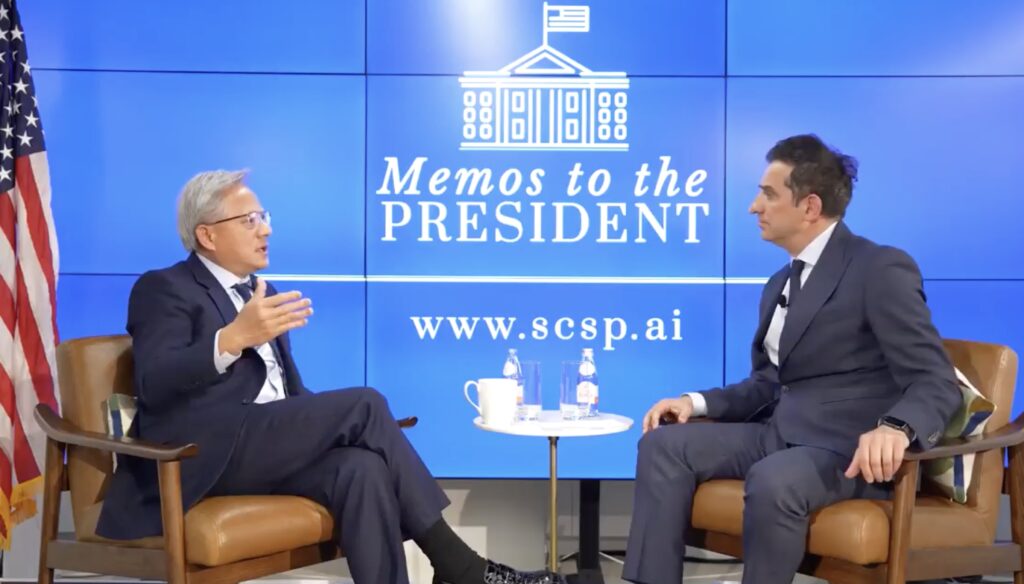
Jensen Huang and Ylli Bajraktari on the Special Competitive Studies Project (SCSP) podcast, “Memos to the President”
Right now, AI narratives seem to be propagating an ROI of return on ignorance instead of a more productive ROI, “return on intelligence.”
Enterprise leaders are currently navigating a critical transition toward AI-native operating models, yet AI adoption is stalling due to a fundamentally flawed narrative. Instead of focusing on strategic growth, the leadership conversation is paralyzed by speculative doomsday prophecies, a paralyzing fear of change, and a narrow focus on task automation for cost-cutting. This alarmist approach to the future of work is a massive branding problem for artificial intelligence. It actively hinders innovation, limits business transformation, and limits human potential.
When the loudest voices in the room frame AI as an existential threat designed to wipe out entire professions, they distract us from the technology’s true mandate: human augmentation. We need to shift the conversation away from this anxiety and start measuring our progress by a genuine Return on Intelligence.
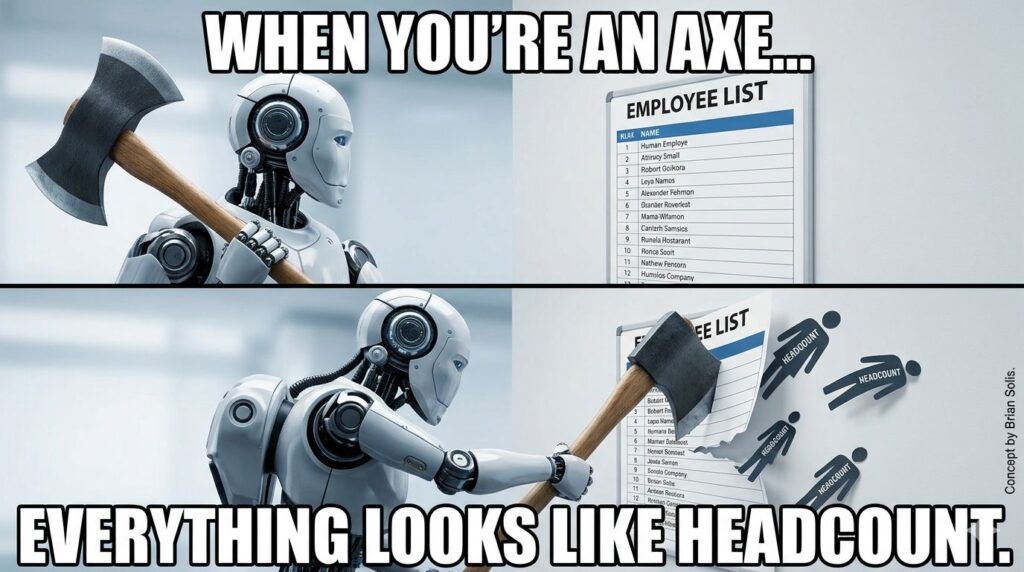
The True ROI of AI: Stop Fearing Task Elimination and Start Architecting Human Augmentation
Nvidia CEO Jensen Huang recently addressed this exact crisis of communication, pushing back against the industry’s “god complex” and re-centering the discussion on the factual realities of job creation, economic growth, and the future of work.
Jensen Huang recently joined Ylli Bajraktari, the CEO of the Special Competitive Studies Project (SCSP). The conversation took place on SCSP’s podcast, “Memos to the President.”
In the conversation, Jensen expertly, and sincerely, argues that alarmist claims about AI destroying jobs are fundamentally flawed and hurtful. He believes that AI is a powerful engine for job creation and reindustrialization. He challenges the leadership fear of change, reframing AI not as a mechanism for pure automation and cost-cutting, but as a tool for human augmentation that delivers a new ROI, “Return on Intelligence.”
As I was listening, I had to stop and notate meaningful quotes that I feel will benefit any leader navigating AI transformation…from AI native founders to AI-first and AI-forward leadership teams to academics and thought leaders.
“On the one hand, maybe a scientist thinks that by warning people that AI is going to completely permeate and proliferate across radiology and therefore radiologists are going to get wiped out…
…that might be considered warning and therefore helpful. But in fact, the counter would have been hurtful.
If we convinced everybody not to be radiologists, and we now need radiologists, that actually is hurtful to society.
It is hurtful if we convince all the young college graduates to not be software engineers and it turns out the United States need more software engineers than ever. That’s hurtful.”
“…we have to be mindful of how we communicate the importance of this technology and what it’s able to do, to advocate for policy and advocate for guardrails….…scaring people with…nonsensical things, which are not going to happen…that this is an existential threat to humanity, there’s a 20% chance that it is existential. That’s ridiculous. That it’s going to wipe out 50% of new college grad jobs. That it’s going to completely destroy democracy. I mean, these kind of comments are not helpful.
…they’re made by, you know, people who are like me, CEOs…and somehow, because they became CEOs, you adopt a god complex and before you know it, you know everything.…we have to be careful and really ground ourselves to talking about the facts.
The facts are AI has created more than half a million jobs in the last couple of years.
The facts are AI is our greatest, our best opportunity to reindustrialize the United States, to bring manufacturing jobs back to the United States.
The facts are that’s going to generate hundreds of thousands of jobs, trillions of dollars of new economy back into the United States.
The fact of the matter is companies that use AI have demonstrated the ability to grow faster. When they grow faster, they hire more people…AI creates jobs.”
The Mindshift from Return on Investment to Return on Intelligence
I was going to say, “louder, for the people in the back.” But instead, I’ll say “louder, for the people in the front!” Those who are the loudest are among the most influential. As the old saying goes, if you’re not part of the solution, you’re part of the problem.
By offloading mundane tasks, AI frees us to apply our imagination to more complex problems, expanding our ambitions and capabilities rather than shrinking our workforce. The narrative needs to shift from automating yesterday’s jobs toward yesterdays performance standards to visualizing tomorrow’s possibilities, making vision tangible, and articulating tomorrow’s roles and tasks that will get us there through human + AI collaboration.
That’s the mindshift from an automation mindset (cost-cutting and efficiency only) to augmentation (value creation, growth, and innovation).
The ultimate promise of an AI-first operating model is not found in a spreadsheet of slashed budgets and reduced headcount, but in the profound shift from task automation to human augmentation. By embracing this mindset, leaders can stop measuring success by what they save and start tracking their true “Return on Intelligence,” the exponential value created when human imagination is finally freed to tackle our greatest challenges. This is our mandate: to stop using AI merely to do less, and start deploying it to expand what we are fundamentally capable of achieving.
The future of AI does not need more doomsday prophets and clickbait headlines. The future needs vision and leaders people can trust.
Watch the video here 👇
https://x.com/briansolis/status/2050617352681922577
Read Mindshift | Subscribe to my newsletter | Please consider me as a speaker


Leave a Reply