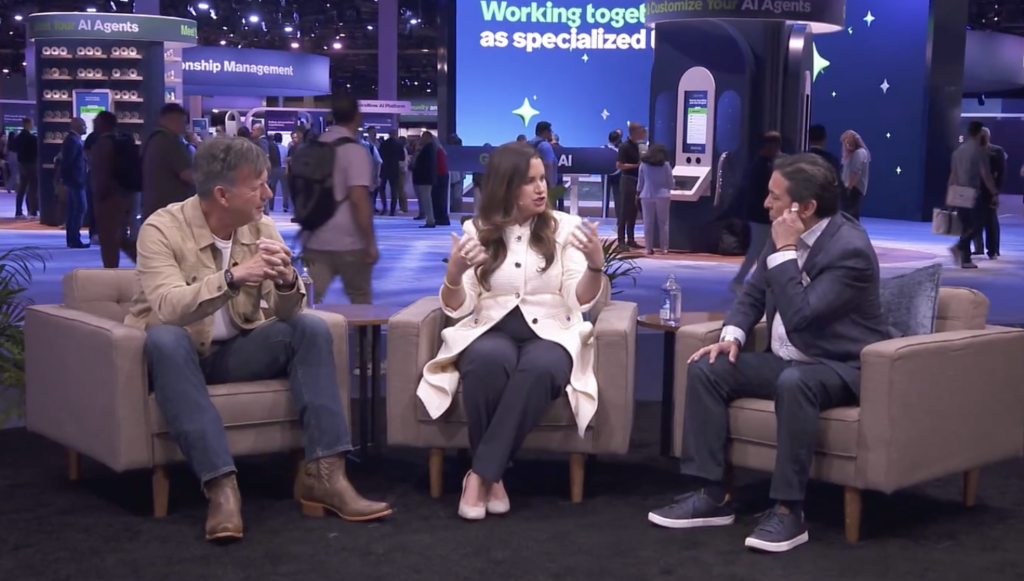
Dave Wright, Allie K. Miller, Brian Solis
At ServiceNow’s Knowledge last year, I had the privilege of sitting down on camera with my dear friend Allie K. Miller and my colleague Dave Wright, ServiceNow’s Chief Innovation Officer, for one of the most honest conversations I’ve had about the state of enterprise AI. And, the conversation still represents the state of AI in business today.
Allie. who was recognized on the TIME100 AI list for 2025, and for good reason, has a rare ability to cut through AI hype and get to the part that actually matters: what are leaders supposed to do with all of this? She pushed Dave and me into territory that I think every executive needs to hear right now.
I want to share the key themes from that conversation because I know not everyone will watch the video. But I hope you do — there are nuances and real-time reactions in the discussion that I can’t fully capture here.
Watch the full conversation: Innovation and Industry Trends with Dave Wright and Brian Solis 👀
AI Summary
In this insightful discussion Dave Wright, Chief Innovation Officer at ServiceNow, and Brian Solis, Head of Global Innovation at ServiceNow, explore the complexities and future of AI. The conversation delves into the evolving landscape of AI, focusing on its rapid development and the challenges organizations face in keeping pace. The speakers discuss the decline in AI maturity scores, the importance of thinking beyond traditional AI applications, and the potential of AI to transform business operations. The session is structured with real-world examples and strategic insights, and it encourages organizations to rethink their AI strategies for greater innovation and competitive advantage. My full analysis is below this section.
Key Takeaways Summarized by AI
AI Maturity Decline: Brian Solis highlights a surprising drop in AI maturity scores, attributing it to the rapid pace of technological advancement outstripping companies’ ability to adapt and invest effectively. This underscores the need for businesses to accelerate their AI adoption strategies.
Strategic AI Deployment: Dave Wright emphasizes that AI strategies should focus on achieving broader business goals rather than just implementing AI for its own sake. This approach can lead to significant organizational transformation and competitive advantage.
Cultural Shift: Both speakers stress the importance of a cultural and mindset shift within organizations to fully leverage AI’s potential. This involves reimagining work processes and encouraging a more innovative approach to AI integration.
AI as a Competitive Advantage: Companies that invest in AI are realizing value faster, creating a competitive edge. The discussion highlights the importance of not just adopting AI but doing so strategically to enhance business outcomes.
Future of AI Roles: The conversation explores the concept of AI agents evolving into AI employees, suggesting a future where AI could take on more complex roles within organizations, potentially reshaping job functions and organizational structures.
Human Experience and AI: Brian Solis points out that while AI can enhance efficiency, the human experience remains a crucial differentiator. Companies should focus on delivering memorable and meaningful experiences through AI-enhanced interactions.
AI as a Catalyst for Innovation: The speakers encourage organizations to use AI not just for efficiency but as a tool for innovation, challenging existing workflows and exploring new possibilities for growth and creativity.
The video also includes additional insights on AI’s role in organizational transformation, offering a deeper look at strategic AI deployment and its impact on business innovation.
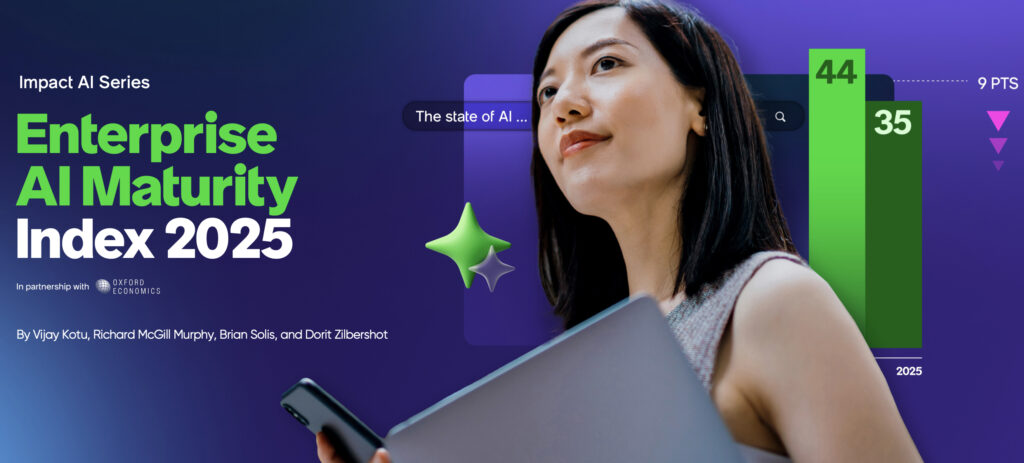
ServiceNow Enterprise AI Maturity Index
AI Maturity Is Going Down, Not Up. And That’s Actually the Story.
In 2023 continuing into 2024, part of my work at ServiceNow studied how enterprise organizations adopted generative AI, the use cases they invested in and how they made the case, how they organized in support of it, and the measures and governance they put into place. The result was a five-stage AI maturity model based on seven foundational pillars that tracked how companies evolved with experience and vision. In 2024, the research team led a global field survey to understand where organizations mapped to the model. Our first report, the Enterprise AI Maturity Index, was published in 2024 and the second in 2025. Our third edition is due out in June 2026.
One of the most interesting findings was that between 2025 and 2024, AI maturity scores declined.
In 2025, ServiceNow’s Enterprise AI Maturity Index studied 4,500 organizations across 16 countries and 11 industries. The research was conducted in partnership with Oxford Economics. The results found that the average maturity score dropped nine points year over year, from 44/100 down to 35/100.
Why? Because the goalposts are moving faster than companies can run. The sheer velocity of AI advancement, new models, new capabilities, new use cases arriving weekly, is overwhelming organizations that were already struggling to operationalize what they had. Companies are hitting a “control-delete moment,” where leaders suddenly realize that AI’s potential is far greater than they initially understood, and they’re forced to rethink everything they thought they knew.
This is not a failure story. This is a recalibration story. And the companies that recognize it as such, that use this moment to pause, reassess, and think bigger, are the ones that will ultimately pull ahead.
Stop Deploying AI. Start Deploying Strategy.
One of Dave’s sharpest points in the conversation, and something Allie pressed us both on, was the distinction between deploying AI and deploying a strategy that happens to use AI.
Too many organizations are chasing AI for the sake of AI. They’re checking boxes. They’re launching pilots. They’re bolting on chatbots and calling it transformation.
Dave was direct about this: AI strategies should focus on achieving broader business goals, not on implementing AI for its own sake. When business outcomes are the objective, you get progress and competitive advantage. The companies leading in maturity, what we call the AI Pacesetters are rethinking how their businesses work with AI.
The research bears this out. The top three industries in AI maturity are technology, heavy manufacturing, and banking. What do they have in common? They were early adopters of automation and already had the organizational muscle to absorb and scale new capabilities. It wasn’t their AI budgets that set them apart. It was their readiness to think structurally about change.
Culture Eats AI Strategy for Breakfast
The biggest barrier to scaling AI toward real transformation is not technology. It’s not budget. It’s not talent. It’s leadership and a culture empowered to transform and innovate.
Allie pushed both of us to articulate what cultural transformation actually looks like in practice.
Most organizations are asking their people to adopt AI, to gain AI fluency, within a culture that was never designed for experimentation, failure, or reinvention. They’re asking people to think differently while rewarding them for thinking the same way they always have.
An AI-first culture doesn’t mean everyone uses AI tools. It means the organization has fundamentally reimagined how work gets done, how decisions get made, and how value gets created. It means asking questions that challenge legacy assumptions rather than reinforcing them. It means giving people permission, and incentives, to explore what’s possible, not just what’s efficient.
This is where leadership matters most. And it’s where most leadership is falling short.
The research is clear: the biggest barrier to scaling AI is not employees. It’s leaders who are not steering fast enough or dreaming big enough.
From AI Agents to AI Employees
One of the most provocative threads in our conversation with Allie was the evolution of AI roles within organizations. We’re already past the era of AI as a tool. We’re entering the era of AI as a teammate. And eventually, as Dave suggested, we’ll be talking about AI employees.
Think about what that means. AI agents are already handling tasks autonomously, summarizing cases, routing requests, generating recommendations. But the next step is AI taking on more complex roles that require judgment, coordination, and context. It’s AI that doesn’t just execute a workflow but participates in shaping it.
This raises questions that most organizations haven’t even begun to ask. What does the org chart look like when some of your most scalable “employees” aren’t human? What does management mean when you’re overseeing agents as well as people? What does talent development look like when the skills that matter most are the ones AI can’t replicate…empathy, creativity, ethical judgment, the ability to ask questions that haven’t been asked before?
As far out as they may seem, they are near-term planning questions. And if you’re not having them in your leadership meetings right now, you’re already behind. (Here’s a report I just published to get your started!)
The Human Experience is Still the Differentiator
This is the point I keep coming back to, and the one I wanted to make sure came through in the conversation with Allie and Dave: in a world where everyone has access to the same AI capabilities, the human experience becomes the ultimate competitive advantage.
AI can make your operations faster. It can make your processes more efficient. It can surface insights you might have missed. But it cannot, on its own, make your customers feel understood. It cannot feel empathy. It cannot build trust. It cannot create the kind of experience that makes someone choose you over every other option.
I used Amazon as an example during the conversation. Amazon’s automation is legendary. But what makes Amazon Amazon is not its efficiency, it’s its obsession with the customer experience. Every automated process exists in service of a human outcome.
Companies that use AI only to cut costs and accelerate throughput will find themselves competing on a very narrow playing field. Companies that use AI to reimagine the human experience, for customers and employees alike, will define the next era of competitive differentiation.
AI Is Not Just an Efficiency Play. It’s an Innovation Engine.
This was the throughline of our entire conversation, and it’s the thing I wish every CEO would internalize: AI is not just a tool for doing what you already do, faster and cheaper. It’s also a catalyst for doing things you’ve never been able to do at all.
The distinction I’ve drawn in my work between Iterative AI and Innovative AI matters here. Iterative AI removes friction and drudgery. It accelerates existing workflows. That’s valuable. But Innovative AI is where the real disruption lives. It unlocks new results, introduces new ways of creating value, and opens the door to entirely new business models.
Most organizations are stuck in Iterative mode. They’re using AI to optimize candles when the opportunity is to invent the light bulb.
Dave and I both pushed this point hard in the conversation. If you’re only thinking about AI in terms of cost savings and efficiency gains, you’re leaving the most transformative value on the table. The organizations that will lead the next decade are the ones using AI to challenge existing workflows, explore possibilities they couldn’t access before, and reimagine what their business could become.
Here’s Where I’d Like to Leave You
AI maturity regressed across the board. The technology is accelerating faster than our organizations, our cultures, and our leadership models can absorb. And most companies are responding by doing more of the same…more pilots, more tools, more incremental optimization. But this moment demands something fundamentally different.
It demands a shift in mindset (a mindshift). A shift from digital-first to AI-first. A shift from asking “How do I do this faster?” to “Why do we do this at all?” From automating the past to designing the future.
It demands tough conversations about workforce transformation, about organizational structure, about what work even means when AI agents are part of the team.
And it demands leaders who are willing to dream bigger than the status quo. A point we made in conversation fits perfectly here…the risk is not thinking too big, it’s thinking too small.
Great leaders design a better future that would not have otherwise happened.
Watch the full conversation with Dave, Allie, and me: Innovation and Industry Trends with Dave Wright and Brian Solis at Knowledge 2025.
Join Us at Knowledge 2026
And I’ll be back at Knowledge 2026, May 5–7 in Las Vegas, on stage with ServiceNow Chief Innovation Officer Dave Wright where we’ll explore our 2026 AI Index findings, “Your Guide to AI Maturity: Charting a Path to ROI.”
Session Description:
AI maturity isn’t a destination. It’s a leadership imperative. This hands-on workshop invites business leaders to collaborate with experts and peers to uncover what it takes to lead in AI. Through guided discussions about the Enterprise AI Maturity Index, attendees will walk away with a clear understanding of where they stand on the AI maturity curve, what Pacesetters are doing differently to realize 160% ROI, and actionable next steps to move from AI experimentation to business reinvention.
If you’re ready to stop optimizing the past and start designing the future, we’ll see you there!
Read Mindshift | Subscribe to Brian’s Newsletter | Consider Brian as Your Next Speaker

Leave a Reply