AI is often compared to the discovery of fire, the invention of the wheel, or even electricity.
At first, those comparisons can sound dramatic, even inflated.
But they are not entirely wrong.
Fire did not change the world simply because it existed. Electricity did not transform civilization simply because someone discovered it. The wheel did not alter the trajectory of humanity simply because it rolled. These were not just inventions. They were enabling forces. Their potential and ultimatle power came from what people imagined, built, and reinvented because of them.
That is exactly where we are with AI. And yet, too many leaders are meeting this moment with painfully small ambitions.
They are using a civilization-shifting capability to write better emails, summarize longer meetings, generate more content, automate existing work, reduce costs, and increase efficiencies. Useful? Of course. Transformative? That’s another story.
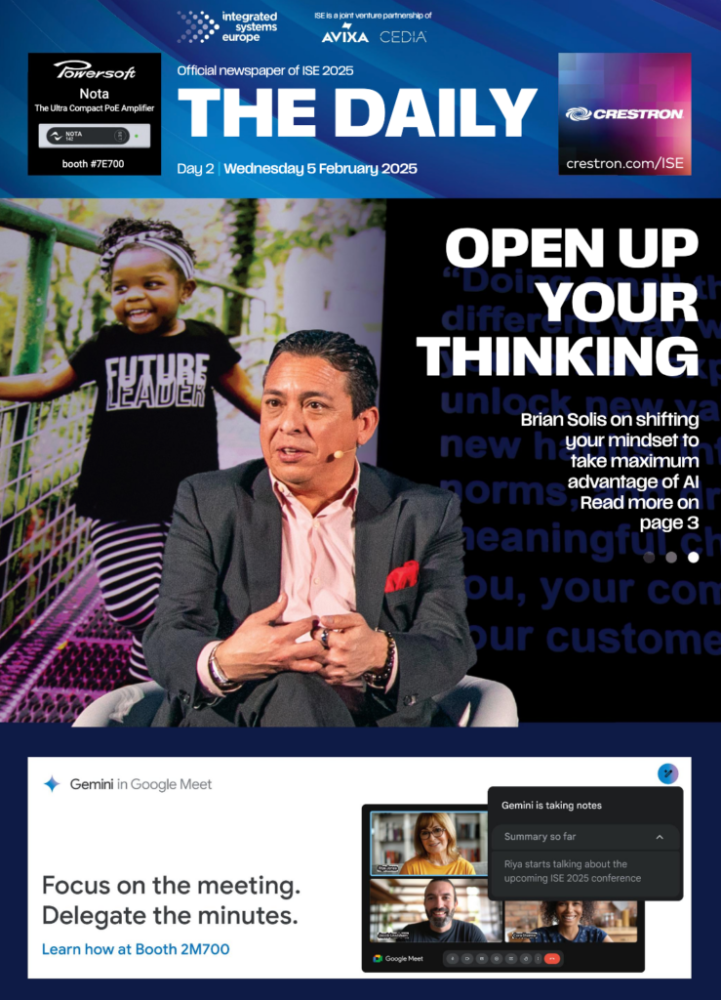
This is the gap I wanted to confront in my keynote at Integrated Systems Europe.
The issue is whether we are bold enough to use it in ways that actually matter.
The Real Risk Is Not AI, It’s Incremental Thinking
Most organizations are still approaching AI through the lens of optimization.
How can we automate this task? How can we reduce that cost? How can we produce more with fewer people? How can we do what we already do, just faster?
These are understandable questions. They are also incomplete questions.
They keep companies anchored to the past while convincing themselves they are moving into the future.
AI does not become revolutionary when it helps us do familiar work more efficiently. It becomes revolutionary when it helps us see differently, think differently, decide differently, and create differently.
That’s proper invitation.
Not iteration, but reinvention.
Not just productivity, but possibility.
Not “How do we move faster?,” but “What becomes possible now that never was before?”
AI is not just improving execution. It can challenge imagination.
AI Is Exposing Leadership, not Just Technology
AI is doing something few technologies have done so quickly and so visibly.
It is exposing how leadership thinks.
When a company approaches AI only as a tool for efficiency, that tells you something. It tells you the organization is still trapped inside the logic of the current model. It tells you leaders are trying to protect the business they know rather than invent the business they will need. It tells you they are managing disruption instead of using disruption as a design material.
AI magnifies intent.
If your ambition is incremental, AI will help you scale incrementalism.
If your vision is constrained by legacy assumptions, AI will help you operationalize those assumptions more efficiently.
If your leadership team is only asking where AI can cut cost, then AI will become a cost-cutting instrument.
But if leadership asks where AI can unlock new value, create new experiences, reimagine workflows, expand human capability, and design entirely new categories of advantage, then AI becomes something else.
It becomes a growth engine…a reinvention engine…a leadership test.
And that is the part many executives still do not want to confront. AI is not only transforming markets. It is raising the bar for vision.
Most Companies are Using AI to Improve the Past
This is the trap, and it’s common.
Organizations tell themselves they are innovating because they are experimenting with AI. But in practice, many are simply optimizing legacy models with better software. They are using AI to make the old machine run smoother.
That isn’t transformation. Transformers will redesign the core of how value is created.
Leaders will ask bigger questions.
- What if the workflow itself is dated or limited?
- What if the customer journey should be reinvented, not improved?
- What if teams should be organized around outcomes instead of functions?
- What if products should become adaptive?
- What if services should become predictive?
- What if intelligence should not sit in dashboards, but move inside every decision, every process, every touchpoint?
This is what too many AI strategies still miss…the opportunity to look beyond yesterday and design tomorrow.
High Performers Use AI Differently
This is true for companies, and it is equally true for individuals.
The highest performers I know are not using AI to avoid thinking, they are using it to think better. These more ambitious thinkers are outperforming their other AI-enabled peers by 7x.
They are not outsourcing judgment. They are sharpening it. They are using AI to interrogate assumptions, test scenarios, expose blind spots, compare possibilities, pressure-test ideas, rehearse decisions, and expand the range of what they can see.
There are two very different futures emerging right now.
In one, people use AI to reduce effort and cost and increase efficiencies.
In the other, people use AI to expand capability.
One path leads to dependency.
The other leads to evolution.
That means learning how to pair machine intelligence with human imagination, judgment, empathy, taste, experience, and courage.
Competing Against AI is the Wrong Mindset
One of the most dangerous narratives in the market right now is that we are somehow in a race against AI.
That framing creates fear. It narrows vision. It pushes leaders toward defensive decisions. It treats AI as a threat to manage rather than a force to shape.
But the real challenge is learning how to compete with AI.
That is a completely different posture. It’s not competing against, but more effectively competing with AI.
When you compete against AI, you protect.
When you compete with AI, you invent.
When you compete against AI, you focus on automation and replacement.
When you compete with AI, you focus on augmentation.
When you compete against AI, you ask how to preserve relevance.
When you compete with AI, you ask how to create new relevance.
It changes strategy, which changes leadership.
It changes how work is designed, how value is measured, how talent is developed, and how growth is pursued.
Five Questions Every Leadership Team Should Ask Now
These are five questions every C-suite should be asking right now:
1. Where are we using AI to optimize the past instead of inventing the future?
Look beyond productivity gains. Identify where AI is simply making current work more efficient versus where it could help create new business value, new offerings, or new market advantage.
2. Which assumptions about work, value, and growth no longer deserve to survive?
Challenge the defaults. Many operating assumptions were designed for a pre-AI world. Some should be improved. Others should be retired.
3. Where can AI elevate human contribution rather than reduce it?
The strongest organizations will not be those that remove the most labor. They will be the ones that free people to do more strategic, creative, relational, and high-impact work.
4. What would we redesign if we built this business today with AI at the center?
Ask this honestly. Not as a thought exercise, but as a strategic lens. Products, journeys, org structures, decisions, service models, and operating rhythms all look different when intelligence is native to the system.
5. Are we leading AI as a technology initiative or as a reinvention agenda?
This may be the most important question of all. Because if AI sits only in IT, innovation stalls. If it lives inside leadership, transformation begins.
This Is a Leadership Moment, not Just a Technology Moment
Yes, AI is a technology revolution.
But for business leaders, it is something more consequential.
It is a leadership moment.
It demands more than adoption roadmaps, governance frameworks, and pilot programs.
This moment calls for imagination. It calls for conviction.
It calls for executives who can see beyond efficiency to opportunity, beyond automation to elevation, beyond incrementalism to reinvention.
It calls for leaders who understand that the future will not be built by those who simply deploy AI first. It will be built by those who understand what AI makes possible and then have the courage to act on it.
That is what I hoped to leave behind at ISE and with you now.
Dream bigger.
Think bigger.
Lead bigger.
🎥 Watch the ISE Keynote
Infinite ∞ | Mindshift | Subscribe | Keynote Speaker
Leave a Reply