I’m honored to be included in The Wharton Blueprint for AI Agent Adoption, a new report from Wharton Human-AI Research and Science Says that explores one of the most important questions facing every leader right now: if AI agents are becoming so capable, why aren’t more people ready to trust them with meaningful work?
The answer isn’t just technical. It’s human.
The report makes clear that agent adoption is moving from a technology challenge to a psychological one. People may be willing to ask AI a question. But asking an agent to act on their behalf, access information, manage workflows, make decisions, or execute tasks requires something deeper than curiosity. It requires belief in the agent’s competence. It requires trust. And perhaps most importantly, it requires people to feel that they are still in control.
That’s where the future of work will be decided.
AI agents won’t transform organizations simply because they exist. They will transform organizations when leaders design them in ways that earn trust, protect human agency, and help people feel more capable, not less relevant. Adoption isn’t about convincing employees to give up tasks. It’s about helping them gain capacity, confidence, and agency in a world where work itself is being reinvented.
So yeah, AI agents are here and they can research, recommend, summarize, analyze, coordinate, and increasingly, act. AI agents can also destroy company records in one fell swoop. But the next frontier of AI adoption will not be determined by model performance alone. It will be determined by something far more human: whether people believe agents are competent enough, trustworthy enough, and safe enough to let them do real work.
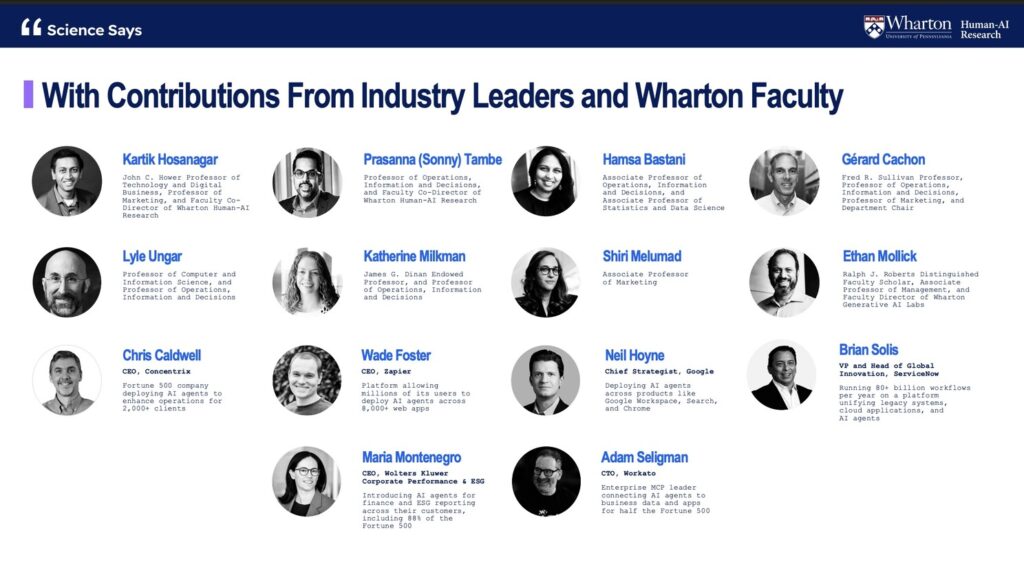
The report brings together research from Thomas McKinlay, Stefano Puntoni, and Serkan Saka, along with contributions from an incredible group of Wharton faculty and industry leaders, including Kartik Hosanagar, Prasanna Tambe, Hamsa Bastani , Gérard Cachon, Lyle Ungar, Katherine Milkman, Shiri Melumad, Ethan Mollick, Chris Caldwell of Concentrix, Wade Foster of Zapier, Neil Hoyne of Google, Maria Joao Montenegro of Wolters Kluwer, Adam Seligman of Workato, and I was honored to contribute on behalf of ServiceNow.
The blueprint organizes the adoption challenge around three psychological frictions: perceived competence, trust, and delegation of control. Said or asked another way: Do I believe the agent can do the job? Can I trust it to act on my behalf? And am I comfortable giving it control?
That’s where the real work begins.
Agents Must Earn Competence Before They Earn Control
One of the most important findings is also one of the most practical: people do not necessarily want AI agents to be warm, charming, or overly friendly. They want them to be competent.
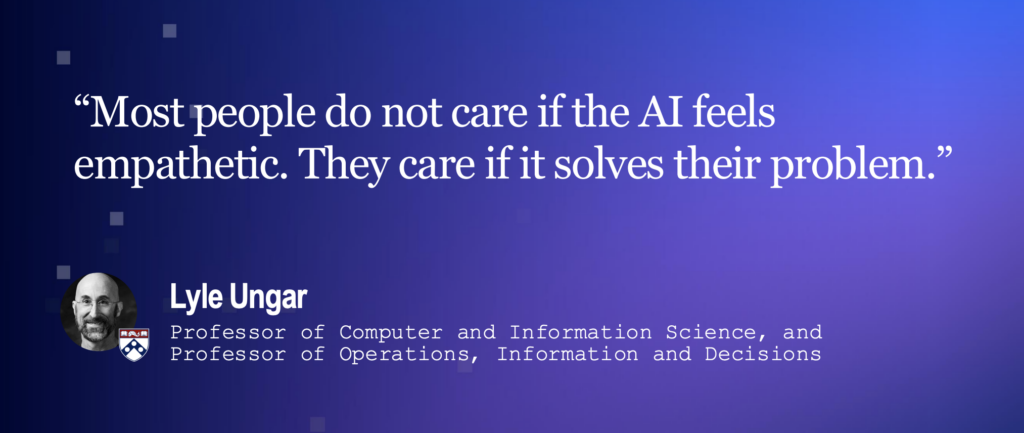
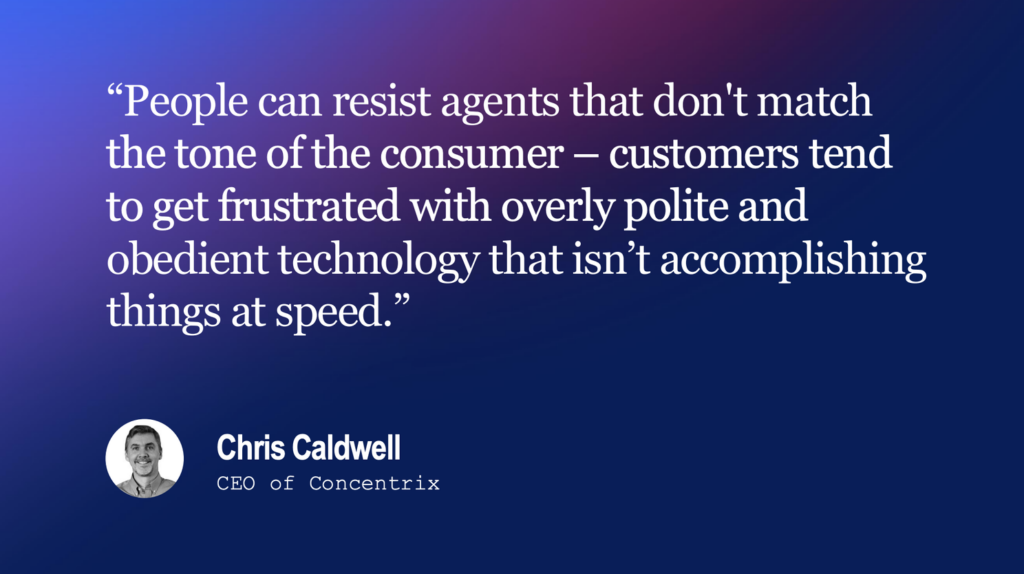
As Lyle Ungar put it, “Most people do not care if the AI feels empathetic. They care if it solves their problem.” Chris Caldwell added that customers can get frustrated with “overly polite and obedient technology that isn’t accomplishing things at speed.”
his is a critical design lesson. Too many AI experiences today are optimized to sound helpful rather than to be useful. But in business, performative helpfulness is not the same as performance. People do not adopt agents because they smile digitally. They adopt them because agents help them make better decisions, eliminate steps, execute the mundane, move faster, reduce friction, and create measurable value.
This is why I believe agents need to communicate competence in business terms. As I shared in the report, “AI agents are too often built in the image of yesterday’s workflows. If we build agents that expose their decision logic in business terms people use, we gain agentic empathy, trust built through auditable reasoning. This way, people can understand them better.”
Agentic empathy is not about making AI feel more human. It is about making AI more understandable and relatable to humans.
It means the agent can explain why it recommended an action, what data it used, what assumptions it made, what tradeoffs it considered, and where human approval belongs. In other words, make the agent’s thinking look less like a neural network output and more like explainability and auditability.
That is how competence becomes visible and ultimately trustworthy.
Trust Is Built Before, During, and After the Work
The second friction is trust. And trust, in this context, is not a feeling. It is an operating requirement.
The report shows that people trust agents more when they understand their limitations. This is counterintuitive for many companies. The instinct is to hide the weakness, polish the demo, and emphasize what the AI can do. But the science says the opposite. When people know where an AI system is likely to fail, they work with it more confidently because they know when to step in.
Trust also grows when people see proof that the agent has succeeded before. One study according to the Wharton report found that evidence of successful outcomes increased people’s belief in an AI’s future accuracy by up to 22.1%. Another found that people chose AI labeled as “learning” 55% of the time versus 43% without that label. Precision matters too. People trusted AI recommendations 12% more when numbers were precise rather than rounded. And when AI advice felt generic rather than tailored, acceptance dropped.
This is the difference between saying, “Trust me,” and showing why trust is warranted. It’s earned not given.
But trust is also fragile.
When AI makes the process too easy, people can actually trust the outcome less because they lose psychological ownership. The report notes that when AI performs all the work upfront with no user input, people spend less time engaging and feel less ownership over the result.
That should give every leader pause.
The goal is not to remove humans from the process. The goal is to redesign the process so humans and agents create value together toward meaningful outcomes. It’s the shift from an org chart to a human-to-agent work chart. Agents should narrow options, surface tradeoffs, explain assumptions, and invite input at the right moments. The best AI experiences do not make people feel replaced. They make people feel amplified.
As I told Wharton, “Giving up tasks is not the issue; employees do not want to lose their identity or give up agency. If anything, they seek empowerment.”
That may be the heart of the adoption challenge.
People are not simply resisting technology. They are protecting meaning, mastery, identity, and agency. Leaders who miss that will mistake human hesitation for stubbornness. It is not however. It is a signal.
Delegation Is the New Leadership Discipline
The third friction may be the most important for the agentic enterprise: delegation of control.
Ethan Mollick captured the issue perfectly: “The hard part of adopting AI agents is deciding what to delegate. When people do not have a clear sense of what the AI should do, what they should do, and when to step in, adoption stalls. Agentic AI works best when delegation is explicit, not implicit.”
This is where most organizations will struggle. Why? Because they have not redesigned the work. And the future of business starts with rethinking work for a world where possibilities are unlocked because they were not available at this level before.
Agents cannot succeed if they are dropped into broken workflows, organizational and data silos, unclear policies, messy data, or political operating models. They need structure. They need context. They need permissions. They need escalation paths. They need governance. They need managers.
I shared in the report, “Design agents like employees you’d like to hire and manage. Give them a job description, permissions, goals, escalation paths, and measurable outcomes. Onboard them like you would a high-performance candidate, and nurture them to thrive.”
This becomes an operating model.
Agents need roles. Humans need new roles too. Someone has to train them, supervise them, evaluate them, improve them, and know when to intervene. As I also shared, “Agents need human managers. They will not behave like Agent Smith in The Matrix and take over your entire enterprise. Human oversight, governance, and training are essential in managing and collaborating with agents.”
This is why I keep coming back to the idea that the future of work is not just human-in-the-loop. It is human-above-the-loop.
Agents can do more of the work. Humans must become better orchestrators of outcomes.
The report also shows that people delegate best when agents have moderate autonomy, not too little and not too much. Too little autonomy makes the agent feel like extra work. Too much autonomy makes people feel like they have lost control. Control concerns accounted for 26% of the decision to adopt AI in one study, and privacy concerns accounted for 31%. Personalization can increase adoption by up to 20%. Under pressure, people relied on AI recommendations 48% of the time versus 39% under lower pressure.
The lesson is clear: autonomy should be earned, not assumed.
The Bigger Lesson: Adoption Starts with a Mindshift
For leaders, the report is really about business reinvention. Yesterday’s mindsets limits AI to iterative gains. A mindset shift however can open the door to infinite possibilities.
Too many organizations are still asking old questions with new technology. How do we automate this task? How do we reduce this cost? How do we make this process faster?
Those are valid questions. And they should be explored. But let’s be clear, they are not transformational questions.
The bigger questions are: What work should no longer exist? What outcomes could we deliver differently? What new outcomes are achievable with AI? Where could agents help us create new value, not just optimize old value chains? How do we redesign workflows around intelligence, not hierarchy? How do we protect human agency while increasing human capacity?
This is where the leadership challenge becomes clear. Business leaders want ROI, especially when quick wins can be elusive. But doing more of yesterday with agents creates an AI status quo, not AI innovation. Technology leaders still have the hard work of preparing data, governance, oversight, security, accountability, and integration. And employees are not just worried about tasks. They are worried about identity, relevance, and agency.
Business reinvention is the minimum ante for agentic readiness. And an agentic enterprise is the minimum ante for becoming more efficient, productive, adaptive, and competitive.
The currency of that reinvention is vision, leadership, and trust. And that delivers a new kind of ROI, return on intelligence.
Where Leaders Should Start
1. Leaders or those who influence them, need to start by redesigning work around outcomes, not tasks. Choose meaningful workflows where agents can help people create measurable value. Do not simply automate yesterday’s process. Reimagine the flow of work from the customer, employee, and business outcome backward.
2. Make agents legible. Show their reasoning. Define their limits. Make their recommendations auditable. Give people visibility into what the agent can do, what it cannot do, where it needs approval, and how its performance improves over time.
3. Next, design for empowerment. Employees need psychological safety, training, and permission to experiment. They need to see that agents are not here to erase their value, but to help them move from task execution to judgment, creativity, orchestration, and higher-order contribution.
4. Finally, govern agents like part of the workforce. Give them job descriptions, access rights, escalation rules, performance metrics, and accountability structures. Build them into platforms and workflows, not around fragmented point solutions. The future of agents is not a thousand disconnected bots. It is intelligent orchestration across the enterprise.
There is an old saying (ok, I’m making it up): do the task and you get the job done linearly. Teach an agent to do the task and you scale the job, the learning, and the outcomes exponentially.
That is the opportunity…and it’s exponential. It’s Infinite.
The companies that earn the right to delegate meaningful work to AI agents will lead the way.
That starts with a mindshift.
From automation to augmentation.
From control to orchestration.
From AI as a tool to AI as a trusted collaborator in the reinvention of work.
The agentic enterprise is not waiting somewhere in the future. It is forming right now, one workflow, one decision, one act of trust at a time.
Infinite ∞ | Mindshift | Subscribe | Keynote Speaker

Leave a Reply