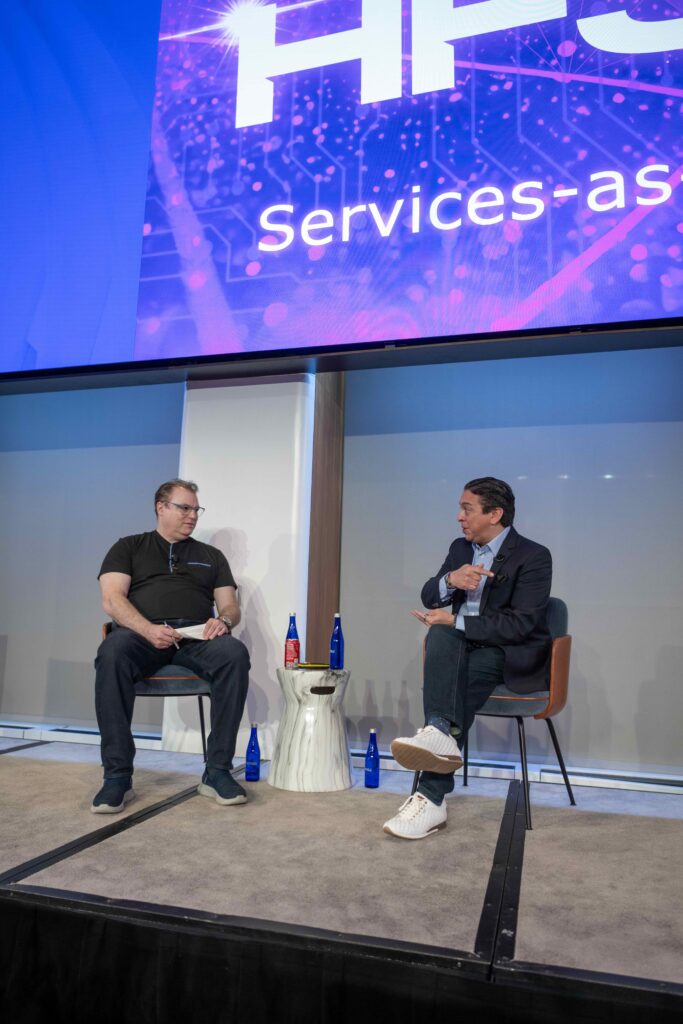
I joined HFS Research in New York for The Services-as-Software Economy: Disrupt or Be Disrupted conference where I delivered a keynote on AI Business Transformation: Optimized + Innovative AI on behalf of ServiceNow.
In a room full of business and technology leaders leading AI investments, I asked everyone to press pause on conversations limited to use cases, automation and efficiency gains, and siloed pilots that optimize yesterday’s work. We are entering a phase of AI where the conversation has to move beyond what’s quickly become an AI status quo.
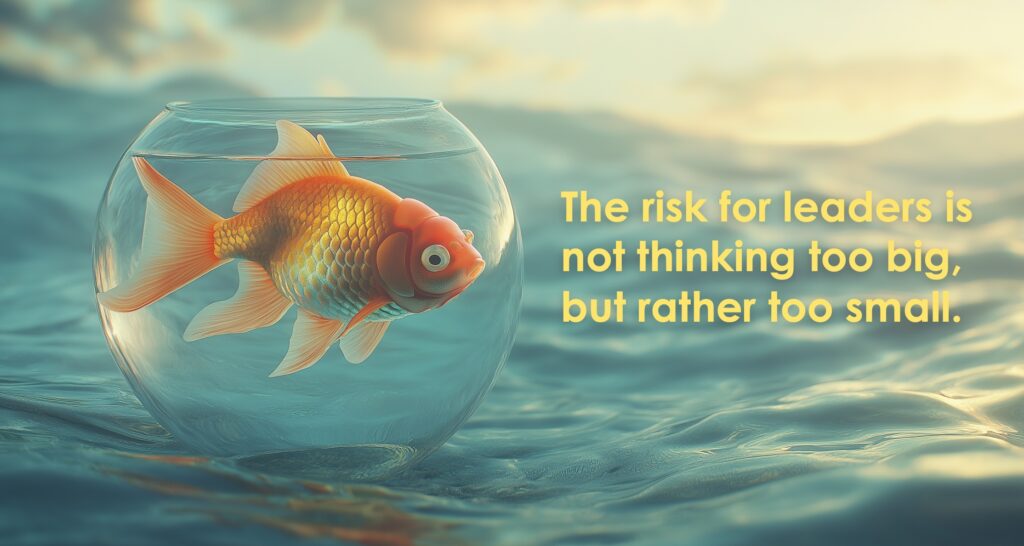
This was the provocation I wanted to leave with the room. The risk for leaders is not thinking too big, but rather too small.
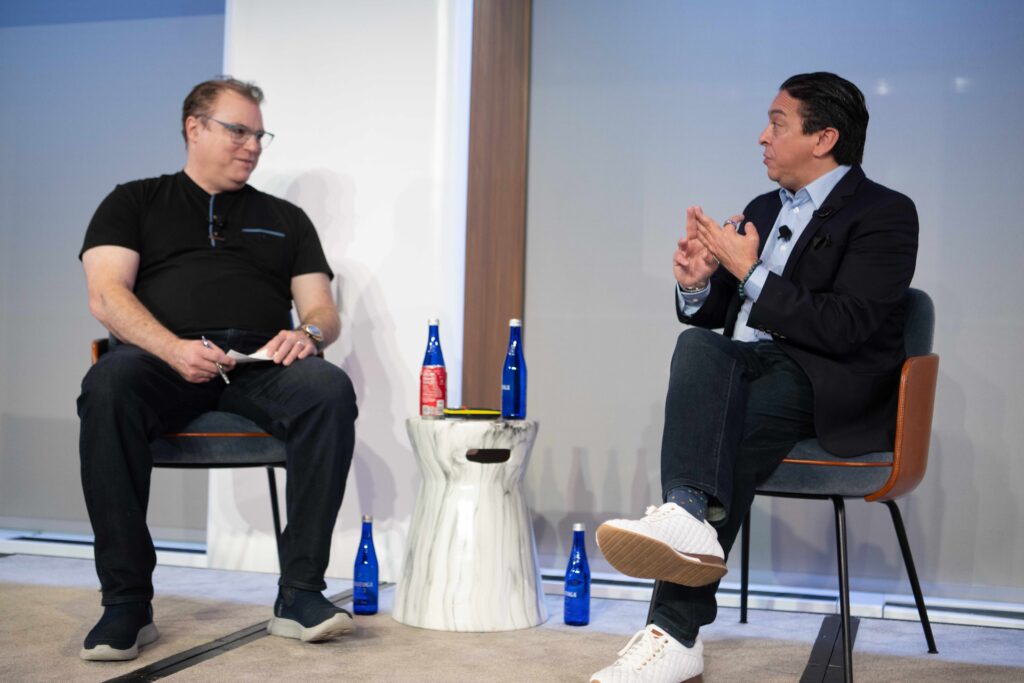
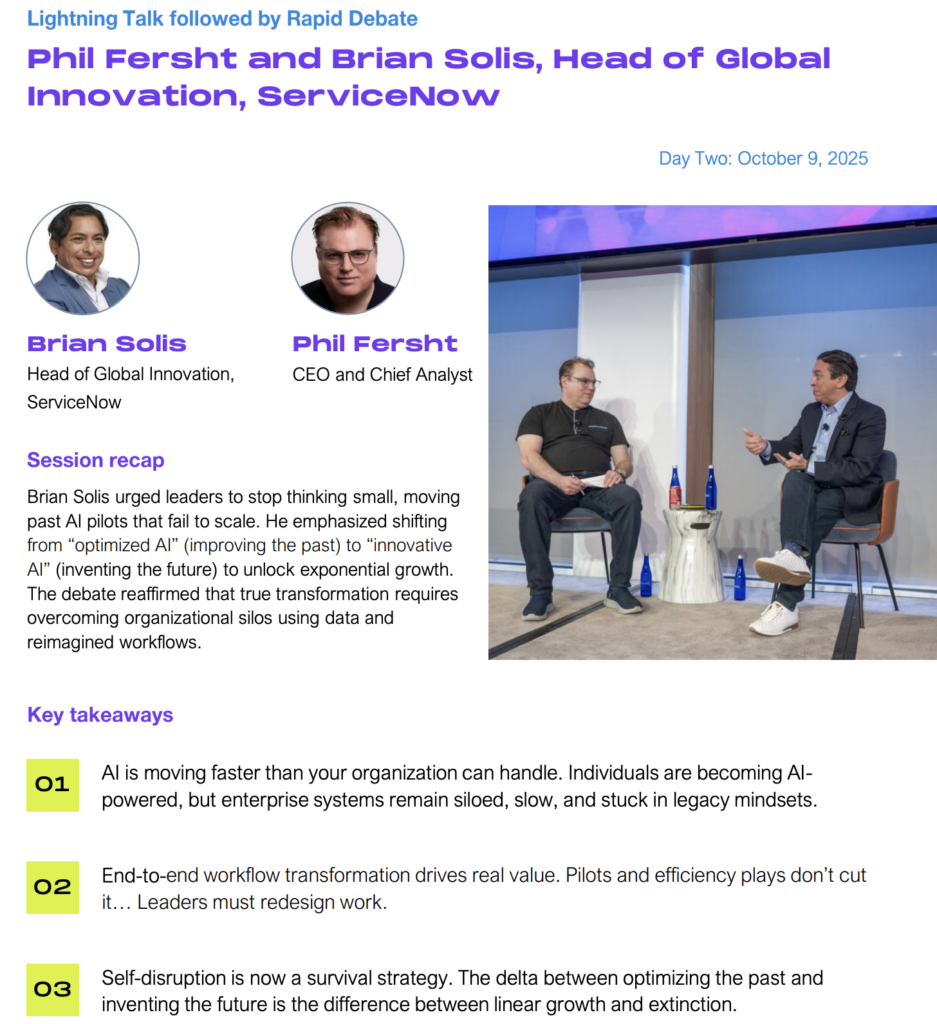
Following my presentation, HFS founder and CEO Phil Fersht joined me onstage to continue the conversation, exploring what AI business reinvention means when technology is moving faster than the organizational structures, operating models, incentives, and assumptions meant to put it to work. You can watch the keynote and conversation here or scroll to the bottom.
Yes, AI is changing how work gets done. More so, it is forcing leaders, or should, to reconsider what work should exist, how value gets created, what customers will pay for, and ultimately what kind of company they are building.
AI Is Everywhere, But Transformation Is Where Exactly…?
There is no shortage of AI activity inside enterprises. There are pilots, copilots, agents, proofs of concept, innovation teams, centers of excellence, and use cases multiplying across functions.
Great! Let’s try. Let’s experiment. Let’s learn! And, let’s fail…and fail forward and upward. Let’s also be honest about our investments. Activity is helpful and necessary, but it is not transformation.
In the research I shared onstage, overall enterprise AI maturity measured just 35 out of 100 and had actually fallen nine points year over year according to the ServiceNow AI Index.
That seems counterintuitive until you look more closely at what organizations are doing.
AI use cases may be widespread, but only 30% of organizations have integrated workflows across business functions.
A company can deploy hundreds of AI tools and still operate essentially the same way. It can automate tasks without redesigning workflows. It can make employees faster without changing how decisions happen. It can install agents without reconsidering the work those agents are being asked to perform. And none of this can be done effectively without a bold vision and governance to support it.
This is one reason AI maturity can feel as though it is moving backward even while AI usage moves forward. The technology keeps raising the ceiling while organizations keep bumping into their existing architecture.
We are becoming better at using AI before we are becoming better at being different because of AI.
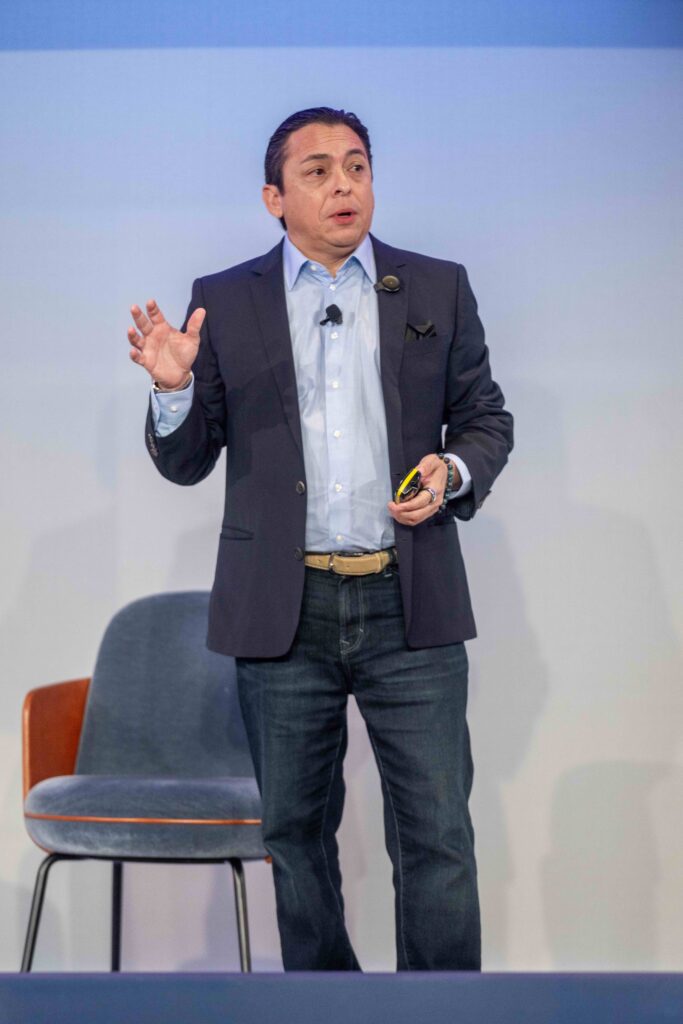
Are You Using AI to Improve the Past or Invent the Future?
This was the question at the center of my presentation. Organizations naturally begin with the past. And that’s perfectly fine. Of course they’re going to look at existing processes and ask how AI can make them faster, cheaper, more efficient, and scalable. They find bottlenecks and remove them. They apply intelligence to workflows designed years, sometimes decades, before this intelligent technology existed.
This is what Dave Wright and I refer to as “iterative AI” in our new book, Infinite: How Visionary Leaders Transform Today’s Businesses into AI-Forward Companies.
The point of iterative AI however is to not just optimize past workflows, but to also evaluate whether as is, they’re the right workflows to carry forward or if workflows themselves modernize with AI at the core. Then iterative AI becomes purpose-built to solve real business challenges and improve everyday workflows. It removes routine and complex work so people and organizations can become faster, more efficient, more productive, and hopefully more valuable.
There is a second portfolio leaders must build at the same time. We call this “innovative AI.”
Innovative AI asks different questions. Instead of starting with the current process, it starts with a desired outcome. It explores entirely new products, services, experiences, workflows, and business models. It looks for opportunities that were previously impossible or impractical, and uses AI to make them possible.
One makes the existing company better and more competitive.
The other helps invent the company that comes next.
You need both.
The Services-as-Software Economy Changes the Question
For decades, much of the services business has been organized around people performing work: expertise, labor, utilization, hours, capacity, projects, and headcount. Software helped people perform that work more efficiently, but the underlying model remained largely human-centered.
AI begins to change the economics of that equation.
When intelligence can increasingly perform, coordinate, and orchestrate parts of the work itself, the question is no longer simply, how do we use AI to make our services more efficient?
The more interesting question becomes, What does the service become when software and AI can increasingly deliver the outcome?
If you only automate the existing service, you may lower its cost. If you rethink the outcome, you may create an entirely new category of value.
And this is why disruption doesn’t necessarily arrive as a better version of your existing offering. It often arrives from someone who was never emotionally, financially, or operationally attached to your definition of the market in the first place.
Become AI-Forward, Not Simply AI-Enabled
In Infinite, we introduce the idea of an AI-forward mindset as a way to reach escape velocity and break from legacy gravitational pull.
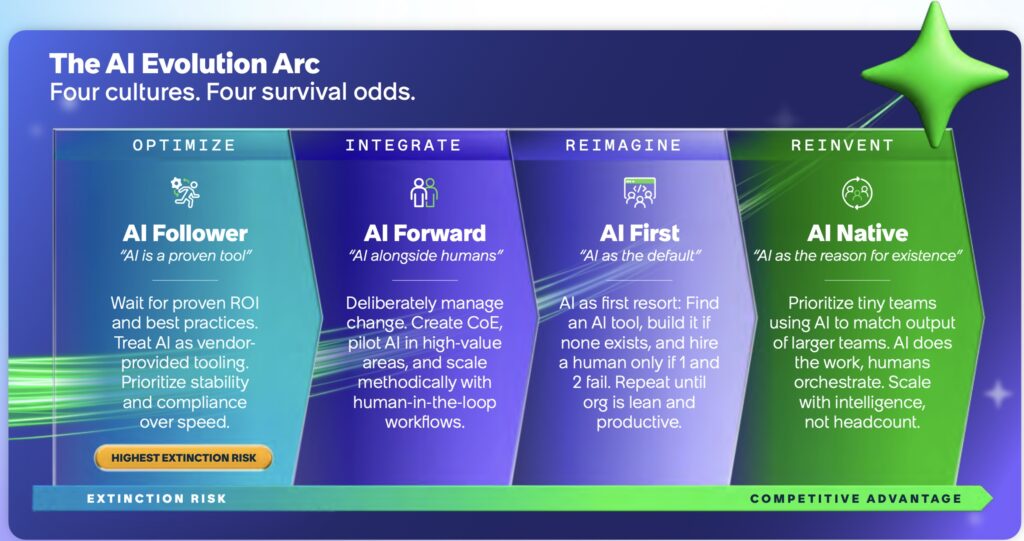
Being AI-forward means prioritizing the use of AI to explore possibilities that could not be achieved without it, and, importantly, outcomes AI could not achieve without us. AI-forward also means AI alongside humans.
Screenshot
The future is not simply autonomous.
Human judgment, imagination, empathy, ambition, creativity, values, vision, and responsibility become more important as AI becomes more capable.
This is about elevating what humans + AI can do together.
The leadership challenge, then, is to simultaneously pursue optimization and augmentation, iteration and innovation, while creating intentional space for reinvention. The problem is that most organizations are structurally biased toward automation and optimization because it’s a known approach But executives need to learn a lesson before finding out the hard way, you can’t cut your work to growth. You can’t automate your way to innovation.
Budgets reward predictable returns. KPIs measure existing performance. Teams are organized around existing products. Leaders are accountable for the quarter in front of them.
Innovation asks them to invest in something that does not yet exist. That is why the AI transformation challenge is ultimately as much about leadership and organizational design as technology. It’s just a broader conversation most aren’t having…yet. But in the end, AI Darwinism pits finite against infinite companies. ∞
The Organizations Pulling Ahead are Doing More than Buying and Bolting-On AI
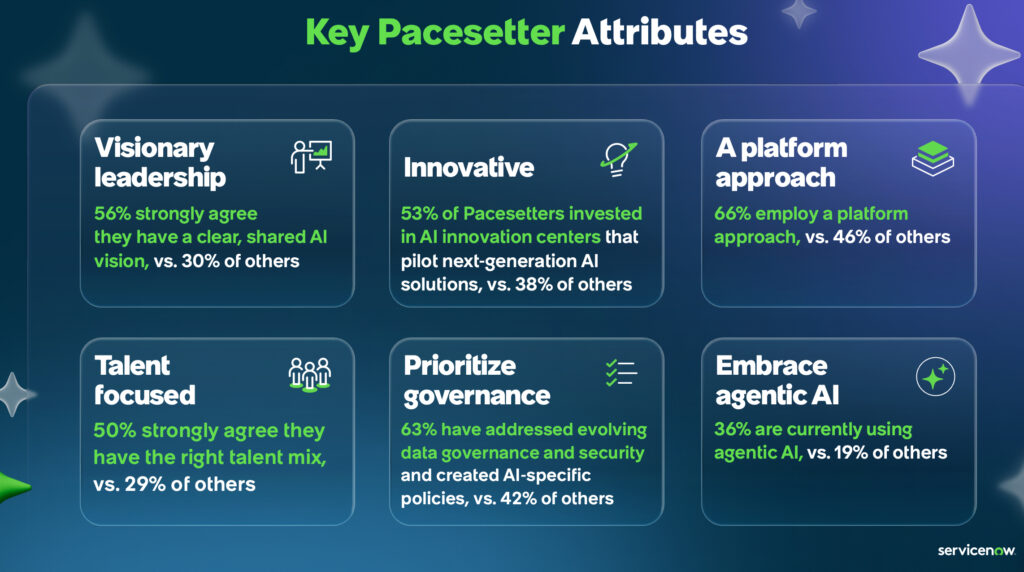
The AI pacesetters studied in ServiceNow’s latest AI Index research provided another important clue.
Compared with everyone else, AI pacesetters were significantly more likely to have a clear shared AI vision, invest in AI innovation centers, take a platform approach, build the right talent mix, establish AI-specific governance, and already use agentic AI. These represent organizational capabilities.
Screenshot
Vision
Innovation
Platforms
Talent
Governance
Agents
That is what separates AI pilots and use cases from AI transformation.
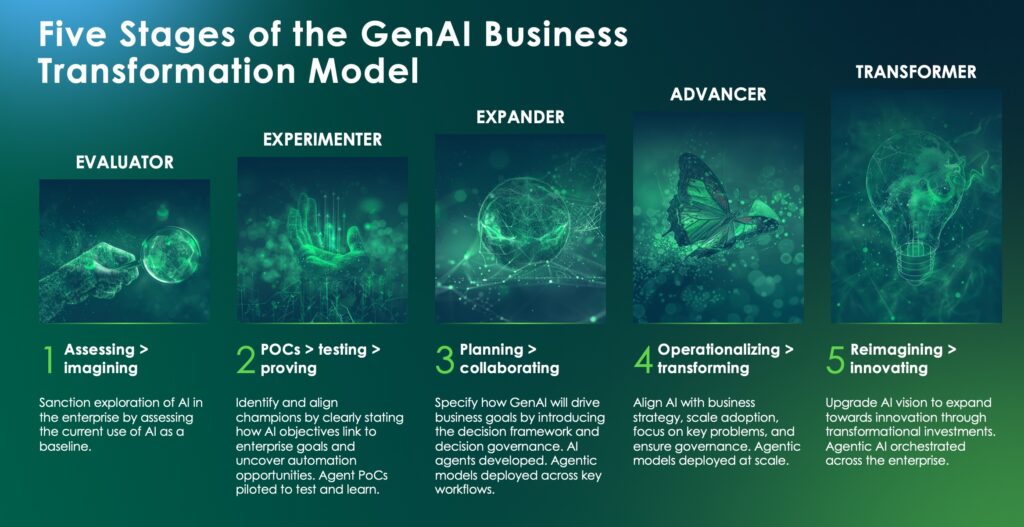
The maturity model reflects that progression. Organizations move from Evaluator, where they assess and explore, through Experimenter and Expander, into Advancer, where AI becomes operationalized at scale. But the final stage, Transformer, requires something more, reimagining, innovating, transformational investment, and agentic AI orchestrated across the enterprise.
At that point, technology stops being the story and business reinvention becomes the story and the outcome.
The Coming Divide: Iteration Vs. Reinvention
One of the visuals I shared plots iterative and innovative AI against business impact over time. In the right cases, with the right approach, they create value. But they do not create the same trajectory.
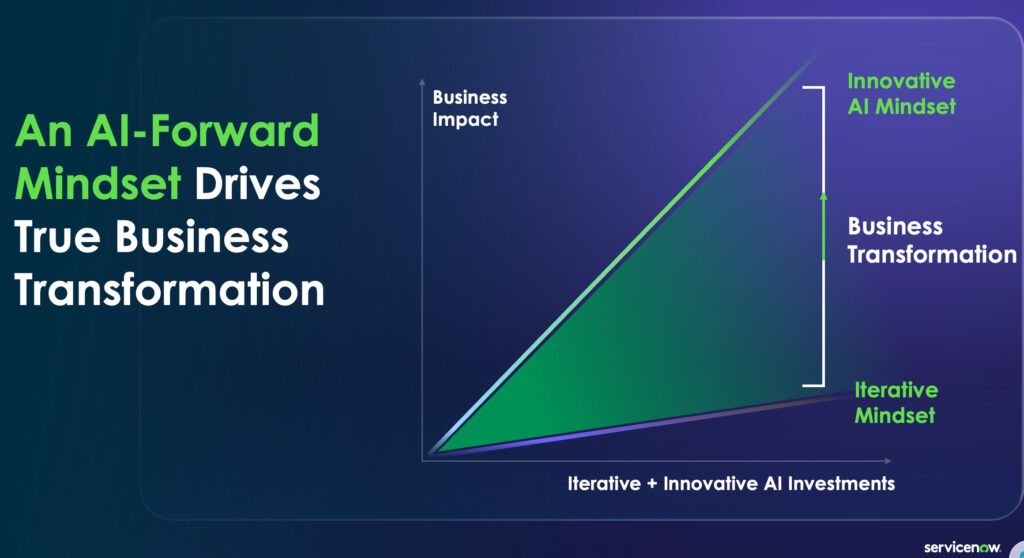
An iterative mindset improves the slope of the business you already have. An innovative AI mindset creates the potential for a fundamentally different curve, what Dave Wright and I describe as true AI business reinvention in Infinite.
Another view contrasts automation with augmentation. Iterative AI solves problems and improves work; innovative AI creates game-changing use cases that reimagine work. The space between those trajectories is where disruption happens.
While an incumbent is celebrating a 20% productivity improvement, an AI-native competitor may be asking why the workflow requires ten steps at all or why the work isn’t leading to an even greater outcome.
One company asks how AI can make employees more productive, another asks what a human-agent team could accomplish that a traditional organization could never economically deliver.
One business uses AI to lower the cost of its existing service or increase efficiency, another redesigns the service around an outcome customers actually wanted all along.
This is the difference between applying AI to your business and allowing AI to challenge your assumptions about the business.
AI-Native Competitors Won’t Wait for Your Transformation Roadmap
I closed the presentation by looking at three emerging postures…AI Native, AI First, and AI Forward (3 of the 4 AI Cultures I recently studied with dear friend and former Altimeter colleague, Jeremiah Owyang.
AI-native organizations do not really need to call themselves AI native. AI is simply in their DNA, embedded through processes and workflows, with human-agent ratios already shaping how small teams can operate at scale. AI-first companies increasingly treat AI as the default way to work and solve problems. AI-forward companies deliberately bring humans and AI together, with greater emphasis on oversight, collaboration, governance, and values.
There is no single template every company should copy. But there is a competitive reality every incumbent has to confront. Your AI strategy can’t be based only on how your existing competitors are using AI. You have to go beyond the use cases everyone is talking about. You have to be user zero or customer zero. You also have to imagine the company an entrepreneur would build today if they had access to your industry knowledge, modern AI, agents, platforms, and none of your legacy assumptions.
Then ask something most incumbents wouldn’t imagine asking, What would they build that would make your current operating model irrelevant?
That is where reinvention starts.
Disrupt or Be Disrupted Is a Leadership Choice
The title of the HFS event was deliberately provocative: Disrupt or Be Disrupted. But disruption is not something leaders can simply schedule. What they can control is their response to it.
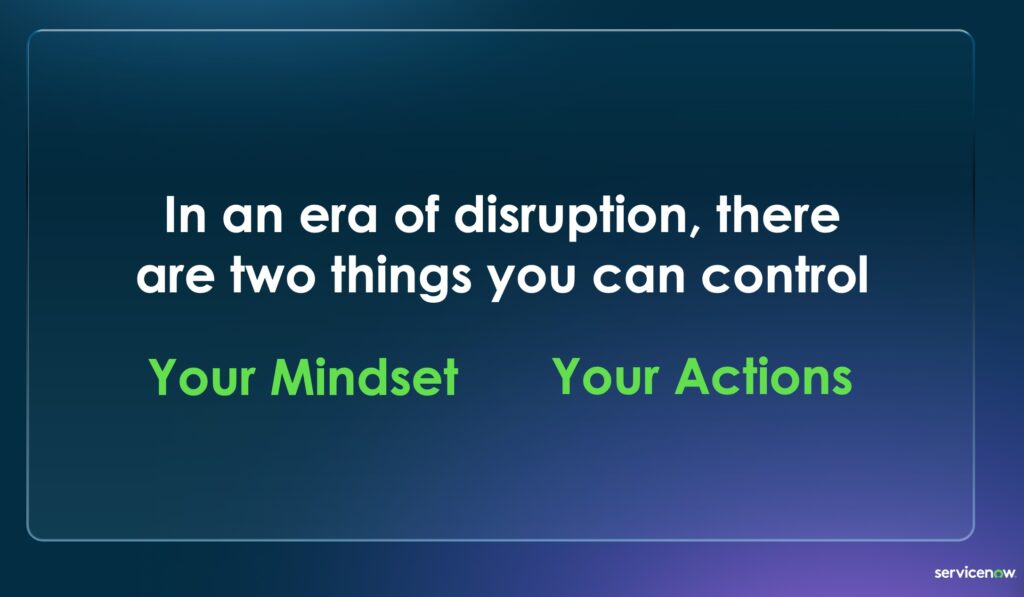
In an era of disruption, two things remain within our control: our mindset and our actions. We can use AI to make yesterday incrementally better. And we also need leaders willing to imagine businesses, services, workflows, experiences, and sources of value that could not exist before.
Companies have to be willing to think differently because AI exists. And then take action.
If you’re waiting for someone to tell you what to do, you’re on the wrong side of innovation. In the end, disruption happens to you or because of you.
AI Is Moving Faster Than Your Organization
Infinite ∞ | Mindshift | Subscribe | Keynote Speaker


Leave a Reply