AI Darwinism isn’t coming. It’s here.
The evolution has already begun inside every organization where employees are experimenting faster than leadership is redesigning the systems around them. Microsoft’s 2026 Work Trend Index Annual Report makes the gap clear: AI is expanding human agency, but many organizations are not yet built to capture it.
That’s the real challenge now. Leadership.
The companies that win this next era will be the ones brave enough to reimagine work, empower curiosity, create psychological safety, and turn experimentation into institutional advantage.
Agents, Human Agency, and the Opportunity for Every Organization
The Microsoft report finds that AI is expanding human agency as agents take on more execution, but the real question is whether organizations are built to capture that agency. Microsoft analyzed trillions of anonymized Microsoft 365 productivity signals and surveyed 20,000 workers using AI across 10 countries. The finding is both hopeful and uncomfortable: in many cases, people are ready ,but he systems around them are not.
Contrary to popular ideology, AI fluency is not the finish line.
AI fluency is a good start, but it is not the destination. Fluency is knowing the language. Like OpenAI, in its research, Microsoft identified an advanced category of work that they called Frontier work with those leading it, Frontier professionals.
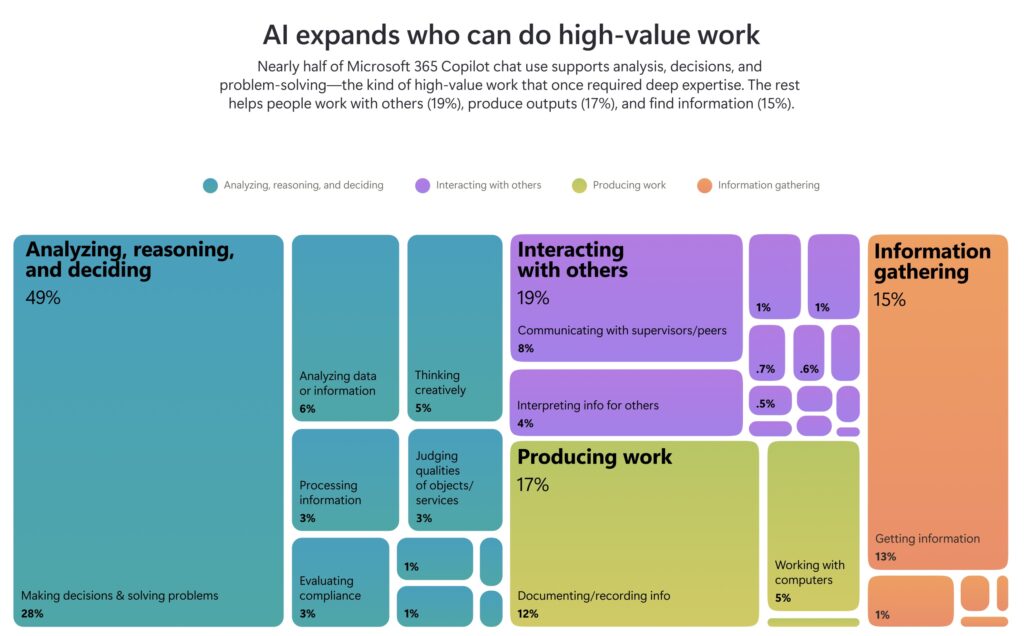
For example, Microsoft found that 49% of Microsoft 365 Copilot conversations support cognitive work: analyzing information, solving problems, evaluating, and thinking creatively. Even more important, 58% of AI users say they are producing work they couldn’t have produced a year ago. That rises to 80% among Frontier workers. These workers use agents for multi-step workflows, rethink where AI should augment or automate work, and help create shared AI standards for their teams.
Said another way, the best AI users are not outsourcing their thinking. They’re upgrading it.
In fact, Microsoft found that 86% of AI users treat AI output as a starting point, not a final answer, and “stay responsible for the thinking.” Frontier Professionals are more likely than others to intentionally do some work without AI to keep their skills sharp and to pause before deciding what should be done by AI versus a human.
You could say that it’s the future of work in one sentence: the human who knows what not to delegate becomes more valuable than the human who delegates everything.
Human skills become the moat. AI does not eliminate judgment or critical thinking or creativity. It these skills the premium.
The Real AI Gap Is Coherence
Recently, Daniel Miessler, a cyber security AI engineer, recently published a post about how most companies are not remotely ready for AI. Miessler argues that legacy companies struggle with AI because they can’t clearly visualize or articulate what they want. “AI is about execution,” he writes, “and it’s quite powerless when it doesn’t know what to execute.” He points to unclear and constantly changing vision, goals, strategies, workstreams, metrics, and costs as the deeper problem.
Exactly.
AI is a mirror with an API. It reflects the past and connects it to efficiency.
This reminds me of something legendary venture capitalist Vinod Khosla once said. “Most businesses have no clue what is about to hit them in the next ten years when most rules of engagement will change,” he observed.
If your company is clear on direction, AI accelerates you. If your company is confused, AI scales the confusion. If your company is tied to the past, AI scales your past until your business can no longer compete in the present.
You can’t automate chaos into clarity.
You can’t agentically orchestrate a business that doesn’t understand its own music.
You can’t scale what you shouldn’t be doing in the first place.
This is why “use AI” is not a strategy. It’s a dare. And for many organizations, it’s a dare issued by leaders who have not mapped the work, clarified the outcomes, aligned incentives, or created the cultural conditions for people to experiment their way into the future.
Miessler’s most important question wasn’t, “What can AI do for us?” It is whether the company is in a state where AI can help at all. And maybe it should be a more direct question,” where can we go with AI that wasn’t possible before” or “what aren’t we doing that would make us more competitive?”
When executives hold up a mirror and honestly see themselves reflecting on these questions, it might help them realize something profounds… we’re not trying to do much more than what we’ve always done, we’re just evolving the past thinking that the market conditions will remain constant.
We’re implementing technology to free up human capacity, but we’re not repurposing that capacity toward value creation.
We’re moving faster but we may not be empowering our people to compete differently, meaning we’re running to stand still.
We’re driving AI adoption, fluency, and training, but to what end? Is AI helping us scale the past but not preparing for or building a new future not possible without AI? Are we pushing people to give their thinking and output to AI without reskilling them toward proper augmentation?
The Transformation Paradox
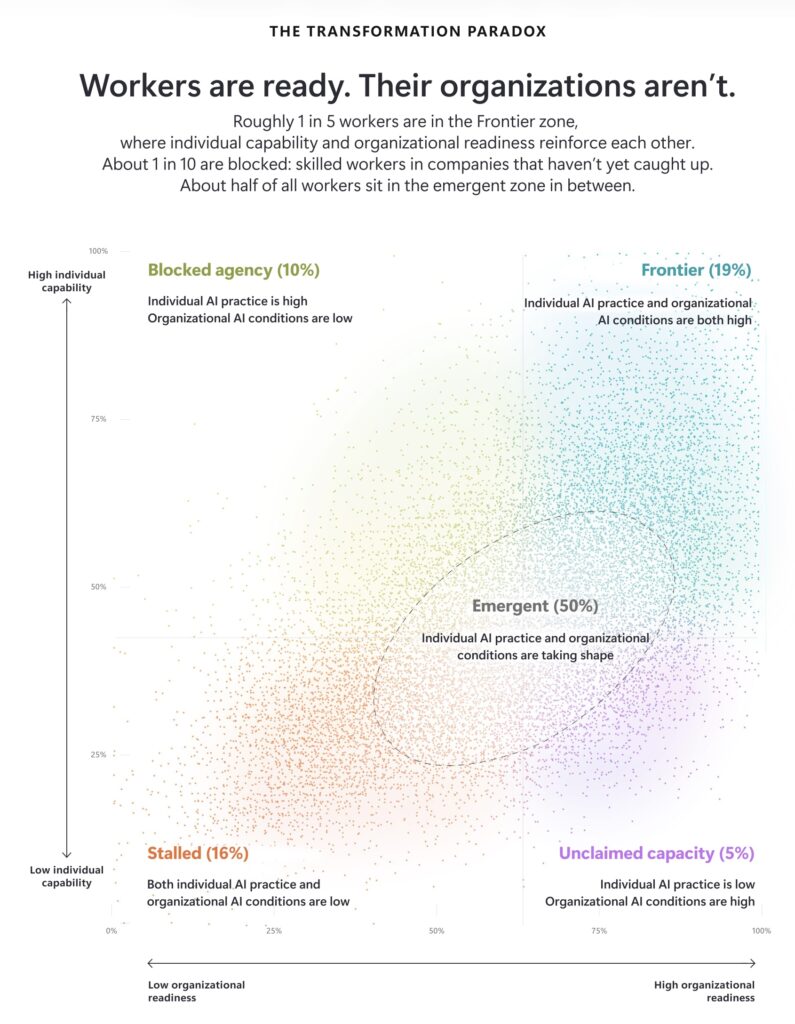
Microsoft calls this the Transformation Paradox: knowledge workers could be ready, but organizations aren’t.
In the 2026 Work Trends Index, Microsoft found that only 19% of AI users sit in the “Frontier” zone, where individual capability and organizational readiness reinforce each other. About 10% are blocked, representing skilled workers in companies that haven’t caught up. Half sit in the messy middle, where both individual practice and organizational conditions are still taking shape.
The misalignment gets worse at the top.
Only 26% of AI users say their leadership is clearly and consistently aligned on AI. Meanwhile, 65% fear falling behind if they don’t adapt quickly, 45% say it feels safer to focus on current goals than to redesign work with AI, and only 13% say they are rewarded for reinvention even when results aren’t immediate.
Leadership is not clear or aligned on AI. People fear falling behind. Employees focus current work instead of redesigning work because it feels safer. And employees aren’t incentivized or motivated to think differently, to innovate, or to improve outcomes.
Think about it this way…people are being told to transform while being measured, managed, and rewarded for not transforming.
That’s not a skills gap. That’s a leadership gap.
You cannot ask people to reinvent work and then grade them only on yesterday’s measures.
Psychological Safety is AI Infrastructure
Work today is based on the verticalization of existing silos. Data, workflows, systems, and measures are all designed to optimize that work. Agentic AI, for example, represents an opportunity to connect disparate silos to make work flow horizontally across the enterprise. This means everything is up for reinvention…everything. Whatever past workflows remain moving forward should only be the result of deep thinking. Your next steps become intentional.
I have two words, “psychological safety.”
In the AI era, psychological safety is operational infrastructure. It is what allows people to say, “This process no longer makes sense.” It gives employees permission to challenge inherited workflows, surface broken handoffs, test new human-agent models, and admit when AI outputs are wrong before those errors compound at scale.
In its Work Trend Index research, Microsoft found that when managers created psychological safety around experimentation, employees reported up to 20 points higher AI readiness and value and were 1.4x more likely to be high-frequency users of agentic AI. When managers actively modeled AI use, employees reported a 17-point lift in AI value, a 22-point lift in critical thinking about their AI use, and a 30-point lift in trust in agentic AI.
That’s proper leverage.
Silence fosters technical debt.
Fear cultivates organizational latency.
And cultures that dissuade experimentation will lose to cultures that learn in public, correct quickly, and scale what works.
From Adoption to Absorption
AI adoption asks, “Are people using AI?”
AI absorption asks, “Is AI changing how value is created?”
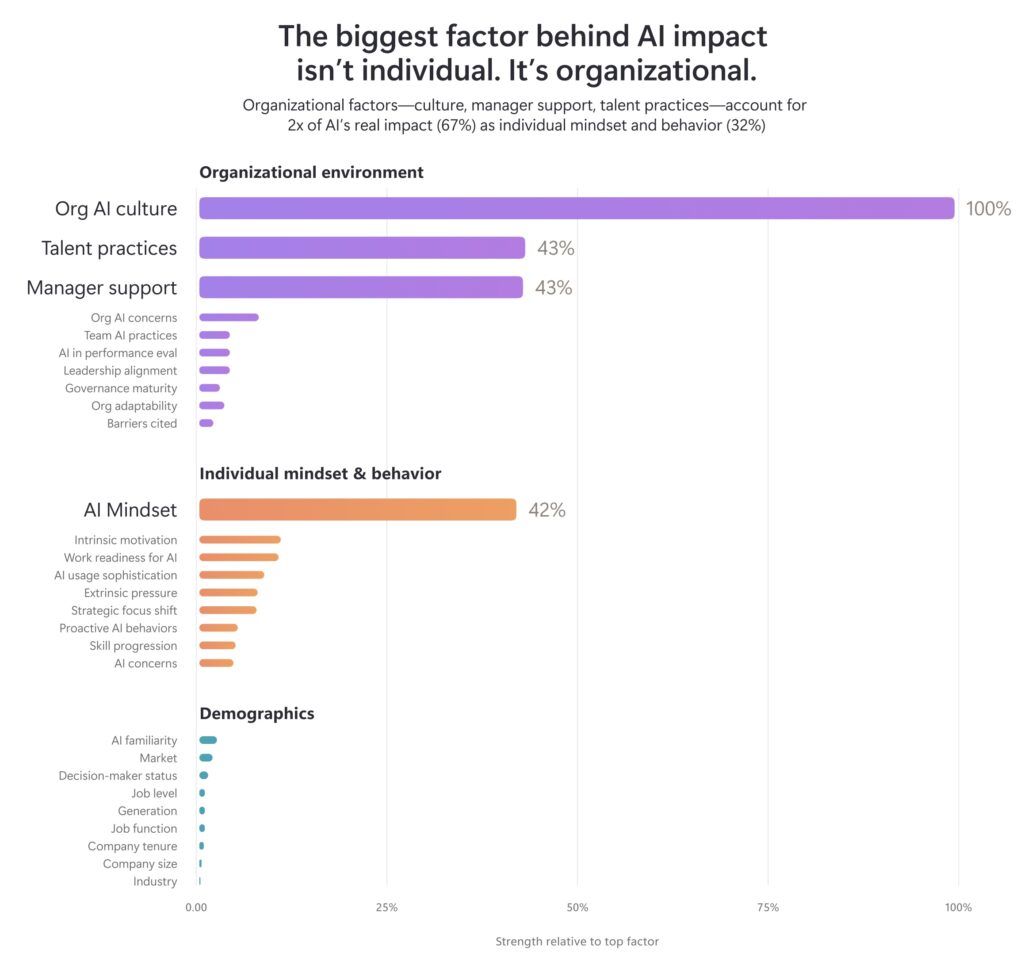
Microsoft found that organizational factors such as culture, manager support, and talent practices account for more than 2x the reported AI impact of individual mindset and behavior, 67% vs. 32%. The constraint is no longer what people can do. It is how work is structured around them.
In other words, you can send everyone to prompt school, but if your culture doesn’t encourage and reward experimentation, your managers don’t model AI use, your workflows remain siloed, and your incentives worship yesterday’s KPIs, congratulations: you’re optimizing the past while your competitors are experimenting forward.
The future of work needs design.
The New Leadership Work
The job of leadership now is to rearchitect work, otherwise, we’re talking about management.
Start with outcomes and the work that supports them, not the org chart. Org charts tell you who reports to whom. Outcomes thinking necessitates “work charts” that show how people and tech move value.
Pick one critical flow: lead-to-cash, claim-to-settle, incident-to-resolution, employee onboarding, product launch, customer renewal.
Then ask: what outcome are we trying to create, where does judgment matter, where does execution slow down, where can agents help, where must humans stay accountable, and what should the work teach us as it runs?
Next, find your Frontier Professionals. They are already there, quietly building the future with Claude in the margins while the organization debates the past.
Study them. Ask how they decide what to delegate, how they evaluate outputs, how they document workflows, how they share what they learn, and where the system blocks them.
Then train managers to become AI work coaches. They must model AI use, set standards for AI-assisted work, create room for experimentation, and reward people for redesigning work, not just completing tasks faster.
Finally, build evaluation infrastructure. As agents execute more work, the cost of bad outputs compounds. Microsoft says every Frontier Firm needs to answer three questions:
- who reviews agent performance,
- who has authority to update the workflows agents run,
- and how does a local win get captured and scaled across the organization?
The firms that answer those questions start building “Owned Intelligence,” institutional know-how that compounds over time and becomes hard to replicate.
That is a real moat.
The Leadership Test
AI Darwinism isn’t coming, it’s here. The evolution has already begun. The future isn’t waiting for the next offsite, the next strategy cycle, or the next perfectly aligned transformation deck. The gap is widening now between people who are learning how to think, create, decide, and lead with AI, and organizations still asking them to fit that potential into yesterday’s jobs, workflows, incentives, and permission structures. That gap will not close itself. Leaders close it.
Every executive team should ask seven questions now:
- What outcomes are we trying to improve, not just what tasks are we trying to automate?
- Which workflows create the most value, friction, delay, or customer pain?
- Where are our frontier employees already using AI in advanced ways?
- Where are they blocked by policies, metrics, incentives, or management habits?
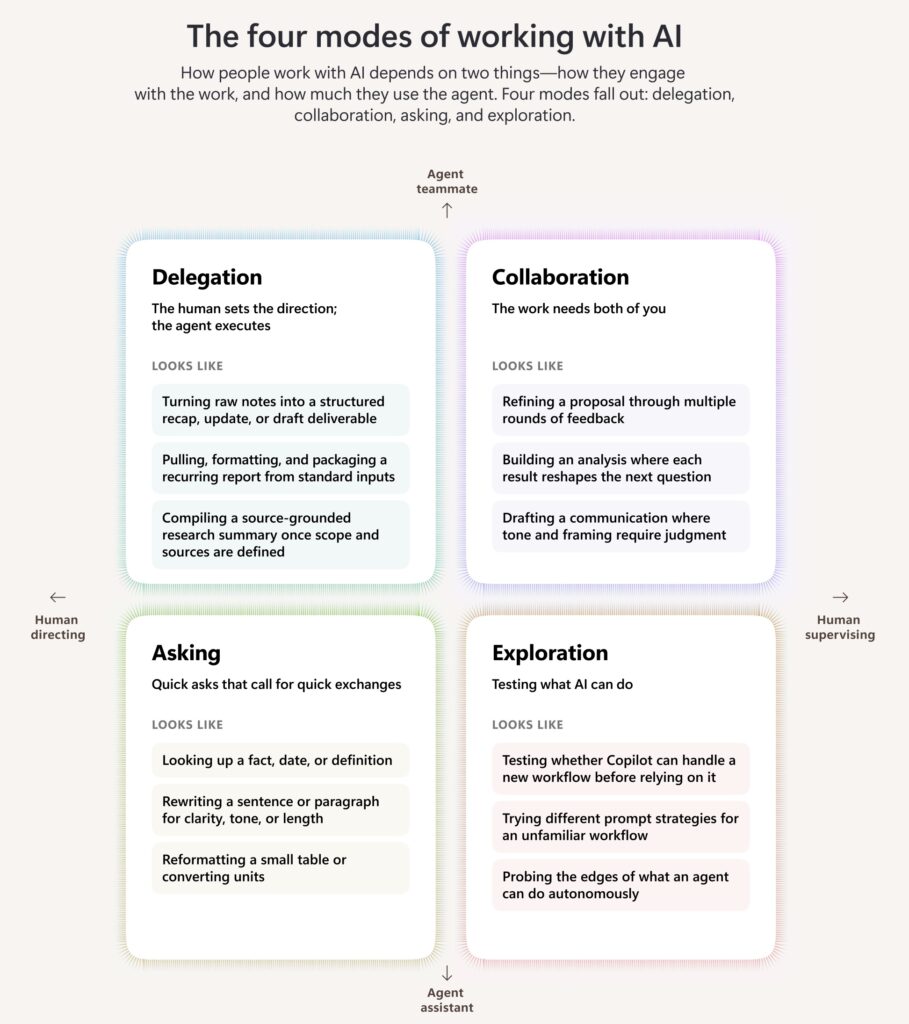
- Which work should be delegated, collaborated on, explored, or kept human-led?
- What quality standards define excellent AI-assisted work?
- How do we capture lessons from every experiment and scale them into the operating model?
That is how companies move from AI adoption to AI absorption.
That is how leaders close the agency gap.
That is how leading companies compete for the future.
That starts with a mindshift.
—
Read Mindshift | Subscribe to my Substack | Consider me as your next speaker


Leave a Reply