The intelligent web is entering its next phase. AI systems are moving from reading and summarizing the internet to researching, deciding, transacting, and increasingly interacting with other agents. That changes what leaders have to design for now.
At WP Engine’s DE{CODE}, I explored an idea that has been occupying a lot of my thinking lately: the intelligent web. We are redesigning the internet for two audiences at once, human beings and the AI systems increasingly acting on their behalf. Search is becoming synthesis. Browsing is becoming delegation. Content is becoming context. Websites are evolving from destinations into intelligent business platforms.
My keynote at the Agent-to-Agent GTM Summit gave me an opportunity to take that thinking one step further.
AI is beginning to participate in the market.
HUMAN Security’s 2026 State of AI Traffic & Cyberthreat Benchmark Report found that monthly AI-driven traffic grew 187% over the course of 2025, while traffic from AI agents and agentic browsers grew 7,851% year over year.
Agentic traffic is still young as a share of the overall web, which explains some of that extraordinary growth rate, but the direction is unmistakable, machines are starting to navigate and act across the internet with purpose.
This is where the intelligent web begins to become a machine-native market.
When Intelligence Becomes a Market Participant
Almost everything we built on the commercial internet assumed a human being was sitting on the other side of the screen. We designed pages for eyeballs, navigation for fingers and cursors, copy for action, forms for human input, and checkout to transact.
Agents are pursuing many of the same outcomes through a very different interface with the world.
They parse. Compare. Verify. Summarize. Rank. Recommend. Ask other systems for information. Invoke tools. Request permission. Execute transactions. Escalate when they reach the boundaries of their authority.
That changes the design brief.
In my A2A keynote, I defined a machine-native market as one where intent, identity, trust, price, availability, proof, permission, payment, service, and fulfillment are discoverable, readable, verifiable, and actionable by agents.
There is a lot packed into that definition because a machine-native market requires us to move beyond the visible web. Product information, pricing, policies, credentials, availability, permissions, APIs, transactions, workflows, customer proof, service capabilities, identity, and provenance all become part of the experience.
For the last three decades, companies obsessed over what customers could see. The next era asks leaders to become equally intentional about what machines can understand, verify, and do.
The Agent Endpoint Becomes the Storefront
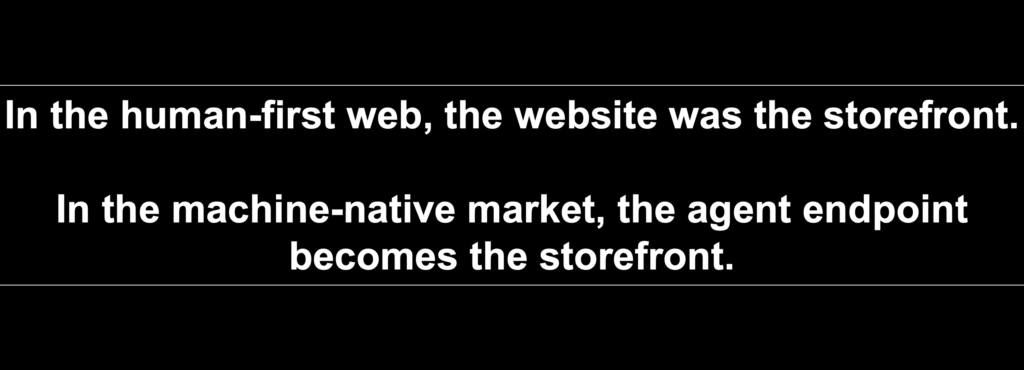
In the human-first web, the website became the storefront. In a machine-native market, the agent endpoint becomes a storefront, too.
Imagine a B2B buyer beginning with a goal instead of a search query: “Find the best platform for our requirements, compare three vendors, evaluate total cost, confirm security and compliance, identify implementation risks, and bring me a recommendation.”
That single request could mobilize a research agent, procurement agent, security agent, finance agent, architecture agent, and eventually the seller’s own agents. The human executive may enter the experience after much of the discovery and evaluation has already happened.
This is already becoming technically possible because an interoperability layer is emerging around agents. Anthropic introduced the Model Context Protocol (MCP) as an open standard for connecting AI applications with external data and tools. Google introduced Agent2Agent (A2A) so agents built on different systems can discover one another, exchange information, and coordinate work.
Commerce is moving in the same direction. Stripe and OpenAI developed the Agentic Commerce Protocol (ACP) to enable commerce flows among buyers, AI agents, and businesses, while Google’s commerce and payments work is establishing mechanisms for agent-driven transactions and proof of authorization.
These protocols will evolve. Others will emerge. The strategic signal matters more than any one standard: the web is acquiring an operating layer for machines that can communicate, coordinate, and transact.
For leaders, that means your next customer journey may begin somewhere you do not control, move through systems you never designed as customer touchpoints, and reach a decision before a person ever visits your homepage.
The Funnel Becomes a Decision Graph
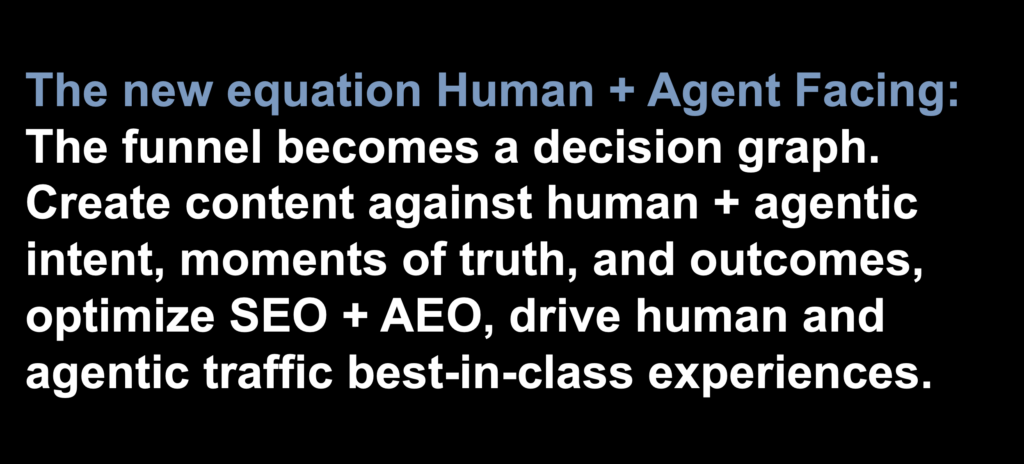
For years, the digital GTM equation followed a familiar sequence: create content, optimize search, earn attention, drive traffic, convert. That model gave us the funnel.
Machine-mediated journeys behave more like a decision graph.
A human’s intent can trigger a network of queries, comparisons, validations, permissions, transactions, and handoffs. Some occur sequentially. Others happen at the same time. Some are handled entirely by machines until the decision reaches a threshold where judgment, authorization, ambiguity, or emotion requires a person.
This gives us new moments of truth to design around.
Can an agent find the right product and understand who it is for? Can it determine whether pricing is current? Can it substantiate a claim? Can it compare your offering with a competitor without guessing? Can it verify security and compliance? Can it understand what it is authorized to do? Can it complete the transaction? If something fails, can it recover? When judgment is required, can it reach the right human with the right context?
Every “no” in that journey becomes friction.
Every ambiguity becomes risk.
Every contradiction becomes a reason to choose someone else.
That is why the shift from funnel to decision graph matters. The work is no longer concentrated at the point of conversion. Trust, context, permission, and actionability have to survive the entire journey.
Trust Becomes Machine-Readable
Trust has always been one of the great currencies of business. The difference now is that some of it must become legible to machines.
For a person, trust can be emotional and experiential. We remember how a company made us feel. We respond to story, reputation, identity, design, service, values, and human judgment.
An agent needs evidence it can evaluate.
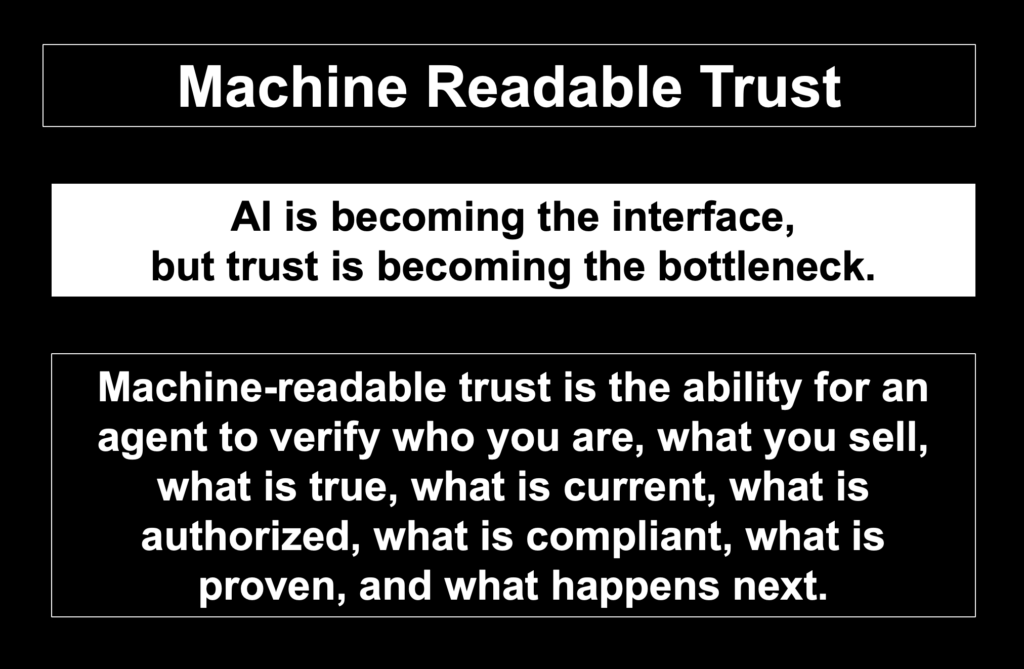
That is what I mean by machine-readable trust: the ability for an agent to verify who you are, what you sell, what is true, what is current, what is authorized, what is compliant, what has been proven, and what happens next.
Think about how much of that information exists today in disconnected places. Product claims live on web pages. Pricing sits in databases. security certifications live in portals. Legal terms are buried in documents. Customer proof appears in case studies. API documentation exists somewhere else. Policies may contradict implementation reality. Escalation paths often live in the heads of employees.
A human can sometimes work through that mess. An agent will interpret the mess as uncertainty.
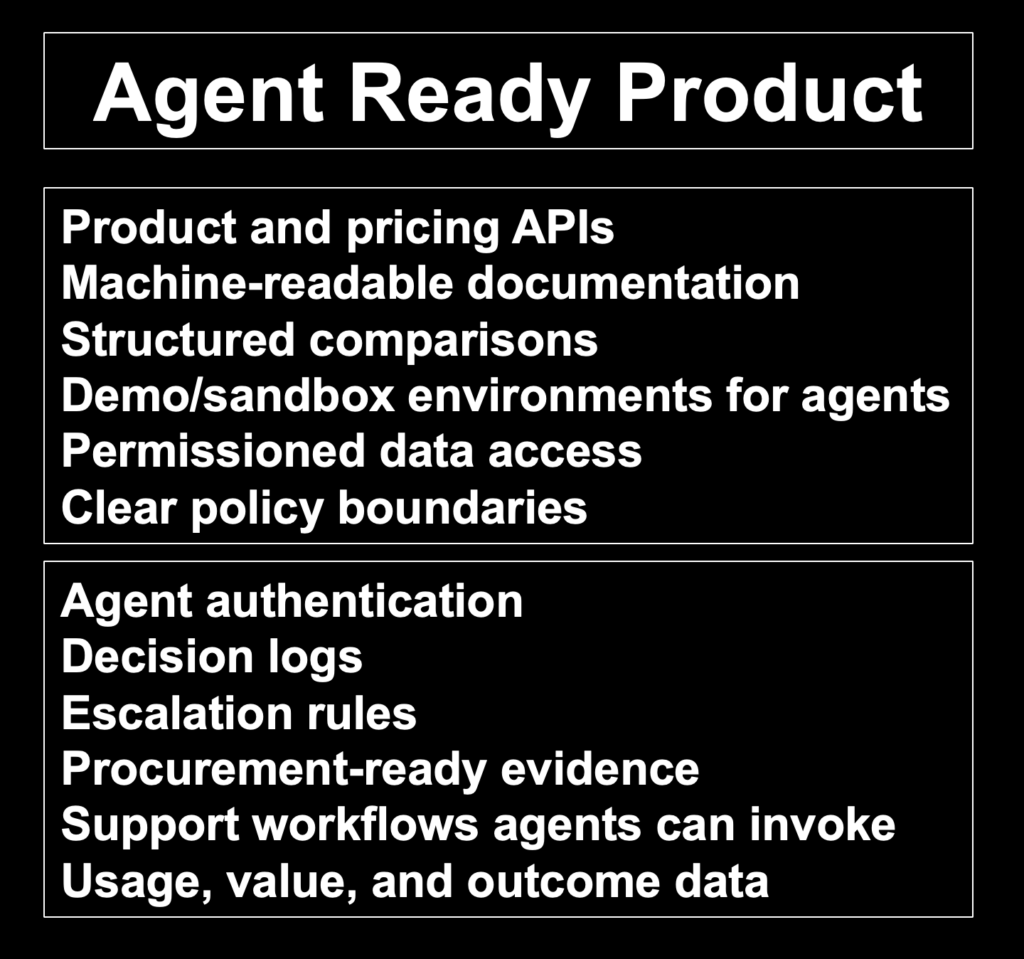
An agent-ready company starts turning that uncertainty into verifiable infrastructure: structured product and pricing information, machine-readable documentation, permissioned data access, clear policy boundaries, authentication, decision logs, procurement-ready evidence, support workflows agents can invoke, and explicit escalation rules.
This is where one of my favorite equations from these keynotes starts to become very real: AI becomes the UI. Trust becomes the click.
In an AI-mediated journey, the interface may be a recommendation, a comparison, a voice response, a purchasing agent, or a service agent. The “click” becomes the moment intelligence decides there is enough confidence to proceed.
Brand Has Two Audiences Now
This changes brand in an important way.
Brand has always lived in memory. Increasingly, it will live in two forms of memory at once.
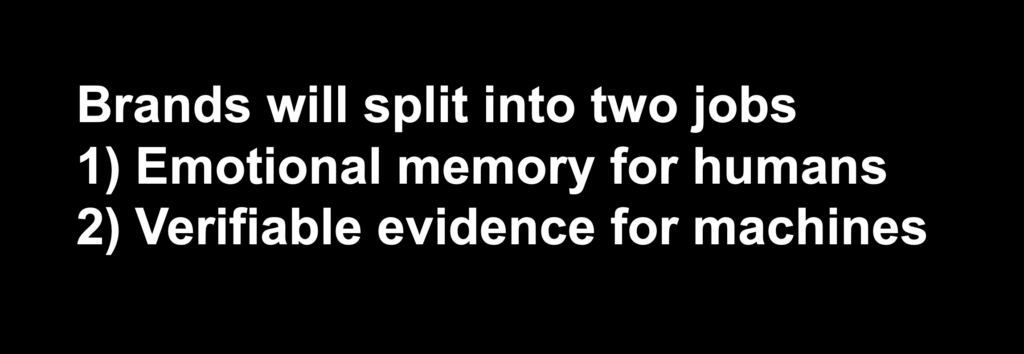
For humans, brands create emotional memory. For machines, brands need verifiable evidence.
Those two jobs belong together. A company can be machine-readable and completely forgettable. It can also be beloved by people and nearly impossible for an agent to evaluate or transact with. The companies that matter in a machine-native market will learn to do both.
This builds directly on the argument I made at WP Engine. We are entering an era of abundant synthetic output, and abundance changes what becomes scarce. When everyone can publish more, generate more, automate more, and fill every channel with more, more stops mattering. The premium moves to originality, usefulness, specificity, authority, empathy, taste, and trust.
I called that becoming source-worthy: creating information and experiences credible enough for people to rely on and AI systems to cite, synthesize, and recommend.
Machine-native markets extend that idea.
Source-worthy gets you into the decision. Agent-ready helps you become the decision.
Your brand becomes a signal interpreted by humans and machines, and clarity becomes a competitive advantage.
What do you stand for? What problem are you uniquely equipped to solve? What can you prove? What can you make easier? What outcome can someone trust you to deliver?
I have asked some version of those questions throughout my career. AI gives them new urgency because ambiguity becomes expensive when intelligence is interpreting you at machine speed.
CX + UX + AX
We spent decades building disciplines around customer experience and user experience. Machine-native markets introduce another layer I believe leaders should start taking seriously: Agent Experience, or AX.
An agent has an experience with your company even if it does not “feel” that experience the way a human does. Its experience is expressed through friction, confidence, completion, recovery, and the quality of the outcome it can return to the person it represents.
Stale pricing is AX friction. Conflicting claims are AX friction. An API that exposes information but cannot support action is AX friction. Ambiguous permissions, authentication loops, inaccessible documentation, opaque policies, and failed transactions without recoverable paths are all AX friction.
I think organizations should begin measuring something I would call Agent Experience Debt. It’s the accumulated complexity, inconsistency, opacity, disconnected systems, and inaccessible knowledge that make it difficult for an agent to confidently understand or interact with the business.
Today, that debt creates work for customers and employees. I call that added burden the AI Tax when technology supposedly designed to make things easier shifts more work onto the human on the other side.
Tomorrow, Agent Experience Debt could have a more direct economic consequence. Your company may become difficult for agents to interpret, expensive for them to work with, harder to verify, or easier to exclude from consideration.
From GTM Stack to Market Operating System
This is why I believe go-to-market has to evolve into something closer to context architecture.
Marketing, product, commerce, IT, security, legal, service, and data teams are all shaping pieces of an experience that agents will traverse as one system. Marketers are helping construct the knowledge layer AI uses to understand the company. Product teams are designing machine-actionable capabilities. IT is exposing tools and data safely. Security is establishing identity and permissions. Legal is turning policy into boundaries that machines can follow. Commerce teams are enabling transactions. Service teams are building workflows agents can invoke.
The customer sees the outcome. The agent experiences the architecture underneath it.
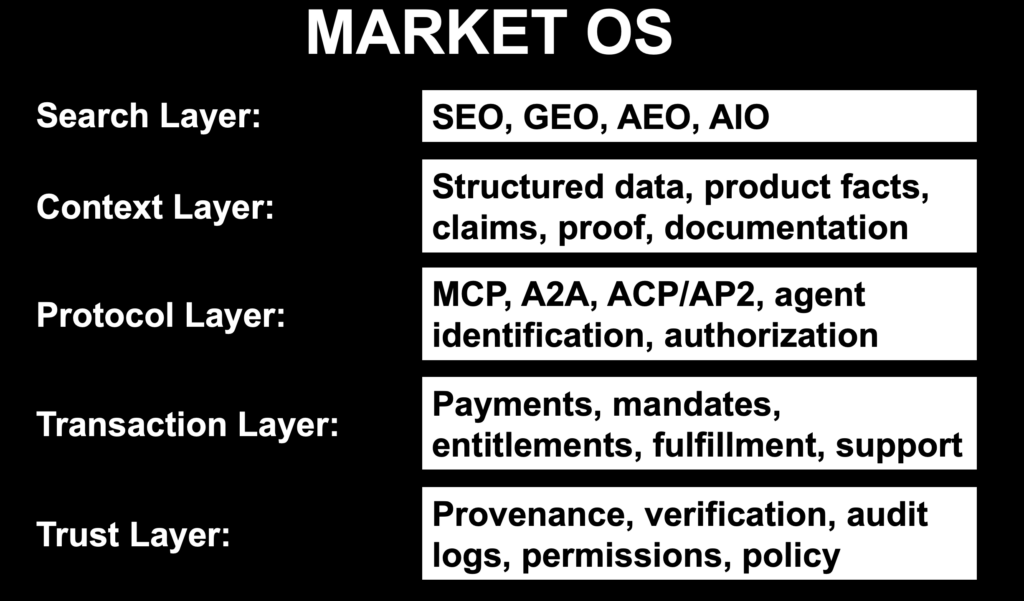
At the A2A Summit, I proposed a simple Market OS as a way for leaders to begin organizing this work:
- Search and discovery: understand where AI systems discover, synthesize, answer, recommend, and increasingly act. Audit what they can learn about your company and where the signal breaks down.
- Context: make product facts, claims, documentation, proof, pricing, availability, policies, and outcomes structured, current, specific, attributable, and useful.
- Protocols: decide how agents can connect to your systems, data, tools, and other agents. MCP and A2A are early examples of this emerging interoperability layer.
- Transactions: define what an authorized agent can actually accomplish: purchase, pay, schedule, provision, renew, return, invoke service, check fulfillment, resolve a problem, or escalate. ACP, UCP, and AP2 are signals that commerce itself is becoming agent-ready.
- Trust: operationalize provenance, verification, auditability, permissions, policy, agent identity, decision logs, proof, and human escalation.
The leadership question changes from “How do we show up in AI?” to something much more consequential:
How does intelligence experience our company? What can it discover? What can it understand? What can it verify? What can it do? Where does it encounter uncertainty? When should it escalate? What would make it recommend us? What would make it return?
Those are the questions I would put on the agenda of every leadership team now.
The More Agentic Markets Become, the More Human the Important Moments Can Be
There is a fascinating paradox emerging alongside all of this.
As more of the journey becomes automated, the moments that remain human can become more valuable.
Gartner reported in March 2026 that 67% of B2B buyers prefer a rep-free experience. Two months later, Gartner reported that 69% of B2B buyers turn to sales representatives to validate AI-generated insights.
I love the tension in those two findings because it points toward a much more interesting future for sales than “AI replaces sellers.” Buyers want independence when independence serves them. They want people when judgment, reassurance, complexity, risk, alignment, and trust become consequential.
Agents can absorb more research, comparison, qualification, procurement, coordination, and routine service. That creates an opportunity to redesign human work around what people do exceptionally well: judgment, empathy, imagination, negotiation, creativity, relationships, and navigating ambiguity.
Sales can become more human in the moments that matter. Service can, too.
We have spent years treating service as a cost center to be optimized. Yet service often happens at the most emotionally charged moment in the relationship: something broke, something is late, someone is confused, money is at stake, or trust is suddenly fragile. Automation can resolve the predictable. People should be empowered to make the ambiguous and emotional moments exceptional.
That is the human side of machine-native design.
Human-First Is the Soul, Machine-Native Is the System
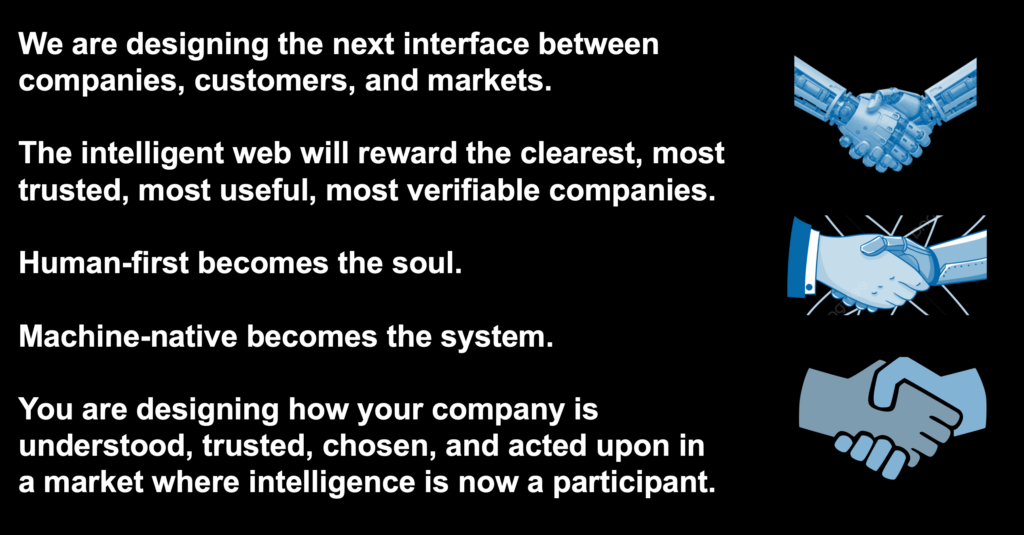
The intelligent web is growing into a market environment where people, agents representing people, agents representing companies, and agents interacting with other agents will increasingly coexist.
We are early enough that many of the rules, interfaces, norms, protocols, and expectations are still being invented. That is what makes this moment so exciting.
We get to decide how trust works. We get to decide how permission works. We get to decide how agents represent our interests and our brands. We get to decide where autonomy ends and human judgment begins. We get to rethink discovery, commerce, service, experience, GTM, and the very architecture through which companies participate in markets.
The imperative I shared at the end of the A2A keynote still feels like the right design principle. It’s this, Human-first becomes the soul. Machine-native becomes the system.
Build the system so machines can understand you, verify you, work with you, and act.
Design the experience so the human outcome remains meaningful, useful, trustworthy, and worth choosing.
The web is becoming intelligent. The market is becoming agentic. Intelligence itself is becoming a participant.
And we are the architects of what comes next.
Infinite ∞ | Mindshift | Subscribe | Keynote Speaker

Leave a Reply