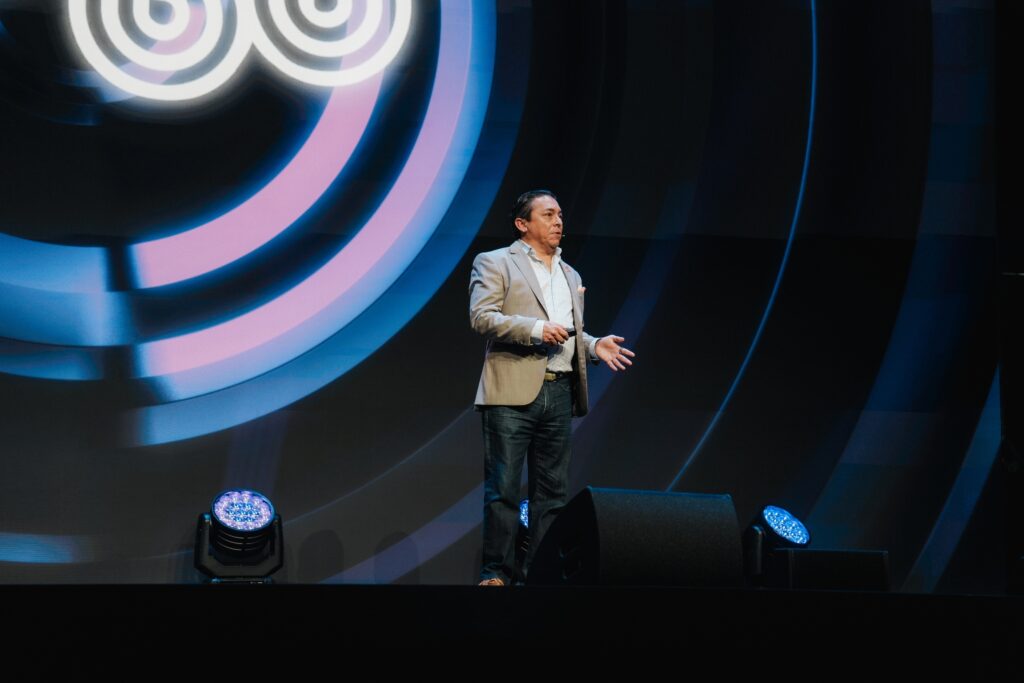
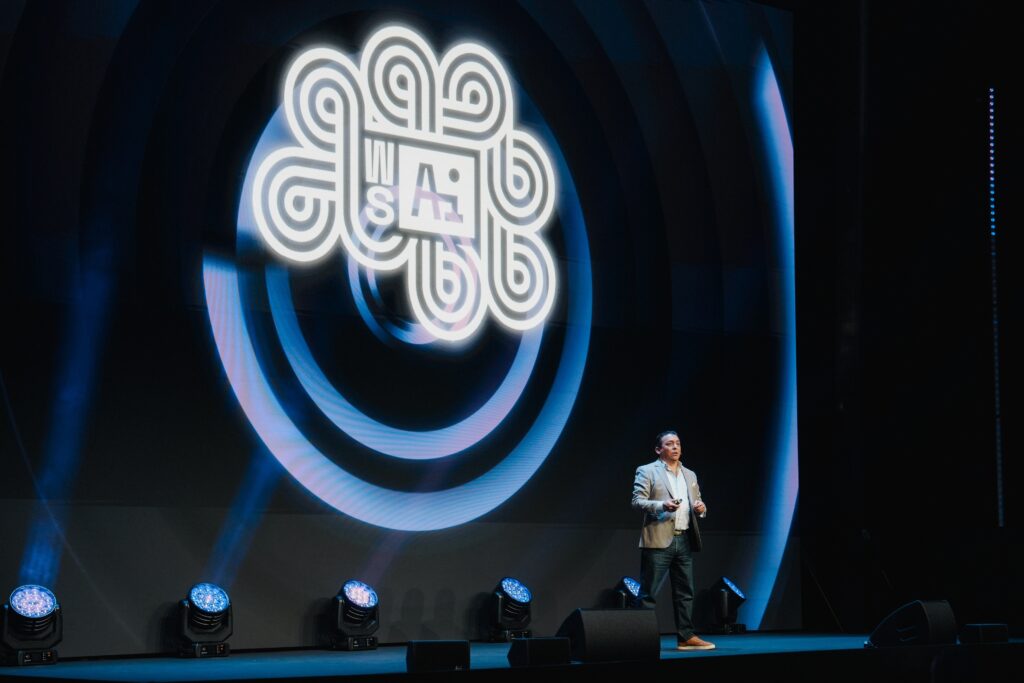
At World Summit AI in Amsterdam, I had the opportunity to share an idea that has increasingly shaped my work with executives around the world, and more recently, the book I co-authored with Dave Wright, Infinite: How Visionary Leaders Transform Today’s Businesses into AI-Forward Companies.
We are living through one of the most extraordinary periods of technological change in modern history. Artificial intelligence is evolving at a pace that challenges our ability to understand, much less anticipate, its implications. New capabilities are emerging almost daily, intelligent agents are beginning to take on increasingly complex work, and organizations everywhere are investing in what they believe will become their next competitive advantage.
Yet, despite all this progress, I still wonder, are we thinking big enough about what AI makes possible?
In my work as a futurist, I spend considerable time with executives discussing the future. What I’ve learned, however, is that most conversations about the future are really conversations about the present. Leaders want to know how to improve performance, increase efficiencies, reduce costs, expand margins, and do more with the resources they already have and the work they already do.
These are necessary conversations. Businesses have obligations to employees, customers, shareholders, and the communities they serve. But when our vision of the future is limited to improving the business we already know, we risk missing the opportunity to create value and ultimately invent something better.
I believe this is one of the most consequential leadership challenges of the AI era.
And to understand why, I invited the audience in Amsterdam to travel back more than 150 years.
Imagine It’s 1870. What Would You Invent?
Shortly before my keynote, I came across a presentation by Jon Gray, president and COO of Blackstone, that captured my imagination. He used generative AI to transport himself into the American countryside in 1870 and then forward to 1900, illustrating the extraordinary transformation that unfolded in just three decades.
In 1870, much of America was rural. Horses powered transportation and agriculture. Buildings were largely constructed from wood. Candles and oil lamps extended the day. Life, commerce, manufacturing, and communication were shaped by the limitations of the era.By 1900, the world was becoming almost unrecognizable.
Electricity was changing how people lived and worked. Railroads connected markets and communities. Steel reshaped the built environment. Automobiles were emerging. Cities, industries, and entire economic systems were being reinvented around new technological capabilities.
What fascinated me about this comparison was the extent to which innovation transformed society in such a relatively short period.
Imagine being a business leader in 1870. If your ambition were limited to improving the business you already understood, you might invest in stronger or “faster horses,” more durable wagons, larger wooden barns, or more efficient candles.
Those investments might have produced meaningful improvements. They might even have made you more competitive in the short term.
But the leaders who fundamentally reshaped the world were imagining possibilities beyond the conventions of their time.
Edison, Westinghouse, Carnegie, Rockefeller, Otis, and countless others recognized that emerging technologies could support entirely new industries, infrastructure, experiences, and ways of life. They pursued ideas that challenged assumptions about what was possible.
One of my favorite observations captures this perfectly, the electric light bulb did not come from the continuous improvement of candles.
I think about that statement often because it speaks directly to the opportunity before us.
Today, most organizations are investing in better candles.
They’re using AI to improve existing processes, accelerate familiar tasks, and operate established business models more efficiently.
They’re finding ways to make yesterday’s organizations faster, cheaper, and more productive.
Meanwhile, the equivalent of electricity is arriving.The question I posed at World Summit AI this, if this is our 1870 moment, what will we build by 1900? And perhaps more importantly, who among us is willing to help invent it?
The Iteration Trap: When Improving the Present Limits the Future
There are two mindsets that I believe will increasingly distinguish organizations in the AI era: 1) finite and 2) infinite ∞.
A finite mindset views the future through the lens of today’s business. Its priorities are shaped by existing processes, structures, capabilities, customers, and measures of success. Innovation tends to mean improving what’s already working, while transformation often means making those same operations more efficient.
An infinite mindset starts by imagining what could be possible as new technologies, behaviors, and market dynamics emerge. It encourages leaders to challenge conventions, explore opportunities beyond existing business models, and continually rethink how their organizations create and deliver value.
These mindsets are not mutually exclusive. A successful business must perform today while creating the conditions to compete tomorrow. The challenge is finding the balance, especially when the systems designed to protect today’s performance can unintentionally constrain tomorrow’s possibilities.
In Infinite ∞, Dave and I call this dynamic the Iteration Trap.
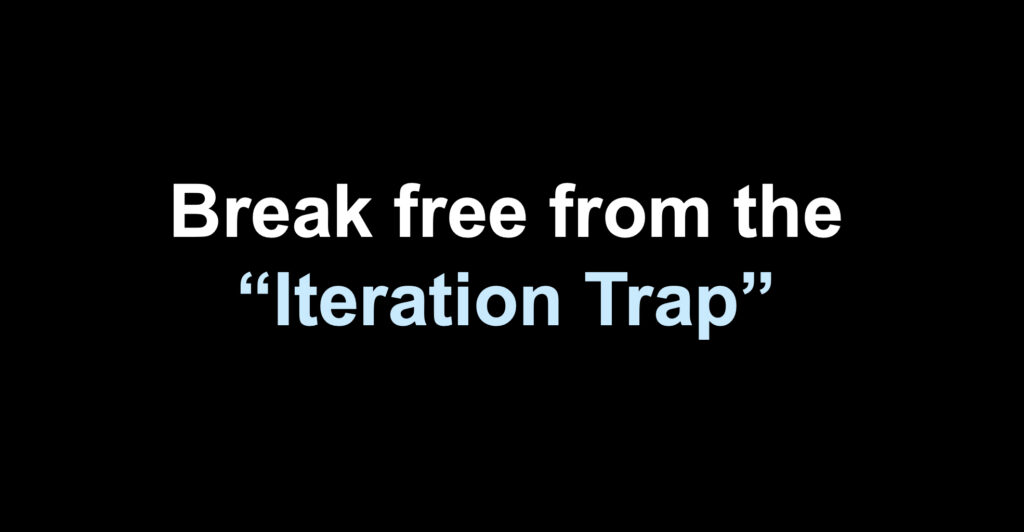
Organizations become so effective at improving what they already do that they struggle to question whether those activities, processes, or even business models should continue to exist in their present form.
Consider how most enterprises are adopting AI.
They’re deploying copilots to help employees write faster, chatbots to accelerate information retrieval, and AI agents to automate specific tasks. Each deployment can deliver tangible improvements, and many are worth pursuing.
But what happens when these technologies are introduced into operating models designed for a fundamentally different era?
In many cases, they reinforce the very structures that need to evolve.
An organization can have the most advanced AI technology available and still operate according to assumptions established decades ago. Its functional silos remain intact. Its approval structures remain unchanged. Its measures of success continue to reward the same behaviors.
The organization becomes more efficient at doing things the way it has always done them.
This is why I believe we need to reconsider how we define innovation in the AI era.
Iteration makes existing things better. Innovation creates new value by doing things that weren’t previously possible. Disruption occurs when those new approaches scale and begin to make established ways of working, competing, or serving customers obsolete.
Each has an important role to play. But if we mistake iteration for innovation, we may convince ourselves that we’re transforming when we’re actually becoming more optimized versions of the businesses we’ve always been. And that distinction has profound implications for AI ROI, or the lack of it.
Why AI Productivity Isn’t the Same as Business Transformation
Over the past several years, my colleagues and I have studied how enterprises are progressing in their AI journeys.
At ServiceNow Futures, we developed an AI maturity model to assess organizational progress across foundational dimensions, including vision and strategy, leadership, data, governance, talent, workflows, and responsible AI.
The findings reinforced what I was observing in executive conversations. Organizations were investing in AI, experimenting with new capabilities, and improving individual productivity, but their overall maturity remained relatively low. On a 100-point scale, average maturity scores progressed from roughly 30–40 in the early stages of our research to approximately 50.
Progress is certainly happening. But the distance between adopting AI and fundamentally transforming an enterprise remains significant. And AI is still evolving, faster than most organizations can adapt. This sets the stage for AI Darwinism.
So what moves the needle in AI transformation?
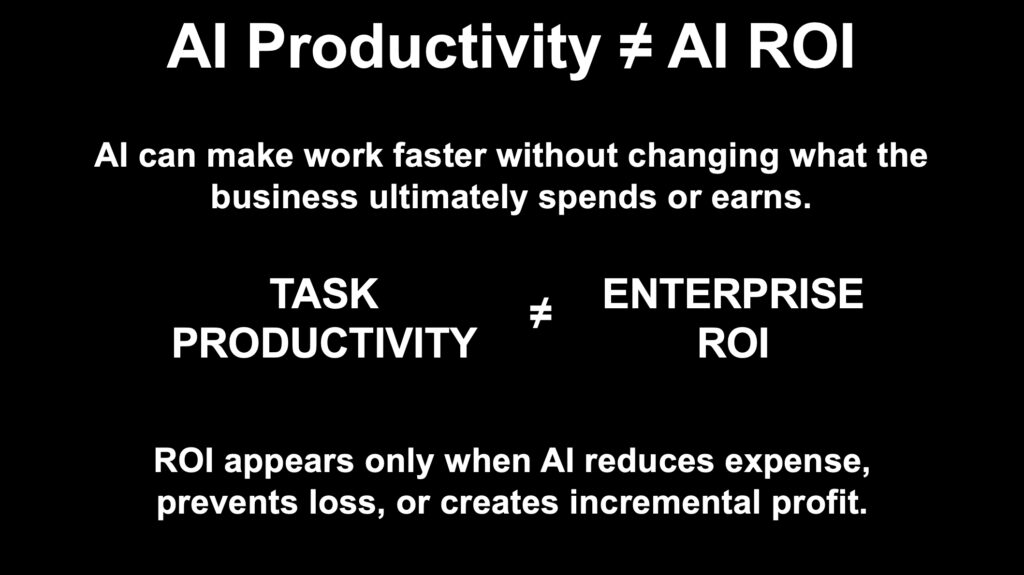
AI productivity and AI ROI are often treated as interchangeable measures of success.
That’s the thing about transformation. It has a beginning, middle, and end. The question is, what are we trying to transform vs. just improve?
Imagine an employee who previously needed ten hours to complete a task and can now complete it in five. That’s an important productivity improvement. The employee has gained five hours of capacity, potentially enabling greater creativity, deeper customer engagement, or additional work.
But from a financial perspective, the enterprise may still incur the same costs. Unless that capacity is translated into additional revenue, reduced expense, avoided loss, or measurable business value, the productivity improvement may never appear in financial results.
This helps explain why organizations can celebrate increasing AI adoption and impressive employee productivity gains while struggling to demonstrate corresponding business returns.
During my presentation, I shared a research example from Procter & Gamble that explored how AI affected product-development work. In the experiment, individuals using AI produced solutions rated comparably to those developed by two-person teams working without AI.
Think about the implications.
An individual equipped with AI can potentially perform work that once required a team. That creates extraordinary opportunities to augment human capability, democratize expertise, and unlock capacity.
It also raises a much bigger question for leaders.
What happens when one part of an organization becomes dramatically more productive while the rest of the enterprise continues operating at its previous pace?
Without redesigning how work flows across the business, those productivity improvements can create additional bottlenecks, greater backlogs, and new operational constraints.
We can make people more productive without making the organization more effective.
This is where the conversation about AI ROI needs to evolve.
The Real Opportunity Is to Redesign How Work Gets Done
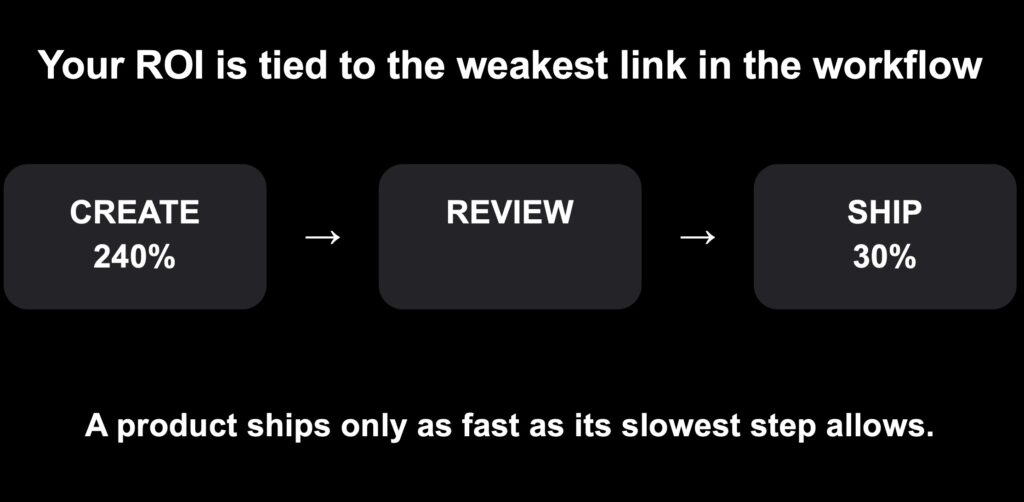
One of the most important concepts I explored in Amsterdam was the Theory of Constraints, a principle of systems thinking that helps explain why optimizing individual activities doesn’t necessarily improve the performance of an entire system.
Consider a simplified workflow spanning three stages: 1) creating a marketing campaign, 2) reviewing it with legal, and 3) preparing it for distribution.
Suppose each stage takes ten hours. The process requires 30 hours from beginning to end.
Now imagine that the marketing team introduces AI and cuts its work from ten hours to five. That’s a 50% improvement for that function. Later, the distribution team makes a similar improvement, reducing its time from ten hours to five.
Both teams can report meaningful productivity gains.
But legal review still takes ten hours, and the entire process now takes 20 hours rather than ten. The organization has improved two functions without addressing the constraints governing the complete workflow.
This is an important distinction because most enterprise AI investments are still organized vertically. Marketing develops its AI strategy. Human resources develops another. Finance, IT, customer service, and legal pursue their own initiatives.
Yet business outcomes rarely operate within a single department.
Customers experience the collective performance of the enterprise. Products move through multiple functions before reaching the market. Employees depend on information, decisions, and approvals that cross organizational boundaries.
If we’re serious about AI business transformation, we have to start designing around these end-to-end flows of work.
Research from McKinsey’s QuantumBlack examined 25 organizational attributes associated with generative AI value creation. Among them, redesigning workflows had the greatest effect on an organization’s ability to achieve measurable EBIT impact.
That finding deserves more attention because it suggests that the greatest financial returns may come from changing the architecture of work rather than simply introducing AI into existing tasks.
Instead of asking where AI can make people more productive, we should begin by identifying the outcomes that matter most to customers and the business. Then we can examine the entire process required to achieve those outcomes, identify its constraints, and explore how humans and intelligent agents might work together to deliver something better.
This also creates an opportunity to ask a question that many organizations should seriously consider, does this workflow deserve to exist in 2030?
The fact that a process exists today doesn’t mean it represents the best way to accomplish an outcome tomorrow.
Perhaps some steps can be eliminated. Perhaps decisions can be made earlier, information can move more intelligently, or agents can coordinate activities that previously required multiple teams. Perhaps the entire experience can be redesigned around the customer rather than the organization’s internal structure.
When we begin thinking this way, AI becomes a catalyst for reimagining work, decision-making, and value creation across the enterprise.
The Innovator’s Dilemma Has Entered the AI Era
One of the more revealing findings I shared at World Summit AI was a disconnect between what executives believe will generate AI value and where their organizations are directing investments.
IBM research featured in my presentation, 78% of C-suite executives recognized that achieving the greatest benefits from AI would require new operating models. Yet 75% were still funding the optimization of existing processes.
Let’s think about what that tells us.
Leaders understand, at least intellectually, that the future requires fundamental change. But investment decisions continue to reinforce the present.
This is a modern expression of the challenge Clayton Christensen described in The Innovator’s Dilemma.
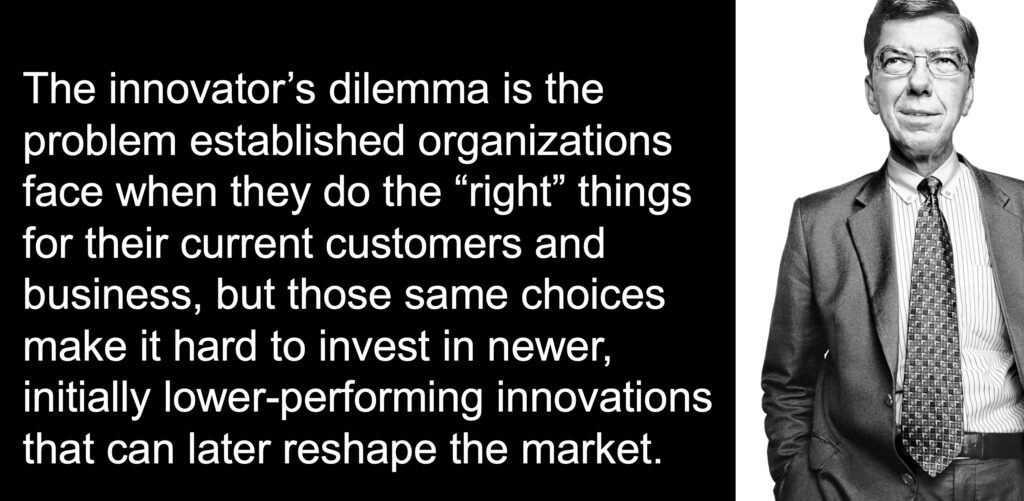
Incumbents often make rational decisions based on the needs of current customers, established business economics, and existing measures of success. These decisions help companies become more efficient and profitable in the short term, but they can also make it difficult to invest in innovations that might eventually redefine their markets.
AI is intensifying this dilemma because it offers organizations unprecedented opportunities to improve their existing businesses.
A leadership team can deploy intelligent agents, accelerate service delivery, automate internal operations, and demonstrate meaningful cost reductions while remaining committed to an operating model that may ultimately become less competitive.
AI can create an appearance of transformation without fundamentally changing how the organization competes.
After spending time with so many leaders, I’ve come to believe that this is one of the central challenges of our time. We have extraordinarily powerful tools for improving the present, but we need greater imagination and courage to invest in futures that don’t yet have a historical precedent.
And that brings us to the central thesis of Infinite.
Designing the Infinite Company
Dave and I spent roughly two years developing Infinite, drawing on hundreds of executive conversations, research, and emerging examples of how AI is changing business.
We wanted to understand why so many organizations were struggling to realize meaningful value from their AI investments, especially when the technology itself was progressing so rapidly.
What became increasingly clear was that the challenge extended well beyond technological capabilities or employee adoption.
The architecture of the enterprise itself needed to evolve.
Most established organizations were designed for an era when expertise was scarce, information moved slowly, and coordination required layers of management. Departments, roles, hierarchies, and processes were organized to manage those constraints.
Artificial intelligence is changing some of the underlying economics of work and intelligence. People can access expertise in new ways. Intelligent agents can help coordinate activities across systems. Decisions can be informed by continuously evolving data and insights. Human teams can expand their capabilities without necessarily expanding their headcount at the same rate.
These advances create opportunities to rethink the fundamental assumptions upon which modern organizations were built.
An Infinite Company ∞ is one that deliberately redesigns itself to compete in this changing environment. It organizes people, intelligent agents, workflows, decisions, and resources around the continuous creation of value.
It recognizes that the future of business will be shaped by organizations capable of learning, adapting, and reinventing themselves as new possibilities emerge.
For established enterprises, this is an opportunity to build on strengths they already possess, including customer relationships, industry expertise, trusted brands, proprietary data, operational experience, and the ability to operate at scale.
When those advantages are combined with visionary leadership, responsible innovation, and new AI-enabled operating models, incumbents can become formidable competitors in the next era of business. But to get there, leaders must be willing to pursue two forms of transformation simultaneously.
The Bi-Modal Imperative: Optimize Today While Inventing Tomorrow
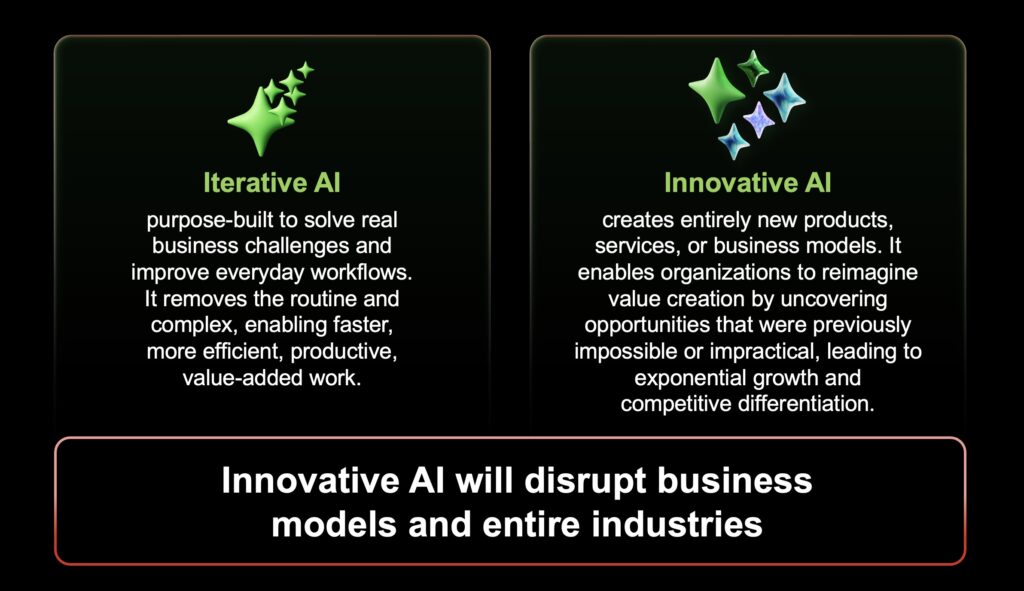
One of the frameworks I shared in Amsterdam was what we call the Bi-Modal Imperative.
It provides a practical way for leaders to balance the immediate demands of business performance with the investments necessary to create new value.
Mode 1 focuses on optimizing the existing business. Organizations use AI to improve productivity, eliminate unnecessary work, increase quality, accelerate processes, and strengthen profitability. This is essential because performance improvements can create the financial resources, credibility, and operational capacity required to pursue more ambitious innovation.
Mode 2 focuses on reimagining the business. Leaders deliberately reinvest some of those gains into exploring new products, services, customer experiences, operating models, and revenue opportunities that weren’t previously possible or economically viable.
I believe this second mode is where many organizations are underinvesting.
When AI saves employees time, the default response is often to increase output, reduce expenses, or absorb more work. Those choices may be necessary in certain circumstances, but they don’t represent the full range of possibilities.
Imagine instead using some of that reclaimed capacity to bring employees together across functions to rethink a customer journey, explore an underserved market, experiment with a new business model, or create an entirely new service.
Imagine giving teams the time, tools, and encouragement to challenge assumptions about how value is created.
An organization could improve its core operations while simultaneously investing in the future of its industry.
This is how iterative and innovative AI can become complementary forces.
Iterative AI can generate more predictable improvements in performance. Innovative AI creates opportunities for new sources of growth that may not have been accessible before. Together, they can support the near-term financial discipline that businesses require while establishing the conditions for longer-term reinvention.
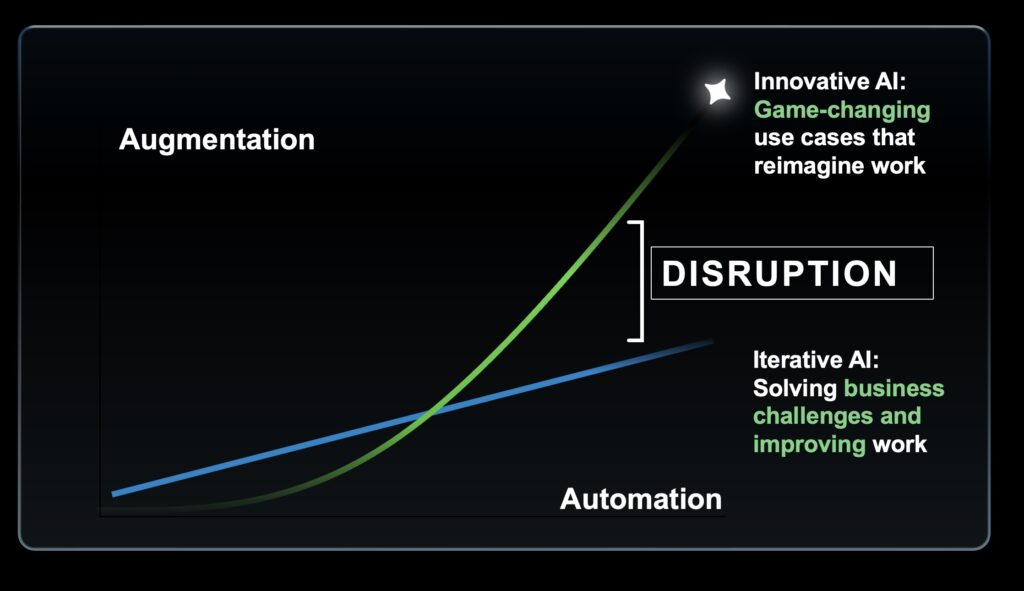
The leadership challenge is ensuring that the benefits of optimization don’t become an excuse to avoid invention.
After all, if every hour saved and every dollar recovered is immediately absorbed into the existing operating model, where will the capacity for reinvention come from?
You can’t cut your way to growth. And you can’t automate your way to innovation.
Culture Determines How Far Innovation Can Go
Toward the end of my talk, I wanted to reinforce something that has remained consistent throughout my work over the years.
Technology doesn’t determine how far an organization will go, people do…through the decisions they make, the assumptions they challenge, the behaviors they reward, and the futures they choose to pursue.
Culture is often the greatest catalyst for transformation and, paradoxically, its greatest inhibitor. Going back to my annual reports on Digital Transformation and Corporate Innovation, this has always been the case.
Intentionally designed culture influence the boldness of a company’s vision and how its leaders respond to uncertainty. It determines which questions people feel comfortable asking, how organizations perceive risk, which ideas receive attention, and whether employees are encouraged to imagine possibilities beyond their assigned responsibilities.
When a culture rewards compliance with established practices while treating experimentation as a threat to short-term performance, even the most advanced technology can struggle to produce meaningful change.
On the other side, when people have psychological safety, time to explore, permission to challenge convention, and leaders who actively support curiosity and creativity, organizations become more capable of discovering opportunities they might otherwise overlook.
In our research into AI cultures, we examined how different organizational mindsets shape the adoption and application of artificial intelligence.
Some organizations remain AI followers, adopting capabilities in response to competitive pressure. Others are becoming AI-forward, deliberately bringing humans and AI together to reshape work and outcomes. AI-first organizations increasingly design processes around AI as a default capability, while AI-native companies are built around intelligence from the beginning (read the report AI Cultures here).
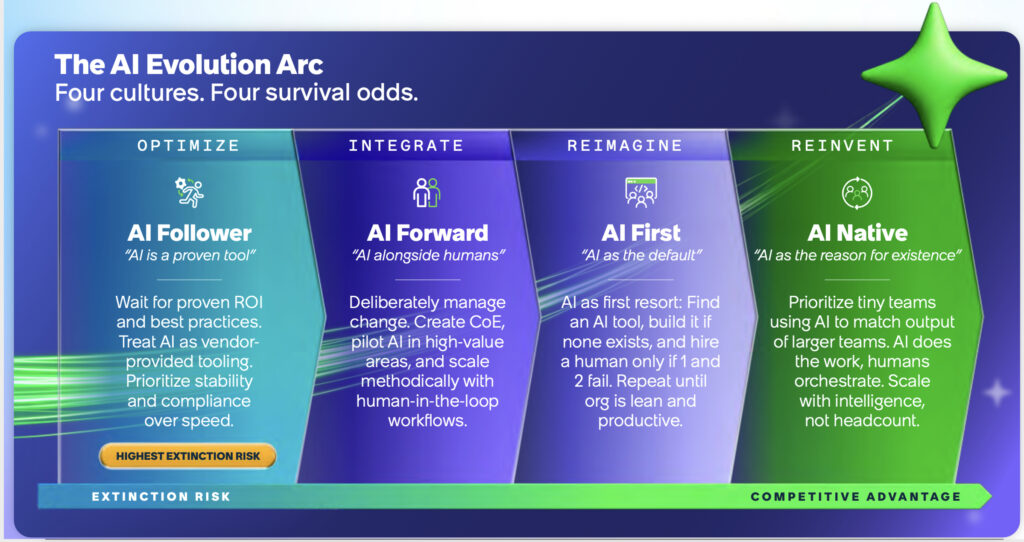
These distinctions are important because adopting AI doesn’t automatically establish a culture of innovation.
An organization can deploy advanced tools at scale and still discourage its employees from questioning how work should be done.
The journey toward becoming an Infinite Company ∞ requires personal transformation as much as organizational transformation.
Leaders must cultivate the humility to recognize that their existing assumptions may no longer be sufficient. They need the self-awareness to identify where established expertise and past success might be limiting their imagination. And they must create conditions in which curiosity, creativity, and informed experimentation are recognized as essential capabilities.
I believe some of the most important leadership questions begin when we acknowledge that we don’t yet have all the answers. And that’s not easy to do. We need a self-awareness to recognize that we do not know what we do not know, but are open and curious to explore the unknown. And we need a mindshift to then see and act differently.
Some questions to consider…
What are we assuming about our business that might no longer be true?
Which capabilities are emerging that could change what customers expect from us?
How might we organize ourselves if we were building this company today?
What could we create if we were willing to challenge the constraints we’ve inherited?
Exploring the answers to these questions can open new conversations about the future, helping leaders move beyond conventional planning and toward invention.
They also remind us that innovation isn’t reserved for people with a particular job title.
Every organization has people who see opportunities others overlook, who understand customers in ways that don’t always appear in research reports, and who have imagined better approaches to work but haven’t been given the opportunity to pursue them.
A culture of innovation gives those people a voice, a purpose, and the means to turn possibilities into progress.
Our 1870 Moment: The Future Is Still Ours to Invent
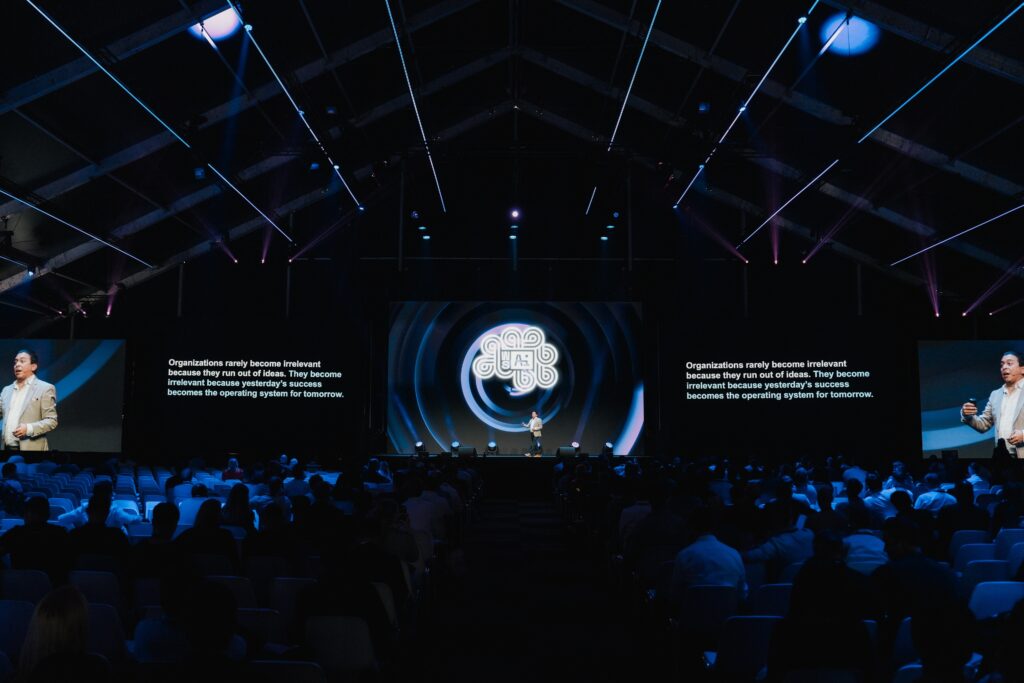
I closed my presentation by returning to that remarkable period between 1870 and 1900.
Electricity did not transform the world on its own. Its impact emerged as inventors, entrepreneurs, engineers, business leaders, and communities discovered how to use it to rethink factories, cities, transportation, commerce, and everyday life.
Tech created possibilities. Human imagination gave those possibilities direction.
AI represents a similar invitation, although the trajectory and outcomes of this transformation will be uniquely our own.
We have the opportunity to develop new ways of working that expand human capabilities. We can rethink how organizations serve customers and create economic value. We can explore how intelligence might help solve problems that have persisted for generations, improve access to essential services, and open opportunities to people who have historically been excluded from them.
This is why I want leaders to recognize that the future of AI is about much more than deploying intelligent systems or achieving the next round of efficiency gains. We have an opportunity to rethink the purpose and potential of our organizations, to create more value than we capture, and to direct innovation toward outcomes that improve people’s lives. This is what it means to be an Infinite Company ∞.
That means developing a longer-term perspective while remaining accountable for today’s performance. It means approaching emerging technologies with informed optimism, balancing the courage to experiment with the discipline to manage risk. And it means recognizing that the benefits of this next era should extend beyond the small number of companies or individuals positioned to capture them first.
I often think about the people who lived through the transformation from 1870 to 1900. Most could not have imagined all the ways their world would change, just as we cannot fully predict the consequences of today’s breakthroughs.
But some among them looked beyond the limitations of their present circumstances and saw the beginnings of a different world. They were willing to imagine new possibilities and then dedicate themselves to making those possibilities real.
We need that same inventive spirit today.
Shortly before wrapping up, I referenced one of my favorite lines from Back to the Future, when Doc Brown reminds us that the future hasn’t been written yet.
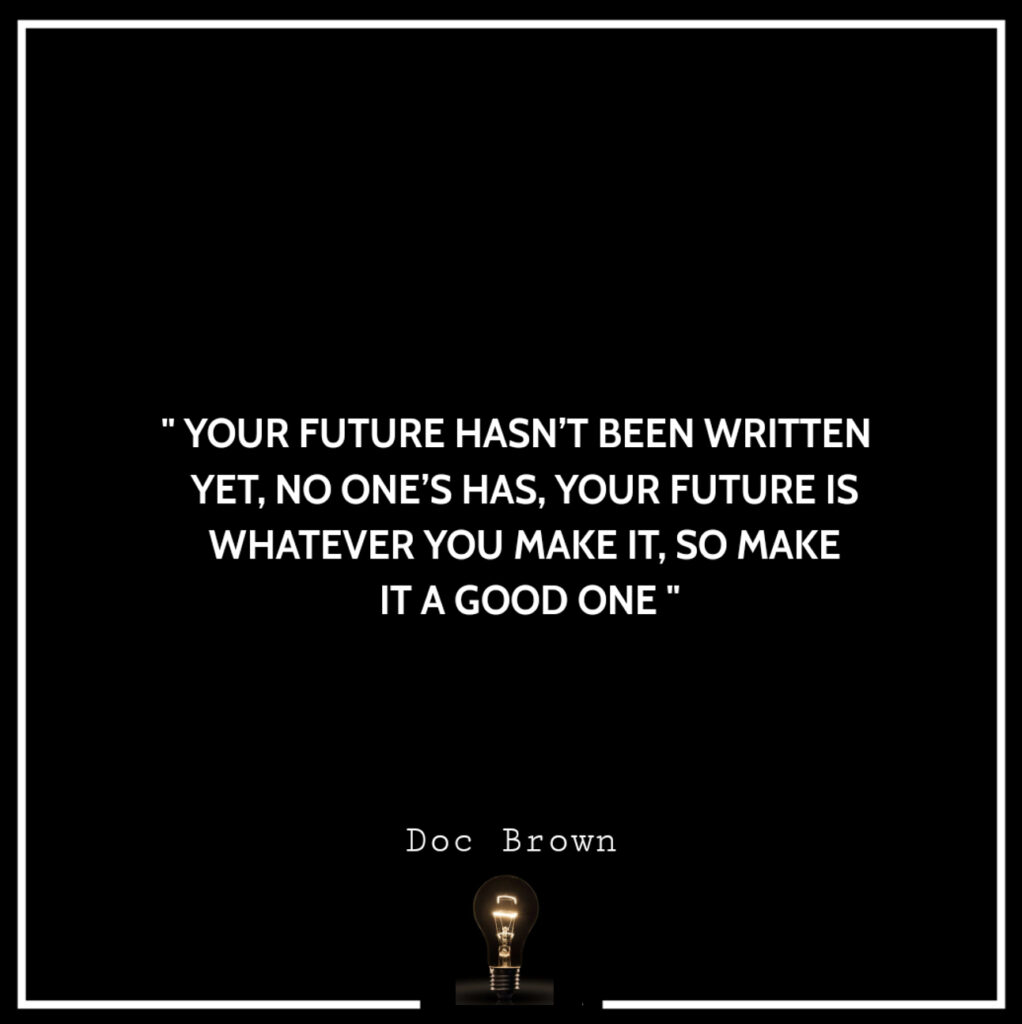
I love that sentiment because it returns responsibility and agency to each of us.
We are the leaders, inventors, dreamers, and creators of this era. We get to decide what problems deserve our attention, what opportunities are worth pursuing, and how we want technology to shape the world around us.
The future will be influenced by the systems we build, but its meaning will be determined by the human aspirations that guide them.
And when future generations look back on this extraordinary period, I hope they see more than a chapter defined by automation, efficiency, and financial returns. I hope they see a generation that recognized the opportunity to reimagine business, expand human potential, create new opportunities for prosperity, and build a better future for more people.
That’s the infinite mindset I hoped to inspire at World Summit AI, and it’s the invitation I want to extend to everyone who wasn’t in the room.
If we are indeed living in our 1870 moment, imagine what we could create by 1900 if we stopped limiting tomorrow to the possibilities of today.
The future is still ours to invent. So, let’s make it extraordinary!
∞
Read Infinite ∞ | Read Mindshift | Subscribe | Book me to speak

Leave a Reply