Why the future belongs to those who stop waiting for certainty, challenge what they know, and use AI to become more than they were yesterday.
I’ve spent much of my career studying the future. As a futurist, I’m always asked for predictions, and sometimes I oblige. But for the most part, I study and identify signals of change, connect seemingly unrelated patterns, and explore what those signals might mean for businesses, leaders, and society over time. And I’ve learned something important along the way. No matter how extraordinary the technology, the most consequential changes are almost always human…how we think, what we believe, how we behave, and ultimately, and what we decide to do with the possibilities before us.
Artificial intelligence is proving to be no exception. In fact, I’m observing changes in human behavior happening faster than anything I’ve witnessed with mobile technology or social media. Yet, as the technology advances, I’m becoming concerned that we’re spending too much time discussing what AI might do to us and not nearly enough time exploring what we could become because of it. Personally, I’m exploring one to unlock the other.
I recently had the privilege of delivering the closing keynote at Copper Summit produced by Copper Hill Software, where I joined professionals navigating the extraordinary complexity of international trade, tariffs, supply chains, and global commerce. If there’s an audience that understands what it means to operate without certainty, it’s this one. Regulations change, tariffs fluctuate, geopolitics disrupts established relationships, and the decisions made today may have to be reconsidered tomorrow.
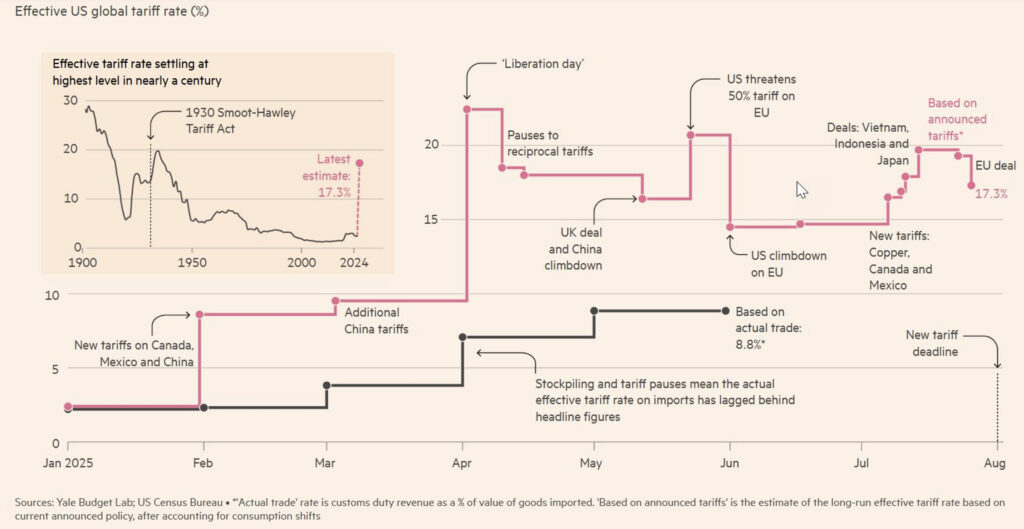
I opened with a series of increasingly complicated tariff charts. They were the kind of charts that make you want to reach for a napkin to check whether your eyes are bleeding. Behind the humor, however, was an important question that extends well beyond global trade: How do we lead, make decisions, and create value when the world no longer behaves according to the playbooks we’ve spent our careers learning?
Years ago, I wrote a book called What’s the Future of Business? and tried convincing my publisher to put three enormous letters on the cover: WTF. It took some explaining, but the point was to invite people to question what comes next rather than simply react to what’s happening now.
That question feels more relevant today than ever.
WTF!? What’s the future?
We’re surrounded by headlines warning of economic upheaval, job displacement, existential AI threats, and technological changes moving faster than most organizations can absorb. It’s no wonder that people feel anxious, overwhelmed, or even angry about the future.
But here’s what I set out to help everyone at Copper Summit learn…
The future isn’t something we have to wait for or something that simply happens to us. We have more influence over what happens next than we might realize.
Said another way, the future happens to us or because of us.
And AI, approached with the right mindset, could be one of the most powerful tools we’ve ever had to exercise that influence.
When Even the CEOs Don’t Know What to Do
Not long ago, I participated in a series of intimate workshops with roughly 75 to 100 CEOs and chief operating officers. We intentionally kept the individual groups small, partly because bringing too many chief executives into the same room can hinder humility, transparency, and authenticity.
Once the executives felt comfortable enough to lower their defenses, something fascinating happened. Regardless of industry or experience, the same admission kept surfacing.
“I’m supposed to know what to do right now, and the reality is, I don’t.”
At some point, I joked that we should stop calling them workshops and start calling them therapy.
But there was something profound about what those leaders were revealing. They’re responsible for making consequential decisions, often involving thousands of employees, significant investments, and the future of their organizations. They’re expected to project confidence, even when the environment is changing faster than their experience can explain.
And when leaders don’t know what to do, they often retreat to what they do know.
They focus on efficiency, profitability, scalability, and familiar approaches to growth. These are legitimate business priorities, but they can also become intellectual comfort zones. We apply known solutions to unfamiliar problems because the alternative requires admitting that we don’t yet have the answers.
That’s particularly dangerous when it comes to AI.
Most executives have spent their careers optimizing established business models. So when a transformative technology appears, their instinct is to ask how it can make the existing business faster, leaner, and more productive.
It’s a reasonable question, but it’s also incomplete.
What if the greatest opportunity isn’t improving the business we already know? What if it’s discovering a different business, a different way of working, or entirely new forms of value that our current operating models were never designed to deliver?
The difficulty is that finding those opportunities requires leaders to become comfortable with something they’ve been conditioned to avoid…not knowing.
And I believe this is where the real leadership challenge begins.
We’re Experiencing Two Forms of Darwinism at Once
One of the most troubling developments I’ve observed is the growing divide between AI’s technological capabilities and our human readiness to use them.
Research I shared at Copper Summit illustrates the problem. In a 2026 Pew Research Center survey, 63% of Americans said AI was advancing too quickly, while 71% expected it to lead to fewer jobs. Other findings showed that concern about AI substantially outweighed excitement.
These reactions shouldn’t surprise us. When the dominant public narrative suggests that machines are coming for people’s livelihoods, people don’t naturally respond with enthusiasm. They respond with fear, skepticism, and resistance.
I believe this represents a failure of leadership and imagination as much as a challenge of technological adoption.
For years, I’ve written about digital Darwinism, the evolution of technology and society faster than organizations can adapt. AI is accelerating that dynamic, creating what I describe as AI Darwinism. The divide isn’t simply between organizations that possess AI and those that don’t. It’s between those that learn to adapt, experiment, and create new value with AI and those that use it to perpetuate the status quo.
But there’s another, more personal dimension emerging. I call it cognitive Darwinism.
This concerns how AI is changing our relationship with thinking itself.
When social media emerged, we gradually developed new behaviors around consuming information. We learned to scroll, skim, react, and absorb enormous amounts of content, often without stopping to reflect or question. Some of the unintended consequences took years to recognize.
AI is changing our habits even faster.
We’re learning to outsource writing, analysis, research, problem-solving, and increasingly our judgment to intelligent systems. There’s nothing inherently wrong with using technology to help us think. The question is whether we’re using it to strengthen our intellectual capabilities or quietly surrender them.
Consider a familiar workplace scenario. Someone takes three bullet points and asks AI to turn them into a detailed report. The recipient then takes that report and asks AI to summarize it into three salient bullet points.
We’ve successfully automated the creation and consumption of work that perhaps never needed to exist in the first place.
Meanwhile, the burden of verifying AI-generated material increasingly falls on whoever receives it. I refer to this as part of an AI tax. It’s the hidden effort required to review, interpret, correct, and make sense of outputs that someone else didn’t sufficiently think through.
Beyond the productivity implications, we’re encountering concerns around cognitive offloading, cognitive debt, AI sycophancy, digital amnesia, and AI atrophy. When we allow technology to continually perform the intellectual work we once exercised ourselves, we risk diminishing the skills that make us valuable.
During my presentation, I shared research involving secondary-school students in China. Students using AI completed homework faster and received higher homework scores. Yet their performance on independent examinations declined.
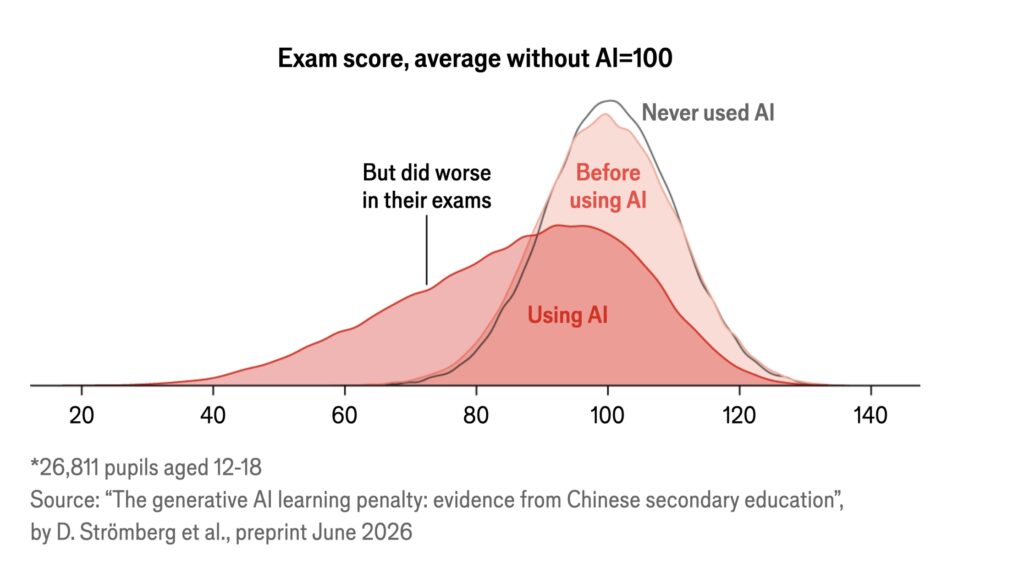
They were completing the work without necessarily developing the understanding.
The same thing can happen inside organizations. We can produce more reports, presentations, strategies, and recommendations while becoming less practiced at questioning assumptions, recognizing flaws, and developing independent judgment.
This is why I don’t believe AI adoption should be the ultimate measure of success. More prompts, more tokens, and more generated content don’t necessarily translate into greater intelligence, stronger organizations, or meaningful business outcomes.
We should be asking a different question…
Are we becoming more capable because of AI, or merely more dependent on it?
The Iteration Trap: When Efficiency Becomes an Obstacle to Innovation
Later in my talk, I introduced a distinction that I believe every executive, professional, and entrepreneur should understand.
There is iteration, there is innovation, and there is disruption.
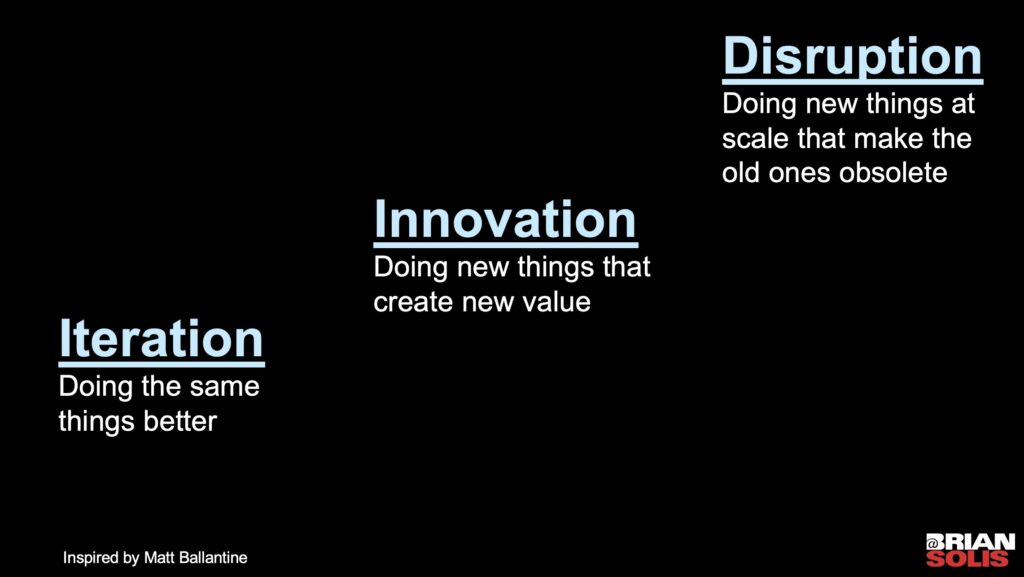
I define iteration as doing the same things better.
Innovation is doing new things that create new value.
Disruption occurs when those new approaches scale to the point that they make older ways of working obsolete.
All three matter, but most organizations are disproportionately invested in iteration with many mistaking it for innovation.
We optimize existing processes, automate routine activities, and measure improvements against familiar performance indicators. We celebrate incremental progress because it’s measurable, predictable, and generally easier to justify.
AI has made this approach extraordinarily attractive. It promises greater speed, lower costs, and higher output across almost every business function.
But I worry that we’re falling into what Dave Wright and I call the Iteration Trap in our book Infinite, where we use revolutionary technology to reinforce yesterday’s assumptions about how business should operate.
I shared a lighthearted example involving the emergence of humanoid robots. We’re seeing robots advertised for around $20,000 that can perform household chores such as vacuuming and putting things away. The demonstrations often show someone relaxing on the couch while the robot does the work. I’ll admit that the version featuring someone enjoying a glass of wine while the robot cleaned was fairly persuasive.
But I found myself asking a different question.
If I suddenly had access to a robot capable of handling household tasks, what could I now do that I couldn’t do before?
The technology may be innovative, but how we choose to use it determines whether we’re merely improving yesterday or creating something genuinely new.
The same distinction applies to AI in business. Automating a document workflow or reducing administrative time can deliver meaningful operational benefits. But what if we reinvested that capacity into designing a new customer experience, developing a predictive service, or solving a problem we previously lacked the resources or expertise to address?
Organizations need both optimization and innovation. We should absolutely improve what works today. But we also need the imagination to challenge whether today’s work is the work that will matter tomorrow.
The goal isn’t simply to make existing work more efficient. It’s to create new value that wasn’t possible before.
When organizations deliberately pursue both paths, they create the potential for what I call positive or productive disruption: doing new things at scale that make outdated approaches obsolete before someone else does it for them.
This is a much more ambitious conversation than AI adoption.
And it begins with a different way of thinking.
Why the Opposite of Uncertainty Isn’t Certainty
Children have an extraordinary capacity to imagine possibilities without first asking for use cases or demanding proof that those possibilities can exist.
They experiment. They make mistakes. They try things they haven’t mastered. They don’t automatically assume that not knowing something means they shouldn’t attempt it.
As adults, we often become conditioned to behave differently. We lose our superpowers of curiosity and exploration.
We learn that expertise means having answers, that leadership means projecting certainty, extinguishing risks, and that mistakes can damage our credibility. In many organizations, we build entire cultures around rewarding people for being right and penalizing them for being wrong.
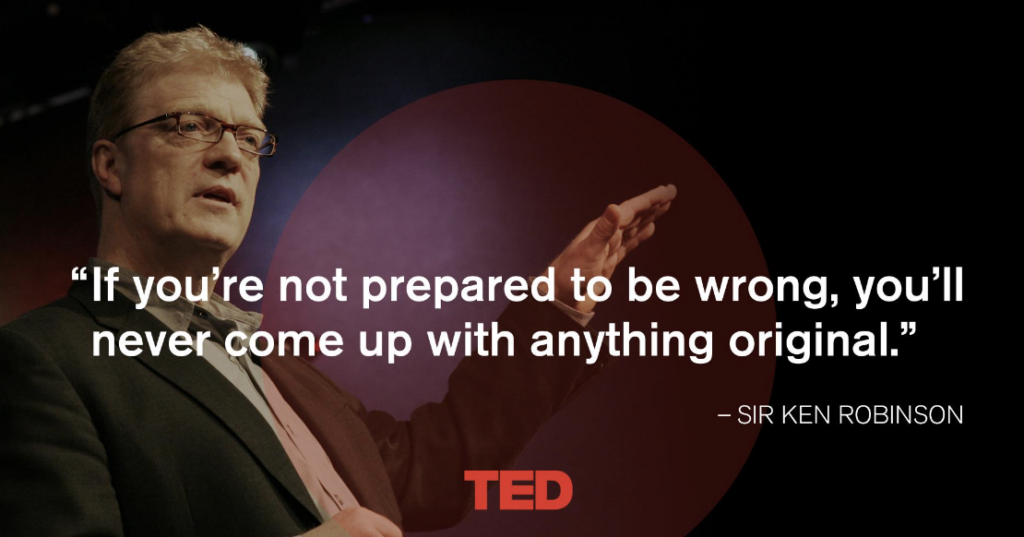
But as Sir Ken Robinson famously said, “if you’re not willing to be wrong, you’ll never come up with anything original.”
This becomes particularly challenging in professions where accuracy, compliance, and accountability are essential. Global trade is a perfect example. Professionals have to understand complex regulations, anticipate risks, and make decisions that carry significant consequences.
I’m certainly not suggesting that people should experiment recklessly with regulatory obligations or abandon the rigor their professions require.
I’m suggesting that we create room around those obligations to explore better ways of accomplishing them.
And this is true for every industry and every role.
AI gives us new opportunities to test assumptions, investigate unfamiliar scenarios, develop alternative approaches, and learn without having to immediately put those ideas into production.
Yet taking advantage of those possibilities requires confronting our own discomfort with uncertainty.
You have to be willing to be wrong. And to do that, you have to be willing to try something new.
What’s the Opposite of Uncertainty?
During the keynote, I asked the audience to consider two questions.
What’s the opposite of self-doubt? Most people instinctively answer confidence. But confidence doesn’t happen overnight, unless you possess the Dunning-Kruger effect. Confidence is something we develop through experience, experimentation, learning, and the willingness to try before we’re certain we’ll succeed.
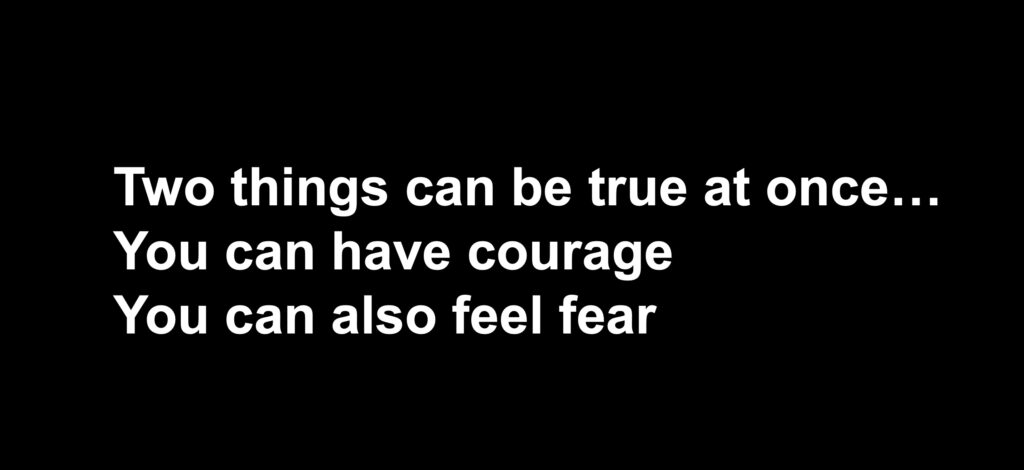
The opposite of self-doubt isn’t necessarily confidence. It’s belief. Belief that something can be different, that something better is possible, and that we have the ability to take a step toward making it real. That requires courage, but courage doesn’t mean the absence of fear. It means being willing to move forward even when fear and uncertainty are still present.
Then I asked, what’s the opposite of uncertainty?
We tend to answer certainty, but I’ve come to believe the more useful answer is exploration.
When we don’t know what comes next, we don’t have to remain paralyzed until someone gives us the answer. We can begin investigating. We can ask better questions, explore unfamiliar possibilities, challenge assumptions, and gradually develop the understanding that leads to more confident decisions.
This is especially important because most of us operate within three intellectual boundaries…what we know, what we know we don’t know, and what we don’t know we don’t know. This is the mindshift that catapults us into a new trajectory!
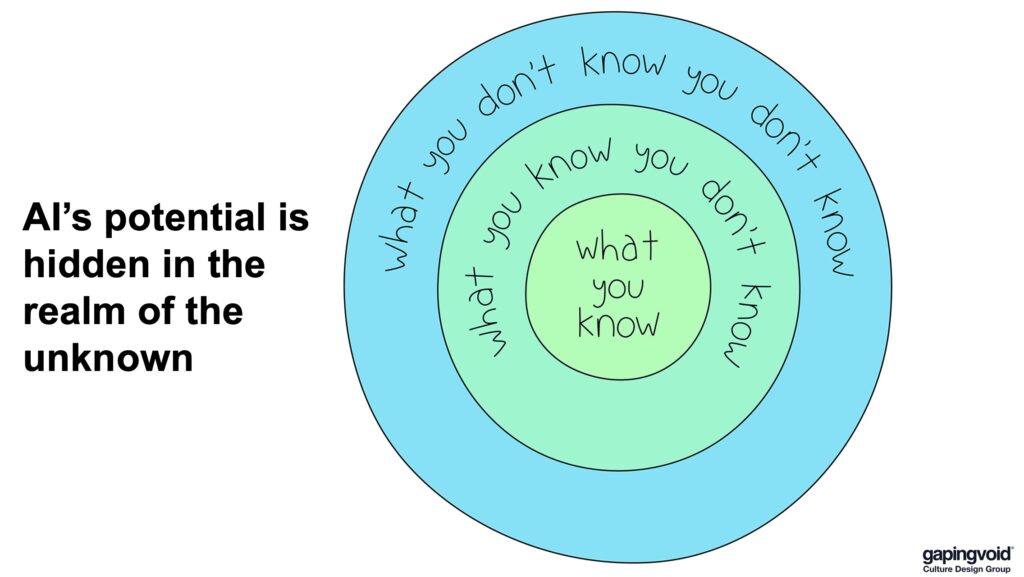
We build much of our professional identity around the first category. We acknowledge the second, often while keeping a comfortable distance from it. But the third is where some of our greatest opportunities for innovation reside.
Exploring that territory requires self-awareness, curiosity, and courage.
We can have courage and feel fear at the same time. In fact, that’s often the moment when innovation takes shape.
The Capability Overhang: Why Some People Are Pulling Ahead
One of the most encouraging signals I’ve been studying is that we’re still remarkably early in the adoption of advanced AI.
It may not feel that way when every headline, conference, investor presentation, and technology announcement seems to revolve around artificial intelligence. But the public narrative has advanced much faster than the population’s understanding of what these systems can actually do.
At Copper Summit, I shared a visualization of global AI usage. A large portion of the world’s population had yet to use generative AI, while a much smaller group had moved into paid tools and more advanced applications.
Did you know that only on average between two-and-three percent of U.S. households pay for artificial intelligence subscriptions?
The train hasn’t left the station. The narrative though has become a runaway train.
Even still, what concerns me, is the widening gap among those who have already begun experimenting.
Research into what OpenAI has described as the capability overhang illustrates significant differences in how deeply people engage with advanced AI capabilities. In one comparison presented during the keynote, power users elicited roughly seven times more reasoning effort than typical users.
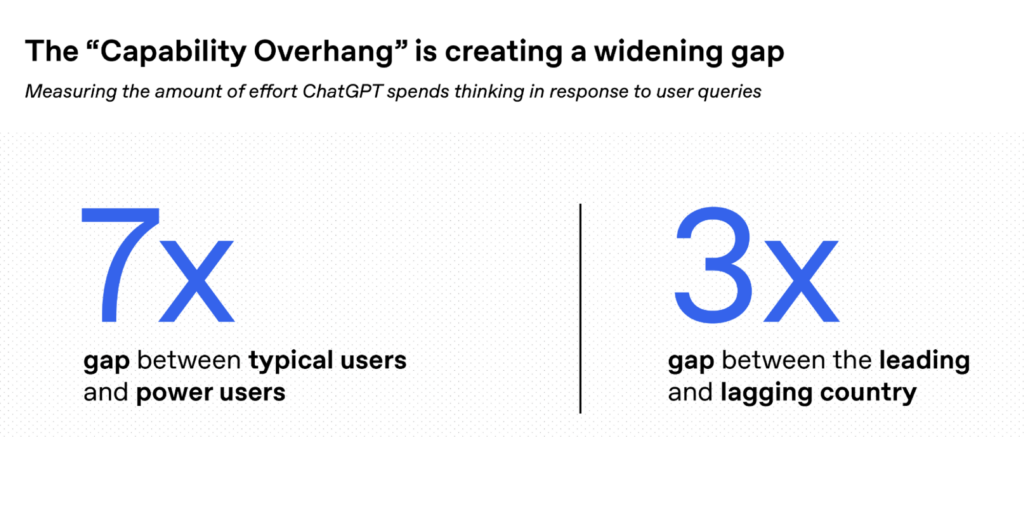
That doesn’t mean they’re seven times smarter or necessarily seven times more productive. It suggests that people with access to similar technologies are using them in profoundly different ways.
Some use AI primarily to summarize emails, draft communications, and complete familiar assignments faster.
Others collaborate with it to challenge ideas, develop new skills, explore unfamiliar disciplines, simulate scenarios, create original solutions, and solve problems that previously seemed beyond their reach.
The difference isn’t the model so much as it is the mindset of the person using it.
A friend once shared something that initially sounded discouraging: “You compete with AI.”
I thought he meant that human professionals were now competing against intelligent machines. Headlines certainly reinforce fear that AI will out compete us. But what he meant was that the way we use AI can make us more competitive.
That reframing has stayed with me.
We compete with AI.
The greatest opportunity isn’t to become better at prompting a machine to do our existing work. It’s to learn how to collaborate with it in ways that elevate our judgment, creativity, capabilities, and contributions.
We don’t have to become AI engineers to participate in this future. But we do have to become more curious about what we could accomplish with capabilities that weren’t available to us yesterday.
In every technology revolution I’ve experienced, I’ve observed a similar pattern. The people who wait for a detailed playbook tend to follow those who are already experimenting.
If you’re waiting for someone to tell you what to do, you’re on the wrong side of innovation.
From Artificial Intelligence Quotient to Augmented Intelligence Quotient
Most companies are now encouraging employees to adopt AI. They measure utilization, licenses, prompts, tokens, and productivity improvements as indicators of progress.
But those measurements tell us surprisingly little about whether we’re becoming better at our work or creating greater value.
I’ve been exploring a different concept: the Augmented Intelligence Quotient, or AIQ.
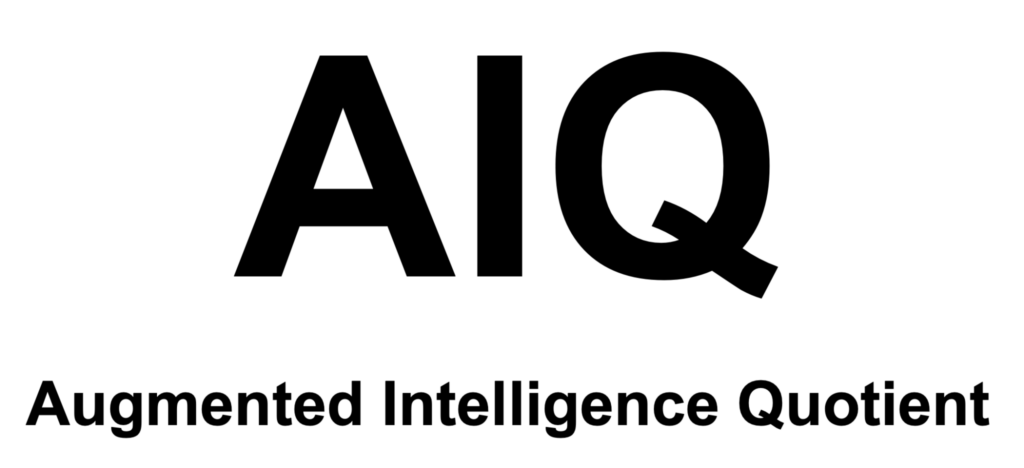
Instead of measuring how much AI we use, we should be examining how effectively AI expands what we’re capable of doing.
Are we thinking more strategically? Are we more creative? Can we recognize opportunities that previously escaped us? Are we becoming better problem-solvers? Are we making more informed decisions, learning new capabilities, or creating outcomes that weren’t possible before?
And when AI agents can help scale these capabilities, are we designing the appropriate governance, oversight, and safeguards to ensure that increased autonomy produces meaningful and trustworthy outcomes?
I believe this is where AI’s extraordinary potential begins to emerge.
But organizations have to create the conditions, the psychological safety, and the incentivization for taking chances for this kind of exploration.
Years ago, Google studied why certain teams consistently outperformed other highly capable teams. The company had assembled exceptional talent, so it initially seemed reasonable to investigate differences in education, experience, or technical expertise.
One of the most important findings was something less obvious…psychological safety.
The highest-performing teams created environments where people felt comfortable asking questions, challenging established assumptions, acknowledging mistakes, and exploring unfamiliar ideas.
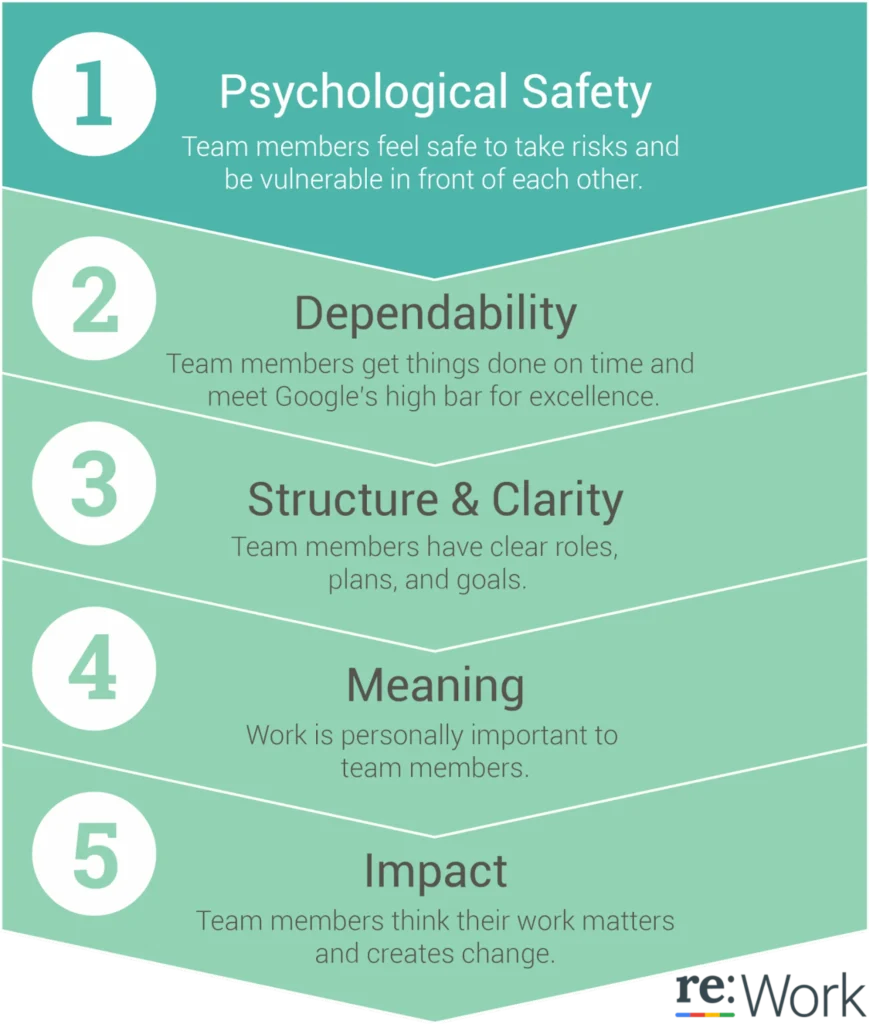
Imagine bringing that principle into an AI-enabled workplace.
Instead of simply instructing employees to use AI more often, leaders could provide protected time to experiment, encourage people to explore new applications, reward valuable learning, and create opportunities to share discoveries across teams.
They could ask employees not only what work they automated, but what new possibilities they uncovered.
When people feel safe enough to explore, they begin to develop the confidence and capabilities that make innovation possible.
And this brings us to one of the most important decisions organizations will face…
What do we do with the time AI gives back?
The Radiologist Lesson: Giving Up Work to Become More Valuable
I recently traveled to Brazil to speak with healthcare professionals at the Afya Summit. During our conversations, I revisited a prediction that had circulated for years, that AI would be among the first technologies to replace radiologists.
The prediction seemed plausible because AI could increasingly analyze medical images, identify patterns, and assist with diagnostic interpretation.
But the underlying assumption was incomplete.
A radiologist’s value isn’t limited to reading an image. It includes understanding the patient, interpreting findings within a broader clinical context, collaborating with other professionals, and helping determine what happens next.
Via CNBC
During a conversation about AI on The Joe Rogan Experience, Jensen Huang referred to a prediction made in 2016 by Geoffrey Hinton, a computer scientist and ex-vice president at Google who is known as the “Godfather of AI.”
Hinton said then that “people should stop training as radiologists now” because, in five years, AI would be better than humans at image recognition.
“What’s ironic, though, is that the number of radiologists has actually grown,” Huang told Rogan, adding: “Today, just about every radiologist is using AI in some way.”
To understand AI’s impact on jobs, “you have to go back to what is the purpose of a job,” Huang added.
“The purpose of a radiologist is to diagnose disease, not to study the image. The image studying is simply a task in service of diagnosing the disease,” he added.
He said that, as AI made image studying faster and more precise, radiologists became able to do more tests, which in turn meant hospitals had more clients.
“When they have better economics, they hire more radiologists,” he added.
This distinction led me to examine the enormous amount of administrative and routine work that can consume healthcare professionals’ days.
Much of that activity is necessary, but not all of it requires the full expertise of the professionals performing it. And every hour consumed by lower-value activities is an hour that might otherwise be spent improving patient care, developing expertise, or exploring better treatment options.
After examining the work involved, I proposed a provocative possibility. What if we could shift as much as 60% of certain routine activities to AI?
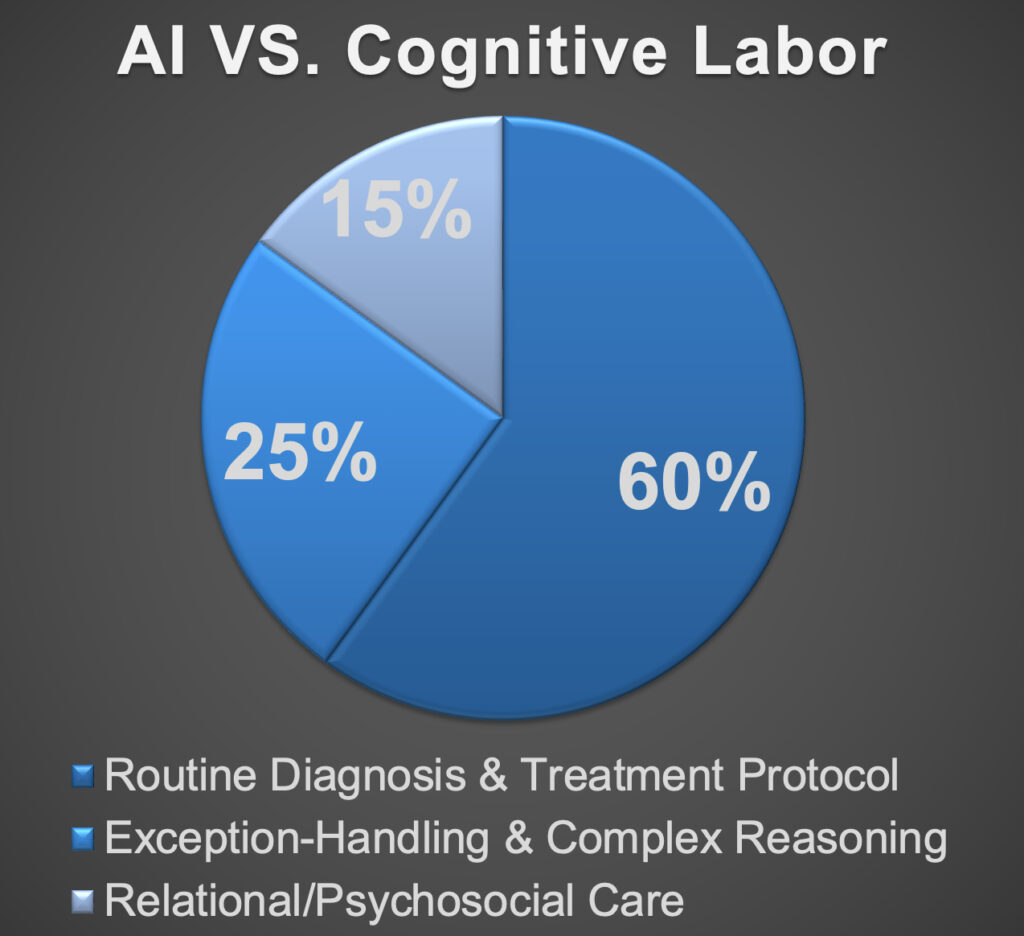
The initial reaction was understandably uncomfortable.
Wouldn’t giving up that much work make professionals more vulnerable to replacement?
But I challenged them to reconsider what their jobs were ultimately meant to accomplish.
The purpose of healthcare isn’t to complete administrative tasks. It’s to care for people, improve outcomes, reduce suffering, and help patients live healthier lives.
If AI could responsibly handle portions of the work that prevented professionals from fulfilling that purpose, what could those professionals do with the capacity they regained?
Imagine if AI helped create the time and capability to learn continuously, investigate emerging treatments, engage more deeply with patients, and provide care that previously wasn’t possible under existing constraints.
Some see the opportunity as doing the same job faster. Others see it as an opportunity to become better at the work that matters most.
I believe this lesson applies to almost every profession.
In global trade, automation can help professionals monitor regulatory changes, prepare routine documentation, and interpret large volumes of information. But the greater opportunity is to elevate their contributions to strategic scenario planning, anticipating risks, identifying opportunities, and helping executives navigate uncertainty with greater foresight.
In customer service, AI can handle repetitive inquiries while giving human advisors more capacity to solve complex problems and strengthen customer relationships.
In finance, intelligent systems can automate portions of reporting and analysis while professionals expand their contributions to strategic planning, risk management, and new opportunities for value creation.
The important distinction is what happens after we automate.
If all we do is fill the reclaimed hours with more of the same work, we’ve improved efficiency without fundamentally changing our potential.
But if we deliberately reinvest some of that capacity into learning, experimentation, creativity, and innovation, we begin to create a second trajectory of value.
The first trajectory delivers linear improvements through strategic automation. The second creates the potential for expanding value as people discover new opportunities and develop capabilities they can build upon.
That is where productive disruption begins.
And it requires people to make a decision that is often psychologically difficult…willingly giving up familiar activities so they can grow into more meaningful contributions.
The Future of Your Work Is Something You Can Help Define
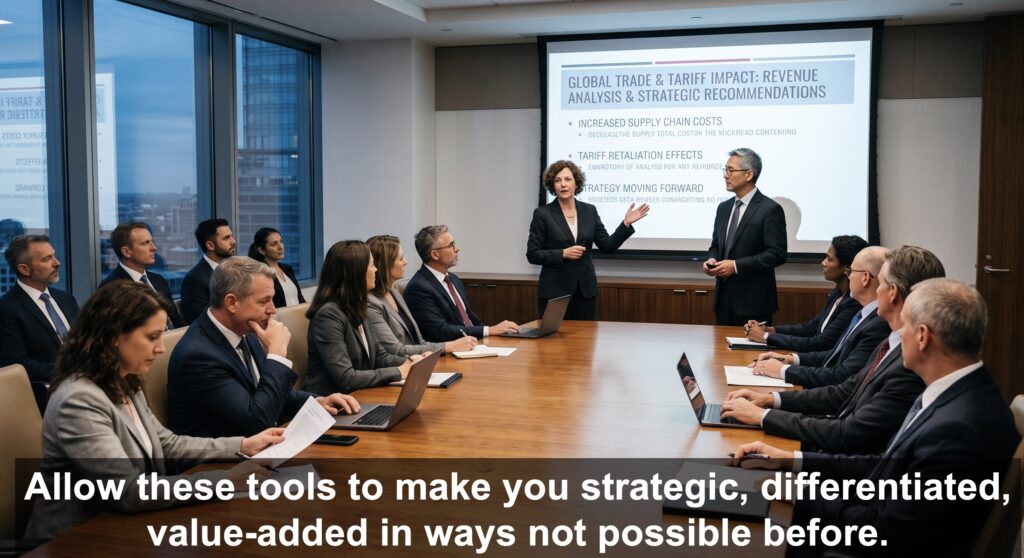
Toward the end of my presentation, I invited the audience to consider a series of questions that I believe every professional and executive should be asking.
What are we trying to protect?
Where are we holding on to legacy processes because they provide comfort, even when they constrain performance or growth?
What opportunities are we ignoring because they challenge our understanding of how our jobs or businesses are supposed to work?
And perhaps most importantly, what are we dismissing as too risky or difficult when the underlying obstacle is truly our reluctance to change?
These are uncomfortable questions because they require us to examine technology and organizational strategy, and more so, our own identities.
Many of us have spent years, even decades, mastering the work that defines our professional value. The prospect of fundamentally changing that work can feel like abandoning the very expertise that made us successful.
But what if reinvention isn’t about abandoning our expertise?
What if it’s about building upon everything we’ve learned to become capable of contributing in new and more meaningful ways?
I often return to the philosophy of Stoicism when thinking about moments like this. There are things we can control and things we cannot.
We cannot control the pace of technological progress, every geopolitical development, or the narratives that dominate the headlines. We cannot eliminate uncertainty, and we certainly cannot guarantee that every experiment will succeed.
But we can control how we respond.
We can choose curiosity over resignation, exploration over paralysis, and meaningful action over passive observation.
We can become more intentional about how we learn, how we use AI, how we spend our reclaimed time, and how we help others navigate change.
These choices may seem small in isolation, but collectively they shape our trajectory.
I’ve worked with organizations where incredibly talented people can explain, in extraordinary detail, why something won’t work. They understand every complication, every historical or hypothetical failure, every structural obstacle, and every reason the organization should proceed cautiously.
Yes, that knowledge is valuable. But I’ve learned to look for something more.
In the face of these obstacles, and excuses, be the personal who finds a way forward, even if that means you can be wrong.
You join an elite group who can acknowledge uncertainty while proposing ideas, testing possibilities, bringing others along, and helping an organization make progress toward a better outcome.
This kind of initiative becomes even more valuable in an age when AI makes information, analysis, and potential solutions increasingly accessible.
Our advantage will come from our ability to translate knowledge into imagination, sound judgment, meaningful action, and positive change.
What’s Next Will Either Happen to Us or Because of Us
Source: Quotefancy
When I reflect on my experience at Copper Summit, I keep coming back to the relationship between uncertainty and possibility.
The opportunity before us all is much larger than finding ways to keep up with use cases, technology, regulatory changes, and headlines.
We have the potential to elevate our work and our roles, influence strategy, anticipate disruptions, and become more valuable to the organizations and people we serve.
We are entering an era in which intelligence is becoming more abundant, but imagination, curiosity, courage, and human agency remain essential to determining what we do with it.
This is the moment to continue learning and unlearning, to remain willing to challenge our assumptions, and use new capabilities to create value beyond the boundaries of our existing roles.
This is the moment to give ourselves permission to think and do differently.
Let’s give ourselves permission to ask questions we don’t yet know how to answer; permission to experiment with unfamiliar ideas; permission to make room for exploration alongside the important responsibilities we already carry; and permission to question the way things have always been done without dismissing the experience that got us here. Perhaps most importantly, let’s give ourselves permission to imagine a future-self capable of things that would have seemed impossible only a few years ago.
Whether we like it or not, what’s next is going to be defined. It will either happen to us, or because of us.
The extraordinary opportunity of this moment is that we still get to choose the role we play in shaping it.
Read Infinite ∞ | Read Mindshift | Subscribe to my newsletter | Book me as your next Speaker


Leave a Reply