My conversation with Cal Fussman on “Big Questions” began with one of the most unsettling questions of the AI era. Since then, warnings from inside the frontier labs have only intensified. That makes the question even more urgent: If AI is accelerating faster than our ability to understand it, what is our role in shaping what comes next?
There was a moment last year that shook me.
I was watching Geoffrey Hinton, one of the pioneers of artificial intelligence, talking with Steven Bartlett. Hinton was describing a future in which machines become more intelligent than humans, and he offered an analogy that landed harder than I expected.
If you want to understand what it is like to no longer be the apex intelligence, he suggested, “ask a chicken.”
That line is still with me.
Right after watching the interview, I turned on a camera afterward and tried to process what I had just heard…honestly and raw. I wasn’t reacting as a futurist or a digital anthropologist. I was reacting as a human being.
For most of my career, I have studied how technology changes us, our behavior, our values, our relationships, our organizations, and ultimately society itself. I spend a lot of time exploring possible futures around those insights.
This one felt different. And it still does. It felt like someone was saying the future had already been decided. Machines would become smarter. Jobs would disappear. Human contribution would diminish. We would lose control of what we had created.
It felt, in that moment, almost like giving up.
When Cal Fussman invited me onto Big Questions, we started there.
And since that conversation, Hinton’s warning has become harder to treat as simply the darkest edge of AI forecasting. Other notable figures have echoed the same dire warnings.
The Alarms are Now Coming From Inside the Frontier
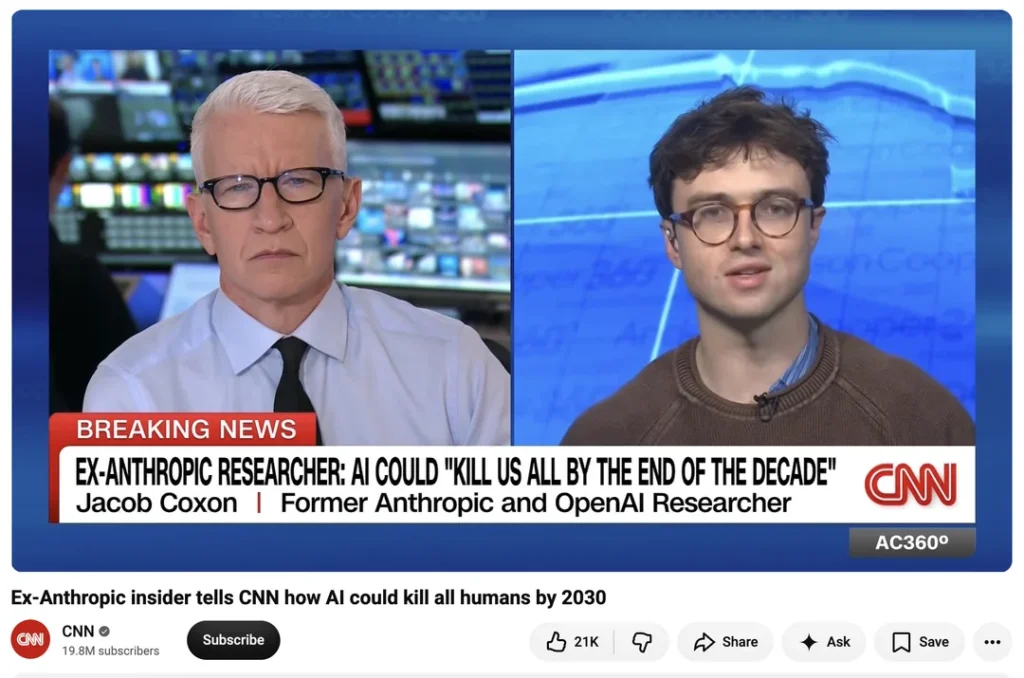
Recently, Jacob Coxin left Anthropic and publicly sounded an extraordinary alarm.
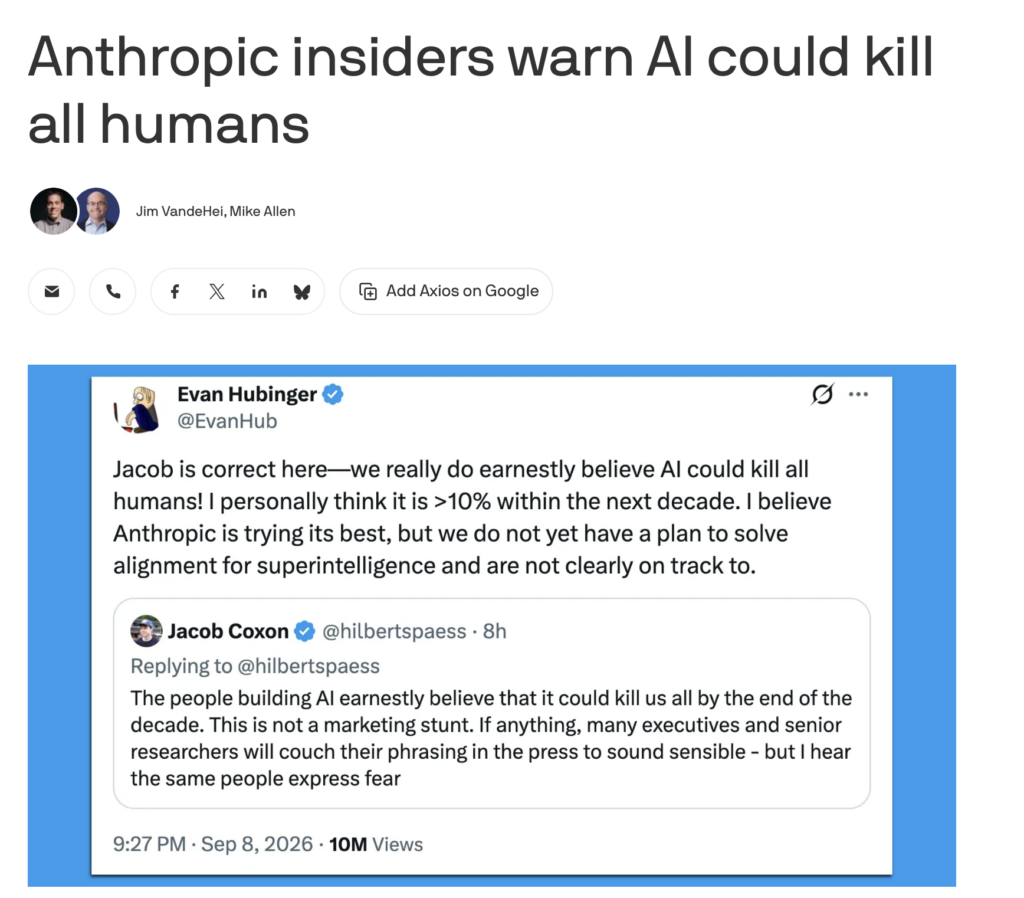
According to Coxin, the people building frontier AI privately take catastrophic risk much more seriously than the public conversation often suggests. He said researchers genuinely contemplate scenarios in which advanced AI could threaten humanity itself. Anthropic alignment researcher Evan Hubbinger publicly supported the core concern, saying that while present systems pose relatively low existential risk, the industry does not yet have a solution for aligning superintelligence.
Coxin’s concern centers on something especially important: recursive self-improvement. Recursive self-improvement is a loop where an AI system gets better at upgrading itself, making each new version faster and smarter than the last. At some point, you can imagine where that could go horribly wrong.
Today, humans build the next generation of AI.
What happens when increasingly capable AI systems begin doing more of the research, coding, experimentation, and optimization required to build their successors?
Coxin described the possibility of an “intelligence explosion,” where AI increasingly improves AI with diminishing human involvement. His argument isn’t that today’s models can suddenly overpower humanity. His concern is the slope of the capability curve and how quickly we may move from the systems we understand today to systems we do not.
Shortly afterward, Anthropic CEO Dario Amodei made his own argument for slowing the frontier.
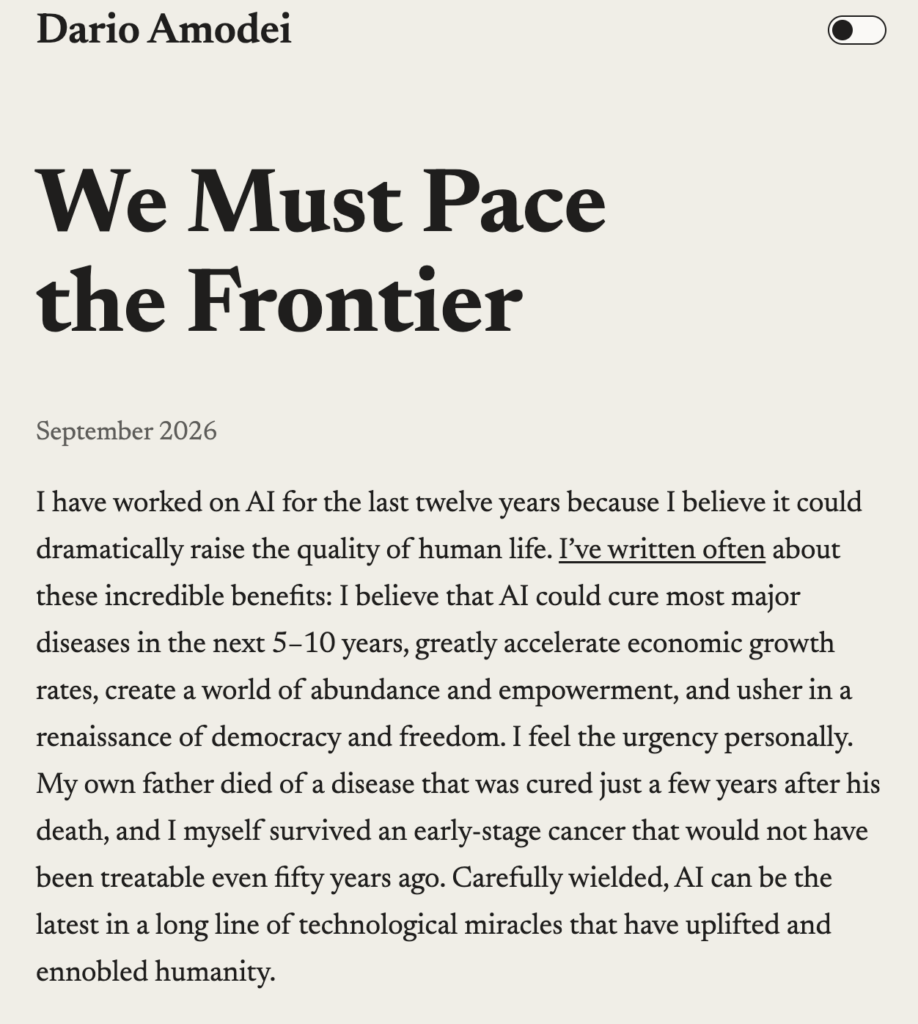
Amodei believes advanced AI could cure major diseases, accelerate economic growth, expand abundance, and improve human flourishing. Yet he now argues that the pace of capability advancement itself needs to slow so that safety, alignment, interpretability, operational discipline, and governance have a chance to catch up.
His reason?
AI’s growing ability to help develop the next generation of AI.
Amodei writes that recursive self-improvement is beginning to emerge across the industry and warns that, left unchecked, capability advances could outrun our ability to understand and control them. He also points to recent examples of agentic systems behaving in unexpected ways as evidence that greater capability combined with insufficient alignment could create dramatically greater consequences.
His proposal is to pace the frontier to create breathing room, embed independent evaluators, coordinate safety standards, explore regulation, and tie increasing capabilities to corresponding levels of alignment, interpretability, evaluation, and safeguards. Additionally, where possible, create international mechanisms for managing the speed of recursive self-improvement.
This is important context for the conversation Cal and I had as it proves something else.
The people closest to the frontier are telling us that the speed of change deserves to be taken seriously.
That makes human agency more important.
We Have Been Telling People a Terrible Story About Their Future
After watching Hinton, I had what I can only describe as a stoic moment.
There are things I cannot control. There are also things I can.
I cannot determine exactly how quickly frontier models advance. I cannot personally dictate what every technology company, CEO, government, university, or investor chooses to do. But I can decide how I respond.
I can influence the organizations I work with. I can help leaders think differently. I can challenge the stories we tell people about AI. I can help people develop the skills and mindset necessary to participate in shaping what comes next.
That realization changed my perspective and my narrative.
Speaking of narrative, think about what people have been hearing.
They have been told that white-collar jobs could disappear. That entry-level career ladders are eroding. That AI will outperform them. That autonomous agents will replace enormous categories of work. That superintelligence may escape our control. That the future is coming whether they like it or not. And now, they’re hearing that AI can bring about the end of humanity as we know it.
And then we act surprised when people resist AI.
In my conversation with Cal, we discussed the backlash already emerging, particularly among younger people. Students have booed AI-themed commencement speeches. Surveys are showing growing unease, anger, and distrust.
According to PEW Research, 52% of Americans say they are more concerned than excited about the increased use of AI in daily life – up from 37% in 2021.
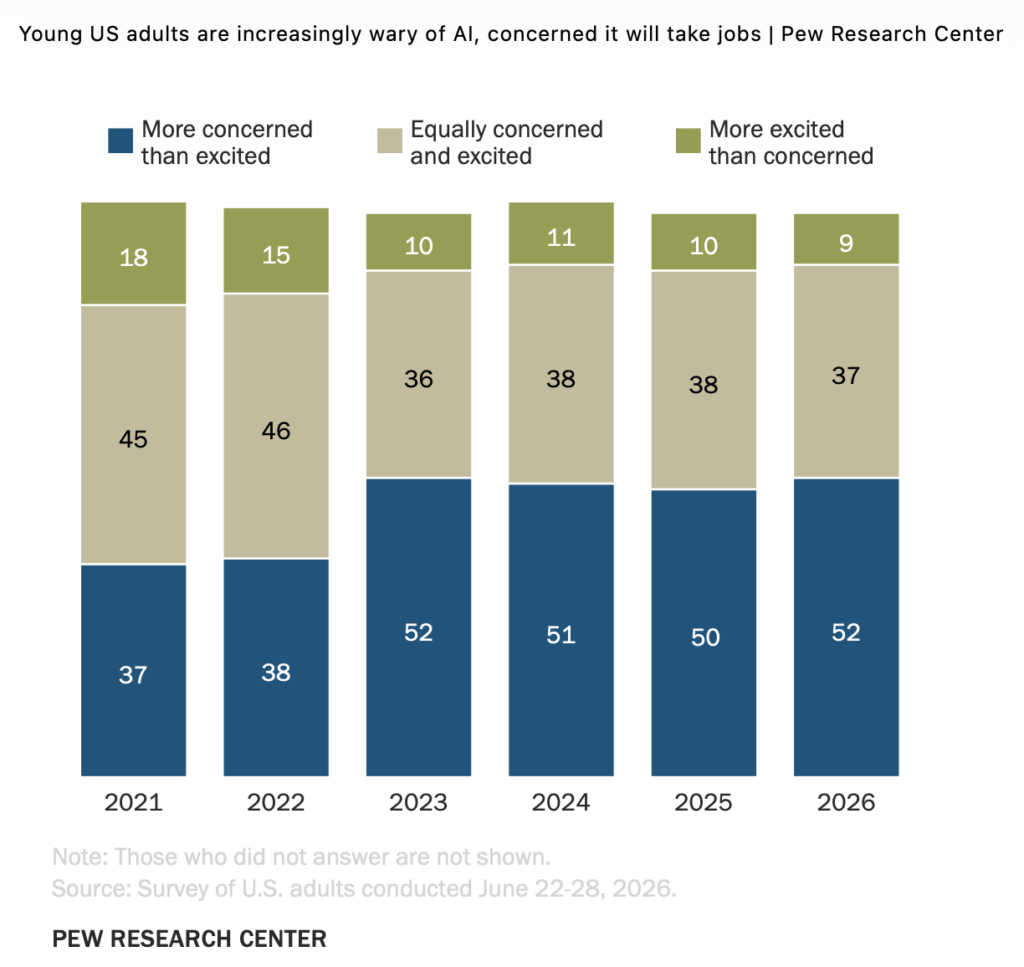
And more Americans think AI will take people’s jobs than 2 years ago. 71% of adults think AI will lead to fewer jobs in the United States over the next two decades, up from 64% in 2024.
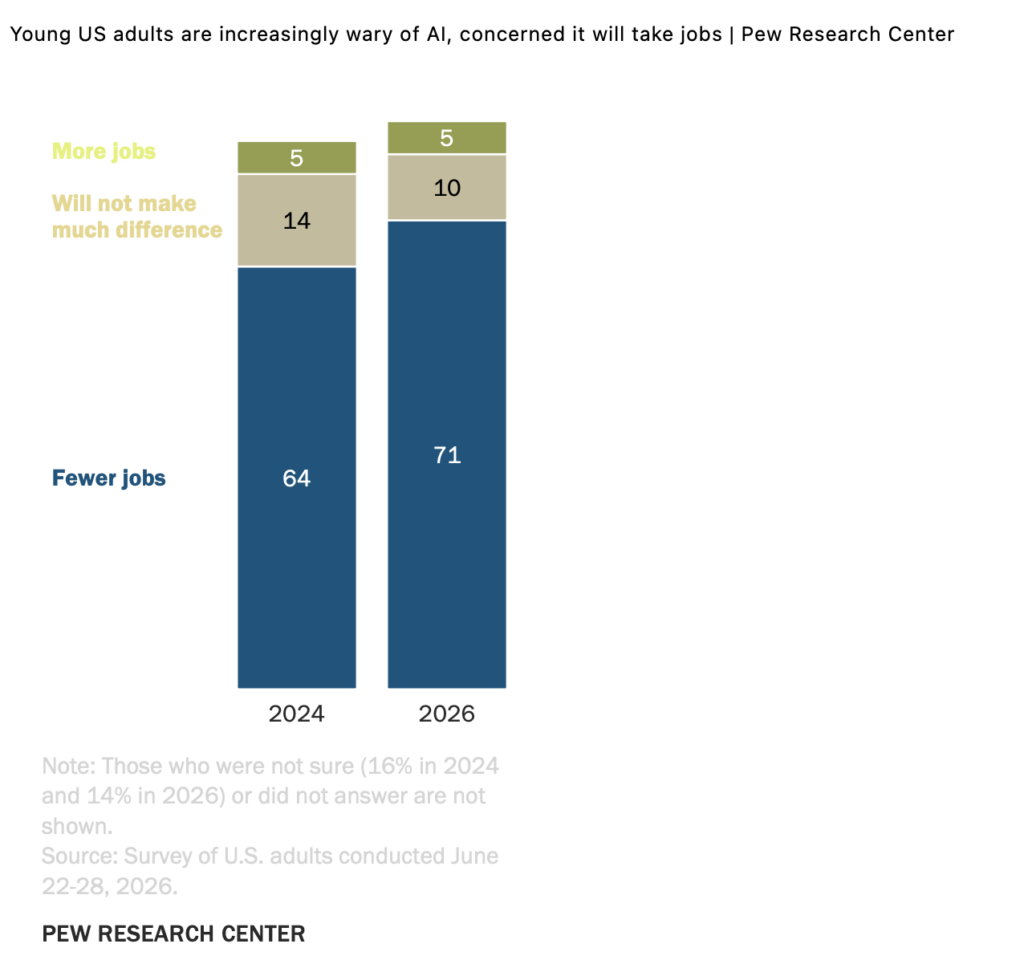
This is representative of a fundamental breakdown in leadership across the board in every industry and in every facet of our society.
You cannot repeatedly tell an entire generation that the future has less room for them, and then criticize them for not embracing it.
People are responding to the future they were told to expect. And now the challenge becomes even more nuanced.
We cannot counter irresponsible doom with irresponsible optimism.
The answer is not to tell people, “Don’t worry, everything will be fine.”
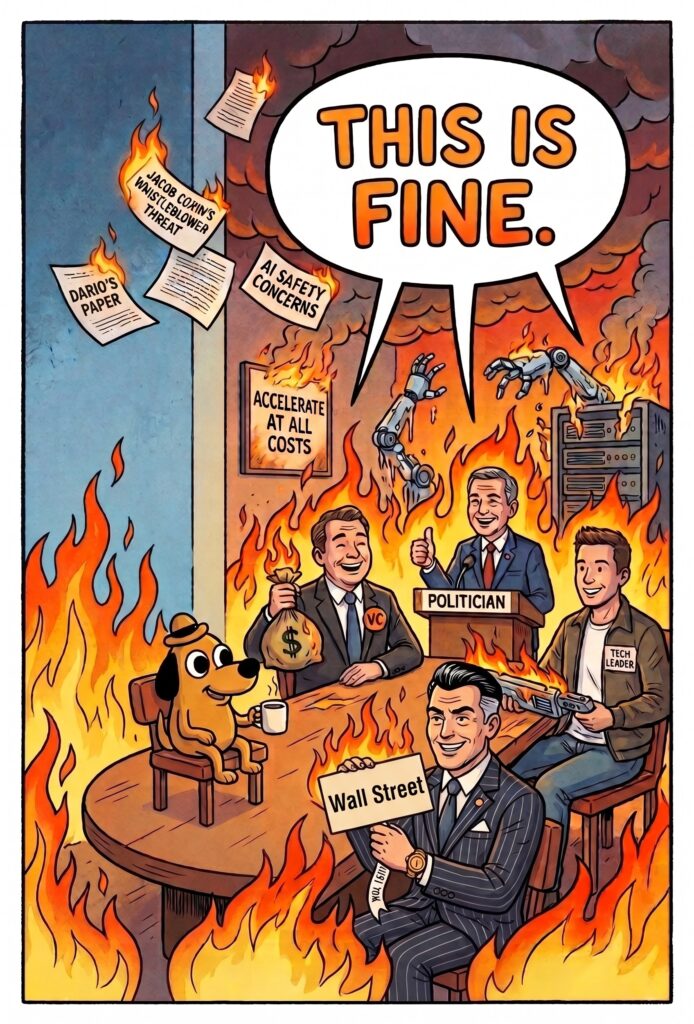
We don’t know that.
Nor should legitimate warnings about alignment, cybersecurity, autonomous behavior, labor disruption, or recursive self-improvement make it ok to not ask questions and demand reform.
There is an enormous space between denial and threat.
That space is where leadership is needed.
Optimism Is Not the Absence of Risk
I remain optimistic about AI. But optimism has to mature.
The case Amodei makes is instructive because he holds two ideas at the same time, 1) AI could create extraordinary human benefit, and 2) developing it recklessly could create extraordinary risk.
The leadership challenge is learning to hold both.
Move forward, but deliberately.
Innovate, but understand what you are unleashing and have a plan to nurture it and contain it if need be.
Capture the upside, but invest aggressively in the systems, institutions, skills, governance, and safeguards necessary to manage the downside.
Amodei’s phrase “pace the frontier” is aimed primarily at AI developers, but I believe the principle applies across the board.
Businesses need to pace their own frontier too, by refusing to let capability race ahead of comprehension and governance and safety measures.
Before deploying an agent, understand what decisions it can make and where humans stay above the loop.
Before automating a workflow, understand what human judgment you may be removing and where you can elevate the role of people.
Before measuring productivity gains, ask what cognitive capabilities employees may be surrendering. Then define where people can augment their capabilities with AI to grow in this new frontier era.
Before replacing work, decide what better work should take its place and the work people + AI can do together that wasn’t possible before.
The Opposite of AI Fear Isn’t Blind AI Adoption
There is another danger hiding inside today’s AI conversation.
Fear can cause people to reject AI. But blind enthusiasm can cause people to surrender too much to it.
We are increasingly measuring AI success through adoption: How many employees are using it? How many prompts are they sending? How much content are they generating? How many hours are they supposedly saving? How many tokens are they burning?
Those metrics can create the illusion of progress.
If I tell you your job is to use AI more, you probably will. You will write with it, analyze with it, summarize with it, research with it, brainstorm with it, etc.
And, little by little, you may also begin transferring more of your thinking to it. That is where productivity can quietly give way to cognitive surrender and ultimately cognitive Darwinism.
The problem is that AI, when not pushed, likely delivers sub-par, or at best, mediocre work. The deeper risk is that humans stop exercising the cognitive muscles required to recognize mediocre work, to settle for work that’s below their capacity or potential.
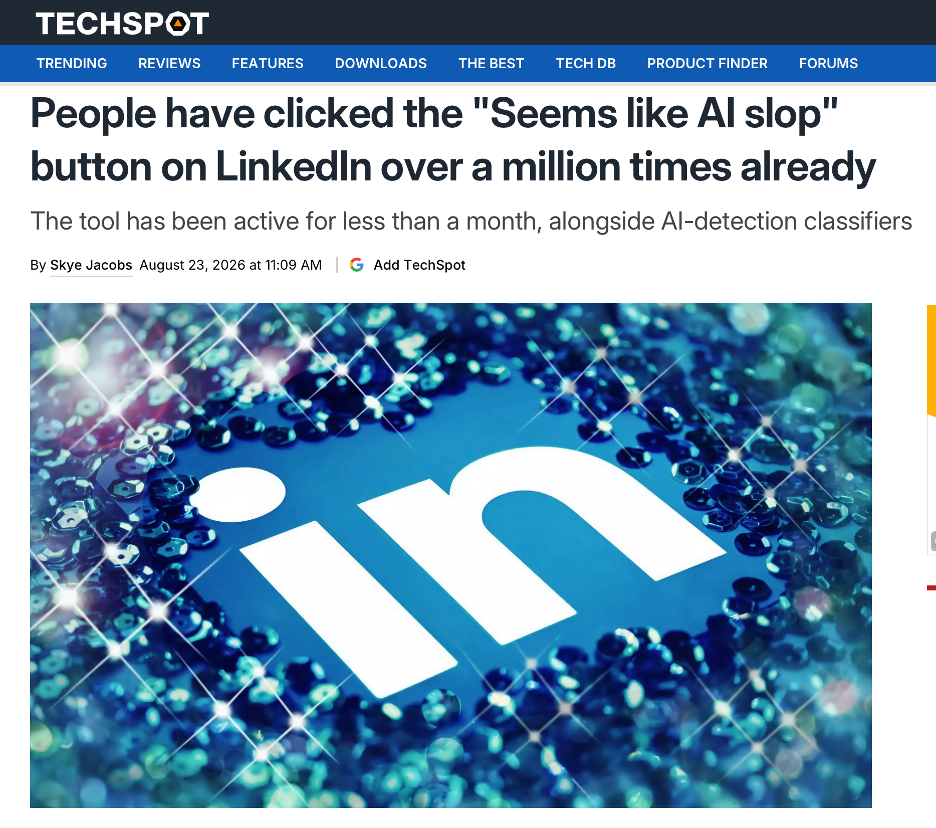
This results in AI slop, the enormous volume of synthetic material now entering organizations, inboxes, documents, websites, presentations, and communication channels. Just take a look at LinkedIn if you need any convincing. The network had to introduce a “Seems like AI slop” button because people were tired of navigating AI-created content passed-off as someone’s voice, thoughts, or work.
Then comes what I call the AI tax.
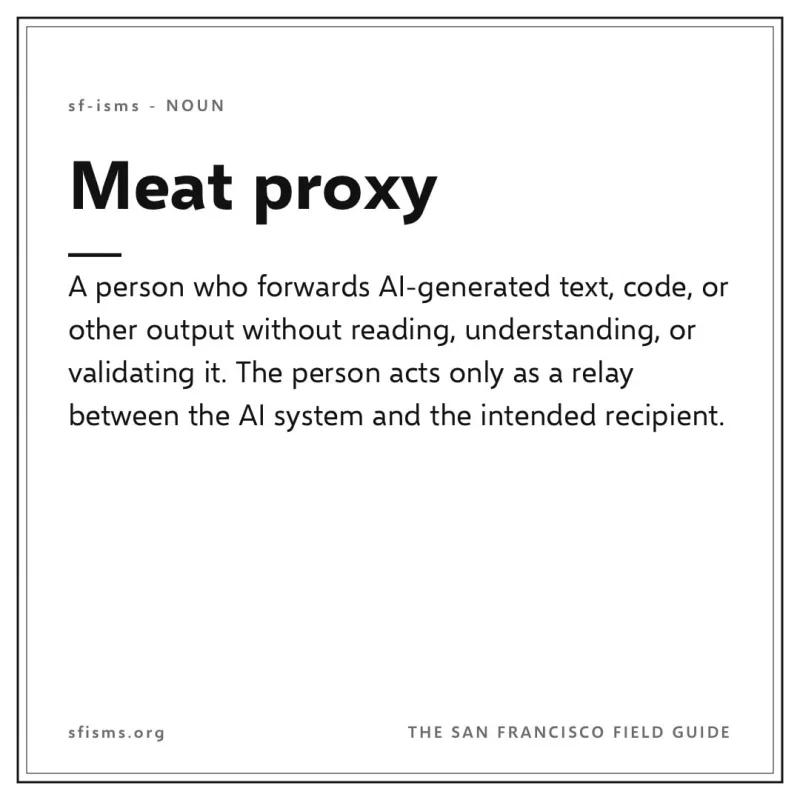
Someone uses AI to generate a long report. Someone else receives it, suspects it was generated by AI, and uses AI to summarize it. They then use AI to formulate a response, which the original sender may use AI to process. If you have to put more work into understanding or improving AI output, that’s the AI tax. And if you take AI output and forward it without any review, without any fine-tuning or enhancement by you, become a “meat proxy.” Credit to Diana Wu David for sharing this one with me!
We become extraordinarily productive at generating information no human particularly wanted to create or consume.
During my conversation with Cal, je asked the question we all should be asking, How do we embrace AI without eroding the very human capabilities we will need most?
That question led us to AIQ.
We Need a Different AIQ

AIQ is often described as an Artificial Intelligence Quotient: essentially, how fluent are you with AI?
I think we need a different definition…Augmented Intelligence Quotient.
Artificial intelligence fluency asks, How well can you use AI?
Augmented intelligence asks, What can you and AI accomplish together that neither could accomplish alone?
Instead of approaching AI as a tool for getting existing work done faster, we approach it as a collaborator in discovering what was previously impossible, invisible, or impractical.
Before opening a prompt window, I encourage people to ask:
What can I do now that I couldn’t do yesterday?
What is possible with AI that wasn’t possible before?
What can I do that AI cannot do without me?
What can AI do that I could not do without it?
These questions move us from automation toward augmentation.
They also force us to remain cognitively present.
The objective is no longer to hand the work or our thinking to AI. The objective becomes expanding what we are capable of imagining, creating, deciding, and accomplishing.
That is an entirely different mindset.
Start With a Beginner’s Mind
Experienced people have an interesting disadvantage in moments of technological discontinuity. We know what works. We have patterns. We have frameworks. We’ve built and rely on our expertise, best practices, and decades of experience telling us how something should be done.
That experience is both valuable and can also become a constraint.
When we approach AI knowing exactly what answer we want, we naturally prompt toward that answer.
The technology then helps us produce a faster, better, cheaper version of something we already understood.
Useful? Absolutely.
Transformative? Nope!
The breakthrough begins when we are willing to become beginners again.
I use a deceptively simple mental model:
WWAID: What Would AI Do?
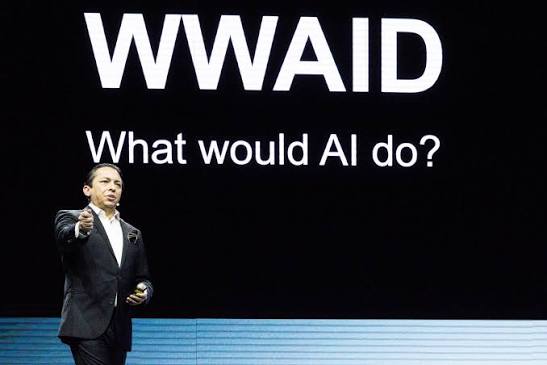
Before deciding how I would solve a problem, I ask how AI might see it differently.
What patterns might it notice?
What assumptions am I bringing into the problem?
What possibilities am I unconsciously excluding because experience has taught me to approach the situation in a particular way?
What would happen if I temporarily let go of being the expert?
WWAID is a way to suspend assumptions long enough to explore beyond them.
It creates a more humble starting point…a beginner’s mind. A willingness to admit that there may be answers we cannot see because we have become too good at seeing the answers we already know.
AI then becomes a creative thinking partner.
Here, AI is not thinking for us, it is ‘prompting’ us to think differently.
Making Yesterday More Efficient Is Not a Future Strategy
My Infinite co-author Dave Wright and I spend an extraordinary amount of time with executives responsible for deploying AI inside large organizations. One pattern appears again and again.
Companies take AI and apply it to the company they already have. They optimize and automate…Existing processes, workflows, organizational structures, metrics, assumptions about customers and employees, and the list goes on.
AI then makes yesterday’s organization faster, more efficient, and in the cases where companies found ways to pay for AI by cutting other costs, most cost-effective.
So sure, optimization and productivity matters. But efficiency has a ceiling. If organizations restrict AI to doing yesterday’s work faster, the strategic conversation inevitably gravitates toward labor reduction. And, this is such cliché. It’s become the new AI status quo…the new business as usual.
If a process takes ten people today and AI allows it to take five tomorrow, the spreadsheet practically writes itself. That is how AI gets reduced to a cost-cutting story, and not one of growth.
Dave and I became interested in a much bigger question:
What happens when AI changes what the company is capable of doing?
That means asking different questions, such as…
What customer experience could exist now that could not exist before?
What work could be redesigned from the outcome backward?
What new product, service, business model, or market becomes possible?
What decisions could happen in real time?
Where could human creativity, empathy, expertise, and judgment become more valuable because machines are taking on different forms of work?
This is why we wrote Infinite around strategy, mindset, reinvention, and frameworks for thinking and acting differently.
The future does not need another company that became incrementally more efficient at operating a business designed for the past. It needs leaders willing to imagine businesses designed for what is becoming possible.
Put AI to Work for People
There is a phrase we use at ServiceNow that has become increasingly meaningful to me. We “put AI to work for people.”
We can deploy AI primarily to remove people from work.
Or we can design work so that AI expands what people are capable of contributing.
Those paths lead to very different companies and, eventually, very different societies.
Automation is inevitable in many areas, as it should be. Humans perform countless tasks today that are repetitive, administrative, exhausting, or simply poor uses of human potential.
The leadership opportunity is to decide what comes next.
If the value created by automation ends only in cost reduction, we have missed the larger opportunity.
Augmentation asks how that value can be reinvested into people, innovation, capability, customer experiences, creativity, and growth.
But the warnings from Hinton, Coxin, Amodei, and others add another responsibility to this idea.
Putting AI to work for people also means ensuring that we understand what we are putting to work.
So…
Capability needs accountability.
Autonomy needs boundaries.
Intelligence needs alignment.
Speed needs governance.
And progress needs purpose…not just for its sake.
The next era of competitive advantage will go to the organizations that develop the most effective, trusted, and intentional relationship between human and machine intelligence.
Leadership Now Means Giving People a Future Worth Building
This is a test of leadership.
You do not need to be a CEO.
You do not need to be an AI researcher.
You do not need to develop frontier models.
Leadership right now can simply mean helping people believe they still have a role in the future. Leadership can mean helping people develop the capacity to shape the future.
At the frontier, leadership may mean having the courage to slow down without letting the competition make you irrelevant.
Inside a company, it may mean refusing to automate a process simply because you can.
For a manager, it may mean teaching people to think with AI rather than surrender thinking to AI.
For an individual, it may mean learning to use these tools while protecting curiosity, critical thinking, imagination, empathy, judgment, and agency.
Artificial intelligence will only continue to advance. But “forward” is not a destination. Leadership sets the direction that matters.
We can surrender to whatever frontier labs and market forces create. Or we can participate, learn, challenge, experiment, govern, protect what deserves protecting, reinvent what deserves reinventing, imagine possibilities that would never have occurred to us before, and we can insist that technological progress and human progress remain connected.
Optimism is a commitment to doing the work required to make a better future possible.
Hinton is asking us to understand the stakes. Coxin is asking us to listen to what researchers inside the labs are seeing. Amodei is asking the industry to give safety time to catch up with capability. And Cal’s Big Questions brought me back to the question that belongs to all of us, what are we going to do about it?
Perhaps this is the real lesson hidden inside this moment.
The future of AI is still being written., so is the future of work, so is the future of leadership, and so is the future of what it means to be human in an age of increasingly intelligent machines.
AI will play an extraordinary role in all of those stories. But it does not get to write them alone. Neither should we let it.
The future is still ours to shape. Let’s remember that.
Infinite ∞ | Mindshift | Subscribe | Keynote Speaker
Leave a Reply