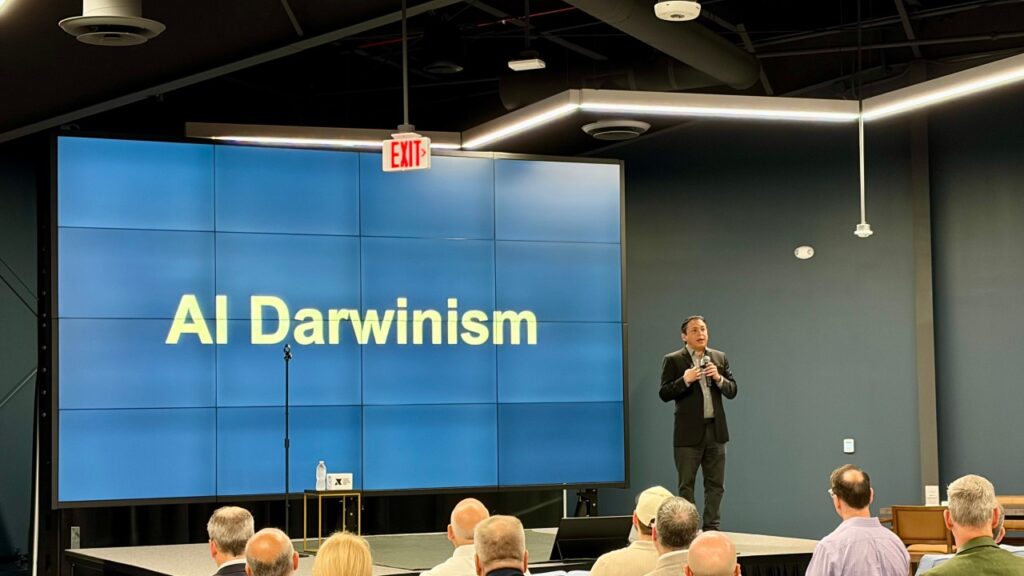
Every company is now asking some version of the same question…how do we use AI to become more efficient? It’s the right question. But it’s not the only question. If we use AI only to automate existing processes, reduce costs, and accelerate yesterday’s work, we may become faster versions of who we already were. That might improve productivity, but it won’t guarantee relevance. The bigger opportunity is to use AI to challenge the assumptions that define the business itself: what we make, how we work, who we serve, and what value we’re truly here to create.
At PhySec in Washington, D.C., I had the privilege of joining a rare kind of executive gathering: intimate, focused, off-the-record, and intentionally designed for the conversations that don’t usually happen in a ballroom or event center.
The room brought together leaders from across the global physical security industry. This isn’t about security though. This is for every leader. Why? Because right now, this is about leadership, innovation, and self-inflicted business disruption.
The companies that define themselves by what they make eventually get trapped by what they made. Companies that define themselves by what they stand for keep earning permission to evolve.
That was the heart of my message.
The future doesn’t reward better candles
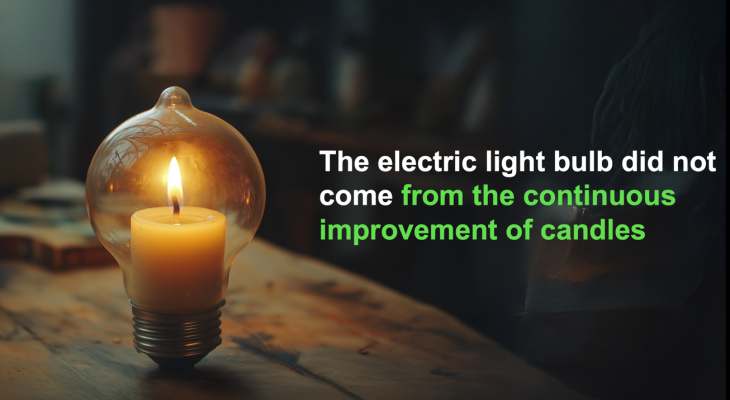
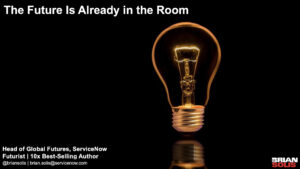
One of the slides I shared quoted a line that captures the problem with most transformation efforts: “The electric light bulb did not come from the continuous improvement of candles.”
Most organizations are very good at improving candles. They optimize. They refine. They standardize. They create committees. They protect revenue streams. They make existing systems more efficient. They make yesterday perform better tomorrow.
There is nothing wrong with that. In fact, every successful business has to do it. The challenge is that continuous improvement, on its own, rarely produces the next curve.
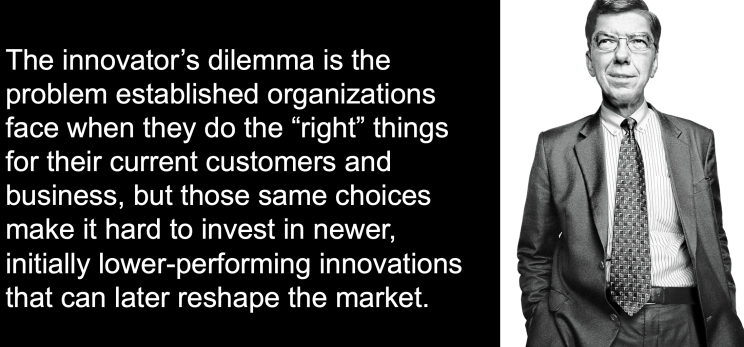
That’s the innovator’s dilemma.
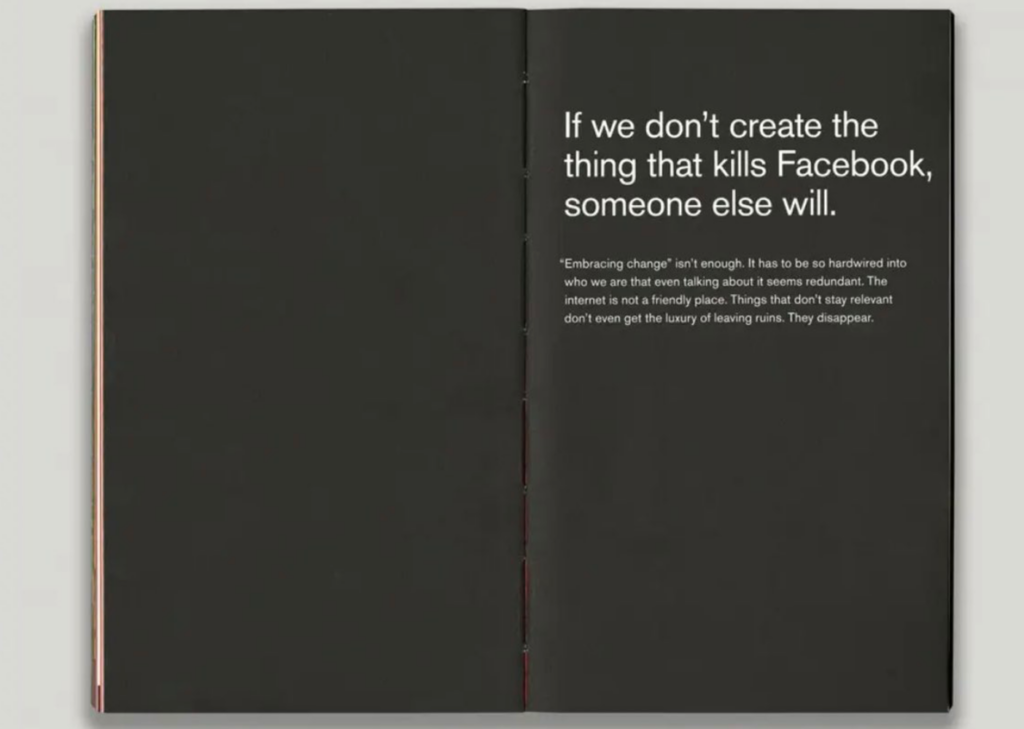
Not that I’m a fan of Facebook, but I appreciate the idea here
Established organizations often do the “right” things for their current customers, investors, operating model, and category. They serve today’s demand. They protect today’s margins. They listen to today’s market signals. They invest in what looks rational.
And then, slowly at first and then suddenly, the market moves.
Kodak did not miss digital photography because it lacked access to technology. Blockbuster did not miss streaming because nobody saw the signal. Walmart did not miss e-commerce because the emerging internet was a secret.
And yet, industry leaders historically have missed their moments.
The music industry did not invent iTunes. The publishing industry did not invent the next model for music. The television industry did not invent the modern streaming experience. Hospitality did not invent Airbnb. Taxi companies did not invent Uber.
These companies and industries were not unintelligent. They were optimized. And optimization has a gravity of its own.
The systems that make a company successful often become the same systems that prevent it from becoming something new.
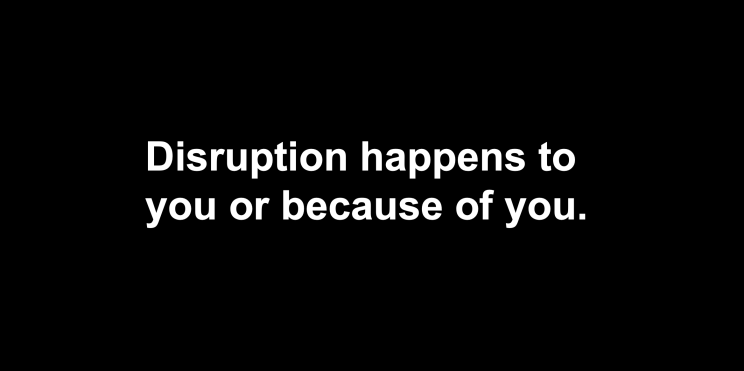
That is why disruption happens in one of two ways.
It happens to you.
Or it happens because of you.
Iteration, innovation, and disruption are not the same thing
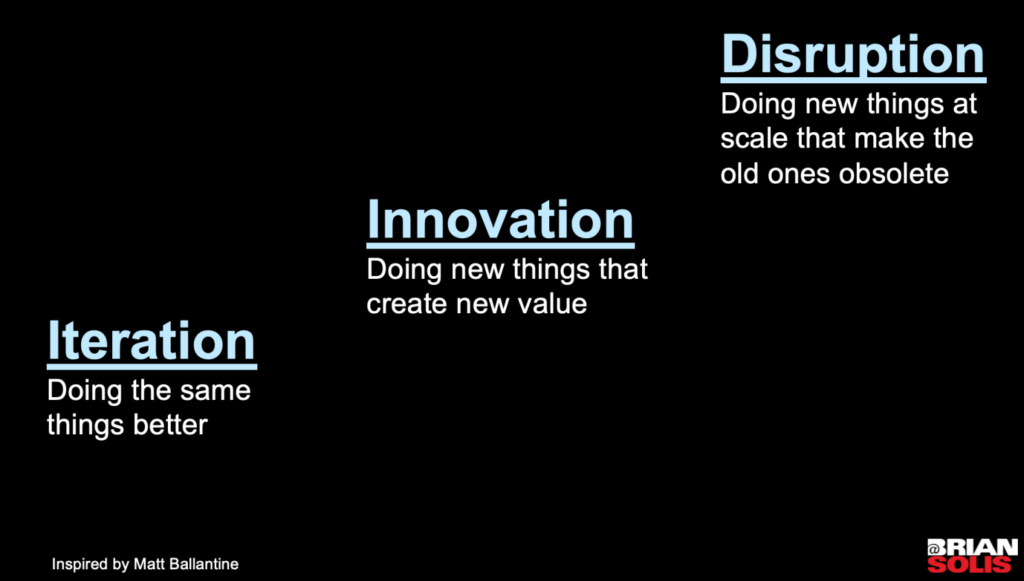
One of the most important distinctions leaders can make right now is the difference between iteration, innovation, and disruption.
Iteration is doing the same things better.
Innovation is doing new things that create new value.
Disruption is doing new things at scale that make the old things obsolete.
And right now, we’re making the same mistakes with AI.
Most AI strategies I see today are iteration strategies dressed up as transformation strategies. They ask: How can we go faster? Where can we take out cost? How can we do this less expensively or more efficiently? How can we upgrade our tools and processes with AI?
Those are important questions. They just aren’t enough.
They produce efficiency. They produce productivity. They may improve margins. They may reduce friction. But they do not necessarily create new value. And they certainly do not guarantee relevance in a market where intelligence is becoming abundant.
AI is already being applied to optimize yesterday’s work. It writes emails. Summarizes meetings. Speeds up research. Generates code. Automates tasks. Deflects calls. Drafts documents. Creates content. In physical security, it can enhance monitoring, detection, alerting, access control, compliance, reporting, and response.
Again, all valuable.
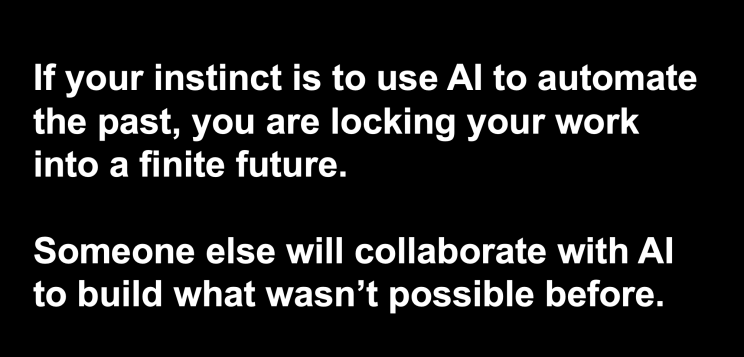
But if AI is used only to automate the past, it locks the organization into a finite future.
Someone else will collaborate with AI to build what wasn’t possible before. Someone else will build with AI to become infinite ∞.
That is where innovative AI begins.
Innovative AI asks different questions. Why do we assume this is the right path forward? Are we solving the right problems, or just improving old ones? How might we create new customer, employee, tenant, citizen, or community value? How can AI connect workflows, data, and systems to create business value? How can we reimagine stakeholder experiences? What new services, operating models, or revenue streams become possible when AI is no longer treated as a tool, but as a collaborator?
For physical security leaders, this is the moment to ask: Are we in the business of locks, cameras, credentials, guards, sensors, and systems?
Or are we in the business of trust, movement, safety, intelligence, and experience?
For leaders of any industry, this is the moment to ask: Are we in the business of “what got us here” or are we in the business of “what will get us to the next thing?”
Asking the question opens the door to permission. And permission creates the future.
Strategic imagination starts with identity
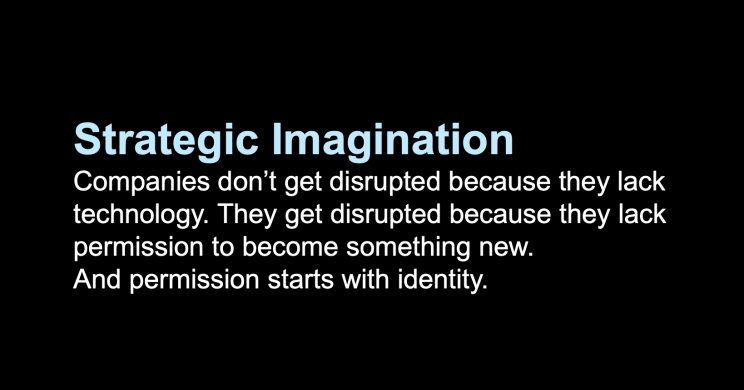
Companies don’t get disrupted because they lack technology. They get disrupted because they lack permission to become something new.
And permission starts with identity.
Remember why you started.

Ask, “what do I stand for?”
This is why #WDYSF (what do you stand for? is no longer a brand question. It is a strategic question.
When a company defines itself by its product, it inherits the limits of that product. When it defines itself by a higher purpose, it creates room to evolve as customers, markets, and technologies change.
That distinction is everywhere once you start looking for it.
What you stand for is the essence of who you are and what you do. WDYSF does not mean any one type of product. It’s the spirit of “why” you exist!
Nintendo began in 1889 as a playing card company. If Nintendo had defined itself as a playing card business, it would have remained trapped by the category it started in. Instead, the company kept evolving around something much bigger: play. That gave Nintendo permission to move from cards to toys to arcades to consoles to characters to worlds to experiences. It became one of the most important companies in gaming because it was never really limited to the format of yesterday’s game.
Michelin made tires. But if Michelin only saw itself as a tire company, it would have been limited by rubber, roads, and replacement cycles. Its broader purpose was helping people travel farther and better. That identity created permission to become one of the world’s most influential restaurant authorities. The Michelin Guide did not come from the hospitality industry. It came from a tire company that understood movement, travel, and experience.
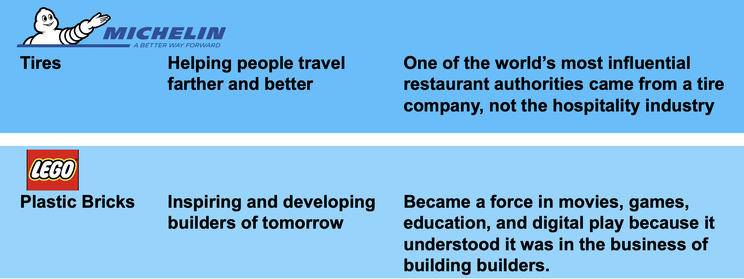
Lego made plastic bricks. But Lego’s purpose was never just plastic bricks. It was inspiring and developing the builders of tomorrow. That unlocked movies, games, education, digital play, theme parks, and entire ecosystems of imagination. Lego did not stay in the business of bricks. It expanded into the business of building builders.
John Deere made tractors. But when the company defines itself around helping agriculture become more productive, precise, and intelligent, then camera vision, machine learning, robotics, and AI-enabled farming become natural extensions of its purpose. See & Spray represents agriculture becoming more intelligent.
Dyson made vacuums. Very good, very expensive vacuums. But Dyson’s true platform was never cleaning floors. It was airflow, engineering, and design applied to everyday problems. That identity gave the company permission to expand into hand dryers, fans, air purifiers, hair dryers, lighting, and beyond.
Tesla was perceived as an electric car company. But its ambition was always broader: sustainable energy systems. That gave Tesla permission to play across transportation, batteries, solar, autonomy, and energy storage. The car was not the whole story. It was an entry point into a larger system.
Amazon started as an online bookstore. But its deeper work was removing friction from commerce, infrastructure, logistics, and data. That identity created the path to marketplaces, fulfillment, delivery, cloud services, and an operating system for modern business. It did not stop at retail because its real work was never simply selling books.
Apple offers another powerful lesson. Apple was a computer company. Then it became a music company. Then a phone company. Then a services company. With Apple TV, Apple also stepped into the television experience, not by becoming a traditional broadcaster, but by reimagining how television could work as a device, platform, app ecosystem, content service, and experience layer. The television industry could have led that shift. Instead, a company outside the traditional category helped redefine the expectations around how people access, navigate, purchase, stream, and experience content.
This is what happens when companies understand their “why” at a deeper level.
The product is just the current expression.
The purpose is the platform for meaning and evolution in every stage.
So what is your industry’s equivalent?
If your company defines itself by its current product portfolio, services, business model, or operating structure, it will mostly iterate from there. It will optimize what exists. It will improve the familiar. It will use AI to make yesterday faster, cheaper, and more scalable.
That may be necessary. But it is not enough.
The bigger opportunity is to define the company around the value it creates, the problems it solves, the people it serves, and the future it has permission to shape.
If you define yourself by what you make, you inherit the limits of what you made. But if you define yourself by what you stand for, new possibilities open. A product becomes a platform. A process becomes an experience. A service becomes an ecosystem. A company becomes more than its current category.
That future is already here. And at at the same time, the future is emerging.
AI is transforming every business from something that records and reacts into something that senses, reasons, recommends, acts, learns, and adapts. Generative AI expands thinking and creation. Agentic AI coordinates workflows across people, platforms, policies, and systems. Physical AI brings intelligence into machines, environments, infrastructure, and the real world. Autonomous AI begins to execute bounded actions with human oversight, not always human instruction.
This is more than becoming a better version of today’s business. This is about creating a new operating layer for enterprise transformation and innovation.
The leaders who understand that will not simply use AI to improve the company they already are. They will use AI to become the company they were meant to become next.
AI Darwinism and the capability overhang
Before AI, I spent years studying what I called Digital Darwinism: the evolution of technology and society when they move faster than organizations can adapt.
Digital transformation was supposed to be the answer. But in reality, much of what passed for digital transformation was digitization. Companies moved to the cloud, adopted SaaS, modernized interfaces, and automated analog processes. They scaled yesterday’s operating model with newer tools.
Now we are seeing the same pattern with AI.
Automation. Productivity. Costs. Headcount Efficiency. All but evolution and reinvention.
That is why I call this next chapter AI Darwinism.
It is the evolution of markets when intelligence itself becomes abundant.
AI Darwinism works against you when you use AI only to automate the past.
AI Darwinism works for you when you use AI to evolve.
The gap is already visible at the individual level. OpenAI has described a “capability overhang,” where power users extract far more value from AI than typical users. In the deck, I referenced the widening gap between people who use AI casually and those who understand how to pull advanced reasoning, creativity, decision support, and problem-solving from these systems.
That gap exists in every company now.
Some people are becoming exponentially more capable. Others are using AI to make the same work faster. Some teams are reinventing workflows. Others are generating more AI slop that someone else has to rewrite, correct, verify, and clean up.
This creates an AI divide inside the organization before it ever shows up in the market.
And that divide becomes a leadership issue.
Microsoft’s Work Trend Index found that only one in four AI users say their leadership is clearly and consistently aligned on AI. That line stood out to me because it mirrors what I see over and over again. Most organizations do not have an AI vision. They have AI activity.
Activity is not strategy. AI is not strategy.
Just like a goal to “deflect 70% of calls” is not a strategy. It is a tactic. And if the only way to prove ROI is to cut heads, then we have chosen the smallest possible imagination for the technology.
A stronger question would be: How can we use AI to increase revenue, improve safety outcomes, reduce risk, create new services, increase customer trust, elevate employee capability, or redesign the workflow entirely?
Then we can ask: How must work flow differently to achieve that outcome?
That is where AI stops being a tool and becomes a catalyst.
The next era of AI still evolving
We tend to talk about AI as if it is a single technology. It isn’t.
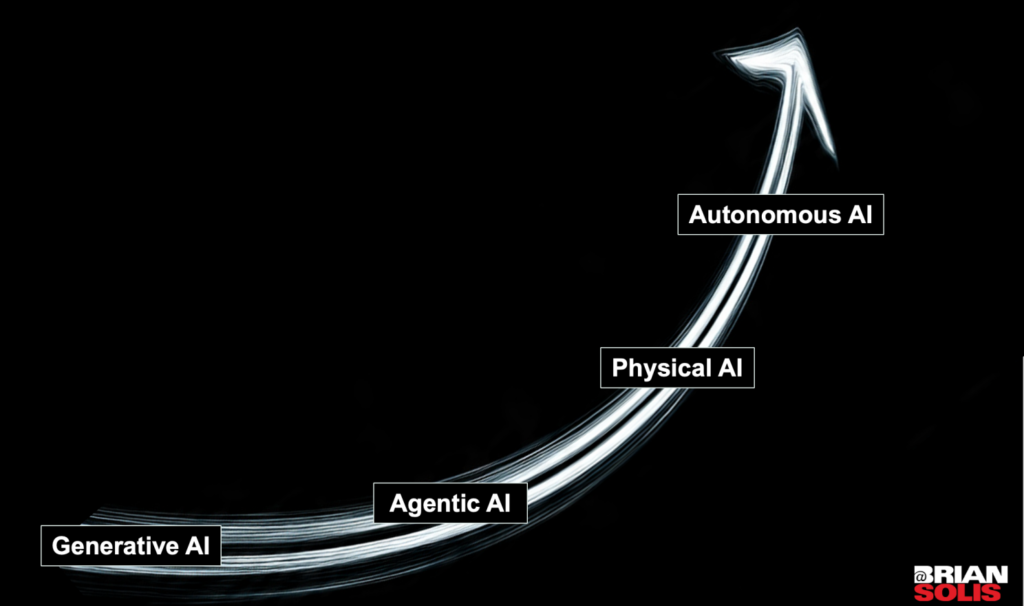
Generative AI was the introduction. It taught the world that machines could generate language, images, software, ideas, summaries, and synthetic outputs at scale.
Agentic AI is the next step. It moves from generation to coordination and action. Agents can pursue goals, use tools, connect systems, manage workflows, escalate exceptions, and collaborate with humans and other agents.
Physical AI brings intelligence into machines, sensors, devices, buildings, environments, robotics, cameras, access systems, and infrastructure. For physical security, this is especially important. It means the physical world becomes computational, contextual, and responsive.
Autonomous AI is the frontier where systems begin to operate with less direct supervision, with humans increasingly on the loop rather than always in the loop.
Each wave raises the stakes.
If we deploy generative AI into old processes, we get faster old processes.
If we deploy agents into old workflows, we get automated old workflows.
If we deploy physical AI into old security models, we get smarter versions of yesterday’s systems.
The opportunity is to reimagine the workflow before we scale the technology…to become infinite.
In any industry, that means not just asking how AI can improve what already happens, but how it can change what is possible.
…not just how AI can detect problems, but how it can prevent them.
…not just how it can improve response times, but how it can coordinate action across people, systems, policies, partners, and platforms.
…not just how it can validate a transaction, approve a request, or complete a task, but how it can create trusted, adaptive, contextual experiences.
…not just how it can monitor performance or risk, but how it can inform operations, compliance, customer experience, employee experience, product development, service delivery, and business continuity.
This is the shift from using AI as a tool for optimization to using AI as a catalyst for reinvention.
The better question becomes, “What would this become if intelligence were embedded into the work from the beginning?”
AI scales in ways automation can’t.
It scales thinking.
It scales creation.
It scales decision velocity.
It scales problem-solving.
And agents scale capabilities.
That is a very different conversation than “how do we reduce manual work?”
The most important AI skills are profoundly human
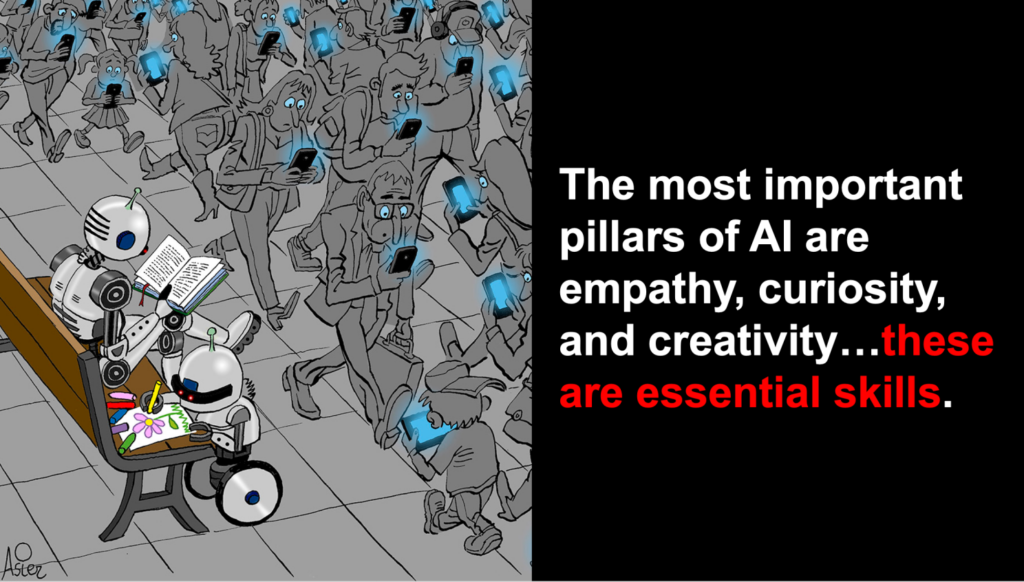
One of the ironies of AI is that the more capable the technology becomes, the more important human qualities become.
Empathy.
Curiosity.
Creativity.
Judgment.
Critical thinking.
Courage.
I don’t love calling them “soft skills.” There is nothing soft about them. These are the skills that determine whether we ask better questions, challenge assumptions, imagine new possibilities, and recognize when the answer AI gives us is elegant but wrong.
As a digital anthropologist, one of the most important things I’m studying is how AI affects us as individuals. AI can make us faster. It can also make us dependent. It can augment our thinking. It can also quietly replace our thinking if we let it.
Many leaders are already offloading too much judgment to AI. They trust the machine’s confidence. They second-guess their own experience when AI disagrees. They start to mistake fluency for truth.
AI will tell you your prompt was brilliant. It will validate you. It will make you feel like the smartest person in the room.
The answer more than AI fluency. It is augmented intelligence. It is AIQ: the ability to combine human intelligence, emotional intelligence, strategic intelligence, and artificial intelligence to create outcomes neither humans nor AI could achieve alone.
AI + human is the real summit.
But that requires leaders to create cultures where people can think, challenge, experiment, and be wrong.
Sir Ken Robinson famously warned that we educate people out of their creative capacities. By adulthood, many people are afraid to be wrong. Then they enter organizations that stigmatize mistakes, reward conformity, and call predictable thinking “alignment.”
That culture cannot innovate.
At Google, one of the most important studies of high-performing teams found that psychological safety was the differentiator. The best teams felt safe asking questions, challenging ideas, and being wrong.
That is where innovation begins.
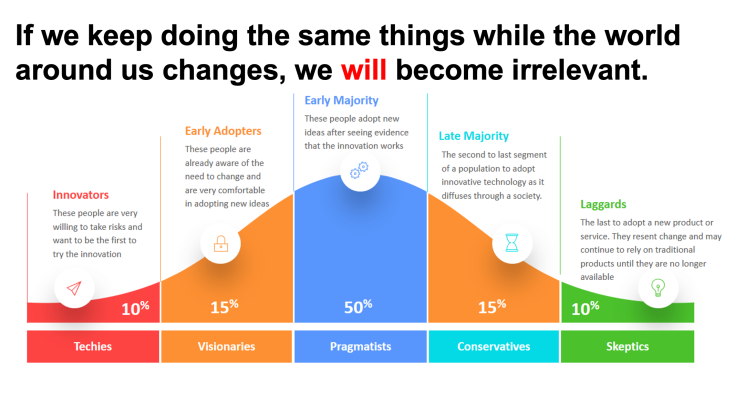
Most brainstorming sessions produce safe ideas because people bring the fear of being wrong into the room. Safe ideas produce linear outcomes. Linear outcomes produce iteration.
Innovation requires a different environment. It requires permission to challenge the status quo before the market does it for you.
Netflix and the courage to cannibalize success
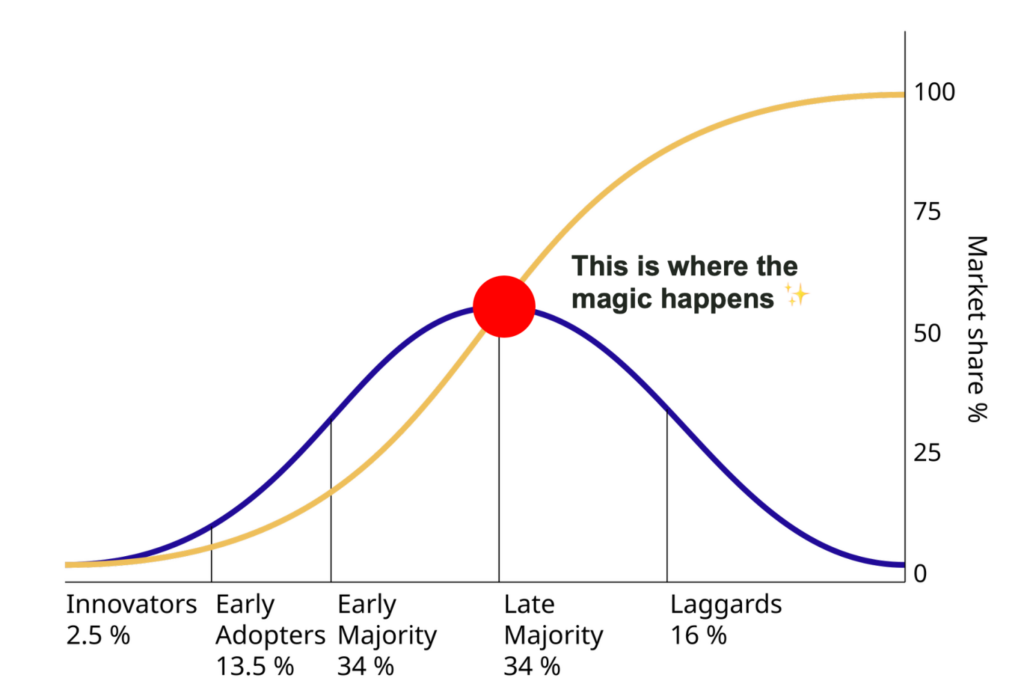
Netflix is one of the clearest examples of a company willing to jump the curve.
I had the opportunity to spend time with Marc Randolph, co-founder of Netflix. One of the original ideas before DVDs-by-mail was hair care by mail. Shampoo, conditioner, treatments. Not exactly the Netflix we know today.
But what made Netflix remarkable wasn’t the first idea. It was its willingness to evolve.
Netflix cannibalized successful models to create the next one. DVDs by mail gave way to streaming. Streaming gave way to original content. Original content was informed by data. Each era required the company to challenge the very model that was working.
In 2000, Netflix famously tried to sell itself to Blockbuster for $50 million. Blockbuster laughed them out of the room.
The lesson isn’t just that Blockbuster missed streaming. The deeper lesson is that Blockbuster followed the curve while Netflix tried to jump it.
Once you are following someone else’s future, you are already behind. Unless you are an exceptional fast follower with extraordinary execution and category-creation strength, the market starts to move without you.
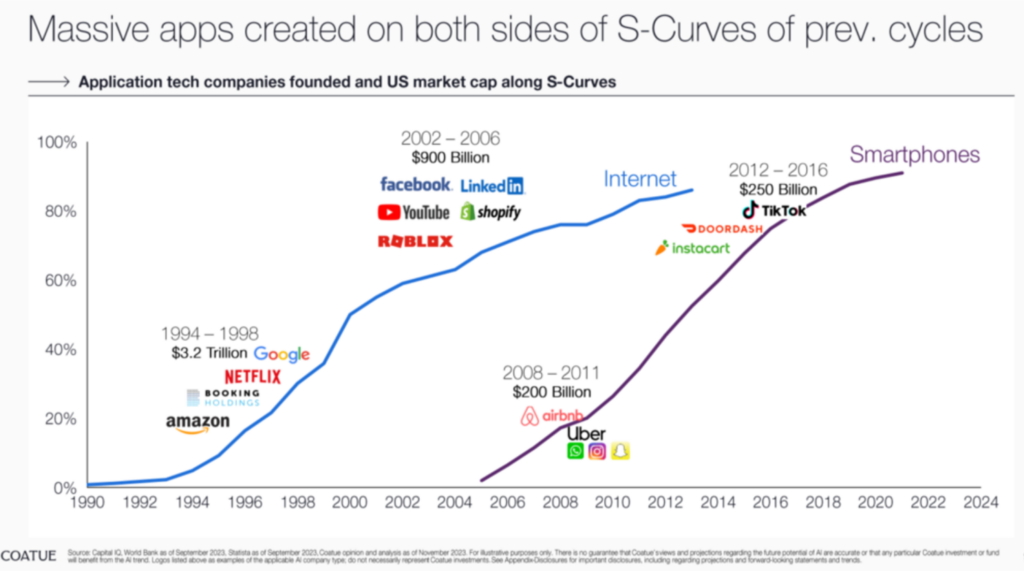
All leaders should take this seriously.
The future competitor may not look like today’s competitor. The company that reimagines security may not come from the security industry. It may come from enterprise software, AI infrastructure, insurance, real estate, facilities management, robotics, identity, logistics, or smart cities.
That is how disruption works. It usually arrives from the edge, not the center.
The unknown unknowns are where innovation lives
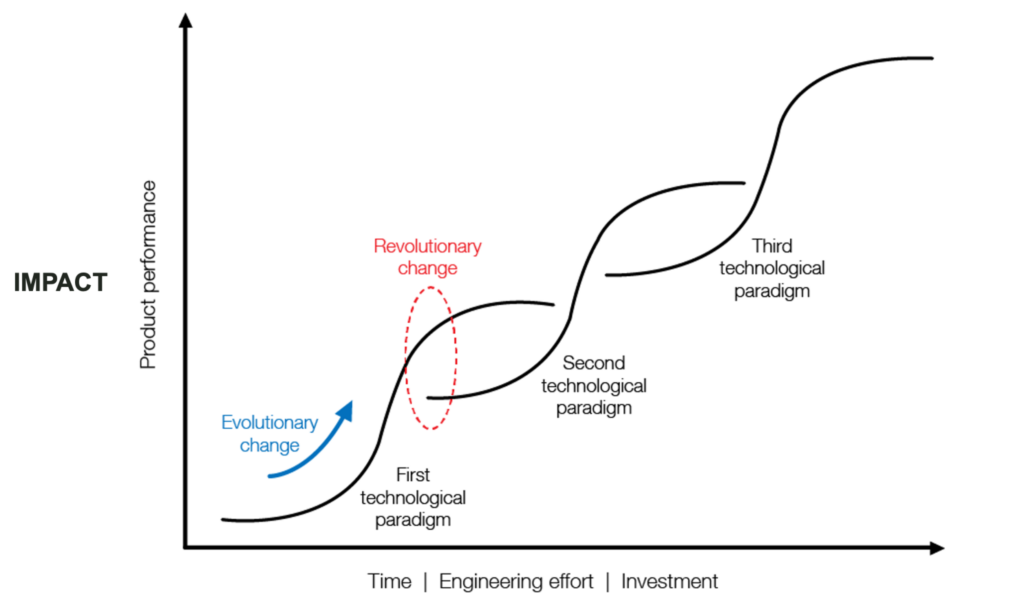
Strategy usually starts with what we know.
We are all products of our experience. Leaders become leaders because they have built expertise, pattern recognition, instincts, and judgment. The problem is that what we know can also become a cage.
Around what we know is what we know we don’t know. That is the realm of research, planning, benchmarking, and learning.
But outside of that is the most important space: what we don’t know we don’t know.
That is where innovation lives. This is where we can benefit from a mindshift.
It is uncomfortable because it isn’t immediately tangible. It doesn’t always fit into existing metrics. It may not satisfy current committees. It may look risky because it threatens today’s model. But often what we call “high risk” is really just “hard to change.”
Venture capitalists live in that outer realm. They are not looking for 5% improvement. They are looking for exponential outcomes. They have built systems to explore uncertainty, place bets, learn quickly, and scale what works.
Enterprises need their own version of that capability.
They need a disciplined way to explore the unknown.
Stay curious. Think big. Start small. Fail quickly. Scale fast.
That was one of the closing ideas in my presentation. Think of it as an operating model.
The questions physical security leaders should be asking now
The slides I didn’t fully get to in the room were designed to push this conversation into leadership practice.
What are we optimized to protect?
Revenue streams? Standards? Compliance models? Committee processes? Existing systems?
Where are we mistaking legacy for performance?
Old approval processes? Fragmented systems? Manual workarounds? “That’s just how we work”?
What are we underinvesting in because it threatens today’s model?
New customer journeys? AI-enabled services? Alternative delivery models? Capability uplift? Reimagined operating models?
Where are we calling something “high risk” when it is really “hard to change”?
These questions matter because the future of physical security will not be defined by AI alone. It will be defined by the leaders who decide what AI is allowed to change.
Some organizations will use AI to reduce cost.
Some will use AI to improve efficiency.
Some will use AI to make existing products smarter.
A smaller group will use AI to reimagine what security is, what it enables, and how it creates value across the enterprise.
That smaller group will shape the next category.
The Chief Workflow Officer and the end of siloed transformation
After the talk, one of the conversations turned to change management, which is always the hard part. The technology is often easier to understand than the organizational psychology required to make it matter.
This is why ServiceNow Chief Innovation Officer Dave Wright and I have been exploring the idea of a Chief Workflow Officer (you can learn more in Infinite).
We believe it’s a missing leadership function in AI business reinvention.
AI ROI does not come from sprinkling intelligence onto isolated tasks. It comes from reimagining workflows end to end. That requires someone to start with the business outcome, map how work actually flows across silos, connect systems and data, redesign roles, and define where humans, AI, agents, and governance belong.
Most workflows are treated vertically because organizations are structured vertically. But value usually flows horizontally.
A security incident is more than just a security incident. It may touch facilities, HR, legal, compliance, operations, IT, customer experience, emergency response, insurance, communications, and leadership. A credentialing workflow isn’t just access control. It is identity, trust, policy, employee experience, visitor management, risk, and data.
AI reveals how fragmented work really is.
That is why the first step is ask, “what outcome are we trying to create, and how must work flow differently to achieve it?”
The next chapter belongs to the dilemma’s innovator
The title of my keynote was “The Dilemma’s Innovator.”
It is a play on the innovator’s dilemma, but it is also a call to action.
I called the keynote “The Dilemma’s Innovator” because every leader today is living inside Christensen’s innovator’s dilemma, but AI has raised the stakes and accelerated the timeline.
Christensen taught us that great companies don’t usually fail because they do the wrong things. They fail because they keep doing the right things for the business they already understand. They protect today’s customers, margins, products, processes, and performance metrics until tomorrow’s market is built by someone else.
AI makes that dilemma unavoidable.
The question is no longer whether leaders should optimize the current business. They must. The question is whether they can also become the innovator inside the dilemma. Can they use AI not just to improve what exists, but to imagine what should exist next? Can they automate the past while also building the future? Can they disrupt themselves before someone else does?
That is the dilemma’s innovator: the leader willing to protect what works, challenge what limits growth, and use AI to create new value before the market forces the issue.
The dilemma’s innovator is the leader who can hold both truths at once.
Improve what deserves to be improved.
Reimagine what must be reimagined.
Use AI to drive efficiency, but reinvest those gains into augmentation and innovation.
Protect the core, but do not become trapped by it.
Create space for teams to explore what could put the current model out of business.
Build the next curve before someone else does.
Every business, every industry, has an extraordinary opportunity ahead. Not just to become more efficient. Not just to become more intelligent. But to become more essential to the enterprise than ever before.
Will we automate the past or build what wasn’t possible before?
The delta between linear growth and exponential growth is disruption. And disruption will either happen to us, or because of us.
You, we, are the dilemma’s innovator now.
Infinite ∞ | Mindshift | Subscribe | Keynote Speaker

Leave a Reply