The conversation about AI has moved quickly from possibility to pressure or sense of urgency. Leaders are being asked to show results, justify investment, and prove that new tools are changing the business. But there is a more fundamental question underneath all of that…what happens when a new form of intelligence enters an organization whose workflows, decision rights, management systems, and operating structures were designed for a different era?
The opportunity is so much more than making existing tasks faster. It’s really about rethinking how work is organized, how decisions move, where humans create the most value, and how AI agents participate in delivering outcomes. That is where the next phase of business transformation begins.
Let’s go…
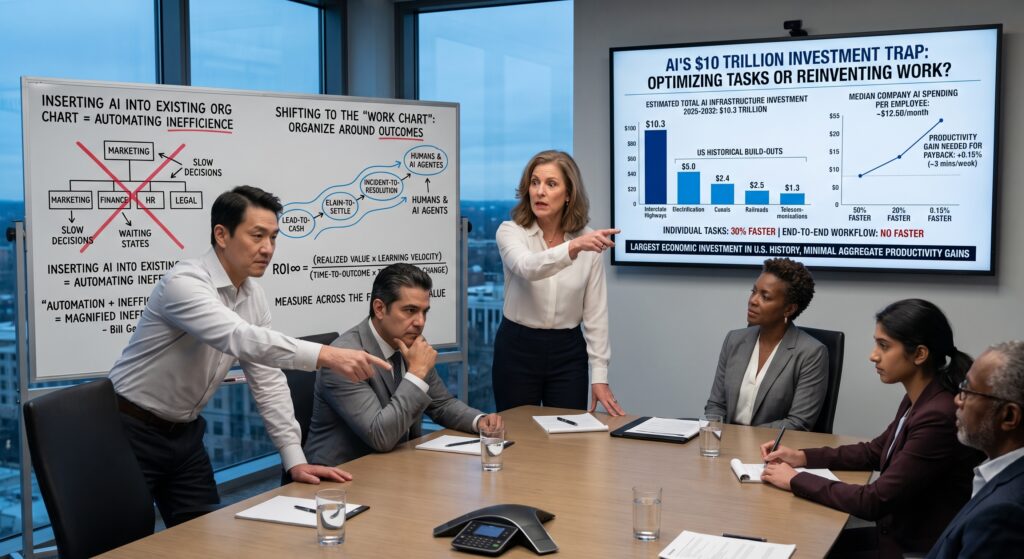
A recent Wall Street Journal analysis described the AI build-out as potentially the largest economic investment in U.S. history. Total investment in data centers and related AI infrastructure is projected to reach $10.3 trillion between 2025 and 2032, equal to an average of roughly 3.6% of GDP annually. On that basis, AI infrastructure spending would exceed the historical build-outs of highways, electrification, telecommunications infrastructure, canals, and railroads.
The five largest hyperscalers, Alphabet, Amazon, Meta, Microsoft, and Oracle, are expected to spend about $4.2 trillion through 2029.
We are no longer talking about basic use cases, AI adoption, tokens, or efficiency gains. We are building an industrial-scale infrastructure for intelligence. The question is are companies prepared to fully take advantage of the opportunity or will this moment symbolize an incredibly expensive set of missed opportunities.
Chamath Palihapitiya kicked off a global conversation when he published an analysis asking why AI adoption is accelerating while aggregate productivity gains remain harder to see.
One of the most useful observations in his piece is how little productivity improvement AI actually needs to generate, at least on paper, to cover its direct cost.
Using Ramp’s AI Index spending data, Chamath notes that the median company spends approximately $12.50 per employee per month on AI. Against an average monthly employee cost of roughly $8,500, AI would need to make that employee only about 0.15% more productive to pay for itself. That translates into roughly three additional productive minutes per week. Already, AI is already capable of saving considerably more than three minutes.
The growing body of research around generative AI shows meaningful productivity gains in writing, coding, analysis, customer service, research, and product development. Chamath points to a P&G example where an individual working with AI was able to produce work with AI comparable in quality to that of a two-person team. He also cites research suggesting that AI-driven automation produces greater returns when work can be grouped together and humans review results at meaningful checkpoints rather than continually interrupting the process.
Yet these studies also expose a more fundamental problem.
AI may make the task faster while the organization around the task remains exactly the same.
That distinction is where much of the ROI conversation begins to break down.
The Productivity Gain Can Disappear Inside the Organization
Imagine AI helps someone complete an analysis in 20 minutes instead of two hours. That’s a real productivity gain. But what happens next?
The analysis may sit in an inbox until the following morning. A manager reviews it. Legal needs to see it. Finance must approve an associated decision. Another department enters the information into another system. The final decision waits until a weekly operating review.
The employee may have saved 100 minutes, but the end-to-end workflow hasn’t moved materially faster because it wasn’t intentionally redesigned. Transformation wasn’t the end-game.
In reality, AI is evolving faster than company culture, behaviors, bureaucracy, and an organization’s overall ability to adapt…end-to-end.
This is why we need to distinguish between different forms of productivity.
At the task level, AI helps someone perform an activity faster, cheaper, or better.
At the workflow level, the question becomes whether the entire sequence of work moves faster…whether handoffs disappear, decisions happen sooner, information moves directly between steps, and agents can take bounded action rather than merely creating another artifact for a human to review.
At the enterprise level, the question is whether those improvements ultimately translate into more revenue, better margins, faster innovation, better customer outcomes, lower risk, greater resilience, or some other measurable result.
These forms of productivity are related, but they are not interchangeable. A company can create significant task-level productivity without creating significant enterprise productivity. The missing variable is often the design of the work itself. This is exactly what Dave Wright, Chief Innovation Officer at ServiceNow, and I set out to solve in our book, “Infinite: How Visionary Leaders Transform Today’s Businesses into AI-Forward Companies.”
The Problem Is Not Human Productivity, It Is Organizational Architecture
Chamath raises a provocative question, what if humans are the bottleneck to AI ROI?
Dave and I would take it one level further.
We didn’t see humans themselves are the bottleneck. The bottleneck is the way we have organized humans, technology, processes, incentives, decision rights, and information workflows.
Modern organizations were designed around historical constraints. Resources and information were scarce and difficult to move. Computing resources were expensive. Expertise lived in specific functions. Managers coordinated work through hierarchies. Applications and tech stacks were built around departments. Decisions moved upward because intelligence was concentrated at the top.
Over time, those assumptions became embedded in the operating model.
Org charts defined reporting relationships. Applications reflected functional boundaries. Budgets reinforced departmental ownership. Policies introduced layers of approval. Meetings and email compensated for all the places where information and work didn’t move cleanly across the organization.
Then AI arrives with the ability to generate, reason, analyze, coordinate, recommend, and increasingly act. Suddenly “intelligence” was abundant.” Yet much of corporate AI adoption still consists of inserting that new intelligence into the same organizational architecture.
That is the fundamental mismatch.
We are introducing AI into businesses designed around very different assumptions about the cost, availability, and speed of intelligence. If those businesses do not change, AI may make individual tasks more efficient while leaving the larger system largely untouched.
Worse, it can make inefficient systems operate faster.
As Chamath pointed out, Bill Gates made this point decades ago when he observed that automation applied to an efficient operation magnifies efficiency, while automation applied to an inefficient operation magnifies inefficiency.
Chamath also pointed out Elon Musk’s similar lesson at Tesla. His process is to 1) question every requirement, 2) delete what is unnecessary, 3) simplify what remains, 4) accelerate it, and only then 5) automate it.
He acknowledged making the mistake of automating processes that should not have existed in the first place. And he observed that many companies start with automation and are now repeating that mistake with AI. They are introducing automation and agents before questioning whether the underlying work should exist or be organized the same way at all.
This is what Dave Wright and I describe in Infinite as the “Iteration Trap,” using powerful new capabilities primarily to improve the organization we already have rather than asking what kind of organization those capabilities now make possible.
That’ll likely produce improvement. It can also produce an increasingly sophisticated version of the status quo.
The Same AI Can Produce Very Different Companies
One of the most interesting examples in Chamath’s article comes from a 2026 experiment involving 515 startups.
The companies received the same AI tools, training, and support. A randomly selected group was additionally exposed to examples showing how other firms had reorganized their work around AI.
The technology was the same. But the difference was what companies learned to do with it.
For the median startup, the revenue impact remained relatively modest. But gains were heavily concentrated among the highest-performing firms. Chamath highlights that the treatment group ultimately generated 1.9 times the revenue of the control group overall, with much of the gain coming from the top portion of participating companies.
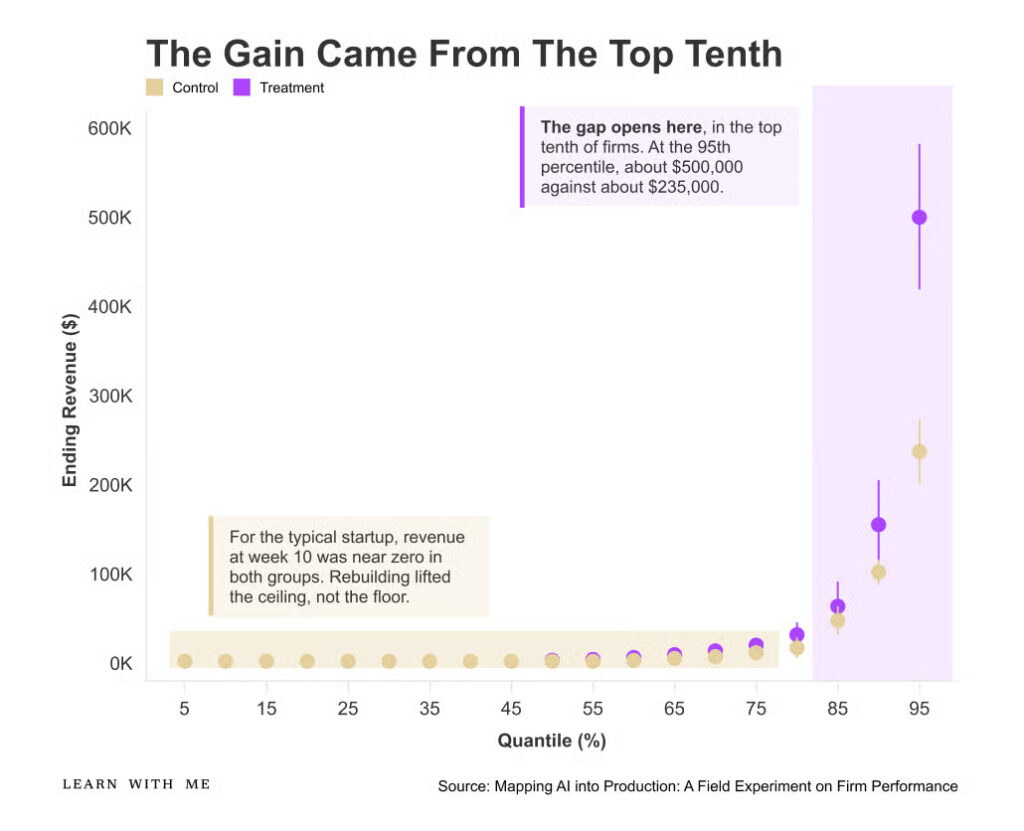
Across much of the distribution, the groups remain relatively close. The gap opens among the highest-performing firms, where companies exposed to new ways of organizing work around AI pulled significantly ahead.
This suggests AI may amplify differences in organizational capability.
As access to advanced models, copilots, and agents becomes more widespread, the technology itself becomes less differentiating. Advantage shifts toward the organization’s ability to translate intelligence into decisions, decisions into action, and action into learning.
That is ultimately a work-design advantage. On the other end, AI can simply scale a new efficient class of AI-powered status quo.
Stop Asking How Each Department Should Use AI
This is where many enterprise AI strategies remain too narrow.
Organizations naturally approach AI through the structure they already know.
How should marketing use AI?
Finance?
HR?
Sales?
These are reasonable questions, but they also reinforce the functional architecture of the existing company…silos.
A more transformative question begins somewhere else: What outcome are we trying to create, and how should work now happen in order to create it?
Consider lead-to-cash, claim-to-settle, incident-to-resolution, idea-to-product, or order-to-cash.
These outcomes rarely belong to one department. They move across functions, systems, policies, data sources, and decision points.
The customer does not experience the org chart. The customer experiences the workflow.
Yet companies traditionally optimize each function separately, allowing individual departments to improve while the end-to-end experience remains slow, fragmented, and difficult to change.
AI gives leaders an opportunity to rethink that architecture.
In Infinite, Dave and I describe the shift from the Org Chart to the Work Chart.
The Org Chart organizes people around reporting relationships. The Work Chart organizes humans, AI agents, systems, data, and decision rights around outcomes.
Once you begin with the outcome rather than the department, a different set of questions becomes possible:
Which work no longer needs to exist?
Where does human judgment create differentiated value?
Where can agents operate independently within defined boundaries?
Where are decisions delayed because authority is separated from intelligence?
Where is the customer waiting while the organization coordinates itself?
These are not primarily technology questions. They are operating-model questions.
And increasingly, they are leadership questions.
Measure AI Across the Flow of Value
Added up, all of this also changes how organizations should think about ROI.
If the primary measure is cost or hours saved, companies may optimize the wrong thing.
Suppose AI reduces the time required to perform a specific analysis by 30%. That sounds impressive. But if the analysis represents only 5% of the total time required to complete the broader workflow, the enterprise impact may be negligible.
Conversely, an agent that reduces one crucial decision cycle from five days to five minutes may create outsized business value even if the direct labor savings appear relatively small.
AI therefore has to be measured across the flow of value, not just the speed of individual activity.
What happened to cycle time?
What happened to time-to-decision?
What happened to customer effort?
What happened to the number of handoffs and waiting states?
What happened to the organization’s ability to learn and adapt?
Those questions move AI ROI away from an employee-productivity conversation and toward business performance.
From Return on Investment to Return on Intelligence
Chamath introduced a formula for AI ROI expressed as AI ROI = Financial Value Created by AI minus the Cost of AI, Divided by the Cost of AI.

In Infinite, Dave and I introduce a complementary idea we call ROI∞, or Return on Intelligence.
Since we live in the world of driving, or attempting to drive, enterprise AI transformation, we include the real world human costs as well. The premise is that AI creates value not only by lowering the cost of performing work, but by changing the speed at which an organization can sense, understand, decide, act, learn, and adapt.
We express it conceptually this way:
ROI∞ = (Realized Value × Learning Velocity) ÷ (Time-to-Outcome × Resistance to Change)
Realized value remains essential. AI initiatives must ultimately create measurable business outcomes.
Learning velocity represents the organization that learns faster to continually improve how it creates those outcomes.
Time-to-outcome represents intelligence that drives action with the intent of that action to create value, otherwise delayed insights-to-action cause the opposite effect… loss of value and ultimately, opportunity costs.
And resistance to change matters because even the most sophisticated AI strategy will struggle inside an organization whose incentives, governance, culture, or management systems prevent the operating model from evolving.
This is where AI begins to change the nature of organizational advantage.
Traditional companies tend to operate primarily in calendar time…weekly meetings, monthly reviews, quarterly planning cycles, annual strategy processes.
AI-forward organizations increasingly have the opportunity to operate in event time, where signals can be interpreted as they emerge, humans or agents can propose and take action within defined boundaries, outcomes generate new intelligence, and the system continuously learns.
The advantage isn’t just about that one employee who performs a task faster. It is that the organization itself becomes capable of moving and learning at a fundamentally different speed.
The Bigger AI Bet Is Organizational
There is extraordinary scale of the infrastructure investment now underway when employed in a novel economy.
The Wall Street Journal reports that AI spending is already affecting construction, labor markets, electricity availability, land prices, technology costs, capital markets, and inflation. The financial stakes are also becoming systemic, with a growing share of hyperscaler investment being financed through debt.
That makes this moment different from an ordinary enterprise software cycle.
We are investing enormous amounts of capital to make intelligence more abundant, accessible, and actionable. The return on that infrastructure will ultimately depend on whether businesses learn how to use it to create new forms of value. That requires more than adoption. It requires redesign.
CEOs and boards should absolutely ask how much their organizations are spending on AI and what return those investments are generating. But they should also ask harder questions.
Where is AI accelerating activity without accelerating outcomes?
Where are productivity gains being absorbed by organizational friction?
Which workflows should no longer look the way they do today?
Where can humans and agents operate differently?
Which policies and management practices were designed around technological limitations that no longer exist?
And perhaps most importantly: If we were designing this company today, with the capabilities now available to us, would we design the work this way?
That is the question that separates AI optimization from business reinvention.
The first generation of enterprise AI has largely been about helping people perform existing work faster.
The next generation will be about redesigning how work happens in the first place…and why. That may ultimately determine whether the largest AI investment in history becomes one of the greatest productivity revolutions in history. It’s that or one of the most expensive exercises in automating the past.
I guess you, we, collectively, get to decide.
∞
Infinite ∞ | Mindshift | Subscribe | Keynote Speaker



Leave a Reply