
I’ve spent much of my career studying how technology changes people and how those changes eventually reshape markets, organizations, and culture (or how it needs to). AI is accelerating and stressing that cycle in ways and speeds I have not seen before. This is why I keep one question close by. Are we using this moment to rethink what is possible, or merely to make what already exists faster, cheaper, or more efficient?
It’s something to think about…
When the future gets literally booed, we need to talk about it. Why? Because it reflects culturally where we lack leadership at work, university/school, and at home.
🚨NSFW
Now, with that said…
I recently joined leaders from the American Supply Association in Newport, Rhode Island, for a conversation about artificial intelligence, the future of work, and the changing role of leadership. Although the presentation was designed for executives from supply, distribution, manufacturing, and construction, the discussion quickly moved beyond any one industry. The questions in the room were the same questions confronting leaders everywhere: What does AI actually mean for our businesses? How quickly should we move? What happens to our people? Where do we begin? How do we measure success (and what does it look like?). And perhaps most honestly, what are we supposed to know when no one has a complete playbook?
I have spent much of my career studying how technology changes behavior and how those behavioral shifts eventually reshape markets, organizations, and culture. AI is different from previous waves of innovation because it is not confined to one device, platform, department, or customer experience. It is influencing how people search, write, learn, decide, communicate, create, shop, manage, and work. It is moving into every function at once, while its capabilities continue to improve at a pace most organizations are not designed to absorb let alone scale.
That does not mean the future is predetermined. Technology may introduce new capabilities, but people determine what those capabilities become. The most consequential question facing leaders is whether we will use AI primarily to optimize what we did yesterday or to imagine what could or should exist tomorrow.
Technology Changes People, and People Change Markets
Every major technology begins as something obscure, unnecessary, or even threatening. Over time, it becomes useful, then convenient, then expected. Eventually, the behavior it introduced becomes so normal that we forget how quickly or dramatically we changed.
For example, I told the sequential steps from the Internet to Ubers and Lyfts to Waymos and the autonomous flying vehicles that come next.
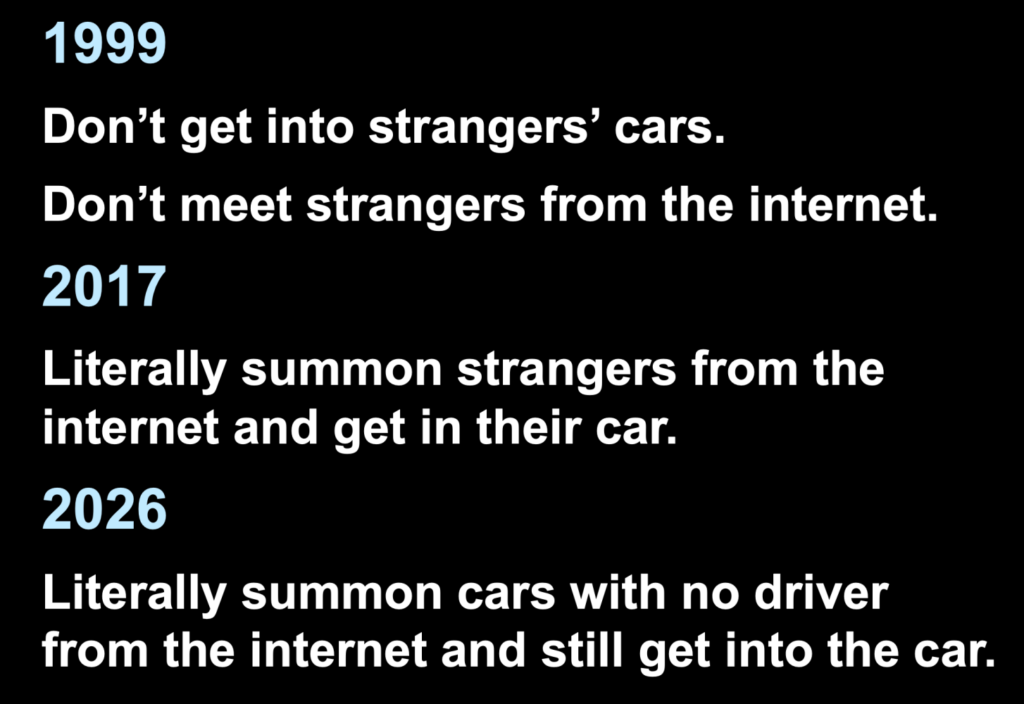
In 1999, parents warned their children not to meet strangers from the internet and certainly not to get into their cars. Less than two decades later, millions of people were summoning strangers from the internet and climbing into their vehicles without hesitation. Today, in cities such as San Francisco, Los Angeles, and Austin, people can summon a car with no driver at all. What once sounded reckless became innovative, then convenient, and finally ordinary.
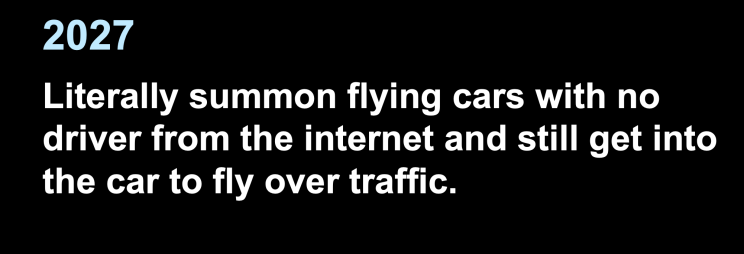
https://www.youtube.com/watch?v=wEWs1VYXTS0
The same progression is unfolding with AI. People are already giving intelligent systems access to their calendars, preferences, communications, documents, and decisions. AI agents are beginning to research, schedule, compare, recommend, purchase, and act on behalf of users. Some of these behaviors still feel experimental, but so did mobile banking, social media, streaming, and ride-sharing when they first appeared.
This matters for business because technology does more than improve convenience. It resets expectations. Once customers experience an intelligent, personalized, immediate response in one part of their lives, they begin to expect that level of service everywhere. They do not care whether your company operates with legacy systems, fragmented data, old approval structures, or entrenched processes. They simply know that another company made something feel easier.
Your customers are not comparing your business only with your closest competitor. They are comparing it with the best experience they have anywhere. Their expectations are being shaped by Amazon, Apple, Uber, Netflix, ChatGPT, and every other platform that teaches them what speed, personalization, simplicity, and intelligence can feel like.
That is why AI is not only a technology initiative. It is a customer-experience issue, a workforce issue, an operating-model issue, and a leadership issue.
AI Anxiety Is Often a Reflection of Leadership
Many employees, particularly younger workers, encounter AI through headlines about layoffs, automation, job loss, and displacement. Then they hear their own executives describe AI in terms of efficiency, productivity, cost reduction, and doing more with fewer resources. It is not difficult to understand why enthusiasm may be limited.
Employees are not necessarily resisting the technology itself. They may be resisting the future they believe leadership is designing around it.
When companies introduce AI without a clear human narrative, people are left to fill in the blanks. Executives say “transformation,” while employees hear “replacement.” Leaders say “productivity,” while teams hear “more work with fewer people.” Management says “efficiency,” while workers wonder whether their experience, judgment, and contribution are being reduced to a line item.
This is not simply a communication problem. It is a trust problem, and trust cannot be repaired with a training module or a software demonstration.
Leaders have to explain why AI is being introduced, how work will change, which skills will become more valuable, what employees will be able to do that they could not do before, and how the value created by AI will be reinvested. They must show that the goal is not merely to make work cheaper, but to make people more capable and the organization more valuable.
The most responsible leaders aren’t promising that roles won’t ever change. They will help people understand how roles evolve and give them the tools, support, and confidence to evolve with them. They are creating a future with their employees instead of announcing a future to them.
AI Still Needs Human Direction
For all the extraordinary claims made about artificial intelligence, AI does not understand your company in the way you do. It does not possess institutional memory, lived experience, moral responsibility, empathy, or a sense of purpose. It can identify patterns, generate options, synthesize information, and increasingly take action through AI agents, but it does not inherently know what matters.
That distinction is essential because business decisions are rarely based on information alone. They involve context, tradeoffs, consequences, timing, relationships, values, and judgment. A recommendation may be mathematically sound and still be strategically foolish. A decision may increase efficiency while damaging trust. A process may become faster or less expensive while producing a worse experience for employees or customers.
AI cannot resolve those tensions on its own. It needs people who can recognize what is missing, challenge the answer, understand the broader context, and decide what outcome is worth pursuing.
This is why leadership becomes more important in an AI-driven organization, not less. The companies that succeed will not simply be those that deploy the most models, copilots, or agents. They will be the companies that develop people who know how to think more expansively because these tools exist.
The Risk of Outsourcing Our Thinking
One of the easiest mistakes to make with AI is to confuse speed with intelligence. When a tool can write an email, summarize a report, build a presentation, or produce an answer in seconds, it feels as though we have become more productive. Sometimes we have. At other times, we’ve simply transferred our thinking to a system and accepted whatever came back. And that can create AI slop and impose an AI tax on others.
Convenience can become dependency. And with AI help, it might become the MO. If AI writes every message, distills every document, frames every argument, and proposes every decision, we may save time while gradually weakening the skills we need most: critical thinking, synthesis, creativity, judgment, and original point of view.
The more valuable use of AI is not to have it think instead of us or for us, but to help us think beyond ourselves. It can compare opposing perspectives, uncover contradictions, challenge assumptions, model scenarios, simulate stakeholder reactions, and surface questions we may not have considered.
Consider the difference between asking AI to summarize ten reports so you do not have to read them and asking it to compare those reports, identify where they disagree, surface convergences or next layer implications, and reveal the questions no one appears to be asking. The first saves time. The second improves the quality of thought and your differentiated value.
From AI Fluency to Augmented Intelligence
Many organizations are now focused on AI adoption and fluency. Employees are being taught how to use chatbots, copilots, image generators, and other intelligent tools. This work is necessary, but fluency should be treated as the starting point rather than the destination.
Knowing how to operate AI does not mean knowing how to create meaningful value with it. A person can learn to prompt a system without learning to think more creatively, question assumptions, or make better decisions.
I’ve been exploring this distinction through the concept of AIQ. The term is often used to describe an Artificial Intelligence Quotient, or a person’s ability to understand and use AI. I believe we need a more ambitious definition: Augmented Intelligence Quotient.
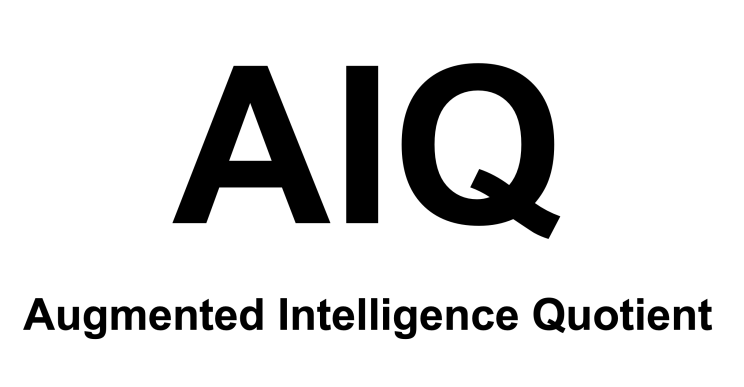
The Augmented Intelligence Quotient is the ability to combine human imagination, judgment, empathy, creativity, and experience with machine speed, scale, and pattern recognition. It is not about asking AI to do our work for us. It is about using AI to extend what we are capable of seeing, understanding, and creating.
Said another way, AIQ is the practice of exploring what we could not produce without AI and what AI could not create without us.
A leader with basic AI fluency may AI to write a strategy memo. A leader practicing augmented intelligence may ask AI to challenge that strategy from the perspective of a customer, competitor, regulator, employee, investor, and future market entrant. The value is not simply in producing more content. It is in improving the quality of the leader’s judgment before a decision is made.
Leaders who use AI to ask more consequential questions will develop more original ideas and make better decisions.
You Compete With AI, Not Against It
The public narrative often positions humans and machines as opponents. It makes for an effective headline, but it is not the most useful way to think about the future of work.
In practice, the more immediate competition is between people who know how to work with AI and people who do not. A salesperson who uses AI to understand an account, prepare for a meeting, anticipate objections, and personalize recommendations will have an advantage over someone relying only on memory and instinct. A manager who uses AI to model scenarios, identify operational patterns, and challenge assumptions will have an advantage over someone relying exclusively on historical reports.
The same is true at the organizational level. A company that combines human expertise with machine intelligence will outperform one that treats AI only as an efficiency or cost-reduction tool.
This is also why the skills becoming more important in the AI era are deeply human. Curiosity, creative thinking, empathy, resilience, adaptability, critical judgment, and the ability to learn and unlearn will become more valuable because machines can scale execution, but humans must still determine what deserves to be scaled.
Iterative AI and Innovative AI
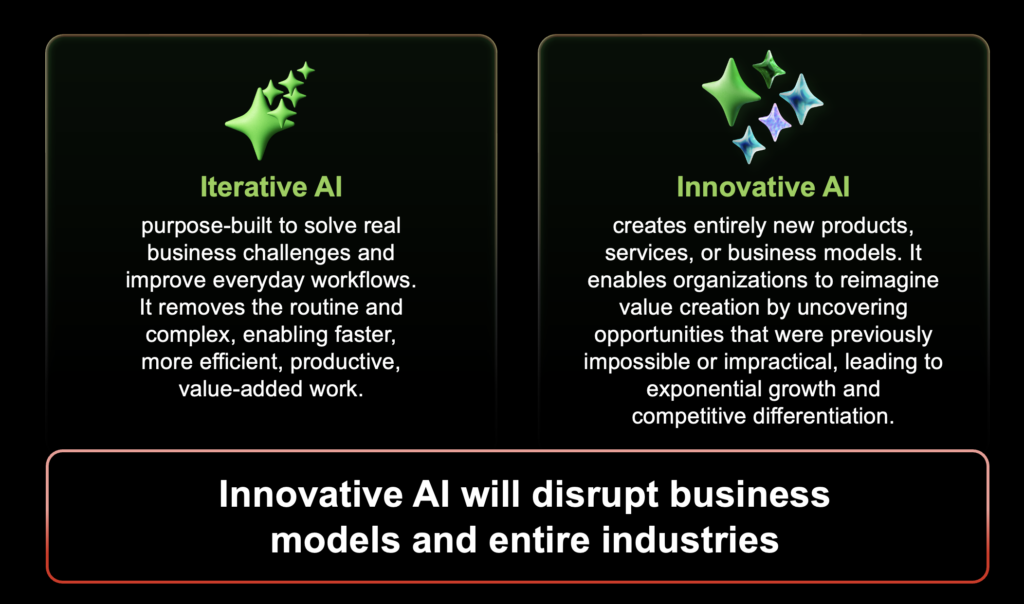
One of the most useful distinctions for leaders is the difference between iterative AI and innovative AI.
Iterative AI improves what the organization already does. It can make processes faster, reduce costs, remove friction, automate repetitive work, improve forecasting, and increase productivity. It asks familiar and necessary questions: How can we perform this task more efficiently? Where can we remove bottlenecks? How can we reduce errors? How can we serve customers more quickly?
Every organization should pursue these opportunities because there is no virtue in preserving unnecessary complexity or inefficient work.
The risk appears when optimization becomes the entire strategy.
Innovative AI asks a different set of questions. Why does this process exist in the first place? Are we solving the right problem, or simply improving an old solution? What customer need remains unmet? What new service, experience, or business model becomes possible now that intelligence is more scalable? What would we create if we were starting the company today?
Iterative AI improves the current business. Innovative AI helps build the next one.
The strongest companies will pursue both, using efficiency gains to create the capacity required for reinvention. That second step is where many organizations fall short. They automate work, reduce expense, and declare success without deciding how the liberated time, talent, and resources will be invested in growth.
Efficiency is valuable, but it is not the same as innovation. You cannot automate your way to imagination, and you cannot cut your way to growth.
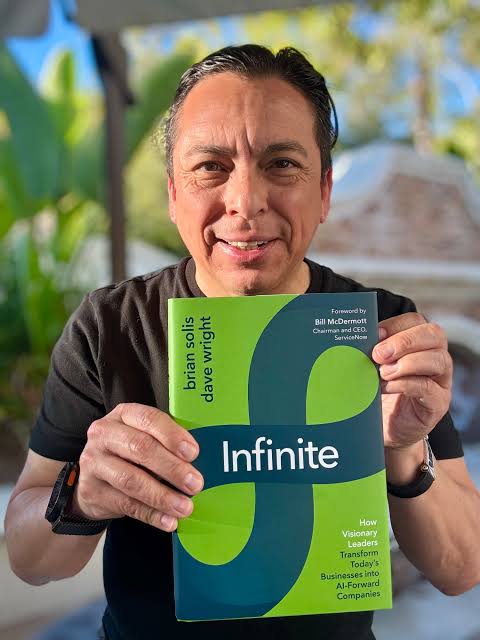
Dave Wright and I explore this topic and what to do differently in depth in our new book, “Infinite: How Visionary Leaders Transform Today’s Businesses into AI-Forward Companies.”
Every Business Has a Reinvention Opportunity
The most immediate applications of AI are already visible across sales, service, operations, finance, marketing, talent, and product development. AI can help teams prepare for customer conversations, personalize follow-up, analyze demand, clarify proposals, improve forecasting, detect risk, summarize service histories, and recommend next actions.
Yes. These use cases matter because they improve existing work. The larger opportunity, however, emerges when intelligence begins to connect workflows and functions across the organization.
Imagine a company that anticipates demand using a combination of customer behavior, market signals, weather, operational patterns, and real-time context. Imagine a service organization that does more than resolve issues quickly; it identifies the patterns behind those issues and helps redesign the experience so the problems occur less often. Imagine training that continuously adapts to an employee’s role, performance, knowledge gaps, and customer needs. Imagine turning years of institutional expertise into an intelligent service that customers can access whenever they need it.
This goes beyond productivity. These ideas represent new capabilities, better experiences, and potentially new sources of revenue.
This is where AI moves from optimization to reinvention.
Start with One Workflow, but Question the Workflow
Leaders often ask where to begin, and a practical answer is to select one meaningful workflow. Choose an area where friction is visible, the outcome matters, and employees or customers would notice the improvement. Establish clear governance, define what AI can access and do, and create a controlled environment for experimentation.
Governance is especially important as AI agents become more capable of interacting with systems and performing work. Organizations must define what requires human approval, what should be monitored, which actions are prohibited, and how mistakes will be contained.
At the same time, governance should enable responsible experimentation rather than become a sophisticated excuse for doing nothing.
Once a workflow has been selected, leaders should resist the temptation to automate it exactly as it exists. Many business processes were designed for another era, shaped by paper forms, functional silos, manual approvals, disconnected systems, and organizational politics. Automating a flawed process can make dysfunction move faster, which is an impressive technical achievement but a questionable business strategy.
Begin with the outcome instead. What is the customer or employee trying to accomplish? Where is information lost? Which steps add value and which survive only because no one has challenged them? Where is human judgment essential? What can AI handle? What should always be escalated? How would this workflow be designed if intelligence were available from the beginning?
That’s how business reinvention takes shape: not through one sweeping transformation program, but through the thoughtful redesign of value creation, one workflow at a time.

Innovation Requires a Beginner’s Mind
Experience helps leaders recognize patterns, avoid mistakes, and make decisions quickly. It can also become a filter that limits what they are willing to consider. Experts know what has worked. Innovators remain curious about what may work next.
A beginner’s mind does not require abandoning expertise. It means creating enough distance from what we know to explore what we may be missing.
Most leaders operate within two familiar categories: what they know and what they know they do not know. Together, these define the boundaries of the comfort zone. AI gives us a powerful way to explore a third category: what we do not know we do not know.
That territory is ambiguous and difficult to measure. It may not come with a benchmark, case study, or guaranteed return. It is also where new possibilities tend to emerge.
To explore it, organizations need more than technology. They need psychological safety. Employees must feel that they can ask questions that sound naïve, challenge assumptions that appear permanent, and test ideas that may not work. Leaders who demand certainty from the beginning will receive predictable ideas based on the past.
Innovation requires a willingness to be wrong before something more valuable can be discovered.
A More Useful Leadership Practice
Leaders do not need to become AI experts or engineers, but they do need to become more intentional about how they think with AI.
Instead of asking AI only to write the memo, ask it to find weaknesses in the argument. Instead of asking it to summarize the market, ask it to identify signals that do not fit the prevailing narrative. Instead of asking how AI can reduce the cost of service, ask what recurring service problems reveal about the design of the business. Instead of training employees only to prompt faster, redesign work so they can spend more time applying judgment, empathy, creativity, and synthesis.
A useful discipline is to begin each day with one exploratory question: What am I not seeing? Which assumption is limiting our options? What would customers expect if they knew nothing about how our industry traditionally operates? Which process would we eliminate if we were designing the company today? What new value becomes possible when human imagination and machine intelligence work together?
The goal is not to accept every answer AI provides. The goal is to use those answers to stretch our own thinking and expand the range of options we are capable of considering.
The Future Remains a Leadership Choice
AI is not something employees should be left to figure out alone, or read or hear about, and it is not a transformation that can be delegated entirely to IT. It is becoming part of how organizations think, learn, decide, operate, and create value. That makes it a leadership responsibility.
The companies that thrive will be led by people who understand how technology changes behavior, how expectations evolve, how work must be redesigned, and how intelligence can be used to create better outcomes for customers, employees, partners, and communities.
Those leaders will not pretend to have every answer. They will be willing to learn publicly, experiment thoughtfully, protect trust, create room for curiosity, and ask questions worthy of the capabilities now available to us.
AI will continue to advance. Agents will become more capable. Workflows will become more autonomous, and established business models will be challenged. Yet AI does not get to decide what your organization becomes. That remains a human responsibility and, for leaders willing to think more ambitiously, an extraordinary opportunity.
Infinite ∞ | Mindshift | Subscribe | Keynote Speaker


Leave a Reply