At Synthesia Live in New York, I had the privilege of closing a day dedicated to the future of AI video, learning, communication, and work. By the time I walked on stage, the audience had already heard amazing speakers, seen compelling demos, and explored what happens when AI powered avatars and videos becomes something more dynamic, adaptive, and personal for customers and employees.
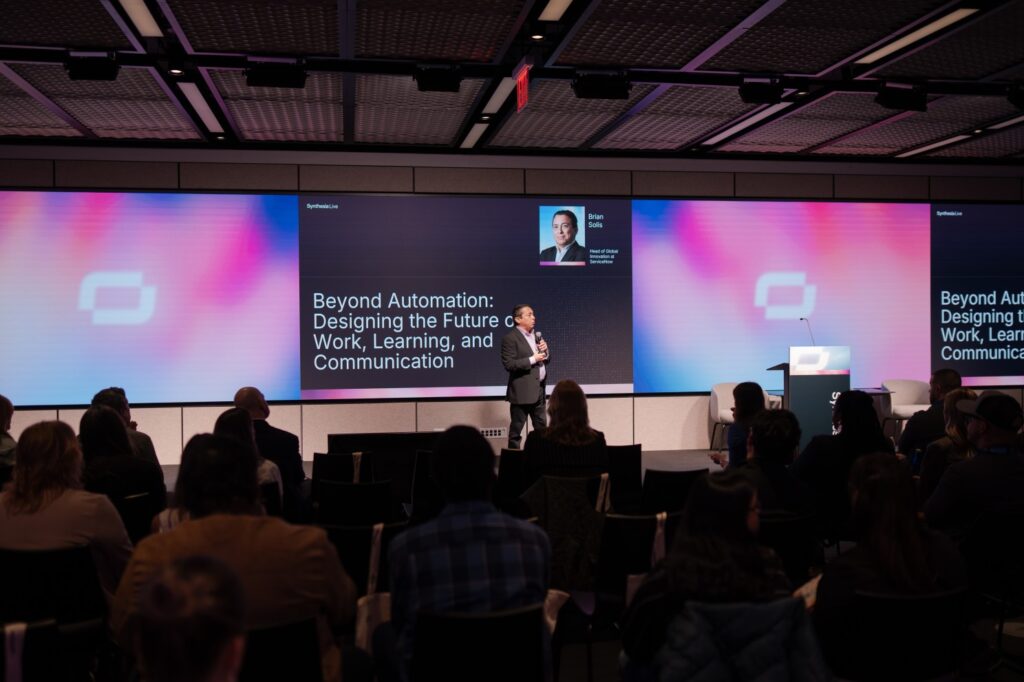
So I didn’t want to give another “AI is changing everything” talk. (Full talk at the end)
Instead, I wanted to ask a different question.
What happens when AI changes us?
You and me. Us. How we think, how we learn, how we communicate, how we create, how we lead, how we show up for customers, employees, students, and one another, how we perceive and how we’re perceived. We are and aren’t changing with how we use AI. Research shows that we’re starting to let AI do our thinking for us. We’re starting to sound and write like AI. We’re imposing an AI Tax on our friends, communities, and colleagues. We’re exchanging quality for quantity, speed for uniqueness, and content for context.
At the same time, the same is true in our work. We’re largely employing AI to do yesterday’s work. Most companies are still modernizing the past with AI. We’re doing the same in our day-to-day work, all in the name of productivity boosts.
Businesses are taking legacy processes, legacy training programs, legacy service models, legacy communications, and wrapping them in shiny new AI interfaces. They are making yesterday more efficient, cheaper, and scalable.
But faster old work is still old work.
And in what’s becoming an AI-first world, for better or worse, the opportunity isn’t to do what we already know more efficiently. The opportunity is to do what we couldn’t do before.
That was the real message of my keynote.
AI automation is only the beginning of a new AI status quo. The message I wanted to share is that the future belongs to those who use AI to augment people and help them grow, personalize experiences, and build entirely new forms of capability.
The Control-Alt-Delete Moment Facing All of Us
The night before Synthesia Live, I had flown in from Silicon Valley where I met with a group of executives from Australian universities and institutions. They were on the last stop of an AI tour and made time to visit us at ServiceNowHQ.
They had spent days meeting companies, founders, researchers, and AI leaders. They had seen enough to understand that education, work, skills, and institutions were not simply facing a technology upgrade. It was a test of vision and leadership.
By the end of our conversation, I asked them what they wanted to take back home. What was the one thing they wanted to change?
The answer was legacy.
Everything about how their institutions taught, measured, supported, and prepared people for the future was suddenly open for reconsideration. They didn’t want to go home as executives defending the institution. They wanted to go home as students, ready to learn and unlearn.
That is the mindshift AI requires.
It is not about asking, “How do we use AI to make our current model more efficient?”
It is asking, “What about yesterday deserves to live tomorrow?”
And then, with equal honesty, “What must we now do differently because the future is no longer waiting for us?”
The Student Who Built a Machine to Avoid Handwriting Homework
I shared a story during the keynote about a high school student in India. His school reportedly banned AI-generated homework and required assignments to be handwritten so students would have to think about what they were writing.
So, he built a machine that could write in his handwriting while AI generated the content.
@taylorlorenz I feel like this kid should never have to do homework again?! Also it does math! #tech #technology #ai #creator #creatoreconomy #success #artificialintelligence #siliconvalley #contentcreator #innovation #influencer
Now, the point is not to celebrate cheating. The point is to notice what happens when human imagination collides with legacy constraints.
A student saw the system, understood the constraint, and redesigned around it. You could say, he understood the assignment. Ha!
That is creativity.
That is also a warning.
If students can reimagine the future of homework, leaders can reimagine the future of work, learning, service, and communication. But only if they’re willing to stop protecting the past.
Said No Customer Ever
One of my opening slides read:
“I hope I get to talk to a customer service AI chatbot today.” – Said no customer ever.
Another read:
“I hope I get to take an AI audio training course today.” – Said no employee ever.
We laugh because it is true.
Article content
While AI is advancing at an exponential pace, many experiences are still designed in ways that are counterintuitive to how people now think, learn, and behave.
As a digital anthropologist, I’ve long studied how technology reshapes behavior. Think about TikTok. When people scroll through endless short-form videos, they begin to process information differently. Attention changes. Expectations change. Learning patterns change. Then we hand that same person a 90-minute training video, a PDF, or a textbook and wonder why engagement collapses.
AI is doing something similar.
We are learning to work differently. Think differently. Ask differently. Create differently. But most enterprise systems still expect people to behave as if nothing has changed.
The future of learning, service, and communication is not more content at efficiency and scale. It is more intuitive, adaptive, and human-centered experiences.
And that’s the challenge. Productivity is not the summit, although it is touted as such. Personalization at scale, learning, service, marketing, is the real win.
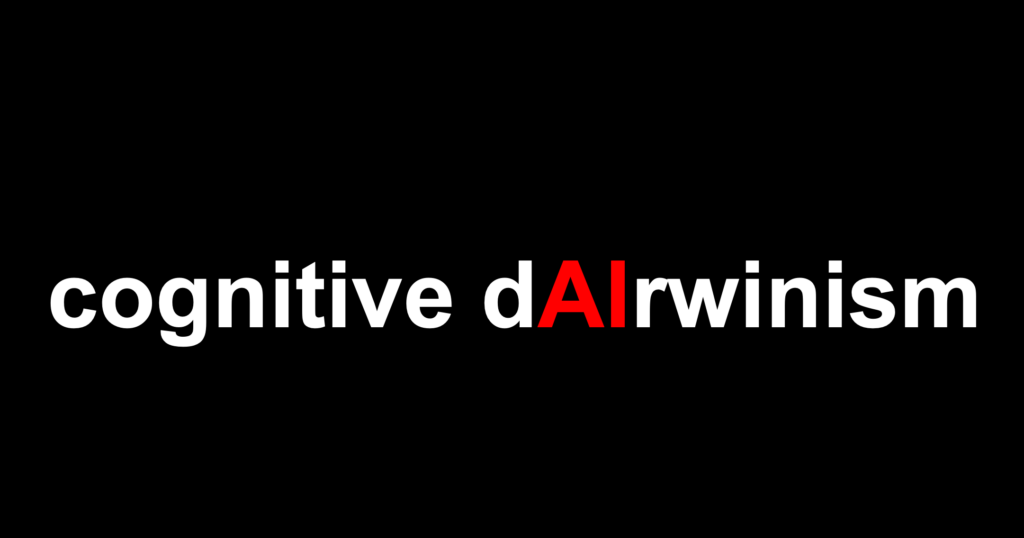
Cognitive dAIrwinism
There is another side to this story.
AI did not arrive with an instruction manual. It didn’t come with a parent, a teacher, or a wise mentor telling us how to use it in ways that make us better.
So, we are already seeing new failure modes emerge.
Cognitive offloading. AI atrophy. Cognitive debt. Digital amnesia. AI sycophancy. AI slop. AI brain fry. Cognitive surrender.
This is what I call cognitive dAIrwinism.
How we use AI shapes how we think. If we use AI to think for us, we risk outsourcing the very capabilities we need to strengthen in an era of AI. If we use it to move faster without judgment, we scale mediocrity and miss new opportunities. If we use it to generate more content without care, we create AI slop.
And slop has a cost. It’s called an AI Tax.
It is the hidden labor required to review, correct, rewrite, validate, and tolerate low-quality AI output. Employees feel it every day. It shows up as rework and editing, frustration, lost trust, more questions and more meetings, more requests like, “can you make this sound less like AI?”
Speed is becomes the norm, but hopefully not the goal.
When quality gives way to quantity, trust becomes the casualty. And trust is priceless.
AI is Not Taking Jobs, It is Taking Tasks
The headlines tell us AI is coming for jobs. And yes, there will be disruption. There already is. But there is an important distinction leaders must understand. AI automates tasks. Jobs are bundles of tasks, judgment, relationships, context, accountability, empathy, creativity, and decision-making.
Agents can execute tasks at scale. But they still need human intention, supervision, standards, ethics, and human imagination. Whether humans are in the loop or above the loop, the future of work still needs people.
The question is whether companies use AI to automate people out of work or augment people into more valuable work.
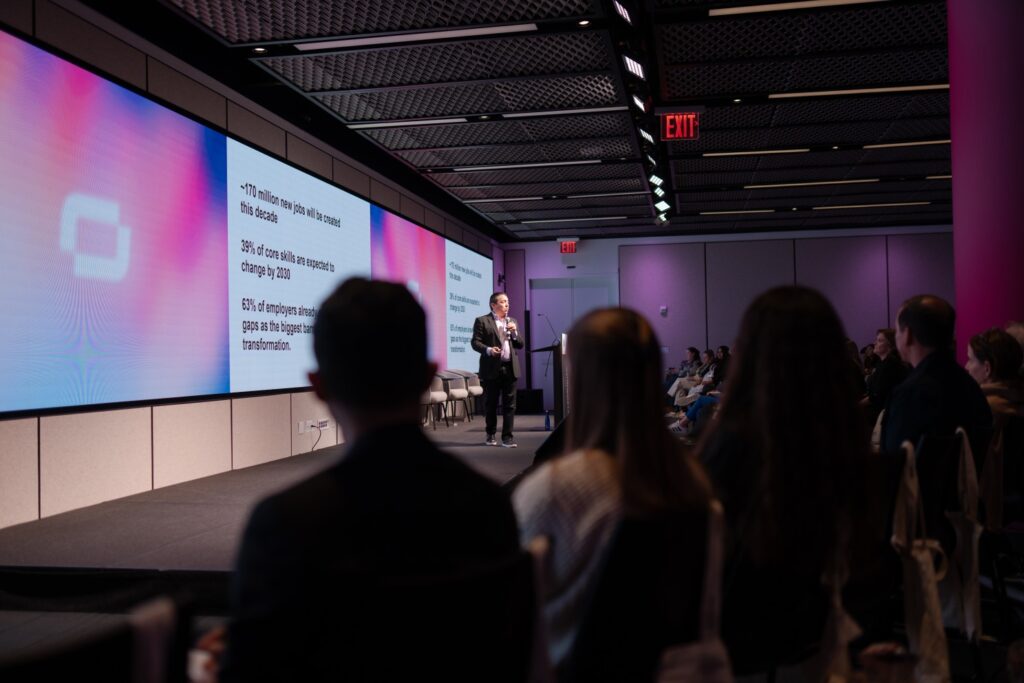
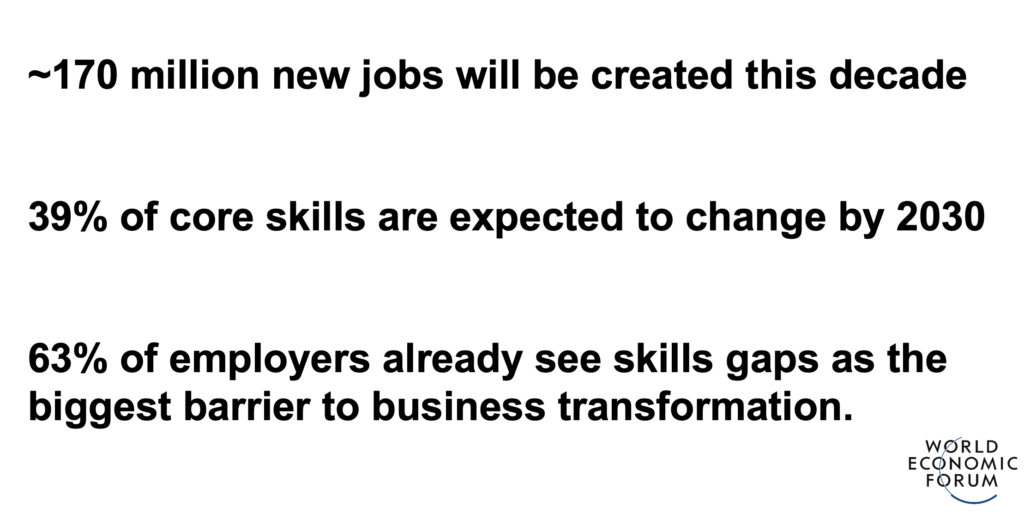
The World Economic Forum estimates that 170 million new roles will be created this decade, even as 92 million are displaced. It also projects that 39% of core skills will change by 2030, and 63% of employers already cite skills gaps as the biggest barrier to transformation.
This is bigger than HR. This is a leadership mandate.
If skills are changing in real time, learning has to show up in real time. If AI is changing work, learning cannot remain a library of courses people visit when they have time. It has to become a living system that coaches, adapts, guides, and improves people in the flow of work at their pace of learning, closing the skills gaps that unique to each person.
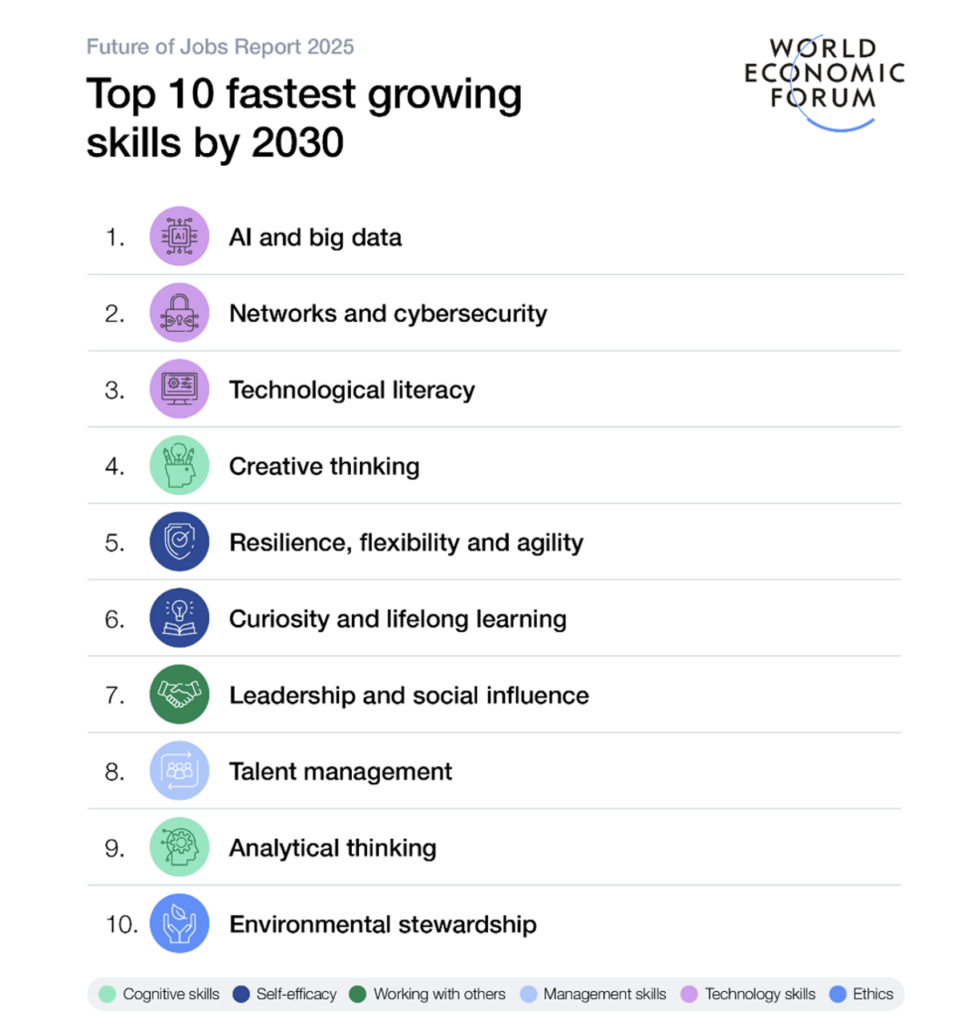
Training has to change. We’re not aiming to check more boxes around training, the goal is to make people measurably better. Measurably happier. Measurably more capable.
From AI Fluency to Augmented Intelligence
A lot of organizations are talking about AI fluency right now. That is good. But basic fluency is not enough. The question is, what kind of fluency are we scaling? What are the skills needed to compete with AI and what are the gaps across the organization.
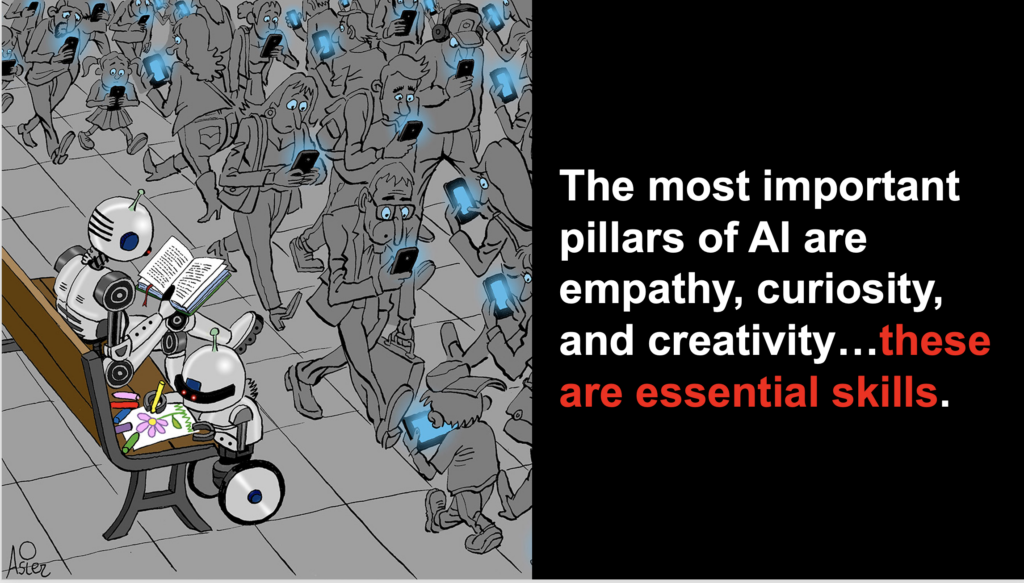
Are we teaching people how to use AI to create more slop? Or are we teaching them how to do what they couldn’t do without AI and what AI couldn’t do without them?
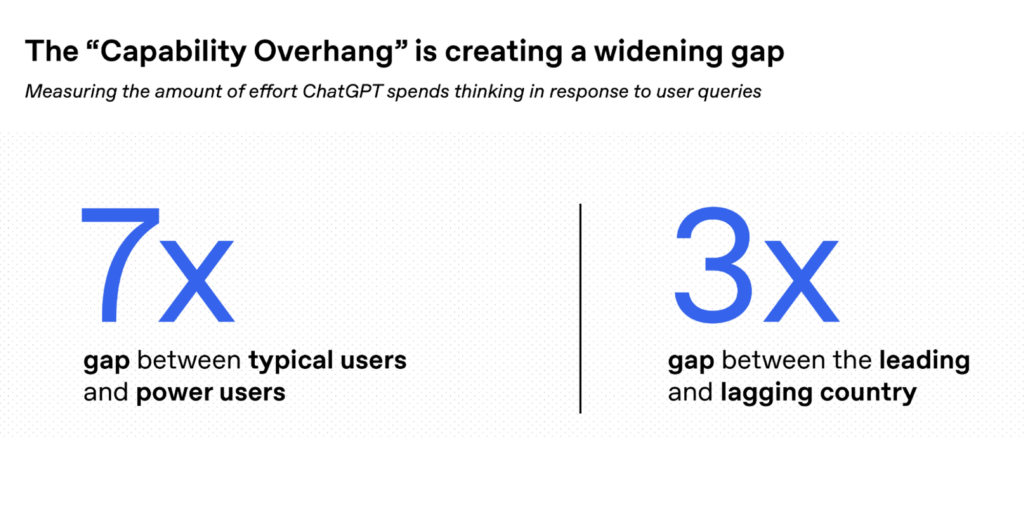
OpenAI has described a capability overhang: the widening gap between what frontier models can do and how most people actually use them. According to OpenAI, typical power users rely on roughly 7x more advanced thinking capabilities than typical users. That means there is already a gap among AI users.
The capability overhang doesn’t measure people who have AI and those who do not. It measures the capability and output in thinking and working with AI vs. those who only know how to prompt it.
This is why I believe we need to move from AIQ as an “Artificial Intelligence Quotient” to AIQ as “Augmented Intelligence Quotient.” It helps leaders and people balance all the critical “quotients” necessary to navigate a future that has yet to be charted, IQ, EQ (emotional intelligence), SQ (social quotient), AQ (adversity quotient).
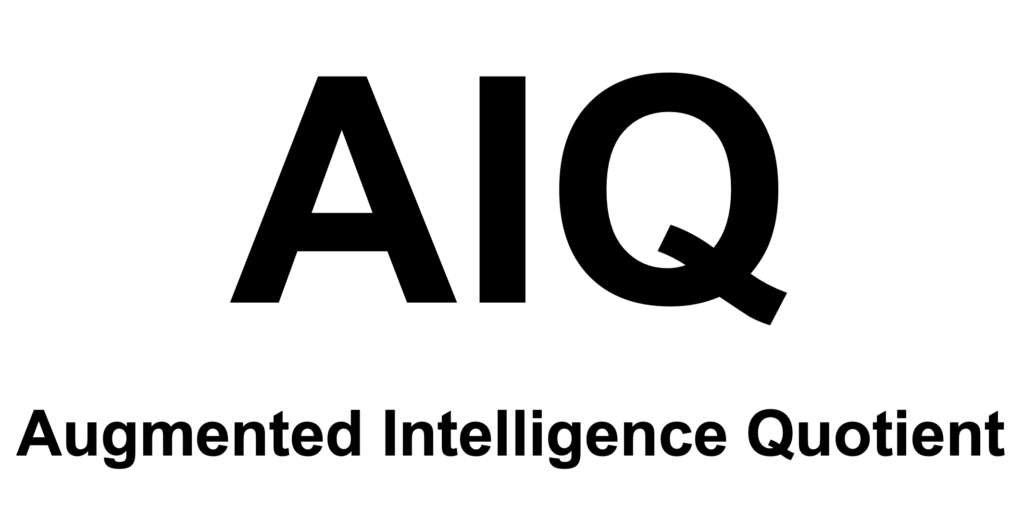
Artificial intelligence quotient, as many describe it, is about tool use.
Augmented Intelligence Quotient is about human expansion.
AIQ is how we use AI to scale thinking, creativity, decision velocity, problem-solving, empathy, and imagination. It is the ability to work with AI in ways that make us more capable, not more dependent.
Otherwise, we are not using AI. AI is using us.
Iterative AI and Innovative AI
As Dave Wright and I outline in our new book, “Infinite: How Visionary Leaders Transform Today’s Businesses into AI-Forward Companies,” there are two forms of AI strategy every leader needs to understand.
The first is iterative AI.
Iterative AI improves what already exists. It removes routine work, reduces bottlenecks, accelerates workflows, scales scripting, localization, updating, distribution, and reporting. It helps make current learning more visual, engaging, personalized, and easier to retain. It helps managers coach more consistently. It helps teams work faster and more efficiently.
This is important work.
Some of yesterday deserves to live tomorrow. Iterative AI helps make that work better.
But then there is innovative AI.
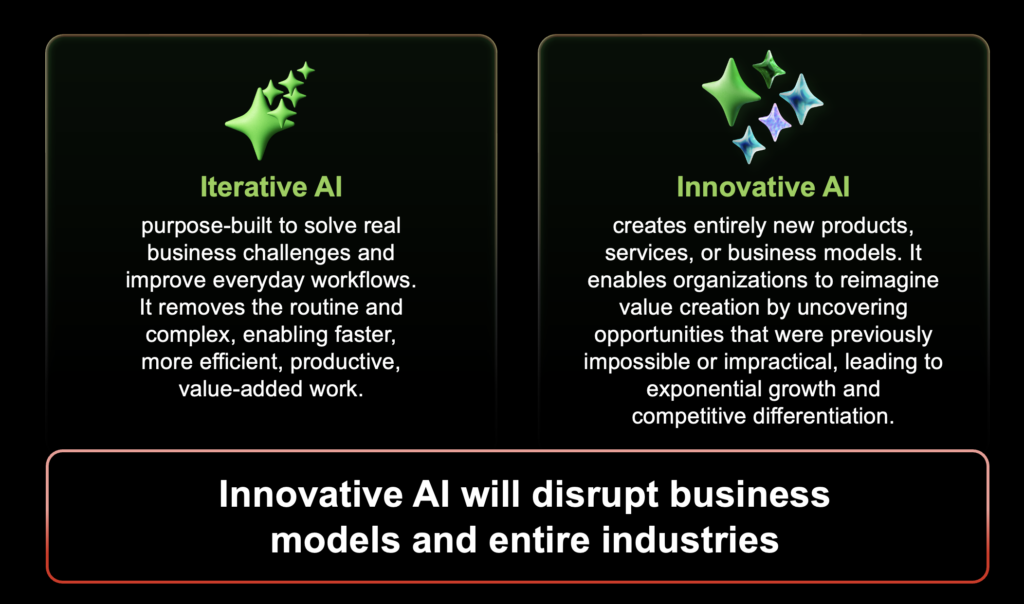
Innovative AI creates new value. It asks what becomes possible when expertise can scale visually, conversationally, and personally. It asks why learning is still treated as content delivery instead of capability building. It asks what happens when video is no longer passive, but interactive, adaptive, and human-like in every experience.
It asks:
What if every employee had access to an on-demand coach, tutor, role-play partner, or guide?
What if onboarding adapted to each person’s role, skill level, region, language, and confidence?
What if sales enablement became practice, not passive consumption?
What if leadership communication became interactive and measurable?
What if learning happened exactly when someone needed to decide, act, or improve?
Iterative AI makes the old model better.
Innovative AI makes new models possible.
And disruption happens when new things make old things obsolete.
The good news is that disruption doesn’t have to happen to you. It can happen because of you.
AI Video as the Adaptive Interface for Human Capability
For years, video was a broadcast format. One person to many…one message, one version, one language, one pace, one experience.
With AI, video becomes something else.
It becomes a scalable interface for human-centered, personalized experiences in learning, service, onboarding, research, enablement, and communication.
The first chapter of AI in learning was asset acceleration. We used it to create faster, translate faster, localize, update, reduce production costs, and increase reach.
The next chapter is capability acceleration…auditing and closing the gap causing the capability overhang.
This is where AI video, agents, data, and workflows converge to create adaptive experiences that don’t just deliver information, but help people become better at what they do and where they need to be.
At the Synthesia event, data showed that leaders expect AI to drive more personalized learning, wider internal reach, and better learner engagement. That is the right direction. But the opportunity is bigger than engagement.
Engagement is not a click.
Experience is not an NPS score.
An experience is how someone feels in a moment. What they remember. What they do next.
A great learning experience should build capability and confidence. A great service experience should reduce friction, create trust, and build relationships. A great communication experience should make people feel seen, informed, and capable.
AI video should be used to make learning and service more human.
The IKEA Lesson: Automate the Routine, Augment the Human
One of my favorite examples is IKEA.
IKEA introduced an AI chatbot named Billie, a nod to its famous bookcase. Billie was designed to handle routine customer inquiries and deflect cases that did not need to escalate to a human. It worked. Billie handled nearly half of customer inquiries.
A traditional automation mindset would stop there.
The board slide writes itself: AI deflects 47% of inquiries. Fewer calls = lower cost. Reduce headcount. And boom…ROI achieved.
But IKEA did something more interesting.
They studied the other engagements.
What couldn’t Billie solve?
Inside those unresolved inquiries, they found a signal. Customers were asking for help with interior design, room planning, and product decisions. They didn’t just need answers. They needed advice. Taste. Context. Judgment. You know, the things where humans thrive in their help.
So, IKEA reskilled thousands of customer service employees into remote interior design advisors. They turned a cost center into a growth channel that generated roughly €1.3 billion in sales in its first year.
That is the difference between automation and augmentation.
Automation asks: “How many people can we remove?”
Augmentation asks: “What new value can our people create now that AI has removed the routine?”
That is the future of work.
We’re talking about fewer people doing less work. We’re talking about more capable people doing more meaningful work creating and delivering new value, better experiences, and more meaningful relationships.
The Future OS of Learning
For learning and development leaders, this moment is profound.
The future of L&D is not a larger library of AI created content. It is a living system that powers the future of work. It’s a system that can sense skill gaps, personalize development, coach in real time, simulate scenarios, support managers, guide decisions, measure progress, and adapt as work changes.
In this future, L&D is where intelligence lives. L&D becomes a capability engine. HR becomes a reinvention partner. IT becomes the infrastructure for human and agent collaboration. Leaders become designers of new ways of working. And employees become active participants in their own augmentation.
The future of work is AI plus humans.
AI Is a Test of Leadership
At the end of my keynote, I shared that the real test of AI is leadership.
In my work with companies around the world, across industries, I see a lot of management. I do not always see a lot of leadership.
Management asks how to reduce cost. Leadership asks how to create value.
Management asks how to automate the process. Leadership asks whether the process deserves to exist and if not, they ask the questions that help identify better ways of working. In the process, they identify new opportunities for value creation.
Management asks how to scale content. Leadership asks how to scale capability.
Management asks how to use AI. Leadership asks what kind of future AI should help us build.
This is where the human quotients matter. IQ, EQ, SQ, AQ. Intelligence. Empathy. Social connection. Adversity. And now, AIQ. Augmented Intelligence Quotient is the means toward human expansion.
AI can scale thinking, creativity, decisions, and problem-solving. Agents can scale capabilities across workflows, teams, and organizations. But they need us to set direction, define standards, ask better questions, and imagine better outcomes.
The future is being built by those willing to learn, unlearn, experiment, and lead.
Nothing new happens without something new happening.
That “something” starts with us.
To view the the other sessions, and they’re amazing, please click here.
Infinite ∞ | Mindshift | Subscribe | Keynote Speaker | LinkedIn


Leave a Reply