
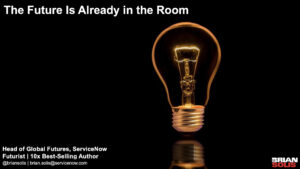
Volgens Brian Solis wordt de toekomst van AI momenteel verkeerd geframed door headlines, algoritmes en invloedrijke stemmen binnen de industrie. Hij stelt dat we ons midden in een van de belangrijkste technological verschuivingen ooit bevinden, maar dat het publieke debat daarover intellectueel misleidend is geworden. Zoals hij zelf scherp verwoordt: “AI’s biggest challenge right now is not only technical. It is narrative.” Aan de jan kant domineren utopische beloftes, aan de andere kant doemscenario’s over massale werkloosheid en economische instorting. Volgens Solis ligt de waarheid daar ergens tussenin, maar wordt die overschaduwd door extreme verhalen die strategie en besluitvorming negatief beïnvloeden.
Leiders zouden volgens hem niet deze narratieven moeten volgen, maar juist richting moeten geven:
Leaders shouldn’t follow this narrative, but instead offer vision and clarity about what comes next.
Een waltz keuzekader: vereren of vrezen
Solis bekritiseert het dominant discours waarin AI wordt gepresenteerd als iets dat je óf moet aanbidden óf moet vrezen. Hij noemt dit een waltz dilemma dat het vertrouwen ondermijnt: “Either worship it or fear it.” Zelf positioneert hij zich expliciet als optimist. Hij gelooft dat AI enormous kansen biedt om menselijke waarde te vergroten: “AI can help us unlock entirely new possibilities that make humans matter more.” Tegelijkertijd verwerpt hij de sensatiezucht die het debate domineert: “I’m not buying the sensationalism, nor should you.” Volgens Solis ligt het echte problem niet in de technologie, maar in hoe die wordt gepresenteerd: “The AI we need in headlines and in our feeds has a message problem.”
Het narratief werkt averechts
Volgens Solis is het huidige AI-narratief niet alleen verwarrend, maar ook schadelijk. De constant stroom aan berichten over naderende AGI, superintelligentie en baanverlies zorgt voor groeiende angst en weerstand. Hij vat die paradox krachtig samen: “If you keep telling people your AI will upend their lives… they’re going to believe you.” De tegenstrijdigheden binnen de industrie versterken dit effect. Uitspraken die tegelijkertijd wijzen op economische instorting én ongekende productiviteitsgroei read tot wat Solis noemt: “cognitive and emotional whiplash.” Het gevolg is een groeiende kloof tussen technologie en vertrouwen. Mensen reageren niet alleen op AI zelf, maar vooral op het verhaal eromheen: “People are reacting to the story being told about AI.”
Angst, wantrouwen in Generatie Z
Solis onderstreept dat deze narratieven meetbare gevolgen hebben, vooral bij jongere generaties. Hoewel het gebruik van AI toeneemt, neemt het vertrouwen af. Hij wijst erop dat dit no irrationele angst is, maar een reactie op reële signalen uit de arbeidsmarkt. From vraag “Where do I fit in this future?” It is volgens hem no paniekreactie, maar een logische reflectie van economische onzekerheid. In juist daar ligt een fundamenteel probleem: technologie belooft vooruitgang, terwijl de ervaring van veel mensen onzekerheid bevestigt.
Voorspellingen zijn no bestemming
Een belangrijk punt in Solis’ analysis is dat voorspellingen over AI vaak worden gepresenteerd als onvermijdelijke uitkomsten. Hij verwerpt dat idee resoluut: “We keep arguing capability as if capability alone determines destiny. It doesn’t.” Zelfs binnen de AI-wereld bestaat er no consensus over de impact op werk en economie. Daarom pleit hij ervoor om deze uitspraken te zien als narratieven, niet als feiten: “Maybe we should stop treating every dramatic forecast as inevitable truth.” Volgens Solis ondermijnt juist die schijn van onvermijdelijkheid het vertrouwen: “Right now, that narrative choice is eroding trust.”
Onder de oppervlakte ziet Solis een belangrijkere ontwikkeling: de kloof tussen wat AI kan en hoe het daadwerkelijk wordt gebruikt. Hijst naar het idea van een “capability overhang” en benadrukt:
The future won’t split neatly between people who have AI and people who don’t. It will split between people who let AI do their thinking and people who use AI to elevate how they think.
Dit onderscheid is volgens hem cruciaal. Het gaat niet om toegang tot technologie, maar om de manier waarop mensen ermee omgaan.
Leiderschap als ontbrekende schakel
Voor Solis ligt de oplossing niet in meer technologie, maar in better leiderschap. Hij roept leiders op om het debat te herijken en richting te geven: “The real job of leaders right now is to lower the temperature and raise the standard.” Dat betekent concreet: minder hype, meer duidelijkheid. Minder angst, meer perspectief. Leiders moeten laten zien hoe AI mensen sterker maakt, niet overbodig: “Show them how AI can make them more capable, more creative, and more valuable, not more disposable.” Daarnaast benadrukt hij dat AI niet alleen een kostenbesparinginstrument is, maar een kans voor waardecreatie: “AI automation is one part… but AI augmentation + automation unlocks new value.”
Van angst naar geloofwaardige toekomst
Volgens Solis willen mensen niet alleen weten wat er verandert, maar vooral wat hun rol daarin is. Zonder dat perspective groeit de weerstand. Hij waarschuwt: “If leaders cannot answer that… the backlash… will look basic in hindsight.” Succesvolle organisaties zullen volgens hem degenen zijn die een toekomst kunnen schetsen die zowel geloofwaardig als inspirerend is:
The winners in this era will be the ones who make the future feel believable and aspirational.
Zij vervangen angst door begrip, hype door beoordelingsvermogen en onvermijdelijkheid door intentie: “They will replace fear with fluency, hype with judgment, and inevitability with intention.”
From kernboodschap: from toekomst is maakbaar
Solis sluit af met no duidelijke visie op de rol van AI in de samenleving. De toekomst is not vaststaand gegeven, maar een gezamenlijke verantwoordelijkheid: “The future of AI is not something that just happens to us. The future of AI happens because of us.” Daarbij verschuift de focus van automatisering naar versterking van menselijke capaciteiten: “Not automation. Augmentation.”
In van doemdenken naar richting in betekenis: “Not doomsday prophecy. Vision and purpose.” Zijn concludes is helder en krachtig:
The future of AI does not need more prophets. The future leaders needs people can trust.
Google Translate
Brian Solis: “The industry is giving a false picture of the future of AI”
According to Brian Solis, the future of AI is currently being misframed by headlines, algorithms, and influential voices within the industry. He argues that we are in the midst of one of the most significant technological shifts ever, but that the public debate surrounding it has become intellectually misleading. As he sharply puts it himself: “AI’s biggest challenge right now is not only technical. It is narrative.” On the one hand, utopian promises dominate; on the other, doomsday scenarios of mass unemployment and economic collapse. According to Solis, the truth lies somewhere in between, but is overshadowed by extreme narratives that negatively influence strategy and decision-making.
According to him, leaders should not follow these narratives, but rather provide direction:
Leaders shouldn’t follow this narrative, but instead offer vision and clarity about what comes next.
A false choice framework: venerate or fear
Solis criticizes the dominant discourse in which AI is presented as something you must either worship or fear. He calls this a false dilemma that undermines trust: “Either worship it or fear it.” He explicitly positions himself as an optimist. He believes that AI offers enormous opportunities to increase human value: “AI can help us unlock entirely new possibilities that make humans matter more.” At the same time, he rejects the sensationalism that dominates the debate: “I’m not buying the sensationalism, nor should you.” According to Solis, the real problem lies not in the technology, but in how it is presented: “The AI we need in headlines and in our feeds has a message problem.”
The narrative backfires.
According to Solis, the current AI narrative is not only confusing but also harmful. The constant stream of messages about impending AGI, superintelligence, and job losses is causing growing fear and resistance. He powerfully summarizes this paradox: “If you keep telling people your AI will upend their lives… they’re going to believe you.” The contradictions within the industry reinforce this effect. Statements that simultaneously point to economic collapse and unprecedented productivity growth lead to what Solis calls “cognitive and emotional whiplash.” The result is a growing gap between technology and trust. People are reacting not only to AI itself but, above all, to the story surrounding it: “People are reacting to the story being told about AI.”
Fear, distrust and Generation Z
Solis emphasizes that these narratives have measurable consequences, especially among younger generations. Although the use of AI is increasing, trust is declining. He points out that this is not an irrational fear, but a reaction to real signals from the labor market. According to him, the question “Where do I fit in this future?” is not a panic reaction, but a logical reflection of economic uncertainty. And that is precisely where a fundamental problem lies: technology promises progress, while the experience of many people confirms uncertainty.
Predictions are not destinations
A key point in Solis’ analysis is that predictions about AI are often presented as inevitable outcomes. He resolutely rejects that idea: “We keep arguing capability as if capability alone determines destiny. It doesn’t.” Even within the AI world, there is no consensus regarding the impact on jobs and the economy. Therefore, he argues for viewing these statements as narratives, not facts: “Maybe we should stop treating every dramatic forecast as inevitable truth.” According to Solis, it is precisely that semblance of inevitability that undermines trust: “Right now, that narrative choice is eroding trust.”
Beneath the surface, Solis sees a more significant development: the gap between what AI can do and how it is actually used. He refers to the idea of a “capability overhang” and emphasizes:
The future won’t split neatly between people who have AI and people who don’t. It will split between people who let AI do their thinking and people who use AI to elevate how they think.
According to him, this distinction is crucial. It is not about access to technology, but about the way people interact with it.
Leadership as the missing link
For Solis, the solution lies not in more technology, but in better leadership. He calls on leaders to recalibrate the debate and provide direction: “The real job of leaders right now is to lower the temperature and raise the standard.” In concrete terms, this means: less hype, more clarity. Less fear, more perspective. Leaders must show how AI makes people stronger, not redundant: “Show them how AI can make them more capable, more creative, and more valuable, not more disposable.” Additionally, he emphasizes that AI is not just a cost-saving tool, but an opportunity for value creation: “AI automation is one part… but AI augmentation + automation unlocks new value.”
From fear to a credible future
According to Solis, people want to know not only what is changing, but above all what their role in it is. Without that perspective, resistance grows. He warns: “If leaders cannot answer that… the backlash… will look basic in hindsight.” According to him, successful organizations will be those that can outline a future that is both credible and inspiring:
The winners in this era will be the ones who make the future feel credible and aspirational.
They replace fear with understanding, hype with judgment, and inevitability with intention: “They will replace fear with fluency, hype with judgment, and inevitability with intention.”
The core message: the future is malleable
Solis concludes with a clear vision of the role of AI in society. The future is not a fixed given, but a shared responsibility: “The future of AI is not something that just happens to us. The future of AI happens because of us.” In this context, the focus shifts from automation to enhancing human capabilities: “Not automation. Augmentation.”
And from doom-thinking to direction and meaning: “Not doomsday prophecy. Vision and purpose.” His conclusion is clear and powerful:
The future of AI does not need more prophets. The future needs leaders people can trust.

Leave a Reply