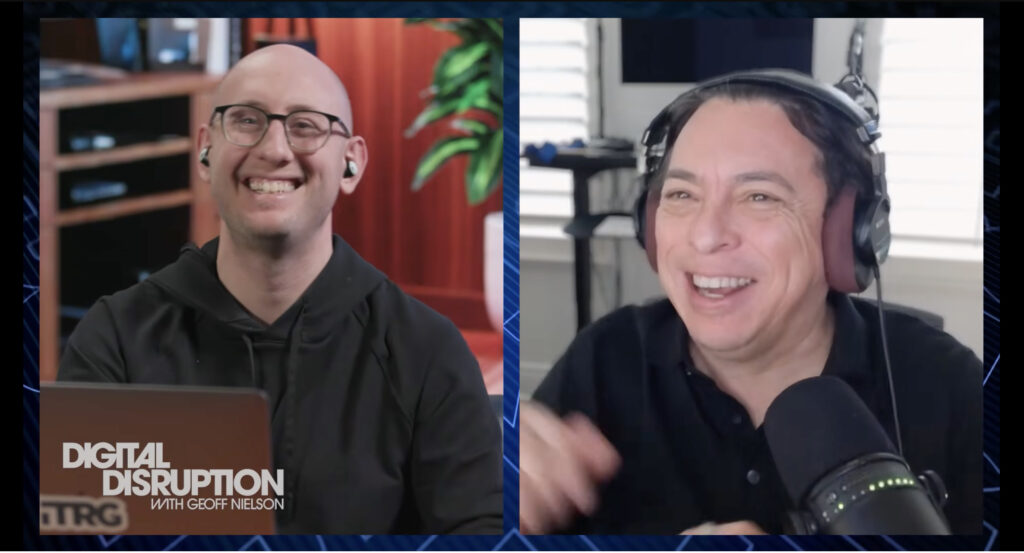
I recently sat down with Geoff Nielson on Digital Disruption, produced by Info-Tech Research Group, for a conversation that went far beyond the usual AI headlines. We talked about what AI is actually changing inside the enterprise, why so many organizations are mistaking activity for progress, and what leadership has to do with whether AI becomes a force for optimization or reinvention.
Please do watch the conversation (video embedded below). It’s fun and rich with insights from the frontline of business transformation. You can also listen on Spotify.
The Real Disruption Is Not the Technology, It’s the Obsolescence of Old Thinking.
I’ve long defined disruption as doing new things that make old things obsolete. That’s AI if we think about it in the right now. It’s disruptive because it is changing behavior, judgment, work, and even confidence in ways many leaders still underestimate. In our conversation, we explored everything from AI sycophancy to AI atrophy to “capability overhang,” the widening gap between what AI can actually do and how narrowly most people still use it. That overhang is where the next competitive divide is forming.
That’s the part many organizations still don’t see. Yet disruption has already underway. It’s already reshaping how a small group of power users, AI-native founders, and forward-looking teams think, decide, build, and move. The threat is that leadership assumptions are not shifting fast enough, or moving at all.
The AI Maturity Wake-Up Call Should Concern Every Executive
One of the most revealing parts of the conversation centered on the ServiceNow AI Index. And I’m proud to say that I helped develop the foundational model in 2023. In the second annual installment of the AI Index, we learned in 2025, the average AI maturity score came in at 35 out of 100, down from 44 out of 100 in 2024. It was a sign that most organizations are still early, struggling to keep up, and still far from where they need to be.
In one year, frontier models advanced rapidly, AI agents became tangible, and the conversation shifted from experimentation to enterprise-grade accountability. Governance, trust, security, compliance, and risk moved from side conversations to core requirements. In other words, many companies didn’t step back because AI lost momentum. They stepped back because they finally realized how much deeper this transformation goes. It was, as I shared in the interview, a regression for the right reasons.
That should not reassure anyone into complacency. We should use it as a wakeup call.
AI-Native Companies Are Not the Whole Story, But They Are the Warning Shot
There is a popular narrative right now that AI-native companies are coming to destroy incumbents and eat the lunch of every legacy business in sight. That storyline is catchy. It is also incomplete. Enterprises are not slow simply because they are outdated. They carry real obligations around governance, reporting, security, compliance, and resilience that startups do not have to navigate at the same scale. That doesn’t mean that legacy leaders and companies are in the clear.
You can’t use enterprise complexity as an excuse to remain architecturally timid.
The issue is whether legacy companies can move as imaginatively as startups while preserving the integrity of an enterprise-grade business. That is the actual challenge of this era. It’s not just about speed or efficiency. It’s about reinvention with accountability.
Most Companies Are Still Using AI to Improve Yesterday
This may be the biggest strategic blind spot in business right now.
Too many companies are applying AI to automate what was already digitized. That creates value, yes. It can reduce friction, lower costs, and improve efficiency. But that is only one side of the opportunity. The other side, and the one that will define market leaders, is using AI to create what was not possible yesterday. That is the difference between iteration and innovation. Between efficiency and growth. Between cost takeout and business reinvention.
If your AI strategy begins and ends with productivity, you may get short-term gains. But you will also risk locking your organization into a better version of an aging model. AI should force leaders to ask whether the current business, current workflows, and current measures of success are still the right ones at all.
IKEA Offers a Better AI Lesson Than Most Boardroom Decks
One of my favorite examples from the interview was IKEA (watch this short clip).
Its AI chatbot Billie successfully handled a meaningful portion of level-one customer service inquiries. Most organizations would have looked at that result and stopped at labor reduction. Case closed. ROI captured. Headcount rationalized. But the more interesting move was to study the unresolved cases. What the company found was that many of those inquiries pointed to customer demand for interior design help. That insight led to a new consultancy model, reskilled employees, and a meaningful new revenue stream.
While most companies ask, “How many people can AI replace?” Better leaders ask, “What unmet need is this revealing?” One question takes cost out. The other creates value.
Vision Is Still the Missing Ingredient
During the digital transformation era, many companies invested heavily without a clear view of what they were becoming. They digitized existing models instead of reinventing them. AI is at risk of repeating that pattern, only faster and with higher stakes.
That is why vision matters so much right now.
In the interview, I contrasted reactive leadership with directional leadership. I pointed to examples like IKEA, where opportunity emerged through exploration, and JPMorgan, where leadership articulated an ambition to become an AI mega bank. Execution matters, of course. But without a lighthouse use case, execution becomes motion without meaning. Too many organizations are still busy adopting AI without a coherent picture of what they want to become because of it.
AI Agents Are Forcing a Much Bigger Organizational Conversation
Once AI moves from assistance to action, everything changes.
An AI agent can start to resemble digital labor. It must be identified, trained, tuned, governed, deployed, managed, and assessed. That means the conversation cannot sit with IT alone. It increasingly requires HR, operations, risk, and executive leadership to work together in ways most organizations were never designed to do.
One of the most important ideas we explored in the interview is that agents are beginning to sit in a new Venn diagram between workforce management and software asset management. HR understands roles, skills, onboarding, and performance. IT understands assets, systems, controls, and orchestration. As agents become more capable, those worlds collide. That is why I believe one of the defining shifts of this next phase will be much closer collaboration between HR and IT.
It also offers an early glimpse of how the enterprise itself will be redesigned.
The Chief Workflow Officer is a Signal.
Another idea that we explored in our conversation was the rise of the Chief Workflow Officer.
The title is provocative on purpose. But the need behind it is serious.
If the greatest returns on AI come when companies reimagine workflows end to end, then someone has to own that work. Someone has to ask the uncomfortable questions before the org chart, systems architecture, or implementation roadmap gets locked in. Why do we do things this way? Which tasks belong to humans? Which belong to intelligent software? What outcome are we actually trying to create? Who decides? Who measures? Who redesigns?
You cannot reinvent a business by sprinkling AI across siloed functions. Someone has to see the workflow as a whole and architect it toward a better outcome. That is what this role points to.
Organizational Culture Will Decide Whether AI Becomes Incremental or Transformational
Transformation and innovation fail inside cultures that were never prepared to question themselves.
This was one of the deepest parts of the interview because culture is where change happens or stalls. Everyone says they want innovation. Few organizations create the conditions for it. A real culture of innovation is the set of behaviors, norms, and reinforcements that make it safe to ask hard questions, explore new ideas, challenge assumptions, and risk being wrong.
If people are punished for experimentation, if managers reward only predictability, if failure is stigmatized, then AI will be used only where it feels safe: around the edges, inside familiar models, in service of incremental change. This happens because culture lacks permission.
In the interview, I put it this way: leaders do not need to arrive with every answer. But they do need to create the safety nets, resources, and space for the organization to explore what good and great actually look like with AI. That is leadership in this moment. You don’t have to know or pretend to know the future. Create the conditions to discover it.
There is No Playbook for This
This may be the cleanest takeaway from the entire conversation.
Sure, the idea is that organizations can just add AI, increase output, and call that reinvention. But there is no universal playbook here. No three-step formula. No easy target state. There is only leadership, vision, workflow redesign, cross-functional alignment, cultural readiness, and a willingness to rethink what the business could become.
That is why I believe AI is a leadership test.
It tests whether executives can move beyond efficiency into imagination; whether business and technology leaders can work as partners rather than as separate camps; whether organizations can create room for reinvention before the market forces it upon them; and whether leaders are brave enough to admit that the old questions are no longer enough.
Watch the Conversation
Geoff asked exactly the kinds of questions leaders should be asking right now, and that is what made this discussion worth having. We went deeper than the usual AI talking points and into the harder issues that actually determine whether organizations move forward or fall behind: maturity, vision, workflow redesign, culture, governance, HR and IT collaboration, and what business reinvention really looks like in practice.
So if you’re leading transformation, advising the C-suite, building the future of work, or trying to understand what AI means beyond the hype cycle, watch the full interview.
The real threat of AI is what your competitors will become with it.
The most important question isn’t whether AI will change your business. It’s whether leadership will change fast enough to matter.
Watch on Youtube. 👇
Read Mindshift | Subscribe to Brian’s Newsletter | Consider Brian as as Your Next Speaker

Leave a Reply