via Avasant
As companies worldwide grapple with AI implementation, a critical gap has emerged between executive ambitions and organizational reality, revealing the urgent need for a fundamental shift in how we approach AI-driven change.
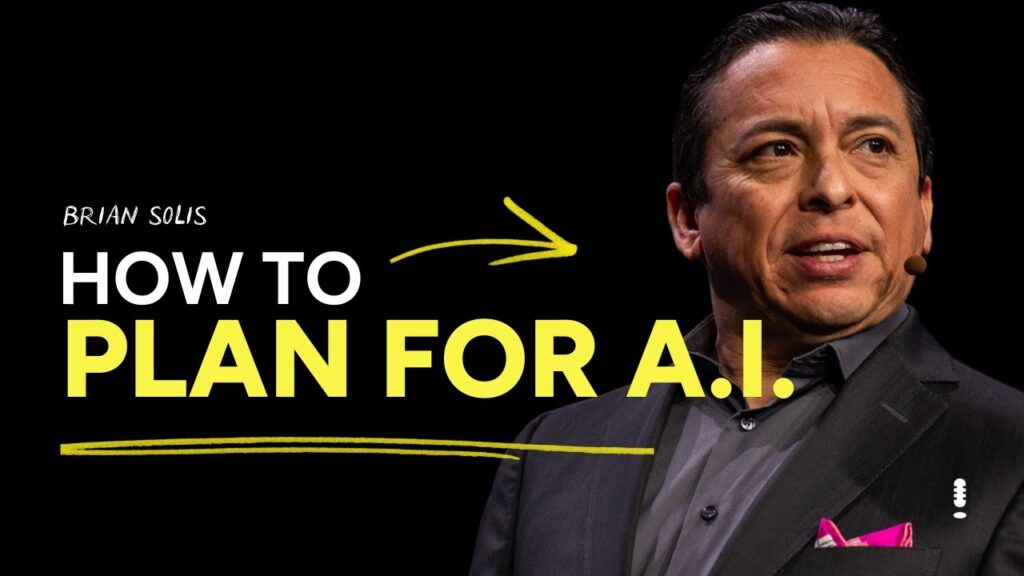
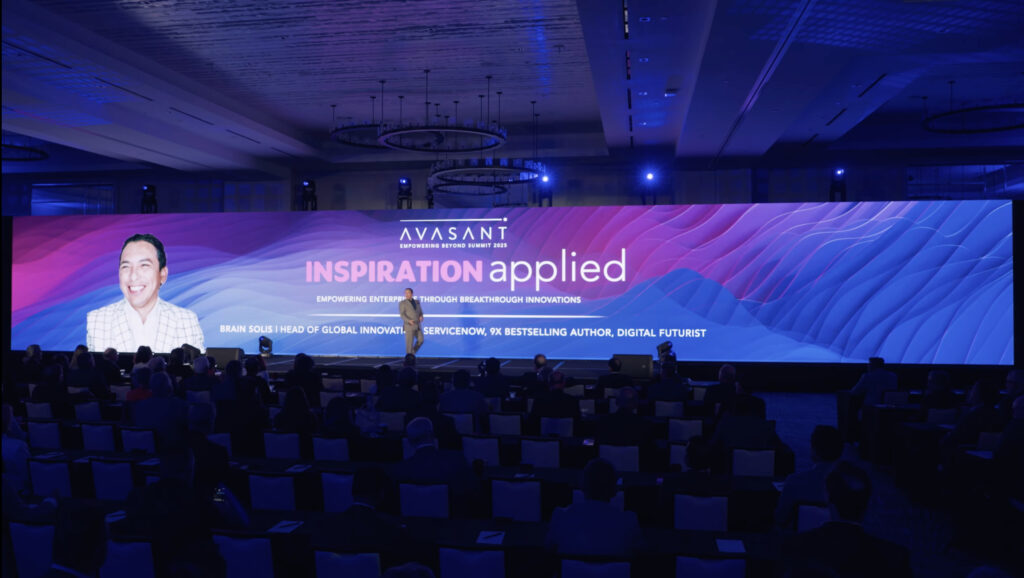
At Avasant’s recent Empowering Beyond Summit 2025, Brian Solis, Head of Global Innovation at ServiceNow and nine-time bestselling author, delivered a compelling case for why businesses must disrupt themselves to fully realize AI’s transformative potential. His insights illuminate the path forward for organizations seeking to move beyond superficial AI adoption toward true business transformation.
The Innovation Imperative: Why AI Demands a Different Approach
AI presents an opportunity to reimagine business models entirely. However, most organizations are falling into familiar patterns, using AI as a sophisticated co-pilot to execute yesterday’s workflows more efficiently rather than exploring genuinely new possibilities.
“We’re not being bold enough. We’re not being visionary enough, and we are falling into the habits that we have had during every technological revolution, to fit it into the box of business as usual,” Brian Solis observed.
Despite AI being mentioned 30,000 to 40,000 times in earnings calls during 2023–2024, with CEOs and CFOs touting it as a competitive advantage, business leaders privately express ambivalence or outright dissatisfaction with their AI transformation progress. Only 1% of companies believe they have achieved AI maturity, highlighting the vast gap between aspiration and execution.
The Leadership Gap: Vision Versus Reality
Research reveals a stark disconnect between executive perceptions and organizational reality. While 73% of business executives feel their company’s AI approach is well-controlled and strategic, employees remain largely unaware of these initiatives. Similarly, 75% of executives claim success in adoption of AI, but this confidence isn’t shared by their workforce.
“The consensus is that the biggest barrier to scale isn’t employees. It certainly isn’t the technology. It is the executives leading the effort. They’re not steering fast enough. They’re not thinking big enough.”
Learning from Venture Capital: A Framework for Bold Thinking
To overcome these limitations, Solis advocates adopting the venture capital mindset when approaching AI transformation. Unlike traditional business leaders who focus on proven use cases and incremental improvements, venture capitalists evaluate investments based on their potential to create entirely new markets and deliver exponential returns.
“Venture capitalists have a formula for assessing their investments, they’re not looking for 5x or 10x returns. They’re looking for 1,000x return over the long term.”
This mindset requires organizations to explore the unknown, take calculated risks, and prioritize innovation over predictability.
The AI-First Mindset: Redefining Business Strategy
Companies like Box, Shopify, and Duolingo have begun embracing “AI-first” approaches, fundamentally reorganizing their operations around AI capabilities rather than simply adding AI to existing processes. This shift requires leaders to ask fundamentally different questions:
“What could we achieve utilizing AI at the core of our business model from day one?”
— A question that reframes strategy.
This mindset moves organizations from automation to augmentation, where AI opens the avenue to opportunities humans hadn’t fully realized before. IKEA’s transformation illustrates this perfectly. When their AI chatbot “Billy” began handling 57% of customer inquiries, management faced a choice: cut costs by reducing staff or reimagine the role of their people. They chose the latter. By analyzing Billy’s conversation logs, they noticed a recurring pattern, customers were seeking personalized design guidance, not just product information. Rather than ignore this unmet demand, IKEA reskilled their call center staff into remote interior design consultants. This pivot turned an efficiency tool into a growth engine, launching a €1 billion service line in less than two years. The key wasn’t the chatbot itself, instead it was leadership’s willingness to treat AI as a signal for new value creation rather than just a cost-saving mechanism.
Iterative vs. Innovative AI: The Dual Path to Transformation
Solis’s research identifies two complementary approaches to AI implementation:
Iterative AI: Optimizes existing workflows, reduces costs, and improves efficiency. It’s foundational, delivering predictable returns through automation.
Innovative AI: Explores new possibilities, creates novel workflows, and enables new business models. It requires risk but offers exponential potential.
Organizations that combine both approaches create a “disruptive layer” that enhances operations while opening new revenue streams. Those focused only on iteration may soon be left behind as competitors achieve transformation.
Building the Foundation: Culture and Psychological Safety
Transformative AI requires cultural evolution. Google’s research on high-performing teams revealed that psychological safety, not education or experience, was the strongest predictor of innovation success.
“The highest performing teams out innovated everyone else because they felt psychological safety.” A culture that encourages curiosity, risk-taking, and challenging assumptions is critical to scaling AI beyond pilot projects. Psychological safety isn’t built by slogans, instead it’s cultivated through deliberate leadership behaviors. This means leaders model openness by admitting when they don’t have all the answers, rewarding experimentation even when results are inconclusive, and creating spaces where employees can propose unconventional ideas without fear of embarrassment or penalty.
For AI specifically, this often includes “sandbox” environments where teams can prototype AI-driven solutions without risking live operations, as well as cross-functional workshops that pair domain experts with technologists to explore new use cases. The goal is to make questioning the status quo not just safe but expected.
Conclusion: The Choice to Transform
The AI revolution gives organizations a choice: optimize the past or build the future. “There can be no revolution if we don’t persuade ourselves to disrupt ourselves, to explore new horizons in ways that uncover new opportunities.”
As Vinod Khosla aptly warned, “Most businesses have no clue what is about to hit them in the next 10 years when most rules of engagement will change.” Those who embrace transformation, who adopt an AI-first mindset and combine bold vision with operational clarity, will lead the future of business.
The choice is clear: disrupt yourself or be disrupted.
Watch the full keynote…
Read Mindshift | Subscribe to Brian’s Newsletter | Consider Brian as as Your Next Speaker


Leave a Reply