
Executives observing digital-, mobile-, and AI-first customers (created with Google Gemini)
I’m preparing a new presentation for a delegation of European CEOs visiting Silicon Valley to explore the future of AI, business, and leadership. As part of my research, I’ve been revisiting some of my presentations and predictions from 2016–2018 to see what we got right, what we missed, and perhaps more importantly, what lessons from the past can help us make better decisions about the future.
It’s been a fascinating exercise in digital anthropology, especially revisiting my work on customers as “accidental narcissists” and “digital introverts, and the ways technology was quietly rewiring human behavior, relationships, expectations, and experiences. These were early signals of changes that would eventually reshape how people engage with one another, brands, and now intelligent machines.
I found this illustration and I was reminded of how important this message is today. I’m also proud of how well this aged!
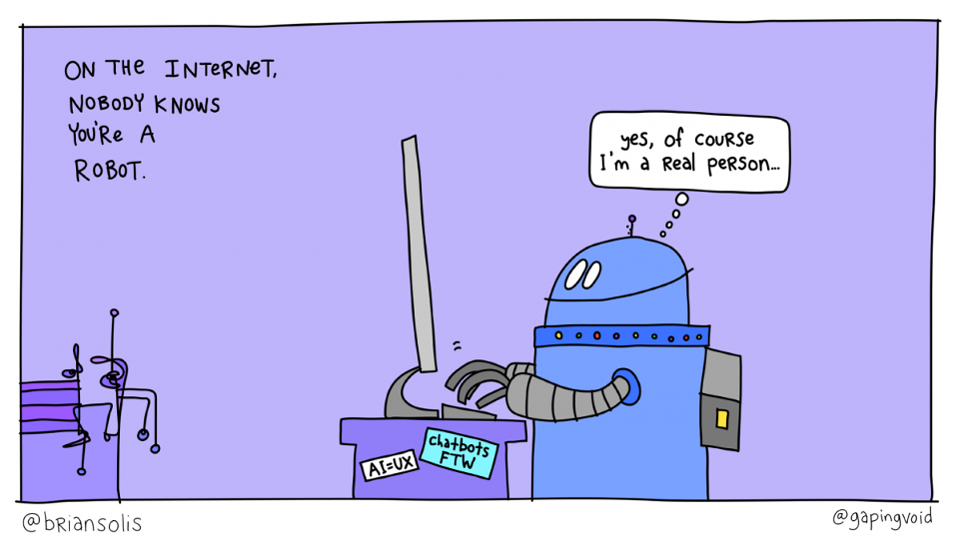
On the internet, nobody knows you’re a robot.
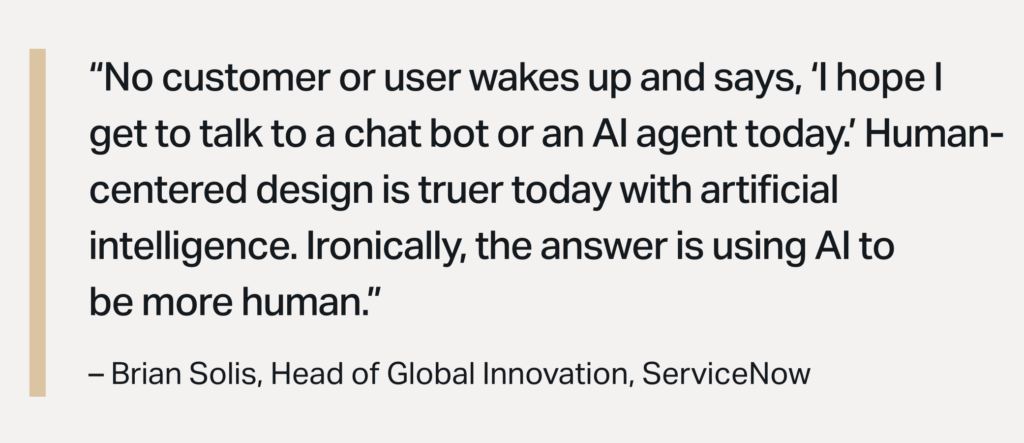
In 2018, for a series of talks on reimagining customer experience (CX), I worked with Gapingvoid Culture Design Group to visualize a simple but important reality: No one wakes up hoping that’s the day they get to talk to a customer service AI agent or chatbot.
It was a play on the famous 1993 New Yorker cartoon, “On the Internet, Nobody Knows You’re a Dog.” At the time, that cartoon captured the anonymity of the early internet.
Our version offered a different perspective on the emerging age of automation, where companies were becoming enamored with the technology they could deploy, sometimes at the expense of understanding the people they were supposed to serve.
My presentations challenged executives responsible for customer experience, service, and digital transformation to approach emerging technologies through the lens of human-centered design. I was exploring early concepts such as “UX as AI,” “AI as UI,” and what I called CX 2.0 at the time, combining intelligence (IQ), emotional intelligence (EQ), and human understanding (HQ) to create experiences that actually mattered to people.
You can revisit some of that thinking in my 2018 article on AI, chatbots, and next-generation customer engagement.
Fast-forward to today, and I believe these lessons are becoming even more consequential.
We’re moving beyond conversational AI into agentic AI and agentic commerce, where intelligent agents will increasingly discover brands, evaluate products, make recommendations, and complete transactions on behalf of people. The relationship between businesses and customers is being fundamentally reimagined, including who or what represents the customer, how decisions are made, and where trust is established.
For CEOs and executive teams, this raises an entirely new set of questions…
- How do you build a trusted brand when an AI agent becomes the customer’s primary interface?
- How do you design meaningful experiences when algorithms increasingly mediate discovery, consideration, and commerce?
- How do you preserve the human connection that inspires loyalty when more interactions become automated or invisible?
The answers to these questions shape the future of business, relationships, differentiation, and value creation. They also shape your brand, service and experience design and innovation,
And we’re already seeing signs that businesses are losing sight of the human beings behind the technology. According to WordPress VIP’s Future of the Web 2026 report, 74% of consumers say the internet feels less human than it did a decade ago. Further more, 61% can’t name a brand using AI well in its messaging. And 60% find AI in brand messaging a turnoff.
This is why I believe CX 2.0 is even more relevant today than it was in 2018. As we redesign business for an AI-first, increasingly agentic world, the trap is using AI to automate more customer interactions or make machines seem more human. Efficiency and cost-cutting usually take away from rather than enhance the customer’s experience. You can’t cut your way to growth. And you can’t automate your way to innovation.
Instead, the opportunity is to to use intelligence to make businesses more empathetic, intuitive, responsive, and valuable to the people they serve, even when those people are represented by intelligent agents.
The future of commerce may increasingly be machine-to-machine, but the ultimate purpose of business remains human-to-human. After all, CX isn’t just “customer experience,” it represents the “customer’s experience.” It’s theirs to have and yours to shape.
As AI becomes more capable and autonomous, our responsibility to design for humanity only grows.
The companies that understand this won’t just compete on the intelligence of their technology. They’ll differentiate through the trust they earn, the experiences they create, and the human outcomes they make possible.
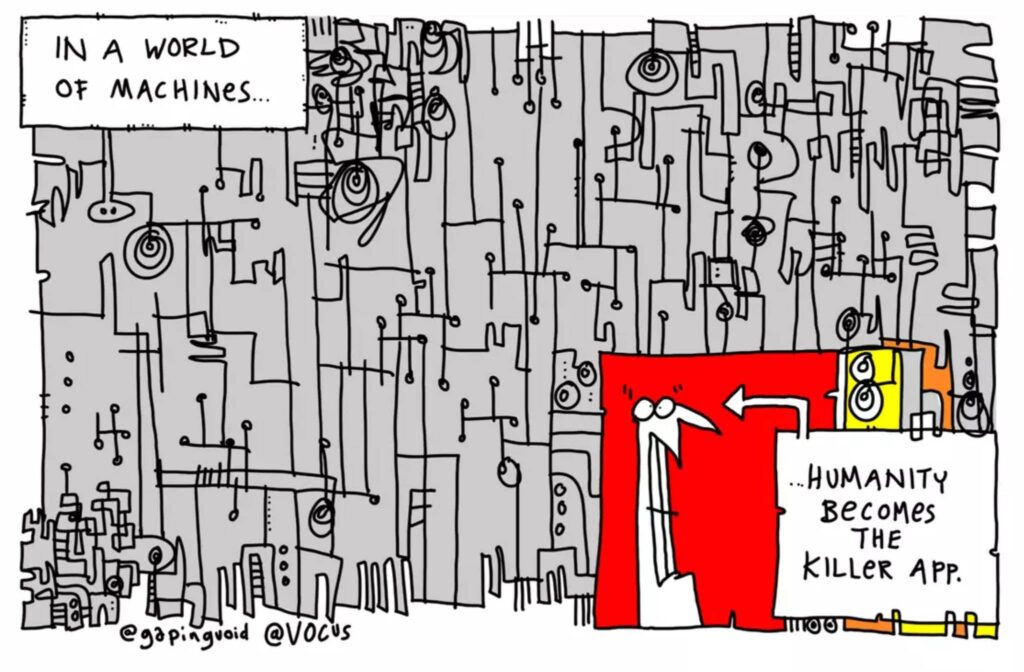
I’ll close with another illustration that also aged well. In 2014, Gapingvoid and I set out to remind leaders of the importance of keeping humanity at the center of every digital revolution.
In a world of machines, humanity becomes the killer app.
The future of the customer’s experience is ours to reimagine and theirs to savor, celebrate, and remember.
Resources:
X: The Experience When Business Meets Design
Mindshift: Transform Leadership, Drive Innovation, and Reshape the Future
Book me as your keynote speaker
Subscribe to my newsletter

Leave a Reply