This is an updated version originally published in my Forbes column
What if the most important thing about AI is not what it can do today, but what becomes possible because it exists?
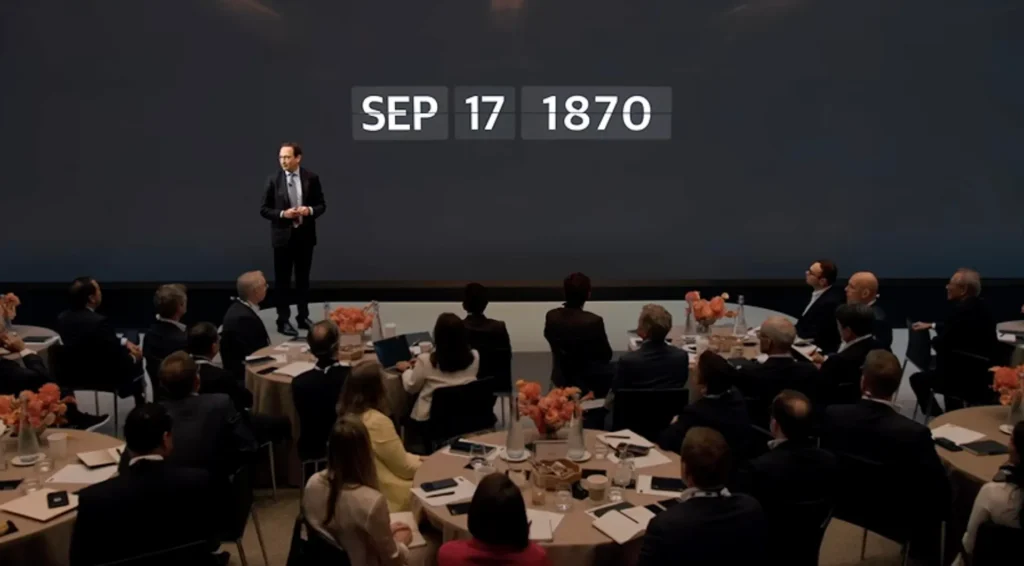
That was the question I kept coming back to after hearing Blackstone’s Jon Gray compare this moment to America in 1870. At the time, much of the country still ran on farms, horses, wood, and candlelight. Thirty years later, by 1900, steel, railroads, electricity, cities, and entirely new forms of industry had reshaped how people lived and worked.
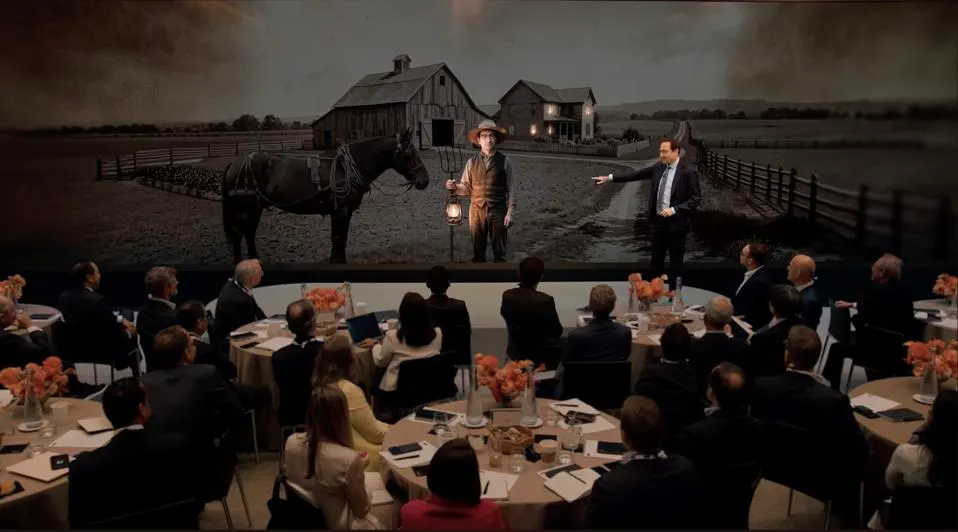
The lesson isn’t really about whether or not AI means history will repeat itself neatly. It’s that transformative technologies rarely reveal their full impact at the beginning. We tend to judge them by how well they improve the world we already know, when the greater opportunity is to imagine the world they make possible.
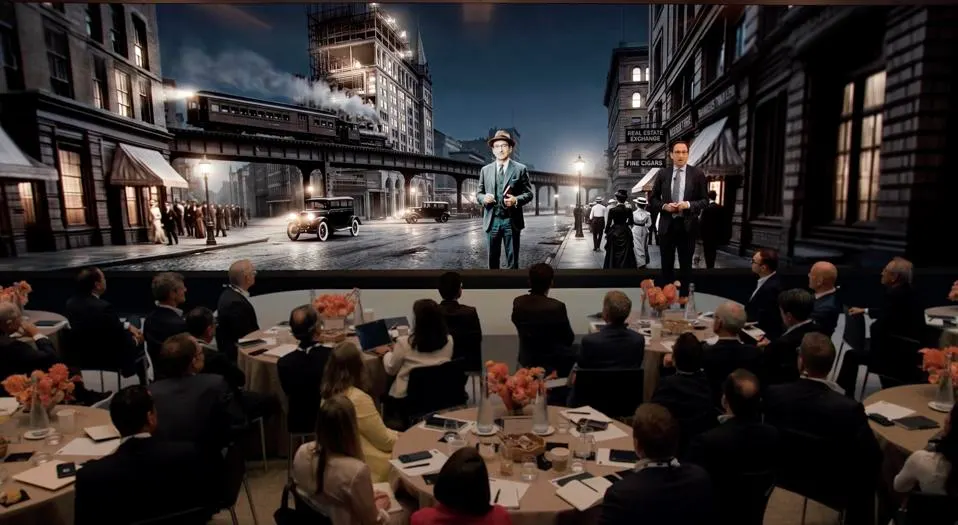
That is the mindshift leaders need now.
AI is beginning to make intelligence more abundant, accessible, and increasingly autonomous. Yet most organizations were designed for an era when expertise, information, and decision-making capacity were scarce. The challenge is not simply to add AI to that system. It is to rethink the system itself.
The leaders who understand this moment will move beyond automation and efficiency. They will ask what new forms of work, value creation, customer experience, and organizational design become possible when intelligence can be distributed throughout the enterprise.
If 1870 teaches us anything, it is that the future is not created by replacing the old tool with a better one. It is created by reimagining what we build once the new capability exists.
The Companies Built for Scarcity Will Have to Reinvent Themselves
The entirety of organizational design and work was built upon a foundation of scarcity. Yet, much of today’s AI conversation is still focused on the technology immediately in front of us, model performance, adoption curves, capital expenditures, valuations and whether the current investment cycle constitutes a bubble. At the same time, we have doomers who have gne so far as to say that AI could wipe out humanity in 10 year’s time and generations of students and workers who worry about AI taking jobs, including graduates seeking their footing on lower rungs of the career ladder.
The first question that comes to my mind is whether organizations are preparing for what happens when intelligence becomes an increasingly abundant and inexpensive operating resource.
The Returns Are Becoming Harder to Ignore
Blackstone has an unusual vantage point into that question. Across roughly 1,400 portfolio companies, borrowers and related businesses, annualized spending with Anthropic increased from approximately $25 million to $525 million in a single year. That’s 21x! Gray also highlighted specific examples where AI investments are already generating measurable returns. Phoenix Tower invested $4 million in an AI-enabled process that accelerated lease processing fivefold and now produces approximately $4.5 million in annual value. Enverus, another portfolio company, is reportedly generating an 18-times return on its spending with model providers for software engineering use cases.
These examples help answer what Gray jokingly framed through the old Wendy’s question, “Where’s the beef?” IYKNY. But there is evidence that real value is emerging beneath the enormous infrastructure buildout. Yet for executives, that should be the beginning of the conversation rather than the conclusion.
The Optimization Trap
The temptation will be to interpret these returns as a mandate to apply AI more aggressively to existing processes. That will certainly produce gains. Companies can automate tasks, compress cycle times, lower costs and increase the productivity of individual employees. But if that becomes the primary ambition, we risk using one of the most consequential technologies of our lifetime to optimize organizations designed for another era.
Here’s where the 1870 analogy becomes much more tangible and useful.
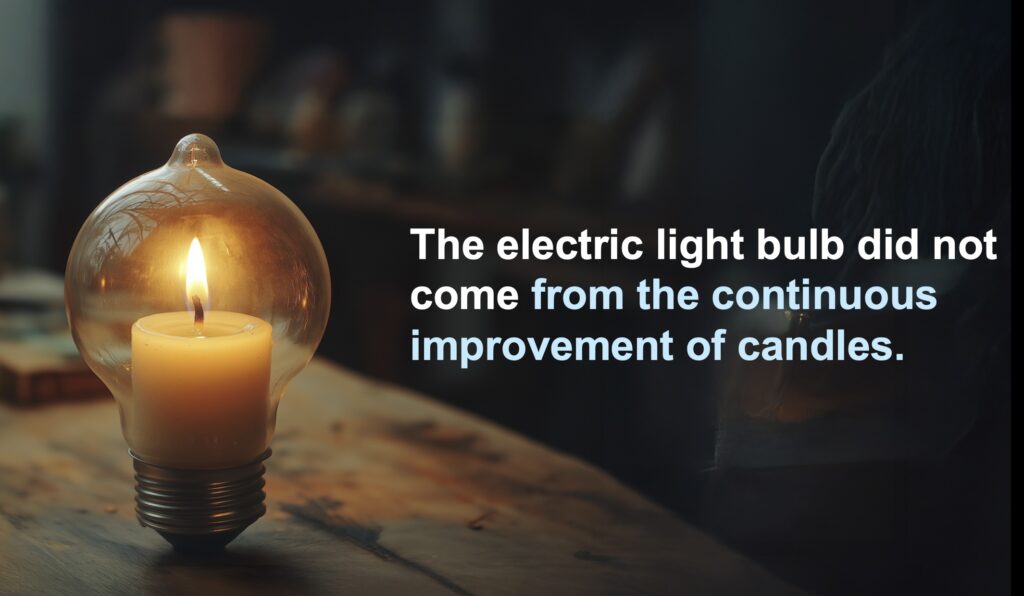
Electricity did not transform business because companies discovered a more efficient replacement for candles. Its real impact emerged as leaders, inventors and entrepreneurs redesigned factories, cities, products, infrastructure and daily life around capabilities that had not previously existed at scale. The breakthrough started with electrification. But it’s growth and value creation was shaped by reimagining how we worked with and because of electricity. Like with AI, electricity powered a world we knew, but also unlocked new possibilities, outcomes, and value creation not possible before. That’s innovation.
As the old saying goes, the lightbulb was not the result of the continuous improvement of candles.
The next chapter of invention isn’t going to happen because any one voice or company decides that efficiency and cost-cutting is the way forward. You can’t cut your way to growth. You can’t automate your way to innovation. This “1870” moment will be defined by bold leaders and visionaries who dream, who invent, who build the scaffolding, the infrastructure, and scale, for the betterment of humanity, not just the elite.
So, who are our Bessemer’s, Carnegie’s, Edison’s, Tesla’s, Westinghouse’s, Hill’s, Bell’s, Rockefeller’s, Otis’, Mergenthaler’s, Eastman’s, and everyone else I’m missing, of this era? It can’t just be the Frontier leaders. This moment demands a new breed of leaders.
What Happens When Intelligence Is No Longer Scarce?

Getty: With AI, is intelligence is becoming abundant?
AI presents leaders with a similar challenge. The strategic question usually starts with “Where can we add AI?” For the curious, the dreamers, and builders, the question is also now, “What would we design differently if intelligence were available everywhere across the organization?”
That’s the mindshift from what Dave Wright and I detail in our latest book, the shift from a “finite” company to an “Infinite Company.”
Most companies remain finite by design. Their structures, processes, management systems and measures of performance were built for an environment in which human expertise was scarce, information moved slowly and organizational coordination required layers of hierarchy. Even when those companies adopt advanced technology, they often use it to reinforce the operating model they already know.
An Infinite Company begins from a different premise. It assumes that intelligence, increasingly expressed through people, models and autonomous agents, can become distributed throughout the organization. The leadership challenge is therefore not simply to automate existing work but to continually redesign how work is performed, how decisions are made and how value reaches the customer.
Disruption Happens to You or Because of You
Gray offered a useful historical parallel through retail. Amazon subjected companies such as Kmart, Sears, Toys “R” Us, Walmart, Costco and TJ Maxx to the same broad technological disruption. The outcomes were anything but uniform, but experts did warn incumbent leaders. Ultimately, some of these companies disappeared while others adapted and strengthened their relevance. Gray expects a similar divergence across white-collar industries, particularly as companies move from business models built around selling seats, labor or access toward models increasingly defined by outcomes.
That shift deserves far more attention from CEOs and boards.
AI Is Changing What Customers Pay For

Getty: The way forward is yours to define
If AI agents can perform meaningful portions of knowledge work, then the economics of many businesses begin to change. And that’s the point. Customers may become less willing to pay for hours worked, software seats consumed, or complexity managed. They will increasingly expect results. That forces leaders to reconsider not only the technology stack, but also pricing, organizational structure, workflows, talent models and the role humans play in creating differentiated value.
There is also an important constraint embedded in Gray’s argument. Intelligence may become abundant, but the physical world remains stubbornly finite. Blackstone sees bottlenecks in chips, power generation, data centers, permitting, capital and community acceptance. Turbines ordered today may not arrive until 2030 or 2031, while the capital required to support a gigawatt-scale AI infrastructure project can reach tens of billions of dollars.
The same dynamic exists inside companies. Often, the limiting factor is not the capability of the technology but the capacity of the organization to change around it. Legacy mindsets, workflows, fragmented data, outdated incentives, functional silos, and deeply embedded assumptions and beliefs can become the organizational equivalent of constrained power grids.
The Question Every Leadership Team Should Be Asking
The ever-popular question, “Is AI a bubble?”, is honestly too small for leadership teams.
There will undoubtedly be failed investments, inflated valuations, and companies caught on the wrong side of this cycle. Gray himself highlighted cybersecurity, geopolitical risk, excessive valuations, and supply constraints as meaningful concerns. The industrial revolutions of the past produced enormous value alongside bankruptcies, dislocations, and periods of irrational exuberance.
But leaders do not have to predict the exact shape of the next 30 years to prepare for it. They do have to decide whether they are using AI to make the current company incrementally better or using this moment to rethink what the company could become.
If you think about it, the most useful question for the next executive meeting be the simplest, If intelligence becomes as ordinary and accessible as electricity eventually became, what could we build differently?
The organizations willing to answer that question seriously will go beyond AI adoption and fluency. They will begin designing the future organization, future value creation, and future operating models today.
Infinite ∞ | Mindshift | Subscribe | Keynote Speaker

Leave a Reply