
If AI is eating the world, you could also say that it’s also exposing leadership. The companies that win next will not be the ones that automate the fastest, but the ones that learn to imagine bigger. That’s how we’ll start this story. Also, my keynote is below if you’d like to jump straight to the video.
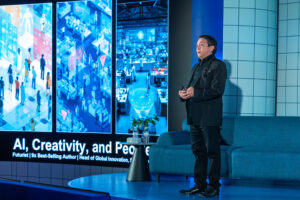
At Integrated Systems Europe in Barcelona, I talked about AI in a way that made some people nod, some people uncomfortable, and others sit a little straighter in their seats.
AI is often compared to the discovery of fire, the invention of the wheel, or electricity. What we’re really talking about here is comparisons to enabling forces. Fire did not change the world because it existed. The wheel did not reshape civilization because someone carved one. Electricity did not transform industry because it was discovered. Each became revolutionary when people learned to apply them in imaginative, practical, and often world-changing ways.
That is exactly where we are with AI. Or it is representative of where we could be.
Yet, too many organizations are using a civilization-shifting capability to write emails faster, summarize meetings, automate yesterday’s workflows, and take out costs while improving efficiency and productivity.
It may seem like strategy. At the same time, it is also a missed opportunity to exercise human imagination, to drive innovation, and to compete in a way not possible before.
So what’s the use case for that?
If there was a playbook, I suppose everyone would compete similarly.
The opportunity for you, for us, is bigger than efficiency. Bigger than productivity. Bigger than cost takeout. Beyond faster, cheaper, more scalable, AI is a new medium for value creation, reinvention, and human amplification. It can absolutely help us move faster. But speed alone is not transformation. Speed without vision only gets you to a familiar destination sooner.
And that is the trap we’re not acknowledging.
Right now, many executives are asking the wrong first question, “Where can AI save time?” or “How can AI reduce headcount?” or “What processes can we automate?” or “How can AI help us save time and money?” Those questions are understandable, especially in a market obsessed with near-term, quarter-to-quarter returns. But they also reveal how small the aperture still is in most leadership teams.
The more important question is this:
Now that AI exists, what becomes possible that was not possible before?
That is the question that separates optimization from reinvention.
It is also the question that separates leaders who will shape the future from those who will spend the next three years reacting to it.
Because AI is not only changing technology. It is changing the standard for leadership.
This is why the moment feels so consequential. AI is not simply testing infrastructure, governance, data readiness, or AI fluency across the workforce. It is testing executive imagination. It is exposing whether leaders can think beyond efficiency and into possibility. It is revealing who can redesign work, reimagine value, and challenge the assumptions that made sense in a pre-AI world, but now quietly limit what their organizations can become.
In that sense, AI is not just a business shift. It is a leadership mirror.
And not everyone is going to like what it reflects.
I know my reflection made me CTRL-ALT-DEL.
For years, digital transformation taught organizations to digitize and optimize what already existed. Most companies became better at moving old work into new systems. AI demands something far more profound. It asks us to question whether the work itself should exist in its current form. It asks whether decisions can be made differently. Whether expertise can be distributed differently. Whether customer experiences can be orchestrated differently. Whether products, services, operating models, and even business models can be designed in ways that were previously impossible.
That is a very different conversation.
It is also why so many AI initiatives feel underwhelming. They are being measured against the wrong ambition. If you use AI to improve the past, you get a better version of the past. If you use AI to rethink the future, you start to create advantage that compounds.
That is the shift leaders need to make right now.
From automation to augmentation.
From productivity to possibility.
From adoption to reinvention.
From asking what AI can do, to deciding what we should do differently because AI exists.
That last point matters more than most people realize. Don’t sacrifice your future to prolong the good old days.
The highest performers I know are not using AI to avoid thinking. They are using it to think better. They are using it to pressure test decisions, stretch scenarios, challenge assumptions, explore edge cases, sharpen strategy, and move from first answer to better answer.
They are not treating AI like a shortcut. They are treating it like an intellectual sparring partner for higher performance.
AI should not become a substitute for judgment. It should become a catalyst for better judgment.
AI should not flatten originality. It should provoke it.
AI should not turn leaders into faster administrators of legacy work. It should help them become architects of what comes next.
This is where the C-suite has to rise above the noise.
In boardrooms, AI is often framed as a technology agenda. In reality, it is a strategic, operational, and cultural agenda all at once. It changes how value is created. It changes how decisions are made. It changes what talent must now be capable of. It changes how leaders lead. It changes how organizations learn.
And perhaps most importantly, it changes how companies compete.
In an AI-shaped market, the winners will not simply be the businesses that deploy more tools. They will be the businesses that redesign themselves around new capabilities. They will understand that AI is not a layer to add on top of yesterday’s model. It is a force that invites you to rethink the model itself.
That is a very different level of ambition.
And it requires a very different caliber of leadership.
So what should leaders do right now?
Start here.
First, stop treating AI like an efficiency initiative. Efficiency is a benefit. It is not a vision. Every executive team needs to define where AI can create net-new value, not just lower existing cost.
Second, audit your assumptions. Where are you preserving workflows, decision models, and customer experiences simply because they are familiar? Legacy thinking is one of the biggest hidden costs in transformation.
Third, elevate the questions in the room. Do not just ask where AI can save time. Ask where it can unlock new growth, new services, new business models, new categories of customer value, and new forms of human contribution.
Fourth, build a culture that learns with AI rather than merely adopts it. Fluency matters, but fluency alone is not enough. Your people need permission to experiment, challenge norms, and rethink how work gets done.
And fifth, as a leader, go first. Do not delegate the future. Use AI yourself, not just to become more productive, but to become more expansive. Let it sharpen your thinking. Let it expose your blind spots. Let it widen your field of view. The future will not be led by executives who approve AI strategies from a distance. It will be led by those who allow AI to change how they see, think, and lead.
That is the real work.
What I wanted the audience at ISE to leave with was not just urgency, but permission. Permission to dream bigger. Permission to ask better questions. Permission to challenge inherited assumptions about work, leadership, and value. Permission to stop treating AI like a faster horse and start treating it like a chance to redesign the road.
Contrary to all the headlines, we are still early.
That is the good news.
The leaders who move now still have time to shape what this becomes inside their organizations. They still have time to set a bigger ambition than cost savings. They still have time to move from experimentation to reinvention. They still have time to build companies that do not just survive the next era, but define it.
But that window will not stay open forever.
AI is not waiting for leadership to catch up.
It is already exposing who is building for the future and who is simply trying to preserve the past a little longer.
And in the end, that may be the most important truth of all:
AI will not replace leaders.
But leaders who cannot imagine beyond yesterday will absolutely be replaced.
Read Mindshift | Subscribe to Brian’s Newsletter | Consider Brian as as Your Next Speaker

Leave a Reply