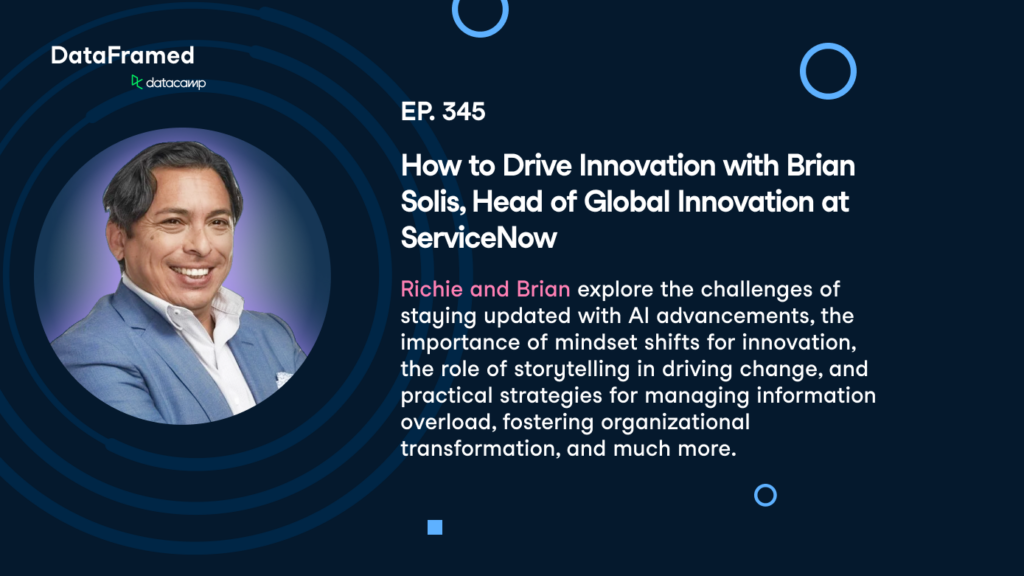
When Richie Cotton asked me on DataCamp’s DataFramed podcast how I stay afloat with everything happening in AI, I joked that I wear “AI floaties.”
Thirty tabs open. New “state of AI’ reports I need to read. Breakthroughs I need to understand. Every day, there’s a new model, a new breakthrough, a new viral article with a new “this changes everything” or “this is the end of…” headline.
Honestly, I’m struggling to keep afloat too with all the AI advancements and industry leaders sharing visions of a future that can make doomscrolling seemingly a reprieve.
And in this relentless cycle, without mindfulness and care, innovation, creativity and optimism can erode.
When everything feels urgent, your thinking gets more constrained. You default to what you know. You optimize yesterday because reinventing tomorrow feels like a luxury reserved for people who aren’t as busy.
Something that has stuck with me throughout each whirlwind, is that on one side, you have stories of AI Natives who are scaling themselves with AI agents. On the other side, you have legacy organizations not realizing ROI in their AI investments.
Tomorrow is being reframed. And as Marshall Goldsmith famously said, “what got you here won’t get you there.
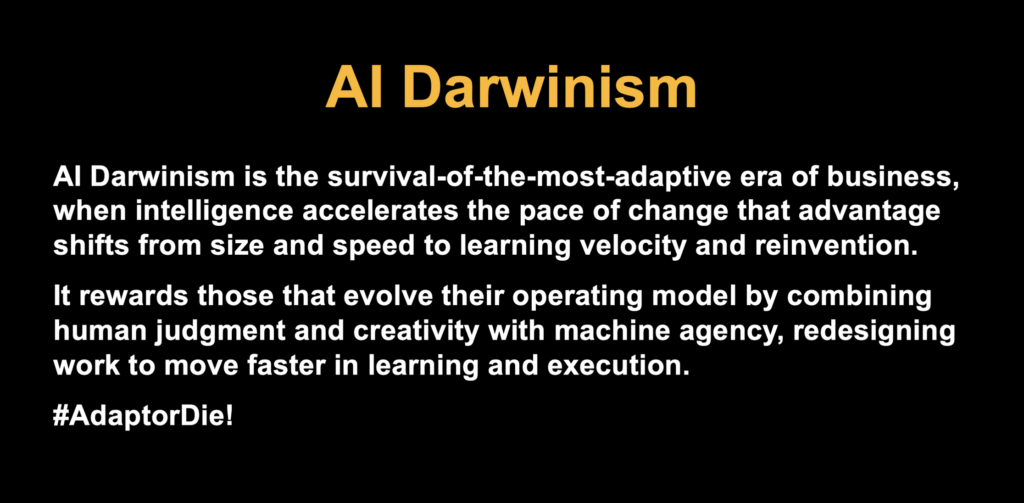
At play is AI Darwinism. Some are aiming reinvent the future with AI while others look to scale yesterday. But you can’t automate your way to innovation. You can, however, mindshift your way to it.
The fork in the road most teams ignore
In the conversation with Richie, we kept circling back to a simple truth: there are two paths forward.
One path is the one most organizations reward because it’s measurable, safe, and familiar.
Iteration: improving yesterday to scale tomorrow.
The other path is the one AI makes unavoidable if you want to stay relevant.
Innovation: creating new value to unlock new opportunities tomorrow.
You need both. But you can’t confuse them.
If AI is only helping you do what you already do, faster, then you’re not transforming. You’re speeding up the past.
So here’s a question I’d like you to introduce into your next AI meeting, especially the ones that sound like “what can we automate” or “where can we gain efficiencies?”
Are we using AI to run faster in the same direction… or to compete differently?
The answer is not one or the other, it’s balance. Do you have balance in how you think about and apply resources to AI iteration and innovation?
Why people resist change
Most transformation efforts fail for one reason that has nothing to do with tools or adoption: it’s that people don’t see themselves on the other side of the change.
Leaders love to talk about vision. Teams hear disruption.
Leaders love to talk about efficiency. Employees feel replaceability.
That’s why vision statements aren’t the key to transformation just like management isn’t the key to ‘change’ management. I
In the episode, we I shared the story about what I learned from Nick Sung, a former Disney/Pixar storyboard artist and the biggest lesson I took away from our work together. and how it tests two things before anyone spends millions animating a film: believability and relatability.
If your vision and strategy aren’t believable, people won’t commit because they can’t see the character they play in that ‘film.’
If it isn’t relatable, people won’t care, because they don’t see the story as relevant to their aspirations or fears or both.
If people can’t see themselves in the story, they will protect themselves from it.
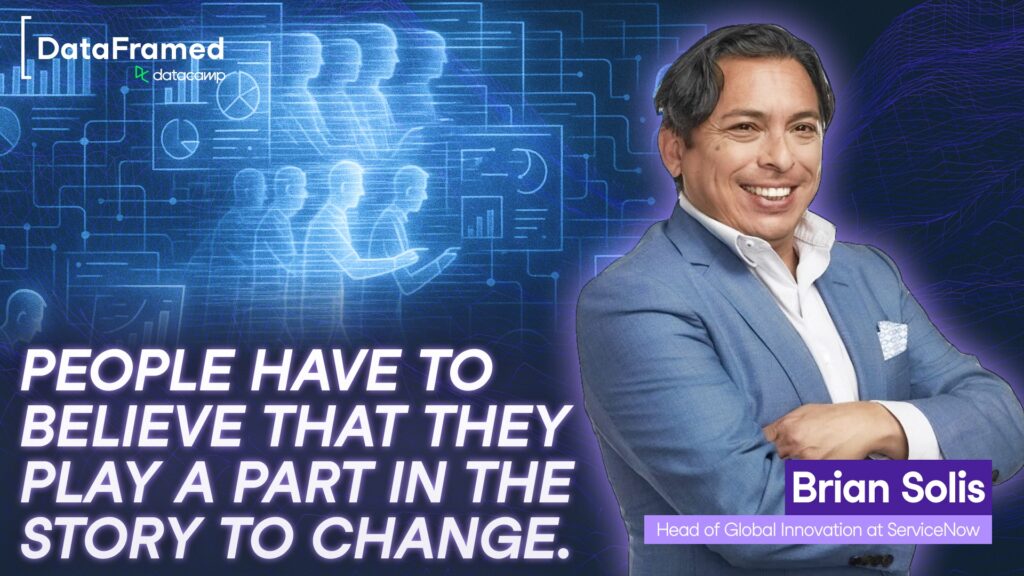
People have to believe that they play a part in the story to change.
Before you ask people to change their work, turn your data into a human journey. Storyboard what changes for the customer. For the employee. For the business. For the person who will have to explain this to their team on a Tuesday when everything is already on fire.
Because transformation doesn’t spread through logic alone.
It spreads through meaning.
“I don’t have time” is a leadership signal
Richie asked the question that is painfully accurate:
How do you find time to do new things when you’re already drowning in old things?
Here’s what I’ve learned (and learned the hard way): time is often a construct built on belief systems.
If you track your week, you’ll discover your calendar is a map of what you value and prioritize. Meetings. Status. Responsiveness. Availability. If not focused on a future motivating state, an articulated destination of what change or success looks like, your time offers an illusion of progress.
And then you wonder why you can’t innovate.
Innovation requires oxygen. Your calendar is often a vacuum.
Which is why one of the most useful soundbites from the conversation is also one of the most uncomfortable:
The most powerful word in transformation is “no.”
If you’ve ever been in a meeting that ends early and someone says, “I’m giving you back seven minutes,” and you feel like you just won the lottery, that’s a sign.
No to the meeting that doesn’t need you.
No to the default 30 or 60 minutes because Outlook decided it was “normal.” (Yes, that’s a real origin story many of us have lived.)
No to “quick calls” that expand to fill every available minute.
And here’s the part we often get wrong: “no” isn’t rejection. It’s focus. It’s direction.
It’s about being accountable to promises you make to yourself, others, and the outcomes the drive toward vision.
The “signal filter” that keeps you from chasing shiny objects
Let’s talk about the other quiet anxiety: trends.
Everyone is expected to “keep up,” but nobody agrees on what “up” even means anymore.
So here’s the simplest way I can make this usable: stop trying to keep up with everything. Start building a practice to tune into signals.
A signal becomes worth your attention when it has four qualities:
It has momentum (it keeps showing up), convergence (it connects with other signals), consequence (it changes what’s possible or expected), and context(it matters to your customers and constraints).
That’s how you separate “interesting” from “important” and “everything” into “what matters.”
And yes, this is also how you avoid getting burned by hype cycles.
Take the metaverse. If you only experienced it through hype, you’d think it disappeared. If you watch it through signals, you see something else: spatial computing, world models, and new creation tools are steadily improving.
For example, World Labs’ “Marble” is positioned as a multimodal “world model” that can generate and iteratively edit explorable 3D worlds. That doesn’t mean “metaverse now.” It means the underlying ingredients are evolving and immersive, dynamic, generative worlds for people, physicalAI, humanoids, will have new experiences, training models and worlds to explore.
That’s what trend work is supposed to do: help you hold two truths at once.
Not everything is real now. But some things become real fast once the right ingredients converge. Help make it make sense.
The hidden tax of AI: workslop
There’s one more signal worth naming because it’s showing up everywhere: the output looks polished, but it costs everyone time.
Harvard Business Review calls it “workslop,” low-effort AI-generated work that shifts cognitive load onto the recipient.
If AI is “saving time” by dumping unfinished thinking onto your colleagues, that’s not productivity. That’s cognitive Darwinism, a tax you give yourself and others. And it’s also how trust erodes inside teams.
Here’s a standard I’d love to see become contagious:
If you use AI to produce something, your job isn’t to hit send faster. Your job is to make it better than what you could have done alone….please.
A practical mindshift sprint you can run this week
If you want to turn this into action, don’t start with “AI strategy.”
Start with a short sprint that changes how you work and how your team thinks.
Idea 1: Run the Iteration/Innovation Test. Pick one AI initiative you’re working on. Write two sentences. One describing how it improves yesterday. One describing how it creates new value. If you can’t write the second sentence, you don’t have an innovation initiative yet.
Idea 2: Build your Signal Filter. Choose three signals you’ll track for 30 days. Not 50. Three. Maybe, five. Assign each signal a consequence: what would it change for customers, employees, cost, speed, risk, or differentiation? (learn more about how to practice futures in Mindshift).
Idea 3: Storyboard the human journey. Take your most important AI effort and write a simple arc: Before, during, after. Who struggles today? What changes? What becomes possible? Where does fear show up? Where does agency show up? If your storyboard doesn’t include emotion, you’re not done.
Idea 4: Defend two hours. Block two hours on your calendar this week as “innovation time.” Then protect it. Practice the word “no” with a reason. Practice “yes” with a boundary.
Idea 5: Eliminate one recurring meeting. Just one. Replace it with an async update. Or shorten it to 25 minutes with a single outcome. Then measure what happens to clarity, speed, and morale.
Idea 6: Declare a “no workslop” standard. Make it cultural. Tell your team: “AI output must be edited, contextualized, and improved before it reaches someone else.” If AI is involved, the bar goes up, not down.
Idea 7: Become the leader you’re waiting for. This is the closer I shared on the show, and it’s the line I keep coming back to: if you’re waiting for someone to tell you what to do, you’re often waiting on the wrong side of innovation.
Management isn’t leadership. And leadership isn’t a title. It’s influence. It’s the ability to change minds, behavior, and outcomes.
It’s choosing the “aha” moment over the “uh-oh” moment…most people respond only when something disrupts them, hence, “uh-oh.” “Aha” on the other hand, is about giving yourself time, space, and permission to think, to ask questions, to wonder, and to imagine.
It’s deciding that the future isn’t something you react to. It’s something you shape.
If you take nothing else from this, take this:
Iteration keeps you in the game. Innovation changes the game. AI can do both. Your mindset decides which path you’re on.
Please watch to dive deeper into all these topics and more!
Read Mindshift | Subscribe to Brian’s Newsletter| Consider Brian as Your Next Speaker



Leave a Reply