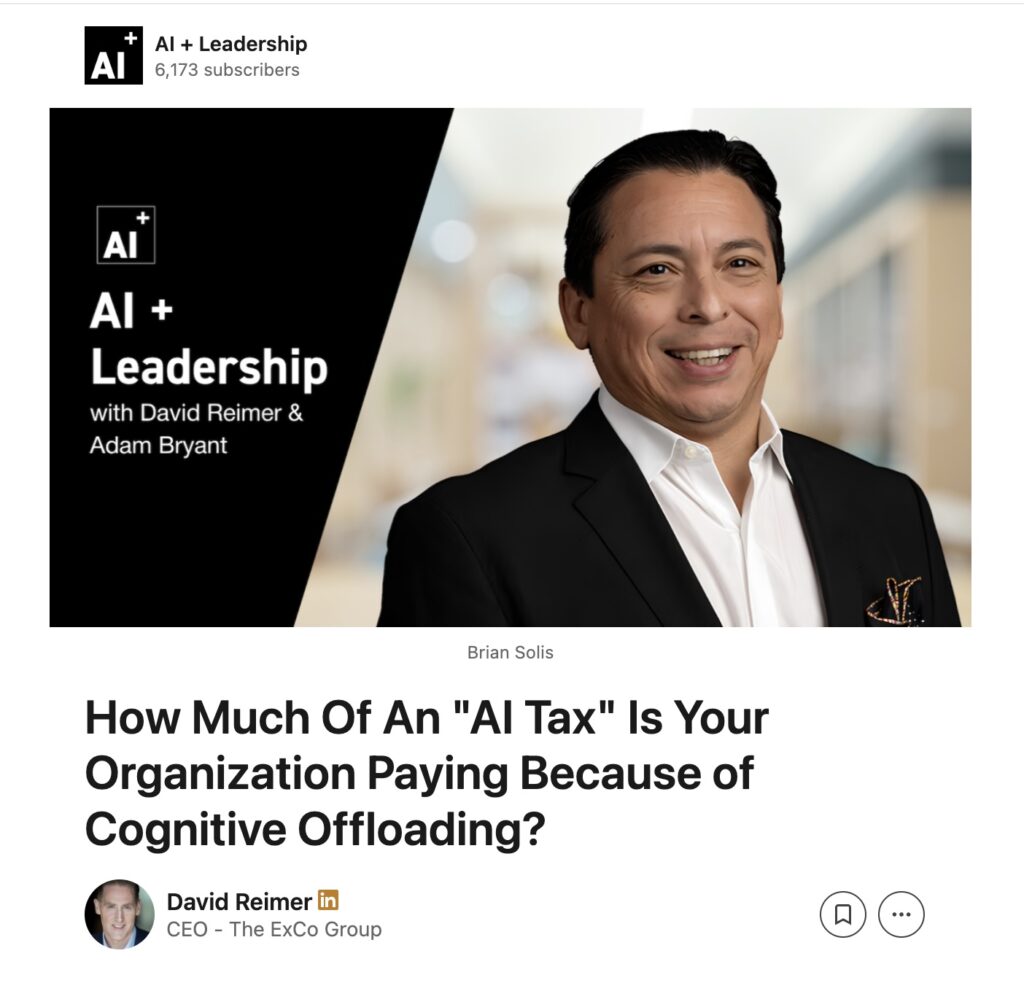
Brian Solis, Head of Global Innovation at ServiceNow, shared timely insights with David Reimer and Adam Bryant, senior managing director at The ExCo Group, for their AI + Leadership series of conversations about the intersection of leadership and AI.
Reimer: What are some common strategic and tactical mistakes that you’re seeing companies make now?
Solis: The most consistent one I see is that executives want to have an AI conversation. But they are leading with AI as the strategy versus thinking first about the desired outcome or differentiation that they’d like to see. They lead with questions like, where can AI drive efficiency gains and cost savings, and where can AI increase speed and productivity?
We’ll hear companies say, “We would like to explore using AI to reduce service call volume by 25 percent by the end of the year.” But then we’ll ask, why? Is it because the existing infrastructure can’t handle the capacity? Is it because you’re looking to free up resources for other higher-value work? The response we usually hear is that they had not talked about that.
Another pattern we see is that companies don’t usually start the AI conversation with a group of C-suite stakeholders who are looking at this issue at a corporate level—where are we trying to go as a company? Instead, individual leaders talk about using AI for their teams, which results in AI essentially fortifying the siloed approach to this technology versus the transformational approach.
Bryant: What are some other traps that you find people are falling into with AI?
Solis: Just as with previous technology revolutions, AI doesn’t come with an instruction manual. With so many companies mandating that their workforce use AI, employees are now using generative AI essentially the same way they use Google. And that leads to cognitive offloading.
People can move faster with AI, and so they give AI more of the same stuff to do, but then what we see is that quality is sacrificed because we are literally handing over our thinking to AI. And that essentially creates output that causes an “AI tax.” For example, if I’m producing reports with AI, I’m assuming that my prompt was good enough, and therefore I can just send the report on to my manager or colleague.
But if the report doesn’t reflect your editing, your brain, your skill set, your understanding of context, and empathy for the person receiving those reports, they’re going to read something that reads just like AI, with zero context and relevance to them.
So that AI tax makes them have to do the work so that the report makes sense for them, which is what the sender should have done. The AI tax has become very pervasive. People are moving faster and using AI more, but it’s not necessarily raising the bar in terms of quality of output.
There is research that shows that cognitive decline is happening at the executive level, too. It shows that many executives are using AI to make decisions for them, when in fact the executive was put in that position for their ability to make decisions. A significant percentage of executives now trust AI more than they trust their leadership teams and more than they trust their boards.
When I meet with groups of CEOs and COOs, and they let their guards down, they often say that they don’t actually know what to do about AI, even though they are supposed to know what to do. And in the absence of knowing what to do, they surround themselves with people who seem to know what to do. But if those people are using AI to do their thinking for them, they’re not thinking from an augmented standpoint or strategic standpoint.
This is a leadership moment, not a management moment—what does leadership mean for the new era? When we look at recent history, an important pattern is that “black swan” events are happening with increasing speed and scale. My hypothesis is that all leaders, not just those in business, have been attacking these black swan events in the way that they’ve always attacked them: experience, expertise, leadership.
But every one of these events essentially shifted the world into a new trajectory. It’s not the same world anymore, especially now with AI, and yet we’re still bringing the same mindset. We’re still bringing the same frameworks. We’re still bringing the same curriculum. We’re still bringing the same textbooks to these moments.
We need new leaders for these times who acknowledge that they don’t have the answers. Instead, they approach the challenges with a beginner’s mindset—they are willing to say they don’t know, even after all their years of being the smartest person in the room. They need to try to understand what’s actually happening right now, make some mistakes, and learn and go forward. You have to be willing to set aside your ego to not be the expert.
We’ve seen the phenomenon of people leaning on what they do know when they are faced with uncertainty. My co-author, Dave Wright, who’s the Chief Innovation Officer at ServiceNow, tells the story of being in a room full of executives who were pushing back on the need to make big changes. They just wanted to improve, iterate, and be more efficient.
Dave noticed that the person leading the pushback didn’t want to change because he didn’t need to change. But whose responsibility is it to make sure that the next generation is ready to take on these challenges? There’s no playbook, and we’re acting as if there is. Humility and self-awareness are some of the most important skills right now.
Reimer: What are the best questions you use to spark a productive conversation?
Solis: When workflow is reimagined end-to-end with AI, it’s not something that’s bolted on to an existing process. It opens your mind to realize that work doesn’t just happen in a silo. But today, work is supported by a tech stack that’s usually siloed, and so AI is fairly limited to what it can do. When you start to reimagine workflow around the outcome, you’re force-functioning the company to break the silo to make the stack horizontal. When you can do that one workflow at a time, you’re transforming the company to be AI-forward.
I remember sitting in a room with about 30 leaders who were responsible for leading AI strategy at their companies. One person said they felt they were debilitated from the outset because they were told their goal was to remove costs. His frustration was that he was not invited to the table to talk about how these investments could drive growth for the organization. His concern was that when you can’t have a conversation about investing in technology to drive growth, as well, then you are hamstringing the company’s ability to be competitive. The point is that you cannot cut your way to growth.
This is something that companies that aren’t thinking bigger about growth from the outset are going to learn the hard way—cutting is no longer the most viable way forward with a technology that allows you to be more intelligent. Intelligence now is abundant, and what we can do now is shift the conversation away from cost-cutting and automation to augmentation. How can AI work with people to do more, to do what was impossible yesterday? Those questions are going to lead to potential growth initiatives.
Bryant: What’s the best way to convince someone to fight against the urge to engage in “cognitive offloading”?
Solis: I will point out that in a world where everybody is using AI, it creates a new status quo. Which then raises the question, how do you want to rise above it? What do you want to do differently? How do you want to stand out so that you’re uniquely you and your voice and your intention and your vision come through?
Reimer: What was it about your upbringing that helps make you comfortable navigating this moment of unknowns?
Solis: I’ll start by saying I’m not comfortable navigating this. Imposter syndrome has been on my resume since the beginning of this. A big early influence was my mother, who instilled a sense of pride in me, as well as expectations of doing better than what my environment dictated would be my likely outcome—we grew up lower-middle-class in the San Fernando Valley.
As a kid, I do remember struggling with following rules in school—the constructs, the ways of learning. It just was really hard to navigate those things. When I was eight years old, I started mowing lawns and washing cars to buy the earliest computers, and I taught myself programming. Later on, I dropped out of college to publish a magazine in Los Angeles. At the time, we had to lay everything out and send it to the printing press. But then we shifted to desktop publishing, and then to digital. It was just this magical revolution.
I recognized that my value was going to be in helping to accelerate things like this, and so I moved to Silicon Valley in ’96 to do just that. It’s a long way of saying that I have been trying to figure this out since I was a kid, and that is the consistent pattern here.
I’m figuring it out for myself, so I can help figure it out for other people. Then I have to figure out how to help people when they don’t want to figure it out or feel like they need to figure it out. I have to understand the psychology of breaking that down and building them back up, and then doing this at scale.



Leave a Reply