I recently had the opportunity to speak with leaders at a global entertainment powerhouse, which was a meaningful full-circle moment for me. Before moving to Silicon Valley in the 1990s, I lived not far from the studios. At the time, I thought my future might unfold in entertainment or technology. Somehow, I found a way to stay connected to both. But the path was through technology and a career in Silicon Valley and the Silicon Valleys around the world.
We are living through a moment when technology, culture, business, creativity, and human behavior are not simply converging. They are colliding, recombining, and accelerating. Every industry is becoming something else. Entertainment is no longer just content. Retail is no longer just commerce. Security is no longer just protection. Automotive is no longer just transportation. Healthcare is no longer just care delivery. Banking is no longer just financial services.
AI is changing how work gets done. And it is challenging what companies are, what they believe, what they protect, and what they are brave enough to become.
This is why I wrote Mindshift. Futures and foresight matters more now than ever. And even though I’ve been doing this work since the mid-to-late 1990’s, I’d never codified my work until now.
Let Me Look into My Crystal Ball
A futurist does not predict the future. A futurist studies signals. We look for what is emerging, what is fading, what is a fad, and what might become meaningful over time. We make sense where hype or ignorance play a dominant role. And e we play out scenarios of potential futures so leaders can be ready for tomorrow, today.
The challenge is that most organizations are not designed to act early. They are designed to react once something becomes obvious.
By then, advantage usually belongs to someone else.
The future almost always arrives as a behavior before it becomes a market. By the time everyone agrees something is a trend, the opportunity has already started to move. The work of leadership is to notice the signal early enough to create options.
And right now, the signals are everywhere.
AI is changing how people think, create, search, learn, work, make decisions, tell stories, consume content, trust information, and imagine what is possible. Yet too many companies are still asking the smallest version of the AI question: How do we use it to become more efficient?
Sure, efficiency matters. But efficiency alone is not reinvention.
If we use tomorrow’s technology only to optimize yesterday’s business, we may become faster, leaner, and more productive versions of something the world is already leaving behind.
Innovation Is not Iteration
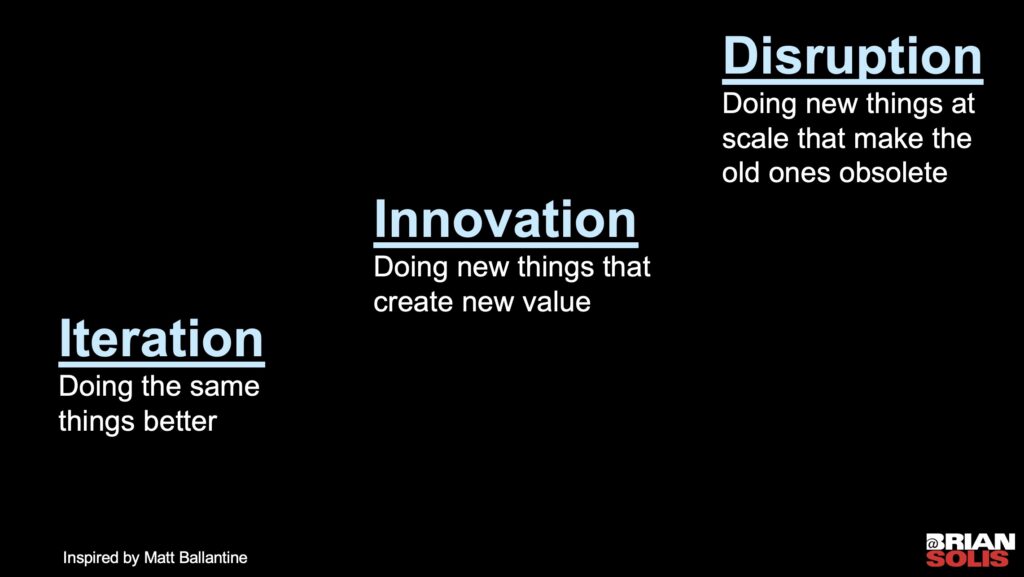
We tend to use the word innovation too casually. But innovation is not iteration, no matter how groundbreaking the new technology in which we adopt.
Iteration is doing the same things better.
Innovation is doing new things that create new value.
Disruption is doing new things at scale that make the old things obsolete.
In an era of AI, this becomes consequential. Every team is looking at workflows, content, operations, customer experiences, cost structures, and productivity. But as those plans take shape, leaders need to ask a simple question, are we improving what already exists, or are we creating something genuinely new?
Most AI work today sits in the iteration bucket. That is not a criticism. Please don’t get me wrong. Iteration is necessary. Businesses need to improve. They need to move faster. They need better tools, better processes, better data, and better ways to serve customers and employees. And workflows can be optimized while reducing costs. But iteration has a ceiling.
If you are doing what you did yesterday better, faster, and more efficiently, that may be useful, but it is not necessarily innovation. It may strengthen the current business, but it does not guarantee the next one.
Innovation requires a different mindset and mindshift. It asks what could now be possible that was not possible before. It challenges assumptions. It connects signals with unmet needs. It looks for new value, new relationships, new experiences, new capabilities, and new business models.
AI can help us do both. It can iterate and innovate. But that’s up to you.
The risk is that most companies will stop at iteration because it is easier to measure, easier to fund, easier to explain, and easier to defend.
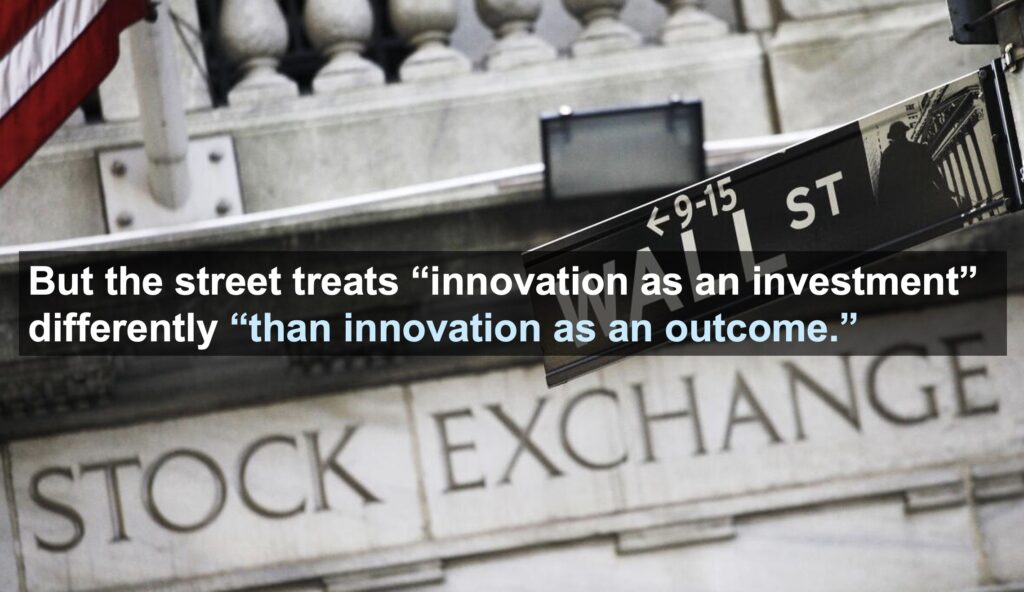
The street treats innovation as an investment differently than it treats innovation as an outcome. Public companies especially know this tension. Investors want growth, but they also want predictability. They want imagination, but not always the messiness required to produce it. They want future value, but they still measure today’s performance quarter to quarter.
This is why leadership matters. Innovation is not just the outcome. It is the discipline of creating the conditions where new value can emerge. And sometimes, that means being willing to put yourself out of business before someone else does.
Better Candles Do Not Become Light Bulbs
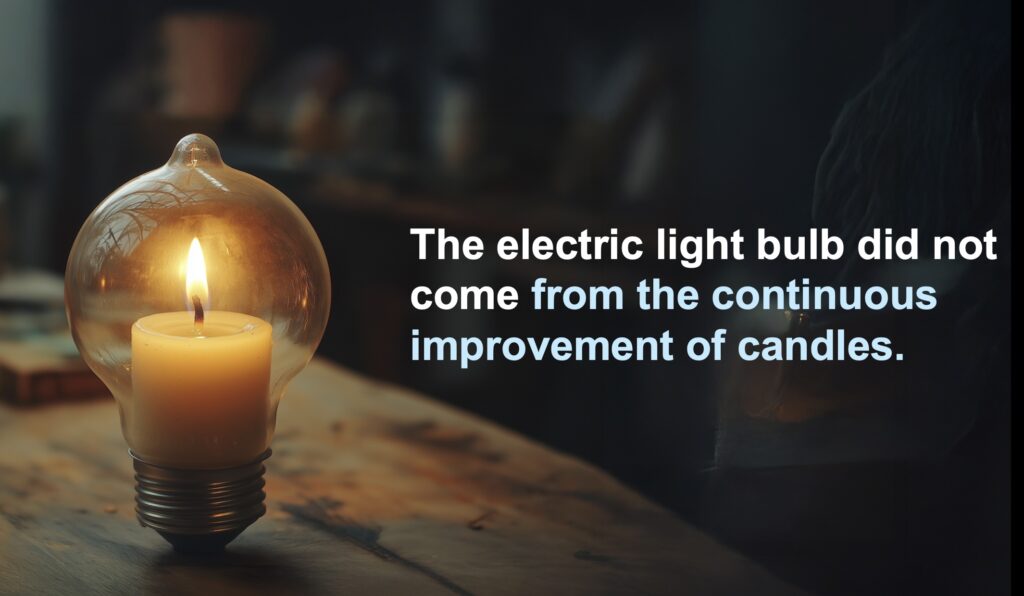
Working in Silicon Valley taught me something I have had to repeat in almost every boardroom and executive session since, the electric light bulb did not come from the continuous improvement of candles. This statement exposes the trap.
Most organizations are very good at improving candles. They optimize. They refine. They standardize. They make the current model more efficient. They create processes to protect quality, manage risk, improve margins, and scale what already works.
Again, there is nothing wrong with this. It’s all necessary. Successful companies become successful because they learn how to repeat success. But success creates assumptions. And success is a poor teacher in preparing for the future.
The practices that produced yesterday’s success become beliefs about how tomorrow should work. Over time, those beliefs become budgets, incentives, approval processes, metrics, org charts, and operating models. Eventually, the business does not just have a strategy. It has an operating system. And that operating system starts rejecting anything that does not look like the past.
This is how companies keep improving after they stop imagining.
They continue to get better inside an established model while the model itself starts to change around them. They invest in performance, but not possibility. They protect what exists, but underinvest in what threatens it. They call something “high risk” when often it is really just hard to change.
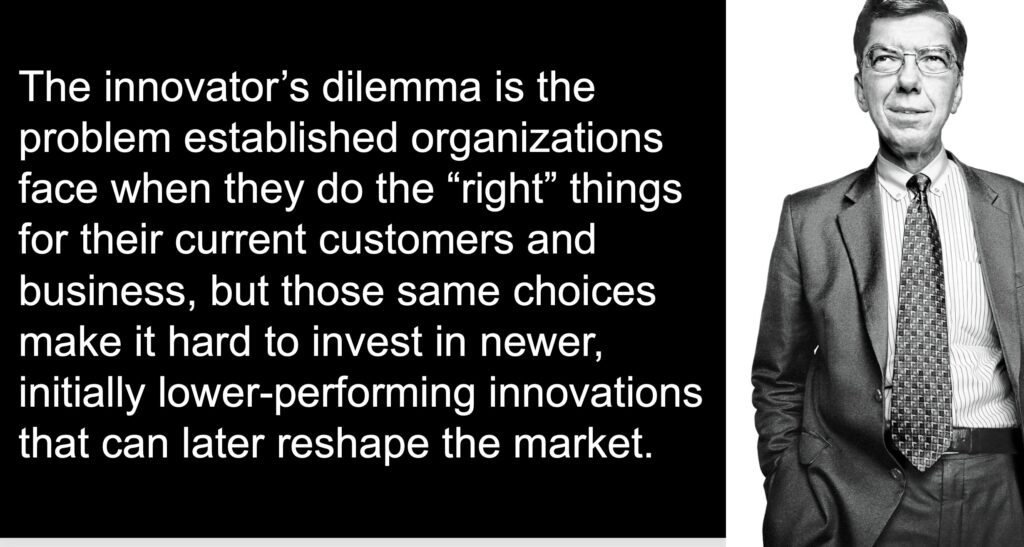
This is the innovator’s dilemma, and it is still one of the most important lessons in business. Established organizations often do the “right” things for their current customers, current investors, and current business model, only to miss the next curve.
This is what makes the dilemma so dangerous.
Day 1 Is a Discipline
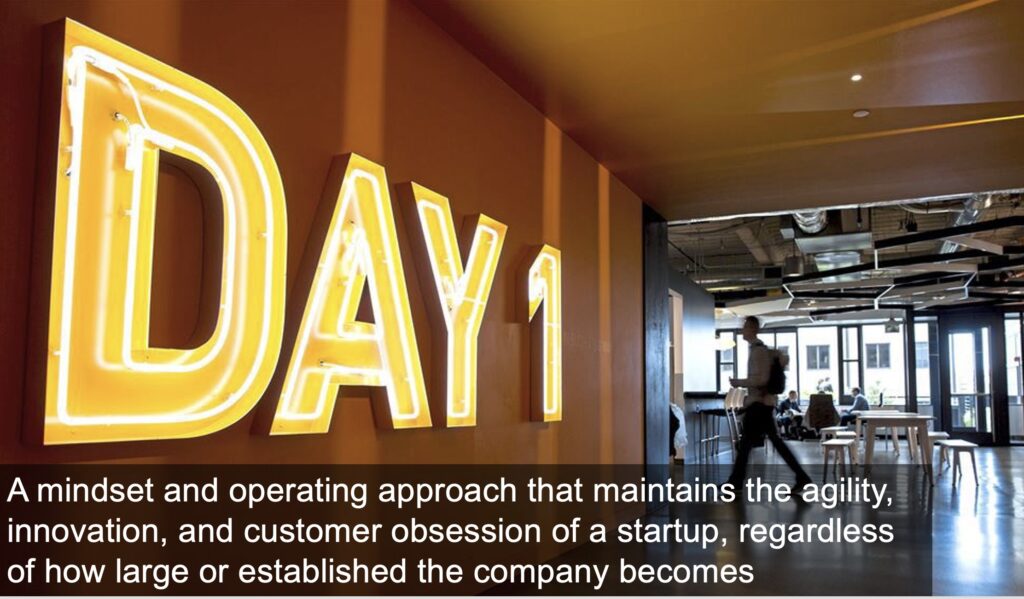
Amazon popularized the idea of maintaining a Day 1 mindset. Whether you admire Amazon or critique it, the idea is powerful. Day 1 is a mindset and operating approach that protects agility, innovation, and customer obsession, no matter how large or established a company becomes.
Screenshot
Day 2 is different.
Day 2 is when organizations begin to stall. They get caught in yesterday’s operating system. They focus on making the existing business better, cheaper, and more efficient. They defend the model. They protect the process. They mistake scale for vitality.
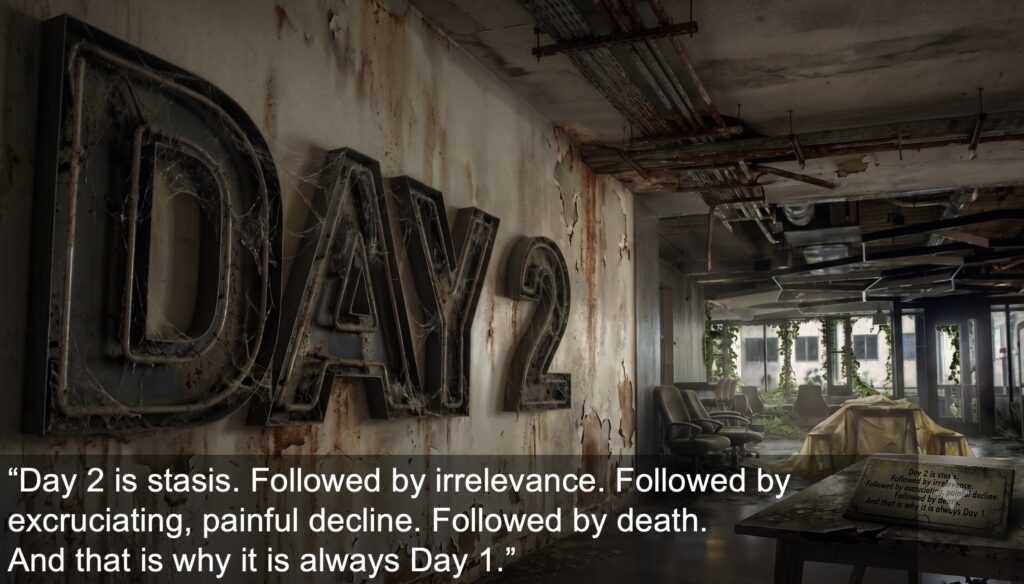
Every company has to fight Day 2 even though it comes so naturally. And it’s not a one-time battle. Innovation is not a one-time event. It’s a way of operating.
Kodak is a classic example because the company did not fail to see digital photography. It had early access to it. It even developed foundational technology. But it treated innovation as a moment rather than a mandate. By the time it moved, the market had moved faster.
@chriskohlernews
That is why innovation has to be broken out of the day-to-day and operationalized in its own way without the typical P&L constraints. It has to become a way of exploring and working.
One company I worked with years ago required employees to dedicate time every week to learning a new skill or exploring a new idea. More importantly, managers were measured by whether those ideas and skills made their way into the business. And that was true all the way up to the top. That is the difference between innovation theater and innovation infrastructure.
Ideas are easy. But ideas without nurturing and experimentation and work will always be Implementation is leadership.
Culture Either Becomes the Highway or the Roadblock
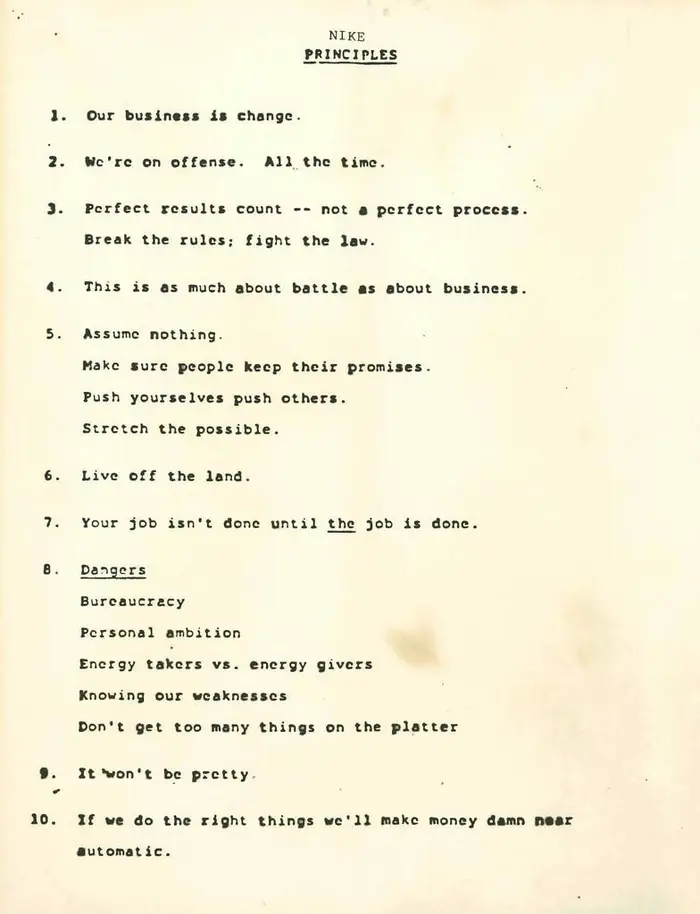
Nike’s original culture memo from the 1970s still reads like it was written for today’s innovation economy: our business is change, we are on offense all the time, perfect results count, not a perfect process, break the rules, fight the law.
That kind of language endures because it captures something most companies lose over time: the feeling of why they started.
I have worked with organizations that were once bold, hungry, human, and inventive, but eventually became trapped in their own infrastructure. They began optimizing channels, systems, operations, and internal processes while slowly losing sight of the people they were actually there to serve.
I’ve worked with Nick Sung, a former Pixar and Disney storyboard artist, going back to my early days of writing X: The Experience When Business Meets Design, and every book I’ve written since then. When I was writing Mindshift, he told me the story of the work he did with Nike. It was a moment to help a company rediscover its North Star. Instead of starting with org charts, product lines, retail channels, or operational challenges, he, through his magic art of story boards, told the story of a young woman training for the New York City Marathon.
This doesn’t do the story any justice. But trust me…live…it’s next level.
She had a dream. She told her friends. She trained. She struggled. She pushed through. She crossed the finish line. Then she became a mentor to others. (the full set of storyboards are in the book.)




The exercise wasn’t about selling shoes or driving operational efficiency or automating service and deflecting service requests. It was about remembering what the shoes helped someone do.
That is the power of human-centered innovation. It forces the company to move from product to purpose, from transaction to transformation, from what we sell to what we make possible.
“We’re Not Building a Phone”
Apple understood this under Steve Jobs. The company was at its best when it started with the customer experience and worked backward to the technology. That was the point Jobs made when he returned to Apple and was asked where the company should go next. The answer was not to start with the technology. It was to start with the experience.
One of my favorite innovation stories comes from the early development of the iPhone.
Before there was an iPhone, the natural thing would have been to assemble people from the phone industry. After all, if you are building a phone, wouldn’t you want phone experts?
Steve Jobs thought differently.
As the story was shared with me by someone close to the original team, Jobs did not want people from the phone industry shaping the iPhone. He wanted the bias out of the room. He did not want the future of the phone limited by the people who already knew what a phone was supposed to be.
The line that stays with me is painfully obvious and nonobvious, “We’re not building a phone.”
A lesser team might have built a better phone. Steve reimagined the phone as a platform, a computer, a camera, a web interface, a media device, an app ecosystem, a marketplace, a remote control for life, and eventually an extension of personal identity.
It is easy to see this in hindsight. It is much harder to practice in the moment.
Every company has its version of the phone industry in the room. Experts who know how the category works. Processes that know how decisions get made. Metrics that know what success is supposed to look like. Customers who know what they currently want. Leaders who know what worked last time.
Expertise is valuable. But expertise can also become a boundary.
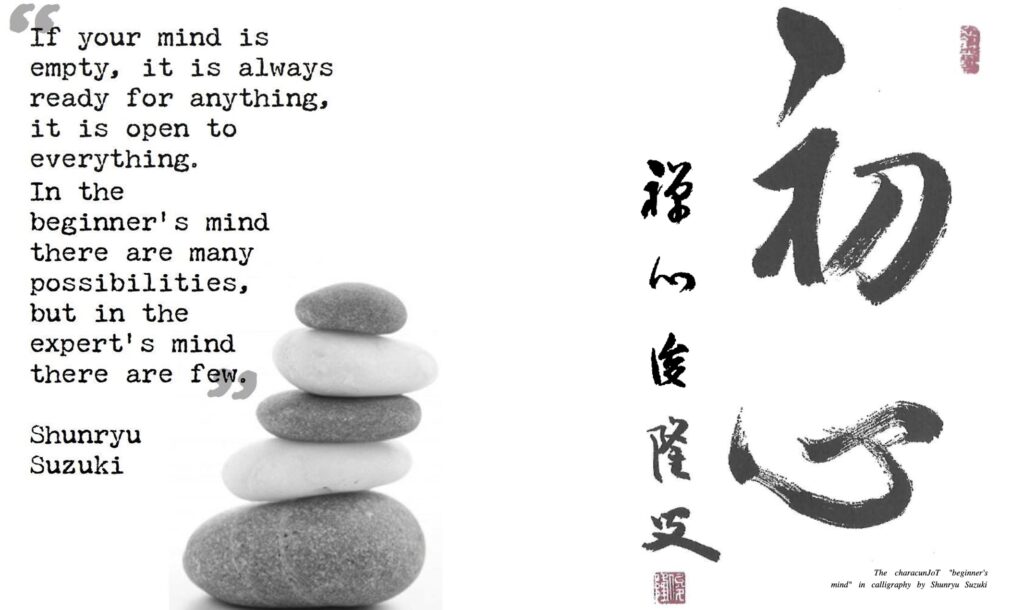
In the beginner’s mind, there are many possibilities. In the expert’s mind, there are few.
The future often needs both. But innovation needs space where expertise does not become gravity.
What Do You Stand For?
Companies that define themselves by what they make eventually get trapped by what they made.
Companies that define themselves by what they stand for keep earning permission to evolve.
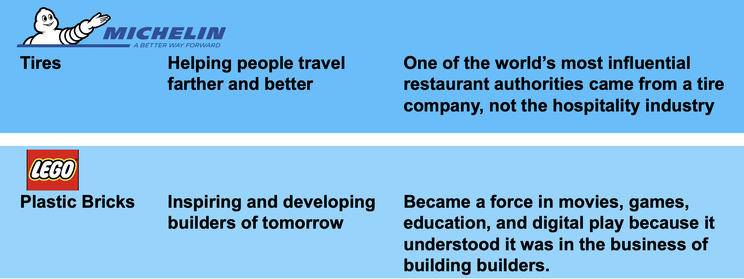
Michelin could have defined itself as a tire company. Instead, at its best, it helped people travel farther and better. That broader purpose created permission to become one of the world’s most influential restaurant authorities.
Lego could have defined itself by plastic bricks. Instead, it understood itself as inspiring and developing the builders of tomorrow. That opened the door to movies, games, education, digital play, theme parks, and entire ecosystems of creativity.
John Deere could have stopped at tractors. Instead, it continues to evolve around helping agriculture become more productive, precise, and intelligent. Camera vision, machine learning, robotics, and AI-enabled farming are not random extensions. They are expressions of a deeper purpose.
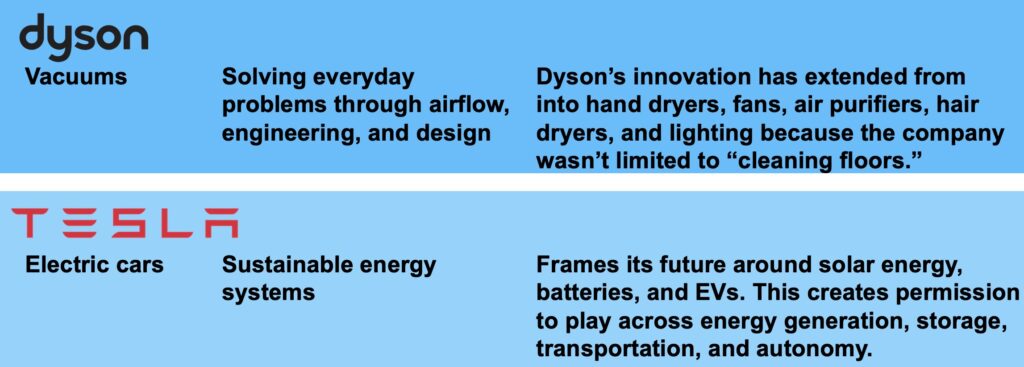
Dyson was never only about vacuums. It was about solving everyday problems through airflow, engineering, and design. That identity created permission to move into hand dryers, fans, air purifiers, hair dryers, lighting, and more.
Tesla was never only about electric cars. It framed its future around sustainable energy systems, which opened the door to batteries, solar, autonomy, transportation, and storage.
The product is the current expression. The purpose is the platform for evolution.
This is a profoundly important exercise for every leadership team, especially now. If your company defines itself by its current product portfolio, you will likely iterate from there. You will improve the portfolio. Extend it.
Defend it. Price it. Market it. Modernize it.
But if you define yourself by the value you create, the human need you serve, the friction you remove, the possibility you unlock, or the future state you help others reach, then AI becomes much more than a productivity tool. It becomes a way to ask what else you have permission to become.
AI Is Not the Strategy, That’s the Role of Imagination, Vision, and Courage
AI is now part of almost every conversation I have with leaders, teams, and even my kids. But I am fascinated by the different ways people use it. Many adults use AI to do what they already do, i.e. write emails, summarize reports, draft documents, make slides, and produce faster versions of familiar work.
That is useful. But it is mostly iteration…or as Dave Wright and I call out in Infinite ∞, it’s the “iteration trap.”
AI can help us complete tasks, or it can help us rethink the task itself.
One company asks, How can AI summarize audience research faster?
Another asks, How can AI help us understand emerging audience behaviors before they become obvious?
One team asks, How can AI generate more content?
Another asks, How can AI help us imagine new formats, experiences, communities, and relationships with audiences?
One leader asks, How can AI reduce cost?
Another asks, How can AI reveal new value?
The technology may be the same. The difference is the question. And ultimately, the outcomes tell the story. And when compounded, we outline the trajectory.
Better prompts are really better questions. And better questions come from better mindsets.
The Unknown Is Where Innovation Lives
In Mindshift, I wrote about the need to see the world through a lens of possibility and pursue the unknown to reshape the future. That work came from frustration, honestly. So many leaders say they want change. They say they want innovation. They say they want transformation. But they do not always change the one thing where transformation has to start…mindset.
Most of us believe we are open-minded. Most of us believe we are self-aware. But self-awareness is more rare than we think. It requires humility. It requires the ability to recognize that what we know may be limiting what we can see.
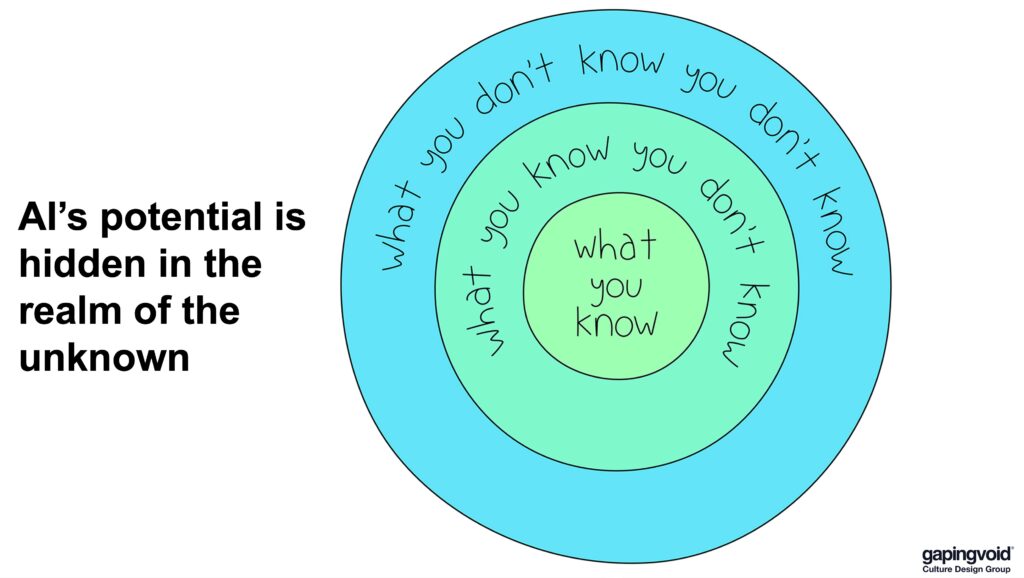
I learned a useful model from an unlikely source: Donald Rumsfeld’s idea of known knowns, known unknowns, and unknown unknowns.
In the center is what we know. That is our reference point. It is where experience, expertise, data, success, and instinct live.
Around that is what we know we don’t know. That is the edge of our comfort zone. We can study it, benchmark it, hire for it, research it, or learn it.
But beyond both is the realm of what we don’t know we don’t know.
That is where innovation lives.
It is also where fear lives. Uncertainty lives there. Anxiety lives there. Vulnerability lives there. That is why most organizations spend so little time there.
But the more time we spend in that outer realm, the more tangible it becomes. The unknown becomes less abstract. Signals begin to connect. Possibilities begin to take shape. Experiments become clearer. What once felt risky becomes learnable.
Foresight is not about predicting the future.
It is about noticing signals early enough to explore opportunities and create options.
Psychological Safety Is an Innovation System
The hardest part of innovation is not coming up with ideas. It is creating an environment where people feel safe enough to explore them.
Sir Ken Robinson famously argued that we educate people out of their creative capacities. Children are willing to be wrong. Adults learn to fear it. Schools reward the right answer. Companies reward predictable performance. Cultures reward certainty.
Then we wonder why innovation is hard.
Being prepared to be wrong means allowing yourself to be wrong. That is far more difficult than it sounds.
Google studied high-performing teams to understand why some teams outperformed other high-performing teams. The differentiator was not simply intelligence, pedigree, location, or experience. It was psychological safety. People felt safe to ask questions, challenge assumptions, make mistakes, and explore possibilities without being punished for it.
That is not a nice-to-have. It is a way of working…a way of existing.
A culture of innovation is not a vision or mission statement. It’s not a poster. It is a workplace environment, an ethos, a shared purpose that encourages people to share creative ideas and solutions. It aligns people around a future motivating state. It gives them the tools to be successful. It rewards new behaviors. It makes space for new ideas to come to life.
The magic of culture happens when leaders assemble people around a motivating future, articulate and socialize new beliefs, equip people to participate, and reward the behaviors that move the organization forward.
Screenshot
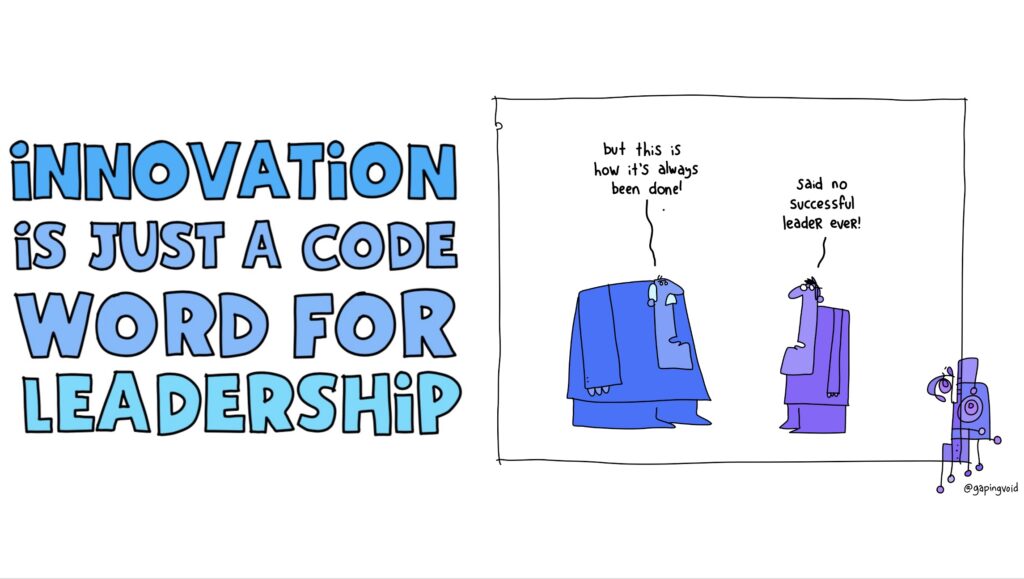
Innovation is just a code word for leadership…leadership as behavior.
The future is shaped by people who say, “Let me take care of that.”
From Signals to Experiments
The question then becomes practical. How do we make this real?
Start with signals.
What are we noticing in culture, audience behavior, technology, talent, or the way people experience the world?
A signal is not yet a trend. It may be weak. It may be small. It may appear in the margins. But signals are valuable because they reveal where behavior may be changing before the market fully understands it.
Then ask what larger shift the signal could represent if it accelerates.
What assumption does it challenge?
What belief about the business, the audience, the customer, the workforce, the operating model, or the category might no longer hold?
Then ask what opportunity becomes possible.
What new value could we create? What experience could we design? What relationship could we build? What capability could we develop?
What business model could we explore?
Finally, design a small experiment.
Not a massive transformation program. Not a fully funded new division. Not a press release. A 30-to-60-day experiment that creates learning.
The goal is not to prove you were right. The goal is to learn fast enough to make a better decision.
That is how foresight becomes action.
That is how innovation becomes repeatable.
Breaking Free From the Iteration Trap
Every leader should regularly ask four questions…
1) What are we optimized to protect?
Revenue streams, standards, compliance processes, existing systems, committee structures, operating models?
2) Where are we mistaking legacy for performance?
Old approval processes, fragmented systems, manual workarounds, internal politics, inherited metrics, “that’s just how we work”?
3) What are we underinvesting in because it threatens today’s model?
New customer journeys, AI-enabled services, alternative delivery models, workforce capability, new partnerships, new formats, new communities, new operating models?
4) Where are we calling something “high risk” when it is really “hard to change”?
These questions are uncomfortable because they reveal the invisible architecture of resistance. They show us where the organization has learned to protect the past while talking about the future.
But make no mistake, the aim in asking and answering these questions is creative self-disruption.
Companies get disrupted because they lack permission to create something new. And permission starts with identity.
If we do not create the thing that challenges our current model, someone else will. They will not ask for permission. They will not wait for our approval process. They will not respect our category boundaries. They will not be burdened by our legacy.
They will simply build what the market is becoming ready to embrace.
The Future Now Weekly Practice
One of the exercises I introduced was a simple leadership rhythm: The Future Now Weekly Canvas.
The idea is straightforward. Plan the week before the week plans you.
Most leaders spend the week reacting to urgency. Meetings, emails, approvals, fires, deadlines, decisions. The calendar fills. The inbox swells. The future gets postponed in the name of the now.
But if the future is always deferred, it never arrives by design.
The Future Is Already in the Room
Every organization has people who can see signals before they become obvious. Every company has employees who sense changing behaviors, unmet needs, broken systems, cultural shifts, and emerging possibilities.
The future is already in the room. The question is whether the operating system allows it to speak.
That is the leadership challenge now. AI is accelerating everything, but it is also exposing everything. It reveals the difference between organizations that are designed to repeat the past and those willing to imagine a new future. It reveals where culture empowers people and where it quietly neutralizes them. It reveals whether leaders are truly curious or only performatively interested in change.
It also reveals something deeply human.
When I work with executives, there is a moment that often surfaces in private conversations. It sounds something like this: “I’m supposed to know what to do.”
That sentence carries the weight of modern leadership.
But no one has a complete playbook for this moment.
The point is not to know everything. The point is to build the capacity to learn, imagine, experiment, and adapt faster than the world changes around you.
That starts with humility. It grows through curiosity. It scales through culture. And it becomes real through action.
Disruption Happens to You or Because of You
There is always an answer to “what’s next?”
The challenge is whether we are willing to ask the question before the market forces the answer upon us.
If we keep doing the same things while the world around us changes, we will become irrelevant. Maybe not today. Maybe not this quarter.
Maybe not in a way that shows up immediately on a dashboard. But relevance does not usually disappear all at once. It erodes quietly, then suddenly.
The leaders who shape the future are fascinated by it. They are restless for change and dissatisfied with the status quo because, in their minds, they can see a better future. The friction between what is and what could be burns them. It propels them forward.
That is the work now. The work is to notice signals, challenge assumptions, create space for imagination, and build the courage and capability to act.
Remember, AI is not the strategy. The future happens to you or because of you. And it starts with one uncomfortable, liberating question, are we using AI and innovation to improve the company we already are, or to become the company the future needs us to be?
Infinite ∞ | Mindshift | Subscribe | Keynote Speaker

Leave a Reply