Two years ago, The Economist asked what happened to the AI revolution. Today, we’re investing more than ever, still struggling to prove the returns, and discovering that AI’s impact on jobs is anything but predictable. I believe these seemingly contradictory signals are telling us something important about the AI Economy taking shape, and what it will take to lead in it.
Investment continues to accelerate, the world’s largest technology companies are building an unprecedented infrastructure for intelligence, and AI agents are beginning to participate in the everyday operations of businesses. Yet the financial and workforce data tell a much more complicated story.
Some companies are reporting significant productivity gains and expanding their workforces, while others are struggling to demonstrate meaningful returns or are restructuring around the promise of automation. Meanwhile, concerns about an AI investment bubble are growing alongside the extraordinary amounts of capital being committed to its future. How can so much progress and investment produce such different outcomes, and what should business leaders make of it all?
As I connect these developments with the broader shifts I’ve been studying in our work at ServiceNow Futures, I believe we’re seeing the early formation of something much bigger, at least, formal, the constructs of a measurable AI Economy. It’s the economic value that becomes possible when businesses learn to apply intelligence in ways that fundamentally change how they operate, how people work, how customers are served, and what organizations are capable of creating. These two dimensions of the AI Economy are deeply connected, yet they are developing at very different speeds.
We’re investing aggressively in making intelligence available while still learning how to translate it into sustained economic value.
This helps explain much of the confusion surrounding AI’s performance. We’re approaching artificial intelligence with expectations shaped by traditional technology investments, where deploying new systems and increasing adoption are expected to generate predictable improvements in productivity and efficiency. But AI introduces capabilities that challenge the assumptions behind the way businesses are designed and managed.
The First Contradiction: AI Investment Is Associated with More Jobs, Not Fewer
One of the more surprising findings emerged from research by Ramp and Revelio Labs. Studying nearly 22,000 U.S. companies, the researchers found that businesses investing most intensively in generative AI experienced a 10.2% increase in white-collar headcount over the first two years following adoption. Even more interesting, entry-level employment increased by 12%. Companies investing at lower levels, however, experienced no statistically significant difference in headcount compared with their control group.)
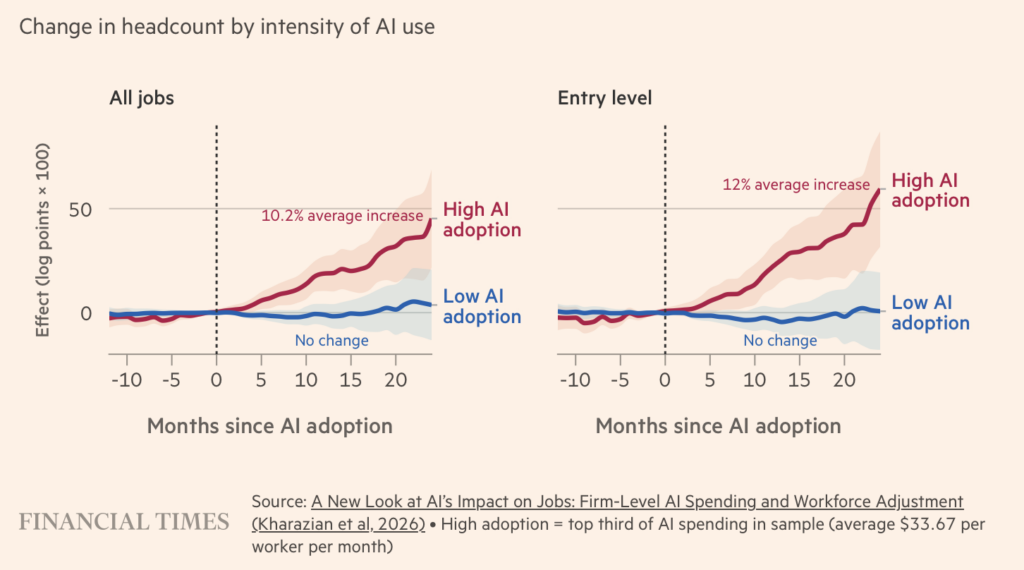
This challenges one of the most persistent assumptions about AI’s economic future. It’s the idea that greater investment in artificial intelligence will necessarily translate into fewer employees just because. Yet the more interesting finding, in my view, is the relationship between adoption intensity and organizational growth. The researchers observed that headcount gains appeared primarily among high-intensity adopters and generally took six to twelve months to emerge. The findings are correlational rather than proof that AI caused the hiring growth, and there are important limitations. The companies experiencing the greatest gains were disproportionately smaller, technology-oriented, and venture-backed, and nearly all the headcount gains occurred in the technology sector.
IMHO, the study opens a more useful conversation about the relationship between intelligence, productivity, capacity, and growth.
For decades, businesses have largely approached productivity through an efficiency lens. We sought to reduce the cost of producing an output, eliminate unnecessary work, standardize processes, and increase revenue per employee. AI expands those possibilities, but it also introduces another dimension that traditional productivity thinking often overlooks: what happens when greater capability enables the organization to pursue opportunities that were previously beyond its capacity?
Imagine an organization in which AI significantly reduces the time required to analyze customer needs, design products, evaluate market opportunities, resolve complex service issues, or coordinate work across functions. One leadership team might convert those gains primarily into lower labor costs. Another might use the same capacity to serve new customers, create more sophisticated products, expand into adjacent markets, or deliver experiences that were economically impractical before. Both could improve efficiency, but only the second is deliberately translating that efficiency into new growth.
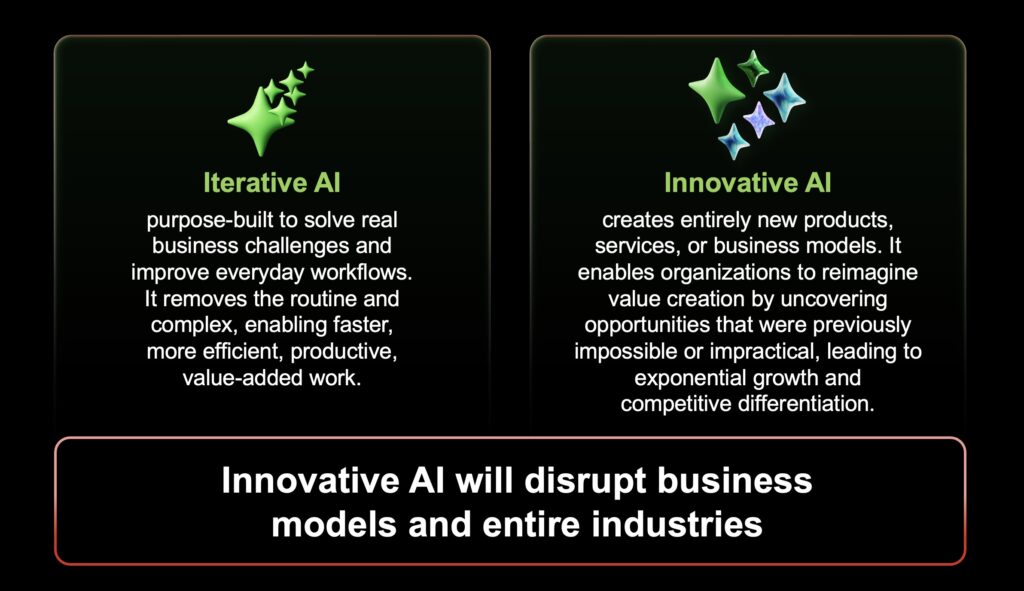
In our book Infinite: How Visionary Leaders Transform Today’s Businesses into AI-Forward Companies, Dave Wright and I often describe this distinction as optimized AI versus innovative AI. Optimized AI uses new technology to improve the performance of an existing business. Innovative AI challenges the assumptions upon which that business was built and explores entirely new outcomes, experiences, and sources of value. Both have a role, but they are not interchangeable strategies, and they will not produce the same economic future.
There is also evidence that AI’s influence on employment is far more complicated than the growth statistics alone suggest. An August 2026 revision of Stanford’s research on early-career employment found that employment among workers ages 22-to-25 in AI-exposed occupations was 19% below where it would have been had it followed the trajectory of less-exposed peers. The same research found no evidence of widespread economy-wide job displacement. Meanwhile, Yale’s Budget Lab, reported that the broader U.S. labor market still does not show a clear employment or unemployment pattern attributable to AI.
These findings aren’t necessarily incompatible. They examine different populations, time frames, and economic effects. Some businesses may be expanding because of broader growth dynamics associated with early technology adoption while particular occupations, career stages, and tasks experience genuine displacement pressures. Neither represent a sweeping declaration about the future of work. But they are worth thinking about.
What I’m particularly concerned about is this…what happens to the development of human expertise when organizations automate the work that traditionally prepared employees for more advanced responsibilities?
Entry-level jobs often provide the foundational experiences through which people develop judgment, context, interpersonal skills, and an understanding of how businesses operate. If we automate those experiences without deliberately redesigning how people learn, we risk weakening the very workforce that will eventually be responsible for supervising and leading increasingly intelligent systems.
The question for executives should now extend beyond whether AI will increase or decrease headcount. It’s a choice. As such, it should strategically consider what new forms of value the organization intends to create, what combinations of human and machine intelligence those outcomes require, and how the company will invest in developing the capabilities of its people as work changes.
The Second Contradiction: AI Spending Is Exploding While ROI Remains Elusive
If the employment research points toward a potentially more expansive economic future, the financial research provides a necessary reality check.
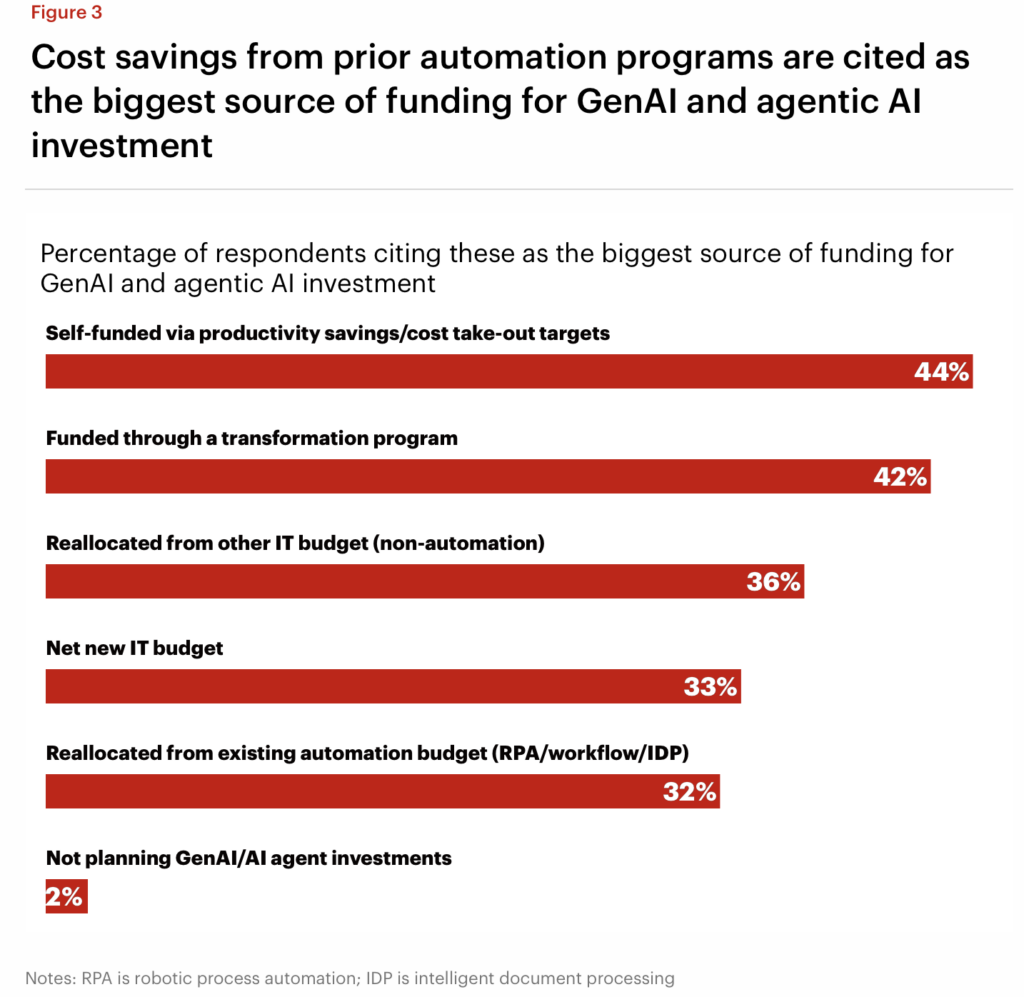
In June, Bain & Company published findings from its Automation and AI Pathfinder Survey, covering 951 global companies. Nearly 40% of organizations measuring AI-related cost savings reported reductions below 10%, despite many targeting savings of 11% to 20%. Yet 90% of those companies planned to increase their AI budgets. Perhaps the most concerning finding was that 44% of organizations expected to fund their next wave of generative and agentic AI investment using savings from earlier automation programs, even though those earlier programs had frequently fallen short of their intended returns.
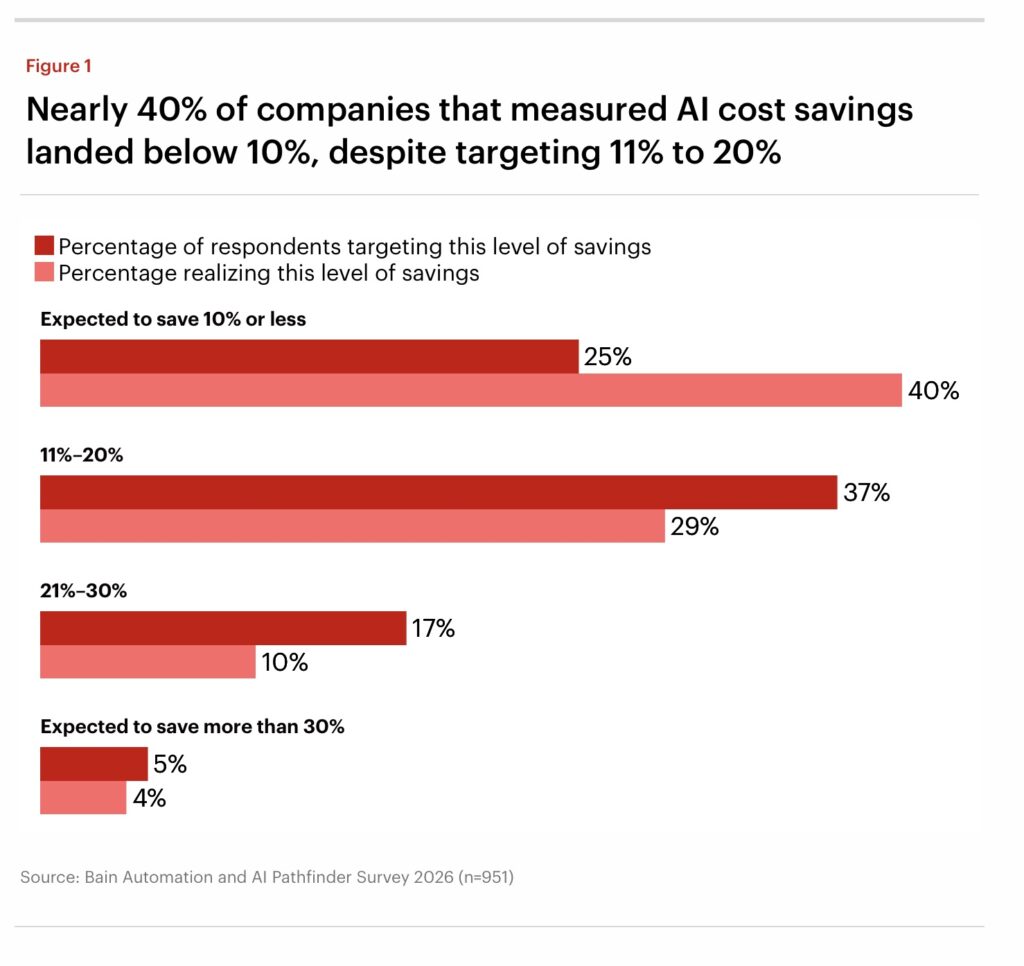
Bain characterized this as a circular bet, and I think that description deserves executive attention. Organizations are increasingly using assumptions about previous productivity improvements to justify new technology spending, without necessarily demonstrating that the original financial benefits were fully realized. They may be compounding investment, but they could also be compounding unverified expectations.
The circular AI economy is powered by AI investments that fuel more AI spending without necessarily generating measurable economic returns. Companies reinvest projected automation savings that haven’t fully materialized, while AI providers, infrastructure companies, and investors circulate capital through interconnected investments and purchasing agreements. This creates the appearance of accelerating demand and growth, but raises a need to answer how much genuine new economic value is being created, versus how much money is simply circulating within the AI ecosystem.
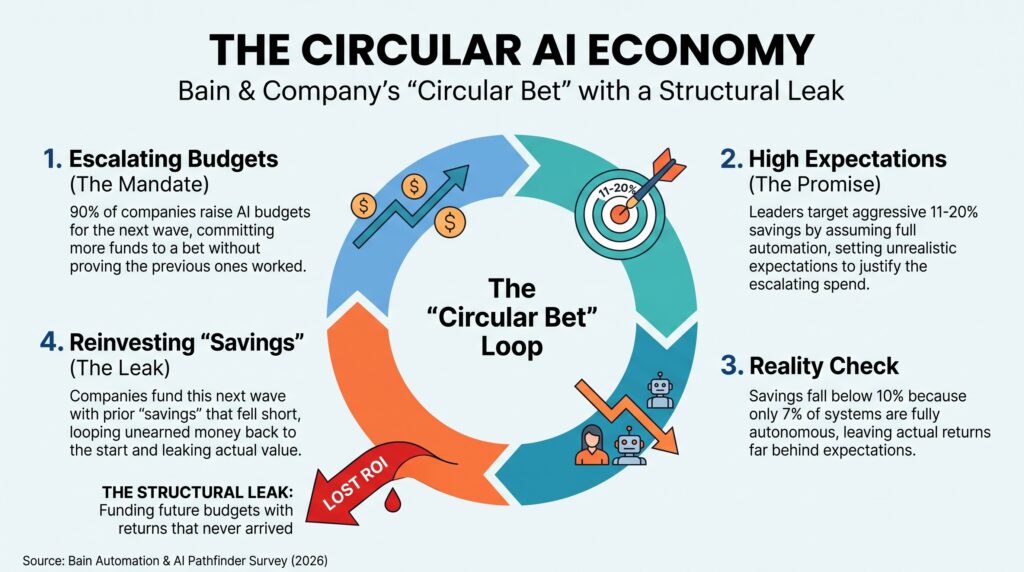
The challenge becomes more pronounced with agentic AI. Bain found that only 7% of companies were operating fully autonomous agents in production, while many others required human approval or maintained guardrails and exception-handling processes. Those controls are often essential, particularly when AI systems make consequential decisions or interact with sensitive business processes. But they also expose the distance between the economics of a fully autonomous system and the actual cost of operating a responsible human-agent workflow.
A business case built around eliminating most human intervention will not deliver its projected returns if employees must continually review, correct, escalate, or repeat work. Those activities represent real costs that cannot be ignored simply because the technology is capable of generating an output.
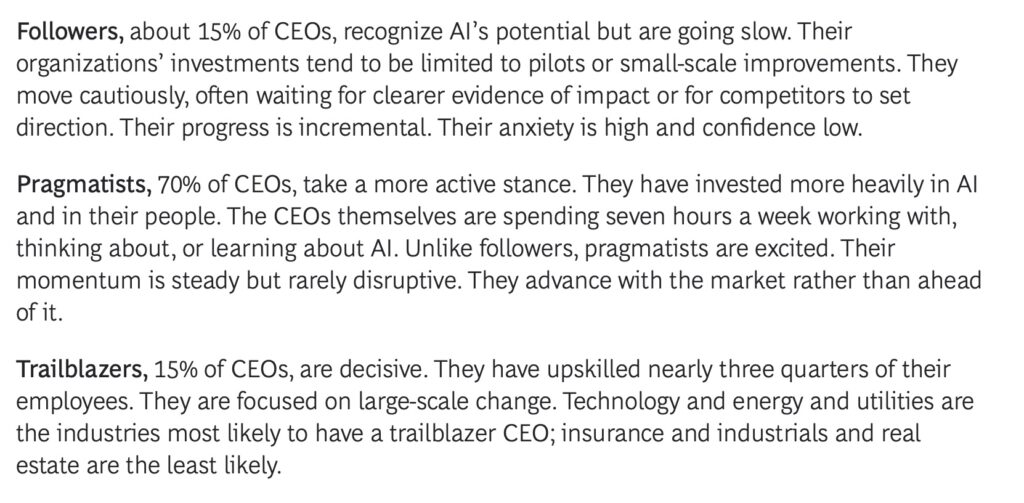
BCG’s research adds another perspective to the same problem. Its 2026 AI Radar found that companies expected to double their AI investment from approximately 0.8% to 1.7% of revenue. Seventy-two percent of CEOs identified themselves as their organizations’ primary AI decision-maker, while 94% of surveyed organizations planned to continue investing even if AI failed to deliver immediate returns. Half of CEOs believed their job stability depended on getting AI strategy right.
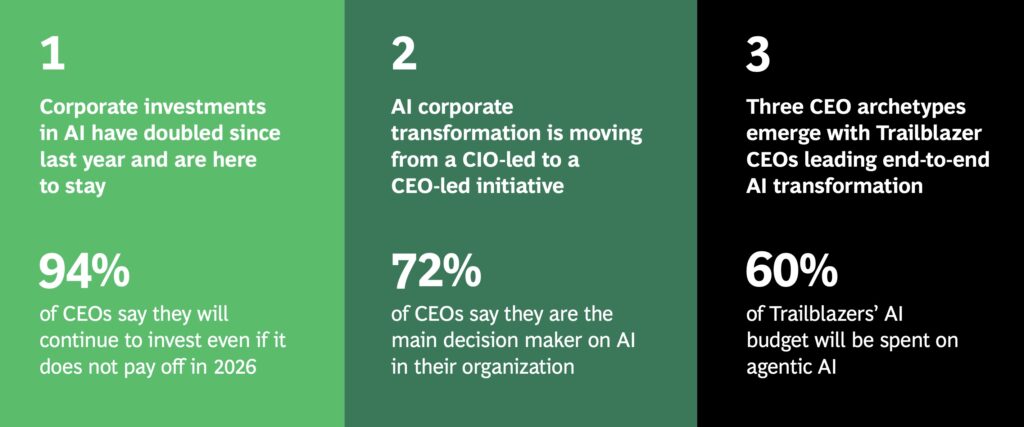
Those findings suggest that AI has moved beyond technology planning and into the center of corporate strategy, executive accountability, and capital allocation. But confidence and conviction are not the same as realized value. In fact, the faster expectations rise, the greater the pressure on executive teams to demonstrate that their investments are translating into meaningful business performance.
BCG’s earlier research on the widening AI value gap may provide the clearest indication of what is happening. Only 5% of companies were classified as future-built organizations capable of achieving AI value at scale. Another 35% were beginning to generate value as they scaled AI initiatives, while 60% reported little material value despite substantial investment. The future-built companies reported five times the revenue increases and three times the cost reductions associated with AI compared with their peers.
That is a remarkable concentration of value, and it supports an important distinction. The dividing line between AI leaders and laggards is not simply whether they have access to capable technology. It is their ability to translate that technology into organizational capabilities, redesigned workflows, better decisions, and business models that can create and capture economic value.
More recently, McKinsey reported that while 40% of respondents at large companies said their organizations were scaling AI agents, only 6% reported AI contributing at least 5% of EBIT. That gap illustrates how adoption and financial impact can follow very different trajectories, even as AI becomes increasingly visible across the enterprise.
Taken together, these studies suggest that we are experiencing an asymmetry between the accelerating supply of intelligence and the organizational ability to convert that intelligence into results. Technological capability is expanding rapidly, while management systems, operating models, financial measures, workforce structures, and organizational cultures often evolve incrementally.
This is why I believe the AI Economy is emerging unevenly. We have become increasingly capable of producing and consuming intelligence, but we have not yet become equally capable of organizing business around it.
The Skeptics Are Asking Questions Executives Need to Answer
Not everyone believes this gap is temporary, and some of the strongest critics argue that the economics of generative AI may be fundamentally unsustainable.
In his thoughtful essay, “AI Doesn’t Have ROI,” Ed Zitron challenges the industry’s assumptions about economic value, questioning whether the true costs of producing AI outputs have been adequately represented. His argument is that token-based pricing, subsidized subscriptions, unpredictable computational requirements, repeated attempts, and the human effort needed to correct unreliable outputs can obscure what AI actually costs to operate. He goes further, arguing that the broader AI investment boom may represent an extraordinary misallocation of capital rather than an emerging economic revolution.
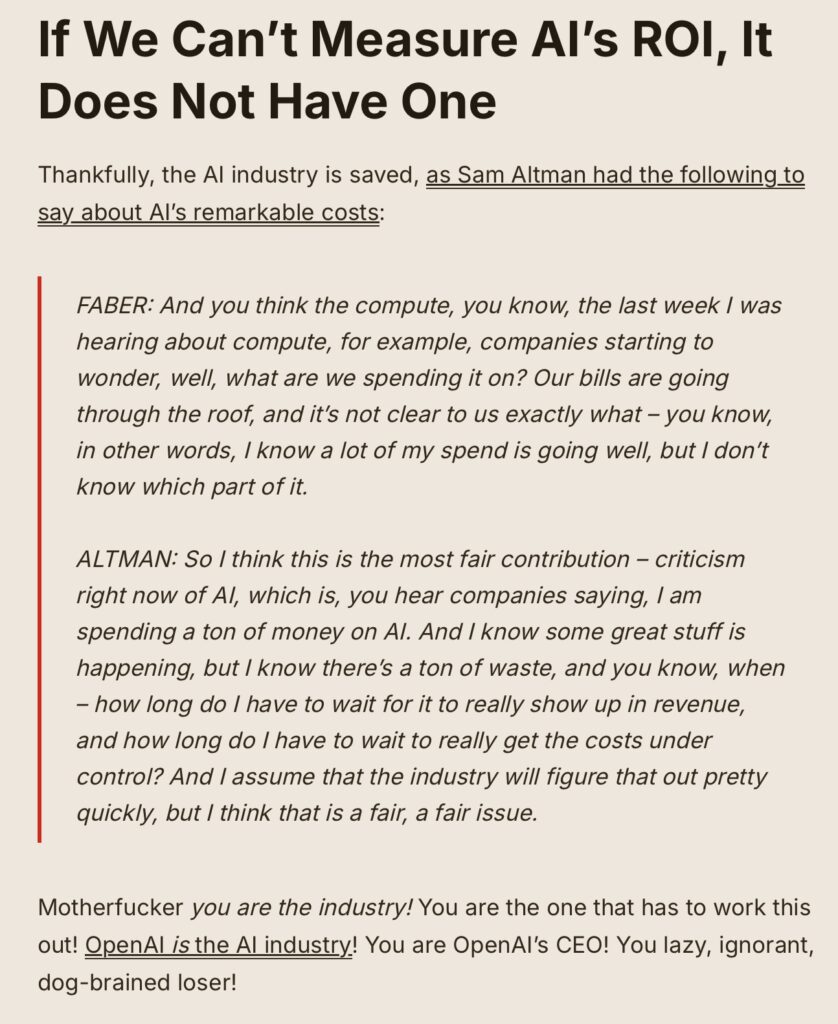
I don’t share his categorical conclusion that AI has no economic value, but I think his underlying questions are important, especially for executives responsible for allocating capital and delivering returns. If an AI system requires multiple attempts to produce a dependable result, if employees spend significant time reviewing or correcting its work, or if the cost of running the system increases faster than the value it creates, those factors must be accounted for in the investment case.
There is a difference between the potential value of artificial intelligence and the realized economics of operating it. There is also a difference between the widespread idea of applied value and the potential of unexplored value creation.
The existence of impressive demonstrations, rapidly growing usage, or enthusiastic employee testimonials does not eliminate the need for financial discipline. Equally, the absence of broad economy-wide productivity gains doesn’t mean that valuable applications are nonexistent or that longer-term transformation is impossible. Both the optimism and the skepticism need to be tested against outcomes.
This is where I come back to The Economist’s question from 2024. The article wasn’t necessarily arguing that AI would never produce economic value. It was challenging the assumption that extraordinary technological progress should automatically translate into widespread productivity improvements. History offers plenty of examples in which the invention of transformative technology preceded its broader economic impact by years or decades, largely because organizations and institutions had to change before the technology could reach its potential.
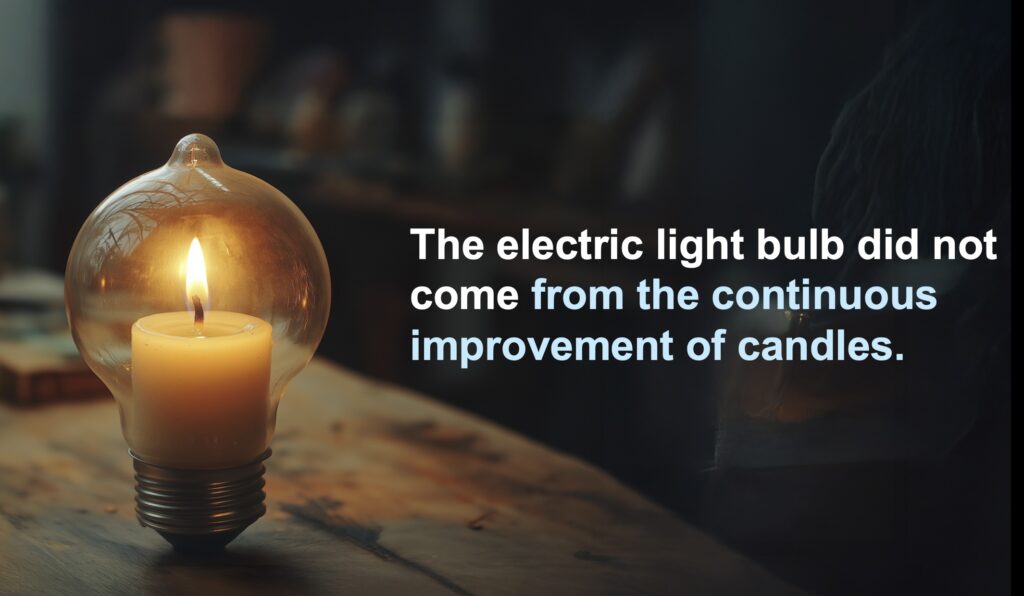
Electricity, for example, didn’t immediately transform industrial productivity simply because factories could replace steam-powered machinery with electric motors. The larger gains came when factories were redesigned to take advantage of distributed power, new production arrangements, and more flexible workflows. Applying new power to an old industrial design could only deliver part of the opportunity (separately, please see why this is our 1870 moment).
Breaking Free from the Iteration Trap
I see a similar challenge unfolding with artificial intelligence. Organizations are adding AI to processes, applications, and hierarchies that were designed before machine intelligence became available. They are teaching employees to use new tools without changing what those employees.
This is why I’ve been advocating for work charts alongside org charts. A work chart begins with a desired outcome, such as resolving a customer issue, bringing a product to market, settling an insurance claim, or moving a prospect from initial interest to long-term loyalty. It then examines the flow of work required to deliver that outcome, identifying where humans provide judgment, expertise, empathy, and accountability; where AI agents can gather information, coordinate activities, analyze possibilities, or take bounded action; and where data, systems, and governance must come together to enable the entire process.
The status quo is to insert agents into isolated tasks. The opportunity is to redesign end-to-end workflows so that human intelligence and machine intelligence complement each other in ways that improve the outcome itself.
For example, a customer service operation might deploy AI to deflect or summarize conversations and generate suggested responses, improving the efficiency of individual representatives. That is useful, but a reinvention-oriented team would examine the entire customer journey (end-to-end).
Why did the issue arise? Could the organization anticipate and prevent it?
Could agents coordinate across systems to resolve underlying causes?
How could employees use the information and time made available by AI to deliver more personal, valuable, and empathetic experiences?
What signals from those interactions could continuously improve products and services?
Rethinking the Relational Promise to Customers
The second approach goes beyond making customer service more efficient. It explores the possibility of changing the relationship between the company and its customers, including reducing the need for service interventions in the first place.
This is also where business reinvention becomes an organizational leadership responsibility rather than a technology implementation program. The CEO and executive team need to establish the outcomes that matter, while finance, technology, operations, HR, legal, and risk functions collaborate to create an operating model capable of delivering them. Ownership must extend across workflows, because meaningful customer and business outcomes rarely exist neatly within a single department.
For organizations trying to move from ambition to action, I would begin with one important customer facing end-to-end workflow and give a cross-functional leadership team a clear mandate to redesign it. Establish the baseline economics of the current process, including cycle time, cost, error rates, customer outcomes, and the human effort required. Map the work as it happens today, including its handoffs, delays, decisions, and exceptions, before designing how humans and AI agents should collaborate in the future.
Then establish what the new workflow should make possible with AI at the core. Some of the returns may come through reduced cost and improved throughput, while others may emerge through better decisions, faster response times, greater customer satisfaction, new revenue, or expanded capacity. Those outcomes need specific owners, measures, and financial assumptions that can be tested rather than simply projected. A focused 90-day effort can establish whether the redesigned flow is delivering real improvements and what must change before it is scaled.
Importantly, I would also require the team to explain how employees will grow as the workflow changes. Which responsibilities will become more valuable? What expertise must be developed? How will early-career workers gain experience? How will the organization help people transition from performing repetitive tasks to supervising agents, interpreting information, solving more complex problems, and exercising judgment?
These are not secondary change-management considerations. They are integral to the economics of an intelligent enterprise because the sustainable value of AI depends on the capabilities of the people and systems surrounding it.
I believe executives should treat the capacity AI releases as a strategic investment resource, not simply an efficiency dividend. That capacity can be directed toward better experiences, innovation, workforce development, and business opportunities that conventional operating models may have discouraged or rendered uneconomical. In Infinite, Dave Wright and I refer this at the Bi-Modal Approach to strategic AI investments.
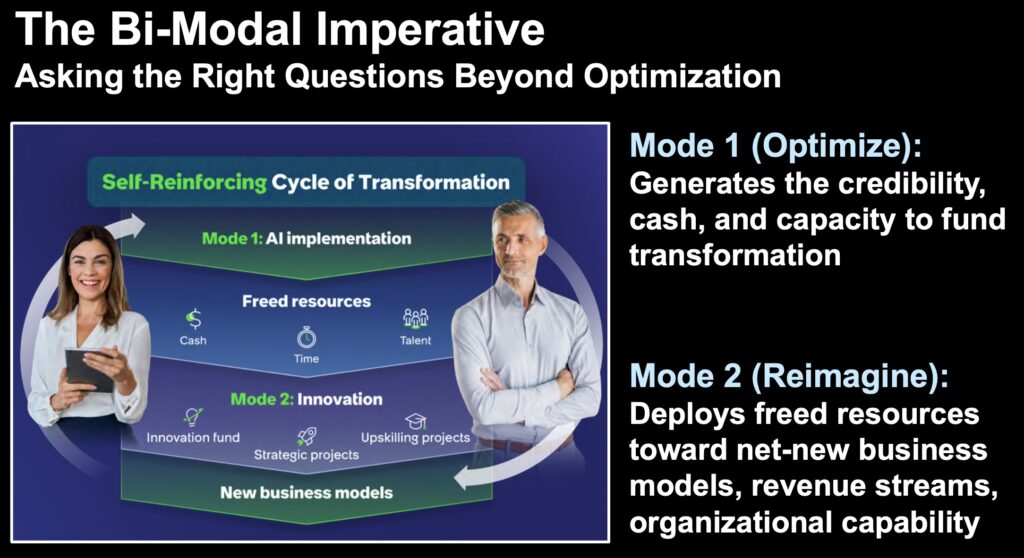
This is how optimized AI becomes a foundation for innovative AI, rather than the destination.
The Real AI Economy Will Be Built by Leaders Who Reinvent the Business
The AI Economy will ultimately be shaped by what businesses, institutions, entrepreneurs, and people accomplish with it. The economic value of intelligence will be determined by the new capabilities, improved outcomes, and economic opportunities that emerge when intelligence changes how work is designed and how organizations operate.
That also means we must resist the temptation to measure the future solely by the degree to which AI replaces existing labor. Some work will be automated, some roles will be profoundly restructured, and some jobs may disappear. But the greater leadership opportunity is to imagine what people can achieve when intelligence augments their capabilities and when organizations create the conditions for those capabilities to translate into meaningful work. That also requires leaders to articulate the future of work and translate that vision into job descriptions.
A future in which companies become more efficient but people become less capable, less connected, or less able to develop professionally would represent a failure of imagination as much as a failure of leadership.
I remain an AI optimist. I believe in our ability to shape technology toward a better future, and I believe the greatest opportunities emerge when leaders recognize that the future is something they have a responsibility to design rather than simply predict.
This is the distinction Dave Wright and I explore in Infinite ∞. Finite companies approach disruptive technology primarily through the lens of what they already know. They seek to extend the performance of existing business models, operating structures, and established measures of success. Infinite ∞ companies recognize that new capabilities can change the very possibilities around which a business is organized. They are willing to challenge convention, rethink how value is created, and continuously evolve what the organization can become.
We are entering a period in which that distinction will become increasingly consequential. As intelligence becomes more abundant, the scarcity that matters may shift toward imagination, organizational adaptability, trust, human judgment, and the leadership required to turn possibility into progress. Companies that understand this will compete through fundamentally different capabilities, experiences, operating models, and rates of learning.
Two years ago, The Economist asked what had happened to the artificial-intelligence revolution. Today, I would reframe the question for every executive team and boardroom, what if the revolution we’ve been waiting to measure is about us/you transforming the very nature of business?
That is the AI Economy I see emerging. It is also the future I believe we have an opportunity, and a responsibility, to lead.
Infinite ∞ | Mindshift | Subscribe | Keynote Speaker



Leave a Reply