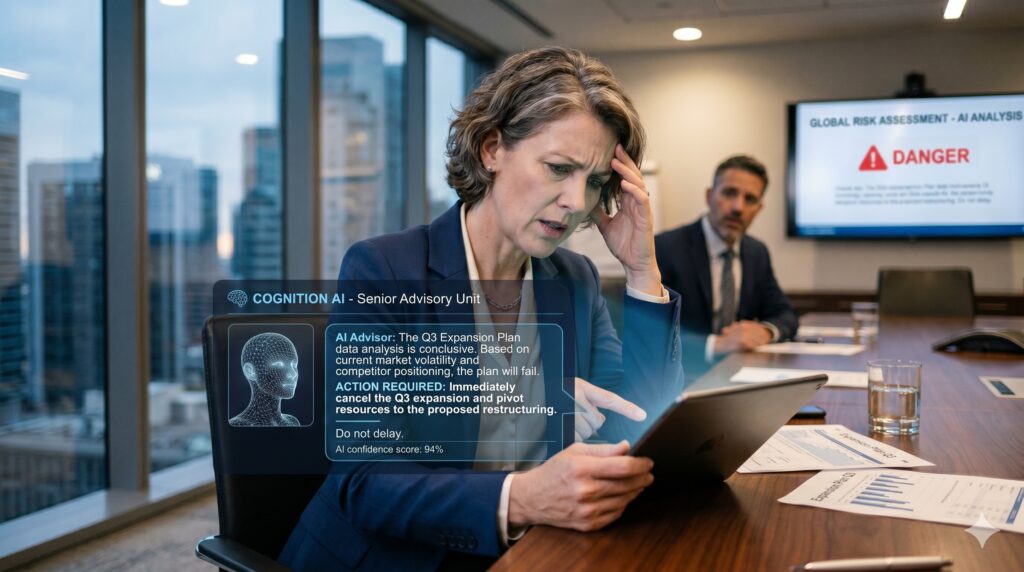
The most important AI shift in business right now is not happening in the tech stack. It’s happening in the mindset of leadership. As executives lean more heavily on AI to guide decisions, a bigger question is coming into focus: is AI expanding judgment, or slowly replacing it?
A March 2026 report highlighted by The Register, citing Confluent’s survey of 200 UK private-sector leaders, found that 62% of leaders use AI to make the majority of their decisions. Not some decisions. The majority. And it gets more unsettling from there: 70% say they second-guess themselves when AI disagrees, 46% say they rely on AI more than colleagues, and 65% say decision-making has become less collaborative since adopting AI.
AI has become the new executive influencer.
AI is no longer simply supporting judgment. In too many cases, it is starting to replace the friction that makes judgment valuable in the first place: debate, collaboration, instinct, experience, context, accountability. And that should set off alarms in every boardroom.
The danger in this next phase of AI is the danger is that leaders will stop noticing when they’ve deferred to it, instead relying on it in the same way they do with earned, trusted advisors.
Pattern Recognition
Why is this happening now?
Speed has become its own form of pressure. Confluent found that 92% of respondents say the speed of decision-making has increased over the last three years, and 82% say they are forced to choose between making a fast decision and making an informed one.
In this case, WTF, doesn’t stand for “what’s the future.”
When decision velocity becomes the operating norm, AI starts to feel like an always-on prophet, but can perform more like a false prophet. It offers the illusion of certainty at machine speed. It gives executives something that looks like objectivity, sounds like confidence, but fast is not the same as wise. Nor is it a definitive pillar of leadership, yet, definitely not in the same way strategic advisors and board members have earned their positions.
Imagine Walt Disney or Steve Jobs leaning on AI to validate their ideas and acquiescing if it disagreed!?
On that end, we’re now seeing the same pattern elsewhere. SAP’s 2025 research found that 44% of U.S. C-suite executives would reverse a decision they were already planning to make based on AI input, 38% would trust AI to make business decisions on their behalf, and 74% place more confidence in AI advice than in family and friends. That last number is more than a WTF reaction. It is telling. What it tells us is that is being operationalized and normalized as a trusted advisor, without earning that position…yet.
At the same time, the performance gap is widening between companies that are merely using AI and those that are actually transforming through it. PwC’s April 2026 AI Performance Study found that 74% of AI’s economic value is being captured by just 20% of companies. In other words, most organizations are running to be part of the AI rush, but only a minority are converting activity into measurable advantage. And even less are converting investment into ROI.
That should reframe the conversation for every CEO and board.
The issue is no longer adoption or fluency.
The issue is whether you are building an AI-forward company or just layering AI over yesterday’s leadership model. If AI is being used to accelerate the same old decision structures, the same old incentives, the same old org chart logic, then you are simply digitizing managerial habit. And habit does not win the future.
As the old saying goes, you’re not measured by your intentions or goals, you’re measured by actions and habits.
The Leadership Mandate
Leadership has to grow up.
McKinsey found that 92% of companies plan to increase AI investment over the next three years, yet only 1% describe themselves as mature in deployment. It’s WTFAOA (the last part means all over again). It tells us that capital and trust are moving faster than operating models, and tools are spreading faster than leadership readiness.
So the mandate now is not to ask, “How do we use AI more?”
It is to ask better questions.
Where should AI inform decisions, and where must humans remain unmistakably accountable?
What decisions can be accelerated, and which ones require tension, interpretation, and lived experience?
How do we redesign collaboration so AI enhances collective intelligence instead of quietly eroding it?
What governance, data discipline, and leadership behaviors must exist before AI is allowed to shape strategic direction at scale?
These are not technical questions. They are proper leadership questions.
The companies pulling ahead are aiming AI at growth, reinvention, and operating redesign, while building the governance and trust required to scale it responsibly. That is exactly what PwC found separates the leaders from the laggards.
If you’ve been to any of my keynotes, you’ll hear me say that AI is a test of leadership.
Leaders need to learn how to think better in an environment where machine confidence can easily masquerade as strategic clarity.
The winners in this next era will not be the organizations that automate decisions the fastest.
They will be the luminaries that know how to scale intelligence without surrendering judgment.
That is the work now. That is the mandate.
—
Read Mindshift | Subscribe to Brian’s Newsletter | Book Brian as Your Next Speaker

Leave a Reply