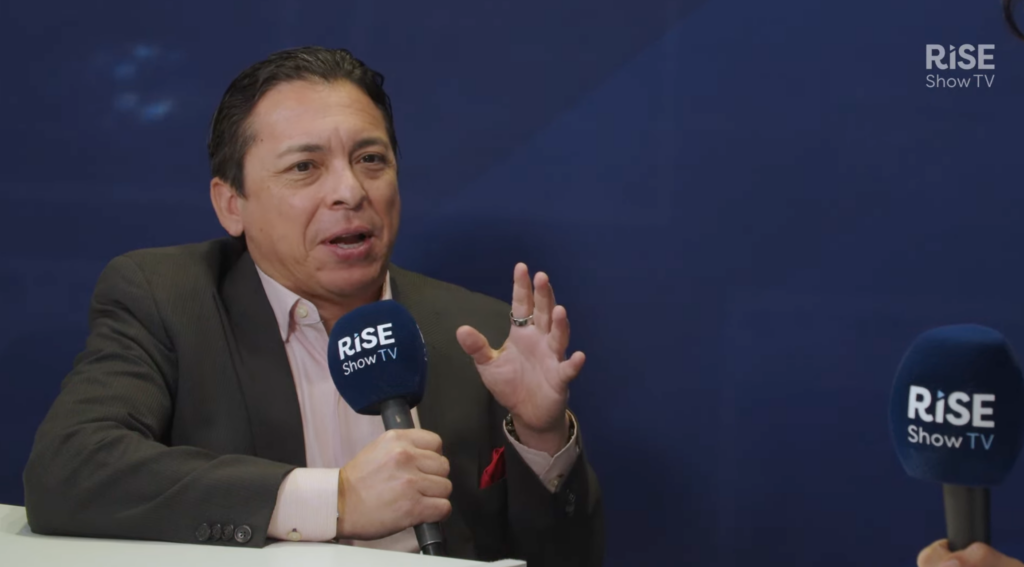
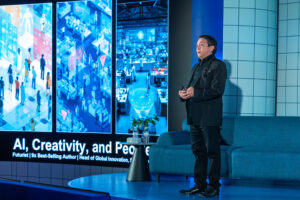
At Integrated Systems Europe, I had the opportunity to continue the conversation after my keynote, “AI is Eating the World,” in a candid video interview with Rise TV about where artificial intelligence is really taking us, and where we’re still thinking far too small.
AI is often compared to the discovery of fire, the invention of the wheel, or even electricity. Those comparisons are dramatic, but they’re not entirely wrong. These weren’t just inventions. They were enabling forces. They expanded what humanity could do, but only because people learned how to apply them in imaginative and transformative ways.
That is exactly where we are with AI today.
We are not simply looking at another productivity or efficiency tool. We are standing at the edge of a technology that can fundamentally reshape how we work, create, decide, and innovate. But realizing that future depends on us. It depends on our willingness to ask better questions, to challenge old assumptions, and to imagine entirely new possibilities.
Too often, AI is still being used in narrow ways, generating amusing images, summarizing meetings, drafting emails, or serving as a slightly better assistant. That has value, of course. It helps us do what we did yesterday a little better today. But that is only the beginning.
The real opportunity lies beyond iteration, toward innovation, and new horizons we can’t see yet.
The future of AI is not just about cost-cutting, efficiency, or productivity over yesterday’s work. It is about exploring the unknown to unlock new value. Iteration improves existing work, making what we could do yesterday better today. Innovation helps us do what we did not know we could do before. That is the difference that matters. AI becomes most powerful when we use it not just to repeat the familiar, but to explore the unknown.
That requires a shift in mindshift.
Most people still prompt AI the way they search Google: looking for a specific answer, trying to get to an expected outcome faster. Or maybe, it’s a bit more sophisticated, where people are extend their work to increase output. But the real magic happens when you begin using AI to stretch your thinking. Ask it to challenge your assumptions. Ask it to model possibilities you have not considered. Ask it to collaborate with you in the spaces where certainty ends and creativity begins.
That is where new value is created.
In the interview with Rise TV, I also talk about something I believe deeply: we are not dreaming big enough. AI should not be reduced to a machine that simply makes us faster. It can also make us more thoughtful, more imaginative, and more capable of seeing what we previously missed. In that sense, I increasingly view AI as an empathy engine, something that can help us reconnect with curiosity, creativity, and perspective in ways that many organizations have lost over time.
There is also an important distinction I like to make when people talk about competing with AI.
You can fear AI as competition, or you can learn to compete with AI.
That small shift changes everything.
AI can be an augmentation tool that helps us become more competitive, more effective, and more inventive. But to get there, leaders need humility. We have to recognize that our past success, experience, and expertise can also limit us. They create comfort zones, biases, and default patterns of thinking. And those patterns can prevent us from seeing the opportunities hiding in the “unknown unknowns.”
That is why this moment matters so much.
Organizations that only use AI to cut costs or optimize routine work will realize some gains. But those who use AI to unlock new value, create new experiences, and discover new avenues for growth will be the ones who truly lead. And at the speed AI is evolving, that growth can become exponential.
My keynote at ISE focused on this broader transformation. The interview that followed goes deeper into the mindset shifts leaders need to make right now—not someday, but now.
If you are exploring how AI can move beyond automation and become a catalyst for innovation, creativity, and growth, I think you’ll find this conversation valuable.
Watch the full video interview following my ISE keynote, “AI is Eating the World,” and let’s continue reimagining what comes next.
Read Mindshift | Subscribe to Brian’s Newsletter | Consider Brian as as Your Next Speaker

Leave a Reply