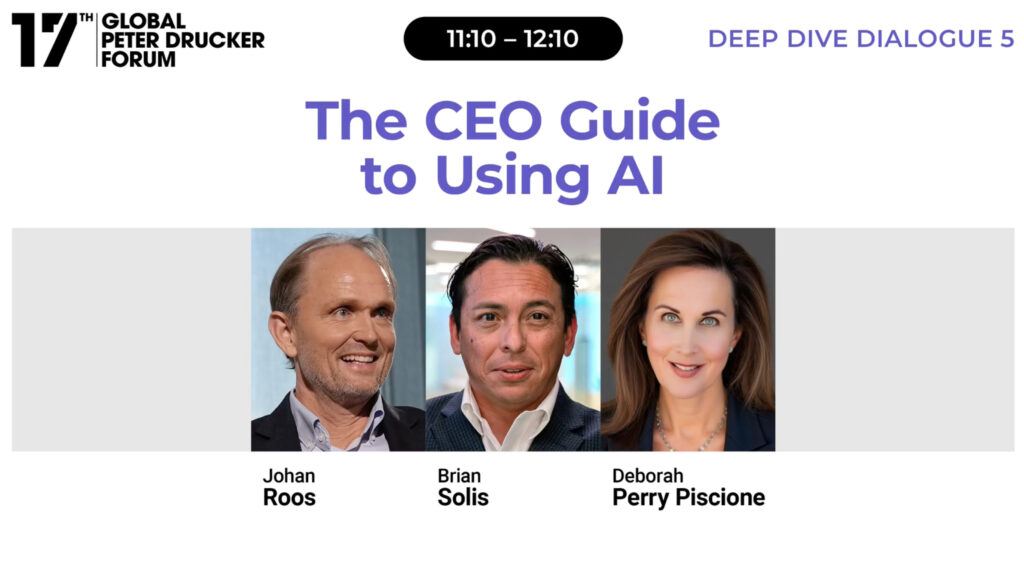
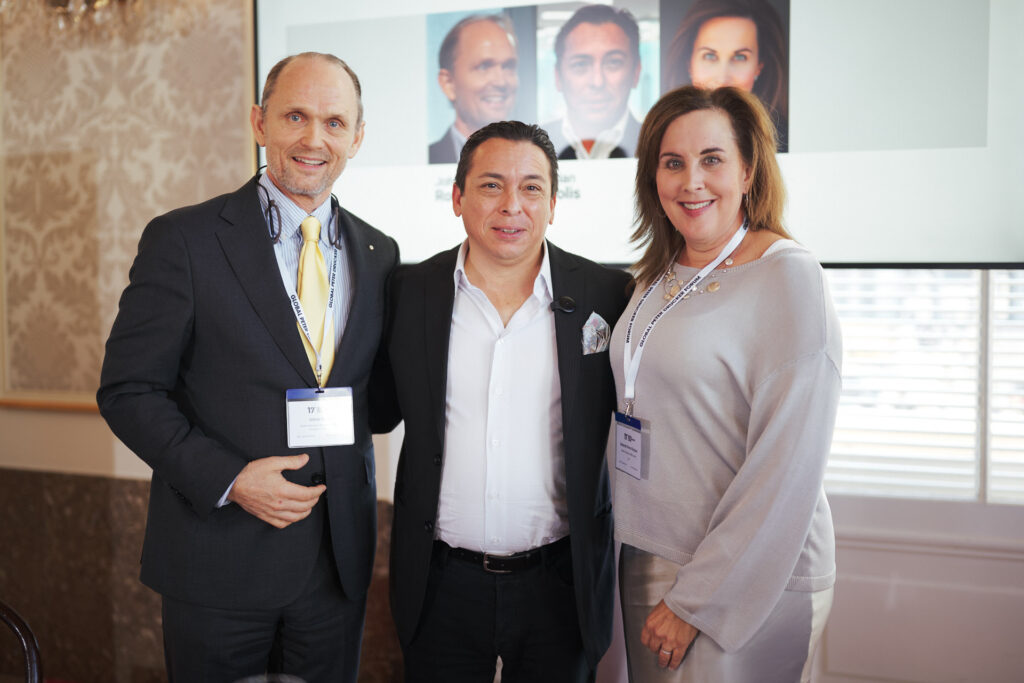
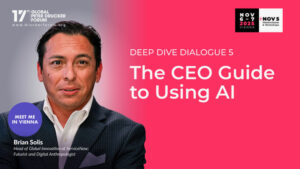
It was an honor to join Johan Roos and Deborah Perry Piscione at the 17th Global Peter Drucker Forum for a session with a title that left little room for abstraction: “The CEO Guide to Using AI.”
Johan is a respected management scholar, educator, author, and longtime contributor to the Drucker Forum. Deborah is a Silicon Valley entrepreneur, investor, and author studying how AI, robotics, and other disruptive technologies are reshaping employment and society. I joined them as a practicing futurist in my role at ServiceNow, and, as I introduced myself that morning, still very much a student of AI.
Anyone who tells you they have mastered this moment probably has not spent enough time understanding the technology and its impact on work, the workforce, and on ourselves.
Johan opened the session by asking each of us to make a strong claim, a provocation, something expressed to raise the collective heart rate of the room. A thoughtful discussion, after all, should do more than confirm what everyone already believes.
So I offered mine:
CEOs are on a path to automating themselves out of a job.
My point was not that an algorithm would soon occupy the C-Suite, though there are parts that could. My argument was that many leaders are using AI to do what their organizations already do, only faster, cheaper, and at greater scale.
They are automating tasks, accelerating processes, increasing output, reducing costs, and optimizing operating models built for another era. Those improvements and incremental gains are real. They may even generate impressive returns over the next quarter.
But a faster version of yesterday’s company is not necessarily prepared for tomorrow. This is a different moment in time.
The defining responsibility of a CEO is not to make the past run more efficiently. It is to imagine and build the future before someone else does.
That became the central tension of our conversation.
Deborah challenged CEOs to understand the economic and technological forces already reshaping work.
Johan challenged leaders to protect and expand human capacity as AI becomes more pervasive. I tried to connect those provocations to the choices CEOs and boards must make now.
Looking back, the session was less of a panel and more an intervention about leadership.
AI Can Help CEOs Manage. The Opportunity Is to Help Them Lead
There are certainly CEOs who are challenging the status quo. There are CEOs who recognize they’re not the right leaders to see AI business reinvention through. And there are CEOs already outsourcing their thinking to AI. In fact, a recent study showed 62% of CEOs reported using AI to make the majority of their decisions. 70 percent admitted to second-guessing their judgements when their choices conflict with AI’s recommendations. 65 percent felt decision-making had become less collaborative since adopting AI. And to top it off, 46% said they now rely on AI more than on the advice of colleagues.
One CEO in the audience offered a useful distinction. AI, he explained, could automate much of his work “below the line”: reviews, analysis, administration, reporting, and other activities that consume executive attention. That would give him more time “above the line” to think about the future of the product, the company, and the market.
I told him he was a blueprint for other CEOs.
But no one in the room asked what they weren’t thinking about, what they hadn’t considered, or what other CEOs or founders were doing differently. And when curiosity or humility aren’t given space to explore what we don’t know to know, any conversation will be limited to validation, agreement, incremental thinking, and reinforcing existing confirmation biases.
That’s exactly why for transformation, growth, and innovation to materialize, leaders must first recognize that there may be other questions, scenarios, and opportunities they’re not yet considering. This is the inception of a mindshift. And from there, an infinite journey can unfold.
His point captured the opportunity. AI can give leaders back time, but what they do with that time will determine whether it becomes a source of reinvention or merely another productivity tool.
Too many executives have gradually become managers of institutional complexity. Their days are filled with meetings about the business instead of time spent imagining the future of the business. They review dashboards, manage expectations, navigate politics, prepare for the next board meeting, and protect the operating model.
AI can make those activities more efficient. But leadership is not the administrative maintenance of the present. That’s ‘management.’ Leadership is the ability to see possibilities others do not yet see, articulate a future people can believe in, and create the conditions for the organization to bring it to life.
AI can help CEOs manage more effectively. The real opportunity is to help them lead more imaginatively.
Months after the Drucker Forum, I led a series of workshops with roughly 100 CEOs and chief operators in Arizona. The stated subject was AI, but the real conversation was leadership. Once we created a trusted setting, several executives admitted a version of something they rarely say publicly: “I know this matters. I know we have to move. But I’m not sure where to begin, and I’m not sure the organization is ready.”
That admission was not a failure of leadership. It was the beginning of it. And that’s the point. Humility and curiosity was in the room.
The greater danger is pretending to know, rushing into activity to project confidence, and allowing urgency to substitute for direction.
Deborah Perry Piscione: Understand What Is Coming, Then Decide How to Participate
Deborah brought urgency to the conversation from her vantage point in Silicon Valley. She described a world moving rapidly from generative AI to agentic systems and eventually to physical AI and humanoid robotics. Her message was not that every prediction from Silicon Valley should be accepted as destiny. It was that CEOs cannot afford to remain spectators while the economics of cognitive and physical work are being rewritten.
Her practical advice began with experimentation. Leaders need direct experience with the technology. They must understand what it can do, how quickly it is improving, where it fails, and how employees, customers, entrepreneurs, and competitors are already applying it.
This does not mean a CEO must become an AI engineer. It does mean AI literacy can no longer be delegated entirely to the CIO, a center of excellence, or the unusually enthusiastic person who discovered prompting last Tuesday.
Deborah also advanced an essential strategic choice…should the organization build its own AI capabilities, buy them from trusted providers, or blend internal and external systems?
Her answer was appropriately contextual. Build where proprietary intelligence is central to competitive advantage. Buy where established platforms can provide common capabilities faster and more effectively. Blend when enterprise knowledge, specialized models, external innovation, and human expertise must work together.
But before any of those choices can produce value, Deborah argued, leaders must fix the plumbing. Data has to be usable. Legacy systems must be capable of communicating. Information must move securely across the organization. The infrastructure underneath AI may not be glamorous, but neither is explaining to the board why the brilliant proprietary model cannot access the information required to do its job.
Her point has only become more relevant. In an article I later contributed to Future Economy, I described an emerging enterprise AI transformation gap: companies are producing more intelligence at the individual level, yet they still lack the architecture to let that intelligence act across workflows.
An intelligent model placed inside a fragmented enterprise does not make the enterprise intelligent. It may simply help dysfunction move faster.
Stop Piloting AI Around the Edges of the Business
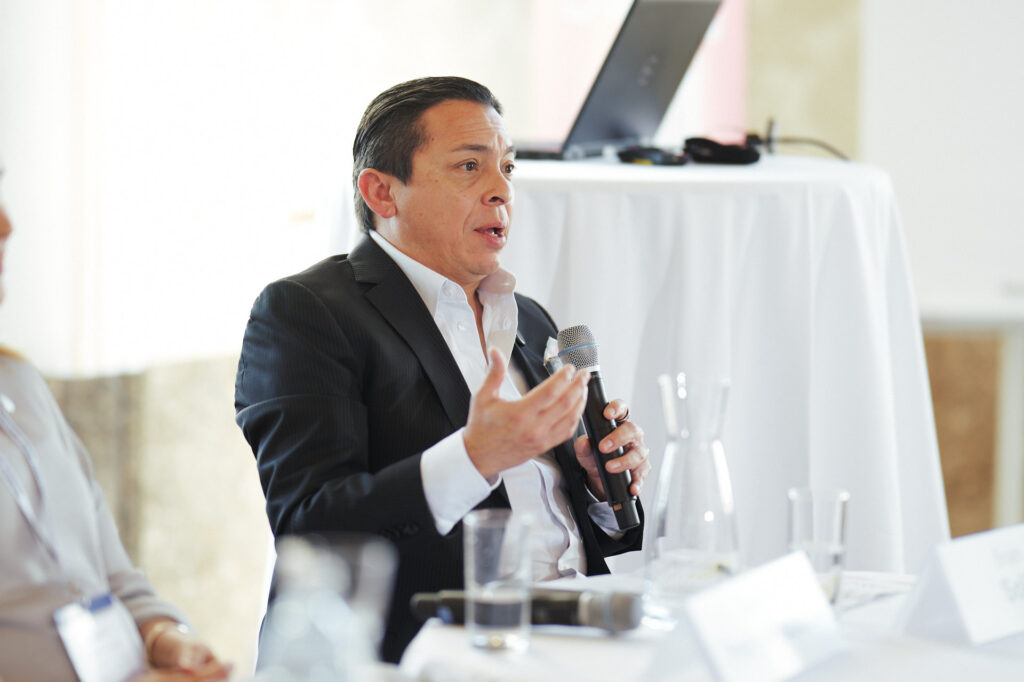
When an audience member asked about reports showing widespread failure among generative AI pilots, I shared what I routinely see in my work with CEOs and boards.
The pilots are siloed. The data is siloed. The workflow is siloed. The ownership is siloed. The measurement is siloed.
The use case may perform perfectly within its narrow boundary and still fail to create meaningful enterprise value because it was never connected to the way value actually flows through the organization.
Siloed pilots produce siloed outcomes.
The better-performing AI transformations begin with an end-to-end workflow and a meaningful business result. That means looking beyond a single department or task to understand how people, data, systems, decisions, and policies come together to create an outcome for a customer, employee, or stakeholder.
Remember, AI is not a strategy.
The organization needs a strategy for competing and creating value in a world where intelligence is becoming abundant, inexpensive, embedded, and increasingly autonomous. AI is a critical part of that strategy, but it cannot be separated from decisions about customers, work, talent, operating models, growth, governance, and the future identity of the enterprise.
A budget, a timeline, a collection of pilots, and a slide featuring several concentric circles do not constitute transformation.
The more useful question of the moment is “What outcome should now be possible that was not possible before?”
The Danger Is Not Experimenting. It Is Failing to Dream Big Enough.
Near the end of the session, I returned to the opening provocation.
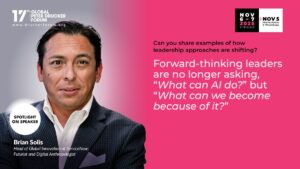
The danger is not that CEOs are experimenting with AI. The danger is that they are not dreaming big enough with it.
When leaders confront an unfamiliar technology, they naturally begin with what they know. They look at the present organization and ask where AI might reduce cost, eliminate effort, improve productivity, or replace labor.
Those are understandable starting points. They are also constrained by the assumptions of the existing business.
If you begin with yesterday’s processes, roles, metrics, and operating model, the most likely outcome is an AI-powered status quo.
You may become more efficient without becoming more innovative, more productive without becoming more valuable, or more automated without becoming truly transformed.
I later explored this at AI Week in Milan. Most organizations are using AI to improve the work they already perform. What they also need is a parallel growth curve dedicated to creating new capabilities, services, experiences, and business models. I describe these as iterative AI and innovative AI. The first improves today. The second invents tomorrow. Leaders need both, and they must prevent the efficiency agenda from consuming the reinvention agenda.
No CEO will be criticized for finding legitimate savings. But efficiency cannot become the outer boundary of imagination.
You cannot automate your way to innovation. You cannot cut your way to growth.
Innovation means creating new value. It means doing something tomorrow that the organization could not do yesterday.
Automate the Work. Augment the People.
I shared the example of IKEA during the panel because it illustrates the difference between treating AI as a cost lever and using it as a platform for growth.
IKEA introduced an AI-powered customer service capability that reportedly handled nearly half of its inbound inquiries. Viewed through an automation lens, that success could have justified significant headcount reduction. If the objective is simply to deflect customer contacts and take out cost, the equation is straightforward.
But IKEA looked at what the AI could not resolve.
Many of the remaining customers wanted help with interior design. Rather than treating those interactions as failures, IKEA recognized an unmet need. Thousands of customer service employees were reskilled as remote design advisers, creating a new service and a significant source of revenue.
The technology absorbed one form of work. The people moved into a more valuable form of work.
Since the forum, I have encountered other examples that reinforce the same lesson.
Ford leaned heavily on automated quality systems and later recognized that technology could not fully replace the judgment and tacit knowledge of experienced specialists. The company brought back more than 350 veteran technical experts—affectionately known as “gray beards”—to find failure points, mentor teams, and improve the systems. Klarna, after becoming one of the most visible symbols of AI-driven efficiency, also began reinvesting in human customer service when it became clear that speed and scale could not entirely replace empathy and human connection.
These stories should not be used to ridicule companies for getting AI wrong. Quite the opposite. They demonstrate what learning looks like.
The mistake is not experimenting and discovering limitations. The mistake is refusing to adapt because the original automation narrative looked better in the investor presentation.
The CEO’s job is to pursue two questions at once:
Where can AI remove friction, repetition, delay, and unnecessary cost?
And where can AI help people become more creative, informed, capable, empathetic, and valuable?
Automation can fund the future. Augmentation helps create it.
Johan Roos: Use AI to Expand the Mind, Not Escape It
Johan brought another essential dimension to the conversation. He argued that professionals, leaders included, face a choice in how they use AI.
AI can amplify curiosity, creativity, critical thinking, communication, and collaboration. Or, it can gradually erode them. It’s a topic I explored in-depth at SXSW 2026.
The risk is cognitive offloading: allowing AI to perform so much of the mental work that our own capacity weakens. This erosion is unlikely to arrive through one dramatic decision. It will happen through hundreds of convenient prompts and outputs.
AI writes the message. AI summarizes the report. AI prepares the argument. AI recommends the restaurant. AI advises us how to handle a disagreement. Eventually, we stop asking AI to help us think and begin asking it what we should think.
The technology becomes more capable while the user becomes less so.
Johan challenged leaders to use it deliberately. His recommendation was to role-model active, thoughtful experimentation and remain alert to the warning signs of over dependence. Use AI before an important communication, he suggested, but then show up as yourself. Do not allow leadership to converge into the same optimized, synthetic voice.
I agree, and I would extend the idea.
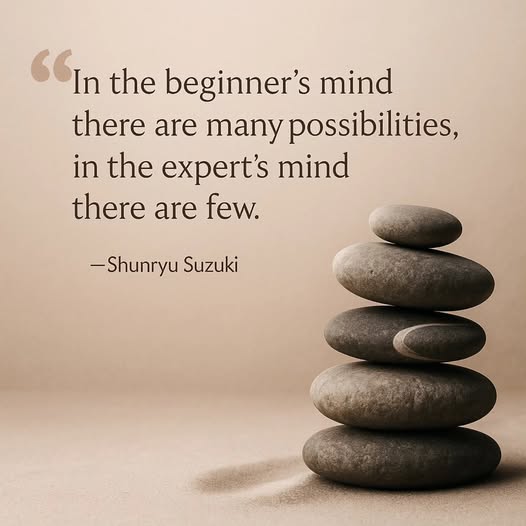
CEOs should use AI to improve the quality of their thinking, not to avoid the responsibility of thinking. More so, use AI to expose biases and “expert mind-sets.” Ask it to challenge assumptions, reveal blind spots, argue against the preferred strategy, model alternative futures, and expose uncomfortable trade-offs.
Do not use it to manufacture confidence where none exists.
This is also the thinking behind a concept I later developed called WWAID: What Would AI Do?
WWAID is not an invitation to outsource judgment. It is a pre-prompt mindshift. Before asking AI to improve an existing process, leaders step back and ask whether the process should exist in its current form at all. Before automating a task, ask whether intelligence could eliminate the need for it. Before adding AI to an experience, ask how intelligence might redefine its purpose and value.
The goal is to help us escape the limitations of how we have been trained to think.
Embodied Leadership Will Become More Important, Not Less
Johan also spoke about embodied leadership…the distinctly human experience of being present with another person, reading the room, looking someone in the eye, sensing hesitation, responding to emotion, and communicating with authenticity.
That idea came to life through an audience member who described receiving a question from her daughter. Unsure how to answer, she turned to AI and sent back the resulting response. Her daughter replied, in effect, “Mom, I wanted to talk to you, not AI.”
Ouch, but I’m sure it was a necessary lesson.
The daughter was not only looking for information. She was looking for connection.
Employees often want the same thing from leaders.
They do not only look to a CEO for an answer. They’re looking for judgment, reassurance, honesty, empathy, presence, and some indication that another human being understands what is at stake.
My answer was simple: humility, humanity, and empathy are among the most important leadership traits we can develop in the age of AI.
Then I added, “My goodness, be human.”
Johan connected that moment to the idea behind his work on “human magic”: the qualities we must hold onto and cultivate as algorithms become more capable.
The message has stayed with me.
As AI becomes more advanced, humanity does not become less relevant. It becomes more differentiated…and, augmented.
Leaders will need the humility to admit that they do not have all the answers. They will need the vulnerability to acknowledge uncertainty while still providing direction. They will need the courage to make decisions that balance economic performance with human consequences.
The CEO Guide to Using AI
Our conversation ranged across technology, work, employment, cognition, infrastructure, governance, accountability, and humanity. But the practical guidance for CEOs can be distilled into seven questions.
1. What future are we trying to create?
Do not begin with the model, tool, or vendor. Remember, AI is not the strategy. Begin with the customer, employee, business, or societal outcome the organization should now be capable of delivering.
2. Are we improving the existing company or inventing the next one?
Pursue efficiency and reinvention simultaneously. Improve today’s performance while creating the capabilities, experiences, and business models that could define tomorrow.
3. Which end-to-end workflows matter most?
Move beyond isolated tasks and departmental pilots. Examine how value actually moves across people, functions, systems, decisions, and data.
4. Is the organizational plumbing ready?
Address fragmented data, disconnected systems, siloed workflows, unclear ownership, permissions, security, governance, and technical debt. AI cannot orchestrate an enterprise that cannot communicate with itself.
5. Where should we automate, and where should we augment?
Use AI to eliminate mundane work, but reinvest the resulting capacity in people, learning, experimentation, service, creativity, and growth.
6. How will we protect and expand human judgment?
Define what AI can recommend, what it can decide, what it can execute, and where accountable human intervention remains essential.
7. How will I personally model the change?
A CEO cannot delegate curiosity. Use the tools. Ask better questions. Share what you are learning. Admit what you do not know. Encourage experimentation without pretending uncertainty has disappeared.
The Future Is Still a Leadership Decision
The session was titled “The CEO Guide to Using AI,” but the enduring lesson was not really about using AI.
It was about what kind of leader, and what kind of company, AI will reveal. This is a moment to invent the “infinite company.”
Deborah reminded us that the economics and capabilities of intelligent systems are moving quickly, whether organizations feel ready or not. Progress is not only a question of what technology can do, but also what we allow it to do to us. The audience brought the lived experience of executives navigating urgency, skepticism, responsibility, and uncertainty.
The leaders most vulnerable to AI are those who believe they have the least to learn, who confuse activity with progress, efficiency with growth, and those who use AI only to defend the business model that made them successful.
The defining work of leadership is not to preserve the company that exists. Yet so many are touting this as the next frontier. The real opportunity however is to build the company that deserves to exist next, and to help people become the best versions of themselves along the way.
Please watch the conversation here and share your thoughts! 🙏
Thank you for the opportunity to be part of this incredible opportunity, Richard Straub!
Infinite ∞ | Mindshift | Subscribe | Keynote Speaker

Leave a Reply