
Jeff Gritchen / MediaNews Group / Orange County Register via Getty Images
AI has a trust problem because they understand the future they were asked to accept.
For the last three-to-four years, AI was introduced less as a platform for human potential and more as a force of inevitability: jobs would disappear, entry-level opportunities would shrink, organizations would flatten, humans would be removed from the loop, and efficiency would become the new north star. That story did not write itself. It was shaped across boardrooms, classrooms, campaign stages, media headlines, investor calls, and frontier labs.
CEOs framed cuts as transformation. Investors rewarded efficiency over reinvention. Educators policed AI as cheating before teaching students how to think with it. Policymakers debated control before building safeguards and capability. Frontier leaders warned of disruption without designing a more human path forward.
So when people resist, distrust, boo, organize, and question whether this future includes them, we should not mistake that for ignorance. It is feedback. The AI trust crisis cannot be solved with better messaging, narrative, or PR. It requires a new kind of leadership, one that stops using AI to make yesterday cheaper and starts using it to make people, work, and growth more human.
When the Future Gets Booed
Of course graduates boo commencement speakers.
At the University of Arizona, former Google CEO Eric Schmidt was met with boos when he raised AI and its effects during a commencement address. He was speaking to a generation that has heard, again and again, that the future they are entering may have less room for them.
At the University of Central Florida, Gloria Caulfield told arts, humanities, communications, and media graduates that “artificial intelligence is the next industrial revolution.” Students booed. One graduate explained the response plainly: “I don’t think that kids are having a hard time accepting it because we know that AI exists. I think we’re just having a hard time acknowledging that it’s taking away job opportunities from us.”
Axios called it a new graduation ritual: booing AI. The same report noted a Glendale Community College moment where an AI system skipped students’ names and the president blamed the technology.
Then came Ronny Chieng at Harvard. In a Class Day speech, he exclaimed, “F AI,” and told graduates their mission was to “destroy AI.” The crowd roared its approval. But beneath the joke was a deeper truth. Chieng wasn’t rejecting medical breakthroughs or scientific progress. He was pushing back on a world where AI is used to smooth away the messy, meaningful, human work of creativity, learning, and effort.
The Signal Beneath the Backlash; Trust is Falling
The pushback is not anti-technology. It is anti-erasure and anti-irrelevance.
And the data says the same thing.
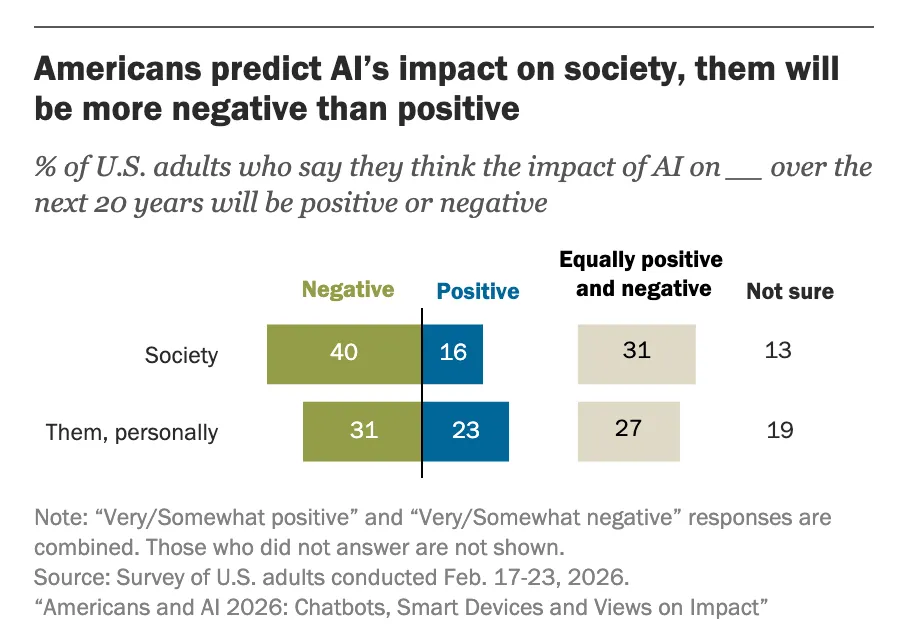
Pew Research Center research found that AI usage is rising, but trust is falling. About half of U.S. adults now use AI chatbots, and 38% of employed adults say they use chatbots for work tasks. ChatGPT alone has reached 44% of U.S. adults.
Yet the same study found that Americans are deeply skeptical of AI’s broader impact. Forty percent say AI will have a negative impact on society over the next 20 years, compared with just 16% who expect a positive impact. For their own lives, 31% expect a negative effect versus 23% positive.
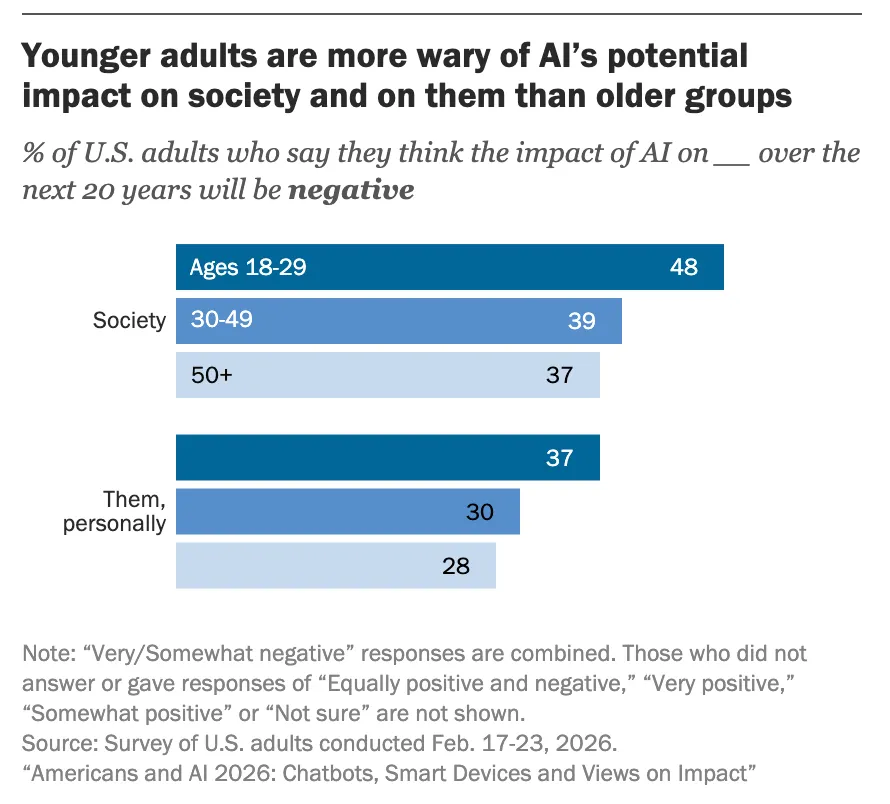
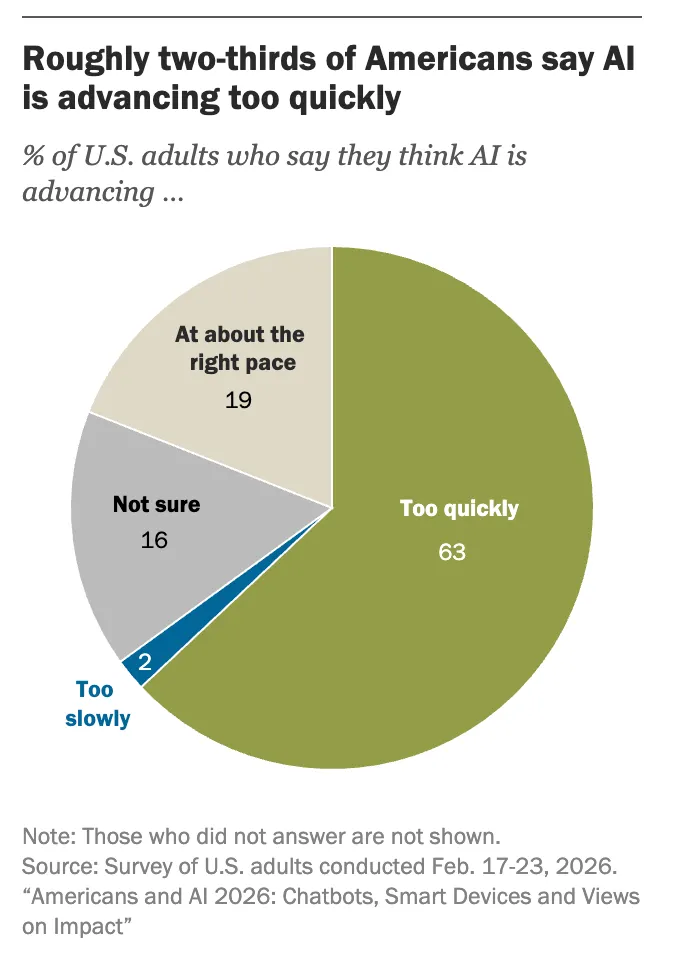
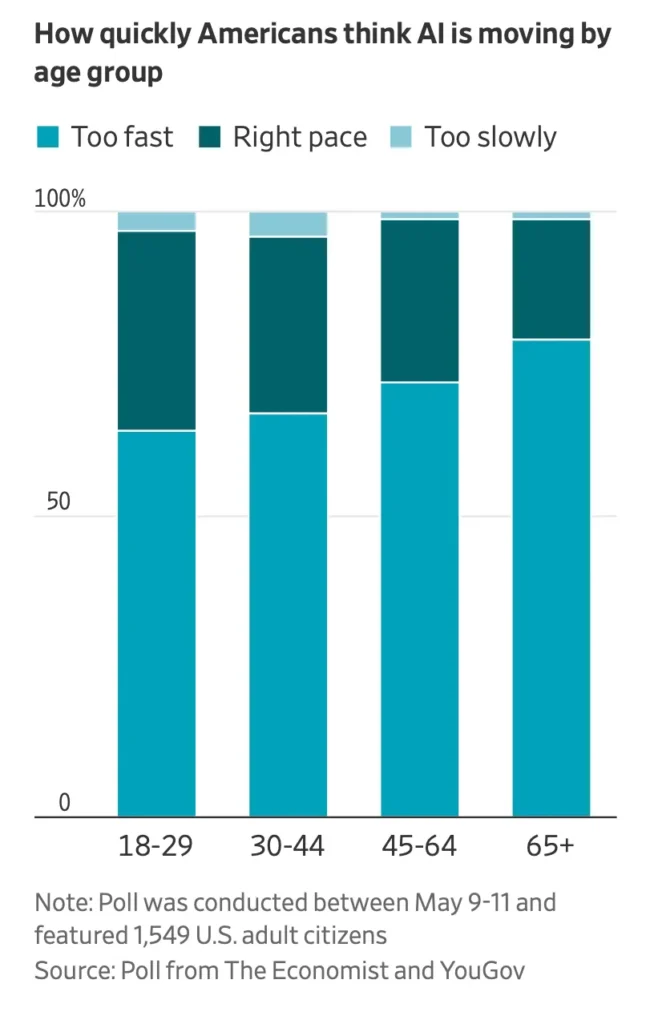
The concern cuts even deeper. Sixty-three percent of Americans say AI is advancing too quickly. Seventy-one percent believe the increased use of AI will make their personal information less secure. Sixty-seven percent have little to no confidence in the U.S. government to regulate AI effectively, and about six in ten are not confident that U.S. companies will develop and use AI responsibly.
It’s hard not to feel that if you don’t already.
Adoption Without Consent Becomes Resistance
The Wall Street Journal framed the backlash as an “American rebellion against AI,” connecting booed commencement speakers, blocked data centers, plummeting poll numbers, protests, political fights, energy concerns, job fears, and growing community resistance. Its reporting noted that voters in Festus, Missouri, ousted four city council members shortly after they approved a $6 billion data center, that roughly 360,000 Americans were in Facebook groups opposing data centers, and that local opposition blocked or delayed at least 48 data center projects valued at about $156 billion last year.
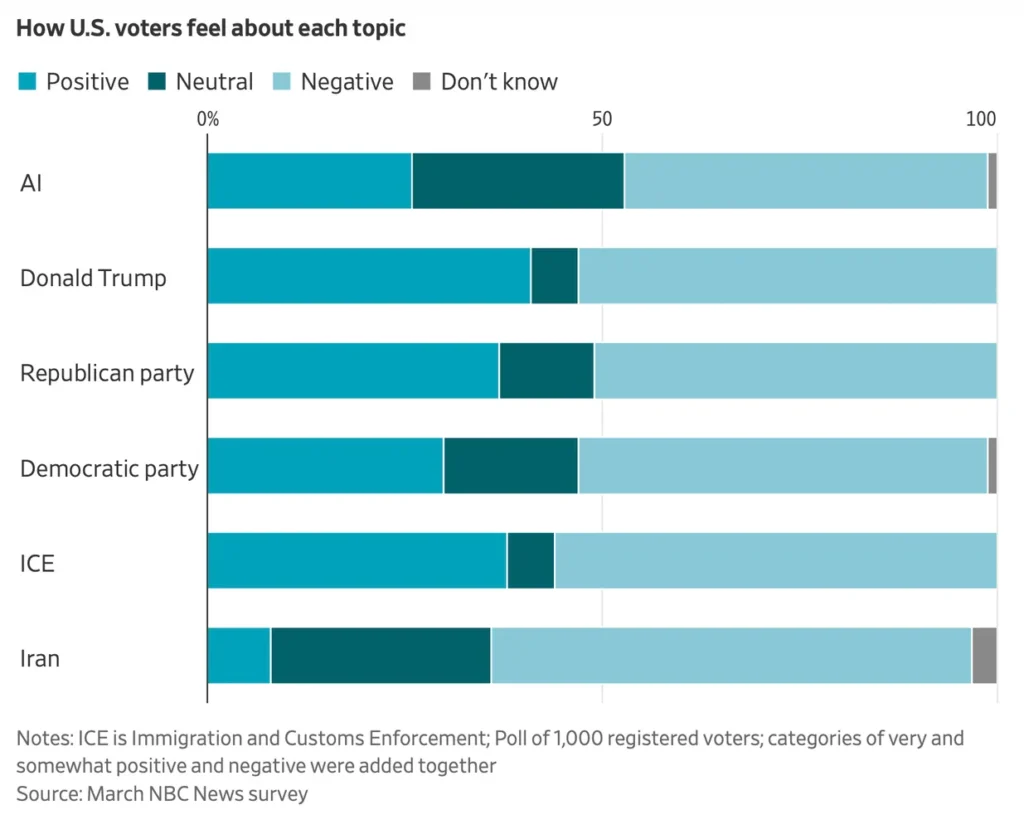
This is what happens when leaders sell inevitability instead of agency at a speed no one was ready for.
This is what happens when the public hears, over and over again, that AI will be used to reduce headcount, automate jobs, cut costs, and accelerate productivity, but rarely hears a credible plan to create new value, new roles, new mobility, and new futures.
You reap what you sow.
And for too long, the AI story has been sown in fear.
You Reap the Narrative You Sow
A growing number of companies have publicly cited AI efficiencies as a rationale for layoffs. Business Insider recently tracked 16 companies that have announced AI-related staff cuts or restructurings, while also noting the possibility that some companies may be using AI as a convenient explanation for cuts they would have made anyway (or at least to cover the costs of AI tech and infrastructure, not because AI could take over jobs.)
AI does not walk into a company and eliminate a job.
Leaders do.
Boards do.
Investors do.
AI can perform tasks. It can summarize, analyze, classify, generate, recommend, simulate, reason, and increasingly act within boundaries. But a job is more than a bundle of tasks. A job is context, judgment, accountability, relationship, craft, care, ethics, taste, presence, and trust. A job is also agency, identity, mobility, contribution, belonging, and hope.
When leaders over rely on AI investments and reduce work to tasks, people become costs.
When people become costs, the only ROI for AI becomes cutting costs.
You’ve heard the saying, “when you’re a hammer, everything looks like a nail.” When it comes to AI automation, that phrase can be adapted, “When you’re an axe, everything looks like headcount.”
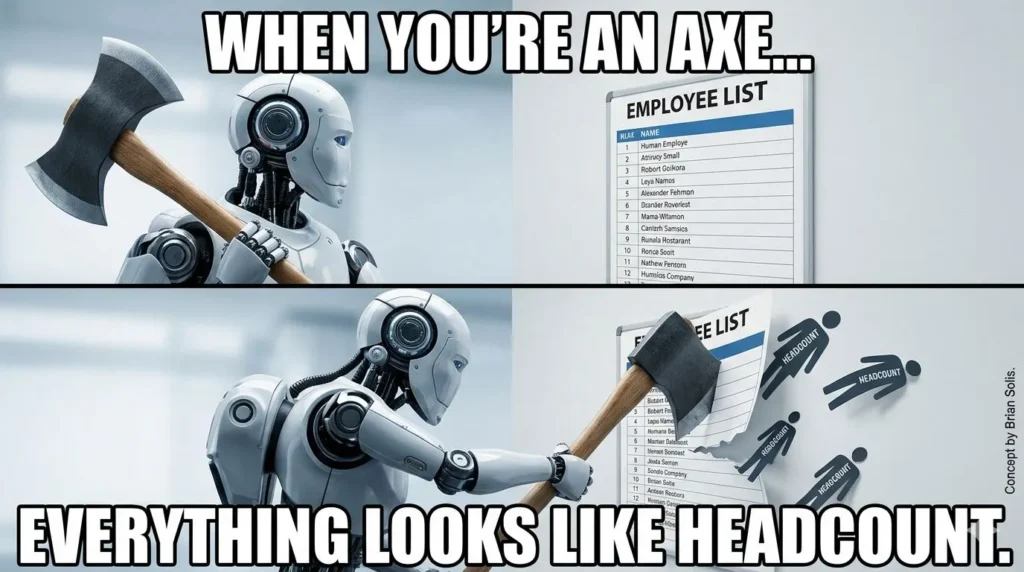
This is why trust collapses. And this is when leaders fail. Failures mount when leaders use an exponential technology with an elimination mindset.
The Old Playbook is Still the Problem
Executives, managers, teachers, parents, mentors, we need to become the leaders we are waiting for.
You can’t automate your way to innovation.
You can’t cut your way to growth.
Yet so much of the AI conversation remains trapped in yesterday’s business logic: reduce costs, increase efficiency, do more with less, focus on the quarter, win over the street. While it looks good on a spreadsheet or an executive dashboard, it does not build belief or instill trust over the long term. It does not inspire people to learn. It does not invite or empower workers, students, customers, or communities into the future.
It does however, create resistance. And that’s where we are.
Researchers are seeing early evidence that AI is starting to hurt entry-level jobs, especially in roles where AI can perform the same tasks junior employees used to do. Stanford Digital Economy Lab researchers found results “consistent with the hypothesis that generative AI has begun to affect entry-level employment.”
AI is not affecting all jobs equally. It is putting the most pressure on the first rung of the career ladder, especially in work where companies can use AI to do what junior employees used to learn by doing. If leaders automate the entry level without redesigning how people learn, grow, and contribute, they do not just cut costs. They break the talent pipeline.
Cengage describes the emerging experience gap painfully and honestly clear: entry-level jobs have long been the training ground where people build judgment, communication, professional confidence, and practical skills. But as AI absorbs routine early-career tasks, employers increasingly expect junior workers to perform more analytical and judgment-based work earlier, sometimes asking them to evaluate AI outputs before they have learned the underlying work themselves.
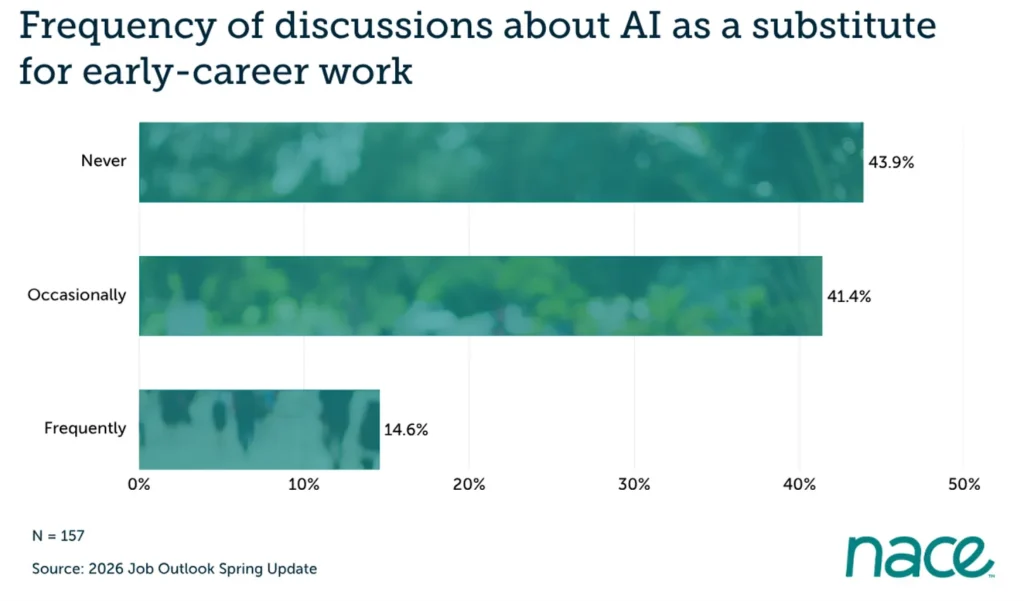
At the same time, employers are rapidly shifting expectations. NACE reports that more than one-third of entry-level jobs now require AI skills, nearly triple the share from fall 2025, and 28% of employers say they are seeking early-career talent who can use AI in their work.
No Wonder People are Angry (and Scared)!
So imagine being a student.
Your professors told you not to use AI because it was cheating. Employers now expect you to use AI because it is essential. Executives tell you AI will create opportunity, while headlines tell you companies are cutting jobs because of AI. Then commencement speakers tell you to embrace the revolution.
The boos are feedback.
They are saying: You have not earned our trust. And this isn’t only a student problem. It is an institutional problem.
AI Should Expand Thinking and Capacity with People
Futurism recently highlighted a small UK executive survey that found 62% of executive respondents said they use AI to make “most decisions,” while 46% said they rely on advice from AI more than from their own colleagues.
The piece also referenced research from Carnegie Mellon and Microsoft suggesting that knowledge workers who trust generative AI’s accuracy may show lower propensity for critical thought. I mean…WTF (what’s the future!?)
The sample is limited and the tone is pointed, but the irony is important: some of the same leaders asking workers to trust AI may already be outsourcing too much of their own thinking to it.
That isn’t leadership. This is cognitive surrender and AI abdication.
AI should expand our thinking, not replace it. It should challenge assumptions, not launder them. It should help leaders explore more possibilities, not avoid responsibility for the choices they make.
And that takes…leadership. From above…from the side…from within.
People are Still the Strategy
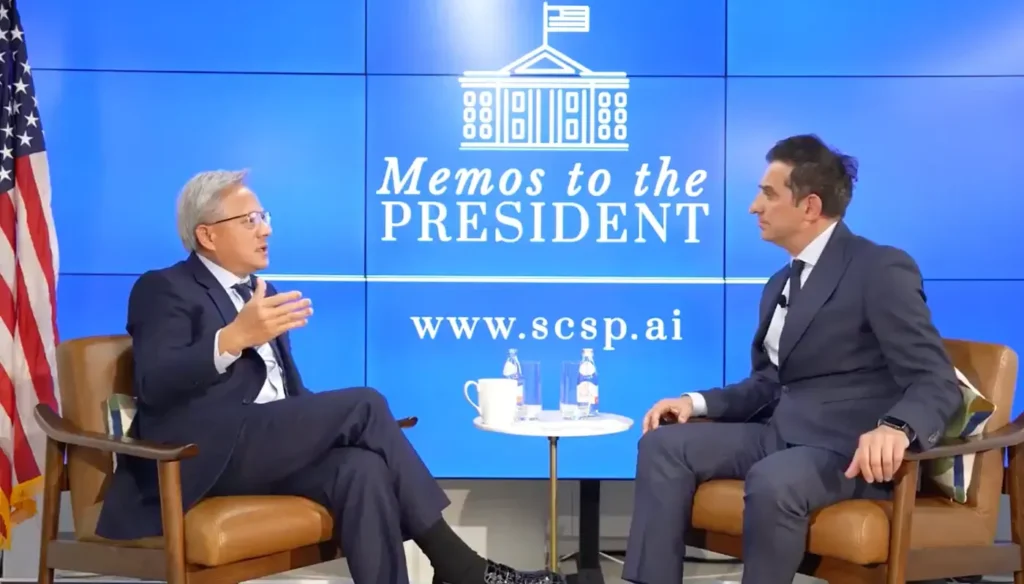
Jensen Huang made an important distinction on Memos to the President. He argued that AI automates specific tasks, such as coding or reading scans, but does not replace the human purpose of a job: innovation and problem-solving. In his framing, AI can increase demand for software engineers and radiologists by supercharging productivity, not by erasing the need for human expertise.
That is the narrative we should have been building all along.
AI is not the strategy. People are still the strategy.
AI is a capability. For leaders who lead it, it’s a force multiplier, a new layer of intelligence and agency that can help people do what was not possible yesterday. But this is only true if leaders choose augmentation over automation…only if they redesign work before they redesign the workforce…only if they build new ladders before they remove the first rung.
This is where the mindshift has to begin.
From Finite Automation to Infinite Possibility
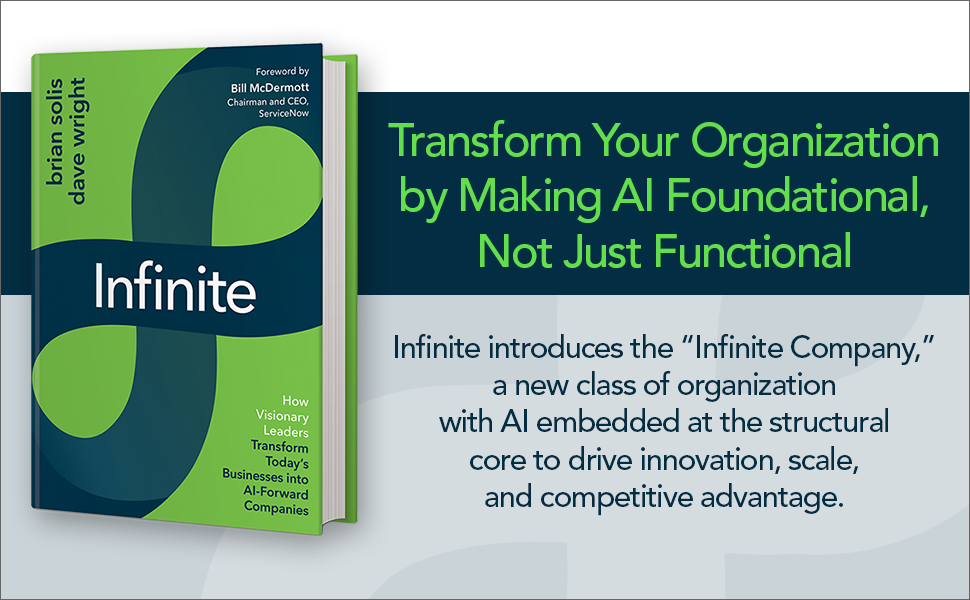
A finite company uses AI to make yesterday cheaper.
An infinite company uses AI to make tomorrow possible.
www.infinitecompany.ai
The difference is not technology. It is leadership. And it’s leadership at every level…as parents, teachers, mentors, managers, leaders.
So, it’s not just “finite leaders,” it’s everyone who hold back progress, whether they realize it or not.
What’s the opposite in this case? It’s infinite…
An infinite company does not start by asking, “How many people can we replace?” It asks, “What new value can we create?” It asks, “What work should humans no longer have to do?” It asks, “What can people become capable of when routine work is offloaded and human imagination is amplified?” It asks, “What outcomes were impossible before AI that are now within reach?”
That is how we change the conversation from fear to agency.
And we need to change it now.
How Leaders Can Earn Back Trust
First, leaders have to stop using AI as a euphemism for layoffs.
If AI is part of a restructuring, say exactly how. Explain what work is changing, what value is being created, what skills are needed next, what investments are being made in people, and how displaced capacity will be reinvested. Do not hide behind inevitability. If the choice is cost reduction, own it. If the strategy is growth, prove it.
Second, redesign work around outcomes, not org charts. Think automation + augmentation. You have to redesign work before you redesign the workforce.
When AI automates work, it replaces tasks that entry-level workers often handle: drafting, coding basic features, research, customer support, analysis, admin work, etc. In those areas, employment for younger or less-experienced workers appears to be declining.
When AI augments work, it helps people do their jobs better rather than replacing the work outright. In those cases, the negative employment effect is weaker or less obvious.
The org chart tells us who reports to whom. It does not tell us how value is created. Leaders need work charts that map outcomes, tasks, handoffs, data, decisions, human judgment, AI agents, risk controls, and feedback loops. AI transformation is not about sprinkling tools across departments. It is about reimagining how work flows.
Third, rebuild the entry-level ladder.
If AI absorbs the routine work that once trained people, then organizations need new apprenticeships. Early-career workers should learn how to collaborate with AI, interrogate its outputs, understand the underlying work, develop judgment, and contribute to real outcomes faster. Do not eliminate the training ground. Reinvent it.
Fourth, make agency and augmentation measurable.
Every AI initiative should answer four questions: What human capacity did we unlock? What customer or employee outcome improved? What new capability did we build? What did we reinvest in people, products, services, or growth? Cost savings alone is not transformation. It is accounting.
Fifth, teach students how to think with AI, not surrender thinking to it.
Education cannot treat AI only as a cheating problem. Students need to learn how to question AI, use it as a collaborator, detect errors, challenge bias, build original ideas, and protect their own critical thinking. The future does not belong to students who outsource their minds. It belongs to those who augment them.
Sixth, include more voices in AI decisions.
Workers. Students. Customers. Artists. Teachers. Communities. Local officials. Privacy experts. Labor leaders. People who will live with the consequences. When AI is designed in closed rooms and deployed into open society, backlash is not a bug. It is the system responding.
Finally, leaders have to earn trust in public.
Prove it in public.
It’s ok if you don’t have the answers. There is no playbook. The problems compound when you try to use yesterday’s playbook to navigate an uncharted future. You have to ask different questions and do the work to answer them.
That’s leadership. So, lead.
Show the jobs created. Show the roles redesigned. Show the people reskilled. Show the guardrails. Show the impact. Show the harms prevented. Show how AI is helping humans become more capable, not just making organizations more efficient.
This is the leadership audition of our time. No pressure! 😉
The leaders of tomorrow will not be remembered for how quickly they cut.They will be remembered for how courageously they imagined.
They will be remembered for turning fear into fluency, fluency into capability, capability into creativity, and creativity into new value.
The AI backlash is real. But it is not the end of the story. It is an invitation to write a better one.
Remember, people are not asking us to stop the future. But they are asking to be included in it. They are asking for a future where AI does not diminish human potential, instead, it expands it. It’s a future where students are not told their degrees are obsolete before they even begin, a future where workers are not treated as costs to be optimized away, a future where leaders do not confuse automation with innovation or efficiency with progress.
This is our moment to wonder again.
Ask better questions.
Design better systems.
Build better companies.
Become better leaders.
Let’s stop asking people to accept a future they were never invited to help shape.
Let’s build it together.
Infinite ∞ | Mindshift | Subscribe | Keynote Speaker

Leave a Reply