
via Dan Costa, Worth
My social feed is filled with ads telling me “Most people still use AI like Google….” and then they try to sell me some online course or collection of prompts. But there is truth to the cliche. Here at SXSW, the distinction between the AI-augmented and the AI-clueless keeps coming up.
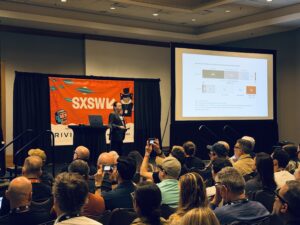
“Most people use AI to do what they already know,” Brian Solis, digital anthropologist and head of global innovation at ServiceNow, said on stage at SXSW this week in Austin, Texas. “The opportunity is to use it to do what they couldn’t do before.”
Most people, he argued, approach generative AI as a way to get work off their plate—summaries instead of reading, drafts instead of writing, answers instead of thinking. The instinct is understandable. The tools are designed to remove friction. But that instinct also defines the ceiling of what AI can deliver.
Solis describes two very different futures. In one, AI becomes a mechanism for outsourcing cognition, compressing knowledge work into faster, cheaper versions of what already exists. In the other, it becomes an extension of human intelligence—a way to explore ideas, test assumptions, and surface possibilities that would otherwise remain invisible.
At nearly every technology conference this year, the conversation around artificial intelligence follows a familiar pattern. Executives talk about efficiency. Investors talk about productivity. Panels debate how many jobs might disappear.
Solis’s presentation offered a more useful frame. The emerging divide may not be between humans and machines. It may be between workers who use AI to extend their thinking and those who use it to outsource their thinking.
Experiments across software development, writing, and research consistently demonstrate that generative AI improves task-level productivity. In controlled trials conducted by Microsoft researchers, developers using GitHub Copilot completed programming tasks roughly 55% faster than those working without it. The findings come from Microsoft Research’s analysis of Copilot usage among developers.
Other experiments show gains ranging from roughly 14 to 40%, depending on the task complexity and environment.
The economic effects of these improvements remain surprisingly modest. Economists estimate that generative AI may increase overall productivity growth by only 0.5 to 0.7 percentage points annually over the next decade.
The paradox is striking. AI appears extremely powerful at the level of individual tasks while producing limited macroeconomic change so far. One explanation is that most organizations are deploying AI to accelerate existing workflows rather than redesign them.
Solis calls this the automation trap. When companies introduce AI tools, the first instinct is usually to ask how they can reduce labor costs or streamline existing processes. Those uses generate measurable improvements quickly, which makes them attractive to executives. Yet they rarely change the structure of the work itself.
“If your first instinct is to use AI to automate the past,” Solis told the audience, “you lock yourself into a very finite future.”
Instead, Solis advocates for augmentation. Instead of asking AI to execute familiar tasks more efficiently, workers use it to explore new possibilities: generating alternative strategies, modeling complex scenarios, or testing ideas that would be difficult to examine on their own.
The difference between automation and augmentation may determine who benefits most from the technology. Early evidence suggests that workers who integrate AI deeply into their workflows can gain disproportionate advantages. Some studies describe productivity differences of several multiples between advanced users and those who employ AI casually.
At the same time, AI usage is creating new forms of friction. A randomized study examining experienced open-source developers found that programmers using AI assistance sometimes took 19% longer to complete tasks than those working independently, largely because AI-generated output required additional review and debugging.
In other words, AI often shifts work rather than eliminating it. The same pattern is emerging in writing and communication.
Generative tools have made it trivial to produce competent text at scale. The result has been a flood of formulaic content across professional platforms—the unavoidable AI slop. LinkedIn feeds filled with emoji-heavy posts, templated marketing copy, and identical thought-leadership articles have come to define the professional internet.
When everyone can generate persuasive language instantly, expertise becomes harder to identify. “Everybody is an expert now,” Solis observed. “And when everybody is an expert, no one can be.”
Researchers are beginning to examine another consequence of heavy AI use: the way it changes people’s thinking.
Studies measuring brain activity during writing tasks have found that participants relying heavily on generative tools show lower cognitive engagement and weaker memory retention than people writing without AI assistance.
Other research links frequent AI use to cognitive offloading, a process in which people delegate reasoning tasks to machines rather than performing them themselves.
The effect resembles earlier technological shifts. When GPS navigation became ubiquitous, psychologists documented “digital amnesia,” the loss of spatial memory that occurs when people no longer need to remember directions. Generative AI may be introducing a similar dynamic in intellectual work.
The danger is not that AI makes people less intelligent. The danger is that organizations design workflows that discourage employees from exercising the capabilities that make human intelligence distinctive.
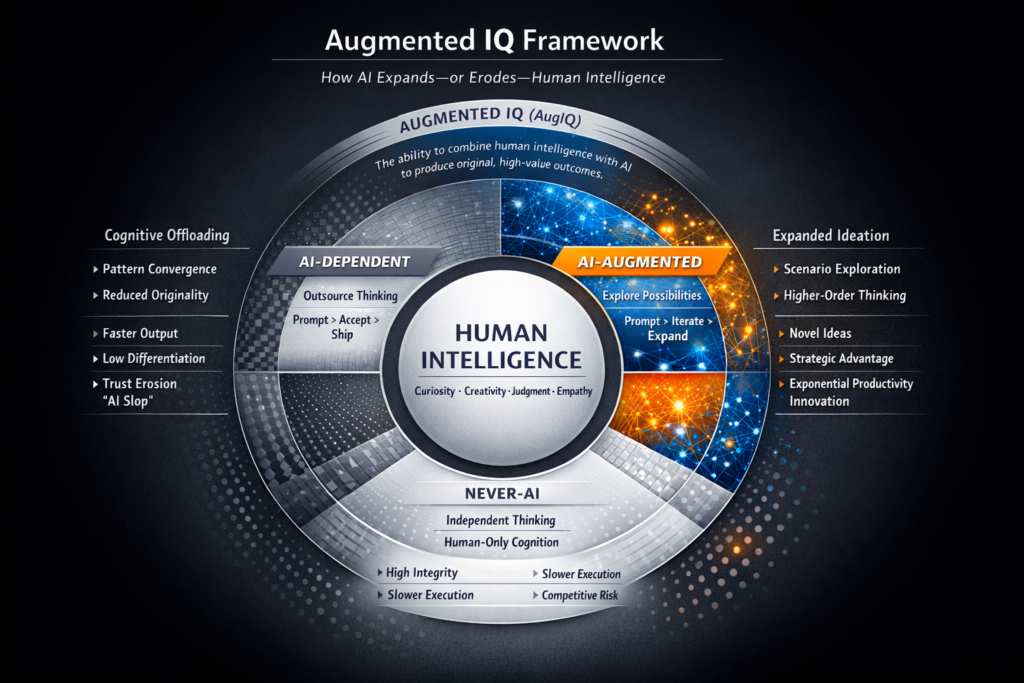
Solis says this makes AI adoption primarily a leadership challenge. Companies increasingly measure “AI proficiency,” evaluating how effectively employees can use generative tools. Those metrics capture a useful skill set, yet they risk reinforcing incremental thinking. Workers become better at using AI to perform existing tasks while the underlying processes remain unchanged.
remedy this, Solis suggests a simple thought experiment he calls WWAID—“What Would AI Do?” Before solving a problem, leaders ask how an intelligence native to the situation might approach it. The exercise pushes teams to move beyond existing workflows and explore new strategies rather than simply accelerating old ones.
The distinction will likely determine which organizations benefit most from the technology.
Despite intense media attention, generative AI still touches a relatively small portion of the economy. Data from the Federal Reserve Bank of St. Louis suggests that about 5.7% of total U.S. work hours currently involve generative AI tools.
Adoption is rising quickly, but the technology remains far from universal. That means the productivity divide Solis describes is only beginning to emerge.
Three distinct profiles are beginning to emerge in the AI economy. First, there are the AI-dependent, who default to the tool for answers, move quickly, but produce increasingly uniform output. Then, there are the never-AI-ers, who preserve independent thinking but risk falling behind as the pace of work accelerates.
The real winners, according to Solis, are the AI-augmented, who use the technology as a partner in thinking—testing assumptions, generating alternatives, and pushing beyond their own cognitive limits—combining speed with originality in a way that is likely to define the durable advantage in an AI-driven world.
“The work you want to do,” Solis said, “is the work you couldn’t do without AI—and that AI can’t do without you.”
Please read the full article at Worth.

Leave a Reply