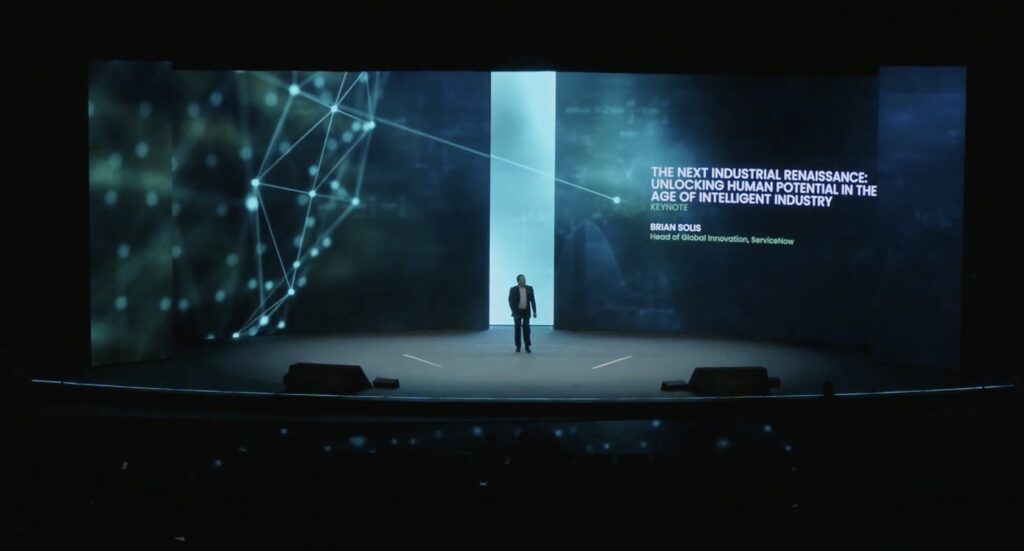
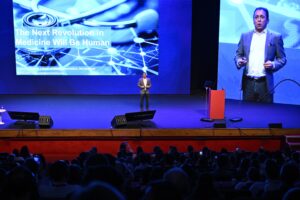
Florence has a way of putting ambition in perspective. You’re surrounded by reminders that the future is something people choose to design, even when the tools, materials, and models of the day feel limiting. That’s what I kept thinking about as I prepared for the Baker Hughes Annual Meeting conference in January 2026. I’m proud to share that they 10-minute keynote address is now online and I’ve included it below 👇
This is not Just a Future of Work Moment, It’s a ReinAIssance of Work Event
At the event, we explored a new era of “intelligent industry.” But I share this with you because this moment is bigger than any one sector. “Intelligence” is no longer confined to IT or executive dashboards. It’s moving into workflows, operations, supply chains, customer experiences, factories, field service, finance, healthcare, public services…everywhere outcomes are created. And, with intelligence, those outcomes can be automated and reimagined to deliver greater value not possible before generative AI and AI agents.
In an era of AI darwinism, an organization won’t be judged by how much AI it uses. It will be remembered by how intelligently it applies it.
AI Darwinism, the survival-of-the-most-adaptive era of business.AI Darwinism applies new selection pressure in business, created when intelligence accelerates the pace of change so dramatically that advantage shifts from size and speed to learning velocity and reinvention.
Baker Hughes describes the stakes through what it calls the “energy equation,” energy that is sustainable, efficient, and affordable. In the AI era, that equation becomes a board-level design imperative and constraint. Why? Because every company is suddenly in the energy business. In fact, energy consumption is expected to double by 2035. And as a result, every company must now build an operating model that runs on sustainable, efficient, and affordable energy: data centers, edge devices, smarter facilities, intelligent fleets, industrial automation, always-on agents, and the growing expectations of customers and employees for instant, high-quality outcomes.
In Florence, we heard projections that energy demand is rising fast, and that data center consumption is rising even faster. For example, data centers, largely driven by AI processing, are expected to double by 2030. Whether you lead in retail, banking, healthcare, manufacturing, logistics, or software, the implication is the same: scale begins now, and scale has a cost you can’t ignore.
But the biggest shift isn’t AI adoption or deciding which AI tools are best…though both are important. It’s that we finally have the chance, and parallel pressure, to redesign work itself. This work of reinventing work in this renAIssance, becomes the moat.
For the last couple of decades during the “digital transformation” years, many organizations didn’t transform so much as they digitized yesterday’s work. We layered technology on top of legacy workflows and called it progress. The risk today is doing the same thing with AI: automating old work instead of creating new capacity, new capabilities, and new value.
That’s why I framed this as a CTRL-ALT-DEL moment.
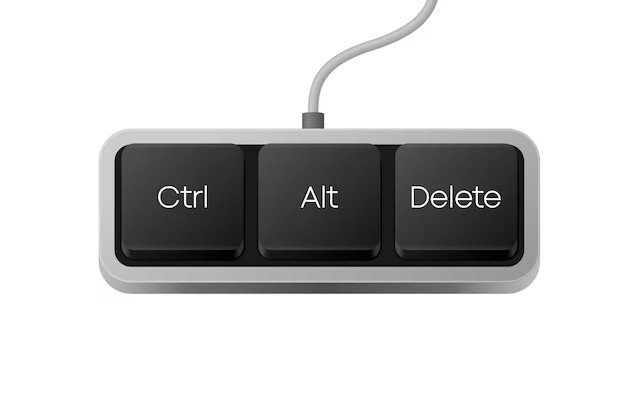
We have a choice in how we choose to reboot. A reboot doesn’t mean replacing people. And a reboot doesn’t have to mean that we come back online as a more efficient, leaner version of who we are and what we did yesterday. It means re-architecting the relationship between humans, AI agents, and physical AI so that:
- we design work and how work flows (data too) across the organization to unlock new outcomes and value,
- agents can execute and coordinate tasks continuously,
- physical AI can extend capability into environments where humans shouldn’t (or can’t) go,
- and people move above the loop, setting intent, defining rules, supervising autonomy, and focusing on judgment, creativity, ethics, empathy, and innovation.
Someone has to define the boundaries. Someone has to decide what “good” looks like. Someone has to separate human work from automated work, break roles into tasks, and rebuild those tasks into an operating model that can learn and improve. That “someone” is leadership. That’s the mindshift!
So if you take one thing from this keynote, let it be this:
AI is not your strategy. Transformation toward greater resilience, relevance, and value creation is the strategy. And transformation demands that we upgrade technology and upgrade ourselves. To transform and innovate, we must be willing ti disrupt ourselves. It is the gift you give to yourself before someone else does.
If you want the full thread, Florence, the energy equation, AI agents, physical AI, and why this is ultimately a human leadership moment, please watch the embedded YouTube video of the talk.
Remember, nothing interesting begins with knowing.
You can hit CTRL-ALT-DEL and reboot as a faster more efficient version of your business, now powered by AI. But in doing so, you do what everyone else is doing, while also becoming part of the AI status quo.
So the question is, how do you want to reboot your organization of the AI renAIssance?
One more thing…
While in Florence, I spent time with the Baker Hughes team. We recorded two short interviews that I’d like to share with you.
In this first clip, I zoom in on two non-negotiables for scaling AI without blowing up the future you’re trying to build: 1) governance and 2) humanity.
Governance is so much more than policy. It’s the trust operating system, the security, compliance, and guardrails that keep people and AI moving fast without breaking what can’t be repaired.
And humanity is the point: if we scale AI by shrinking human capacity, we don’t modernize the value engine. In fact, we sabotage it.
The north-star should be net new value creation. If you don’t define new value upfront, you’ll default to automation, efficiency, and cost cutting, and call it progress. And it is still progress, but it’s linear. What we’re really talking about is AI automation AND augmentation to drive exponential growth!
New leadership is what makes that outcome intentional.
Interview 2
In this follow-on clip, I unpack why physical AI (and world models) is the next major leap. It introduces an entirely new kind of workforce: intelligent devices and humanoids working alongside people. The move from pilot to production won’t be won by experimentation alone; it starts with vision. If you’re still struggling to define your AI vision, physical AI raises the stakes because now intelligence shows up in plants, fields, facilities, and real-world operations.
What makes this moment different is that physical AI is evolving beyond being trained only on language and multimodal data. Emerging world models can train systems on real-world scenarios, making pilots more precise, predictive, and safer by letting you design environments where physical AI can operate in known, tested conditions.
Do not use unimaginatively. Imagine with AI to answer the only strategic question that matters…what can we do tomorrow that we couldn’t do yesterday to create net new value?
This is the real opportunity of intelligent industry: augmentation…humans, agents, and physical AI performing together in ways that create exponential value.
Read Mindshift | Subscribe to Brian’s Newsletter | Consider Brian your next Speaker
Leave a Reply