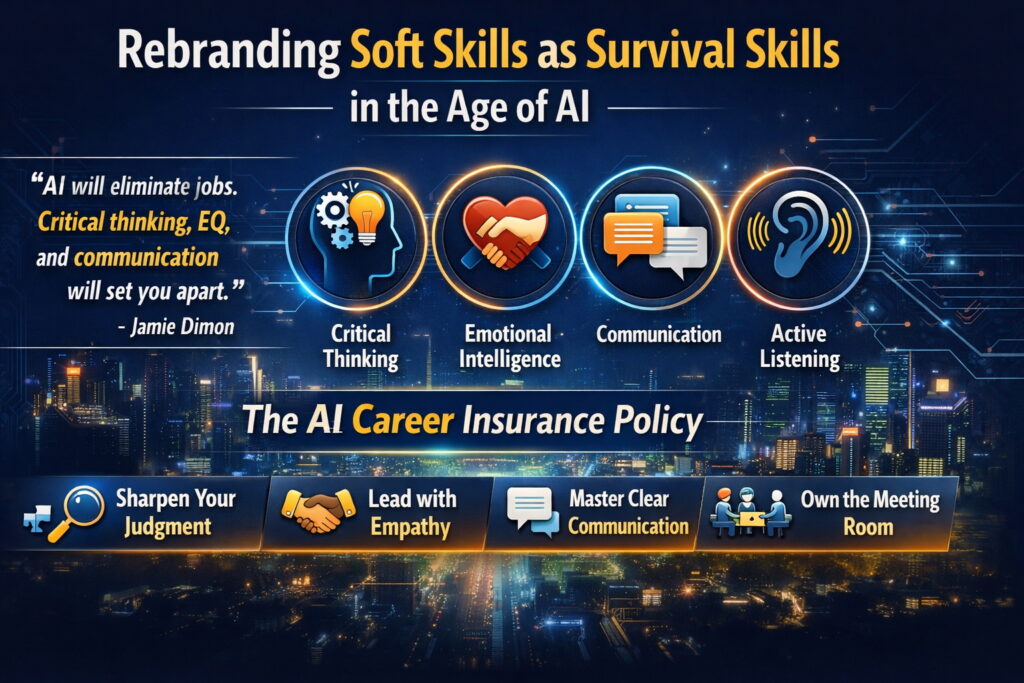
I recently watched an interview with JPMorganChase CEO Jamie Dimon, where he admitted that AI will eliminate jobs. At the same time, he shared his ideas for how employees can stay relevant and resilient with AI.
Double down on the skills AI can’t reliably replicate: critical thinking, emotional intelligence, creativity, communication, and writing.
What’s interesting is how consistent this executive chorus is becoming.
Walmart CEO Doug McMillon has said AI will change “literally every job.”
Amazon Web Services (AWS) CEO Matt Garman underscores that while AI can execute tasks, it still struggles with nuanced judgment. This makes creativity, flexibility, and learning agility more valuable. You’re going to want to be creative. You’re going to want to be [good at] critical thinking. And you’re going to want to be flexible,” Garman observed. “I think the ability to learn new things and adapt is going to be just as important as any particular skill that you learn.”
With this advice, Soft skills just got rebranded as AI survival skills. In an era when intelligence s abundant, these human skills are power skills, and they’re scarce. And scarce becomes valuable. And valuable becomes insurance.
1) Critical thinking becomes your differentiator.
AI can generate answers. You have to generate judgment. Learn to question assumptions, spot patterns, and make decisions when data and AI-generated insights are everywhere..
2) EQ becomes your multiplier.
As automation rises, trust, empathy, and leadership become the true competitive edge. Collaboration is still very human.
3) Communication becomes your currency.
If you can’t explain or articulate it, you can’t lead it. Clear writing and clear speaking are how ideas travel, and how influence builds. At the same time, listening is an essential skill. See #5.
4) Meetings become your stage.
Dimon advised to “be good in a meeting.” Don’t just show up. Add value. It’s about presence: framing, facilitation, decisioning, and momentum.
5) Listening is the underrated superpower.
Harvard’s Alison Wood Brooks nails it: most people perform listening. Few people probe. If you listen and ask the next smart question, you become unforgettable.
“Listening to somebody’s answer then probing for more information is a superhero move, and a shockingly low number of people think to do it,” Wood Brooks revealed. “You should show [you’re listening] by saying [you are] out loud.”
The future belongs to people who treat AI as a multiplier, not their voice or brain. Learn the tools, yes. But invest even more in the human capabilities that make tools meaningful.
If AI is changing every job, then the most important reskilling is behavioral. It’s learning how to think, connect, and lead in a world where “average output” is automated…a new AI status quo.
Train to compete more effectively with AI. Train to excel at what AI can’t do.
AI does not feel empathy. AI is not you.
–
Read Mindshift | Book Brian as a Speaker | Subscribe to Brian’s Newsletter


Leave a Reply