What Benedict Evans’ latest “AI Eats the World” deck reveals about the gap between AI hype and real transformation, and what leaders must do next.
Each deck is packed with sharp observations for anyone covering AI, building with it, or simply trying to survive the changes it unleashes.
This edition is especially revealing. The charts quietly expose how far reality lags behind the hype, and why so many organizations are still stuck in pilot purgatory.
In this piece, I unpack some of Ben’s key slides through the lens of leadership and transformation, and explore what it really takes to move from watching AI eat the world to feasting on transformation and innovation!
Most data shows the same picture: Weekly vs daily gen AI usage
The chart pulls together multiple US surveys on generative AI chatbot use. The numbers are noisy, but the pattern is clear: a meaningful slice of the population has tried AI, a much smaller slice uses it frequently. There’s a visible gap between use and habit.
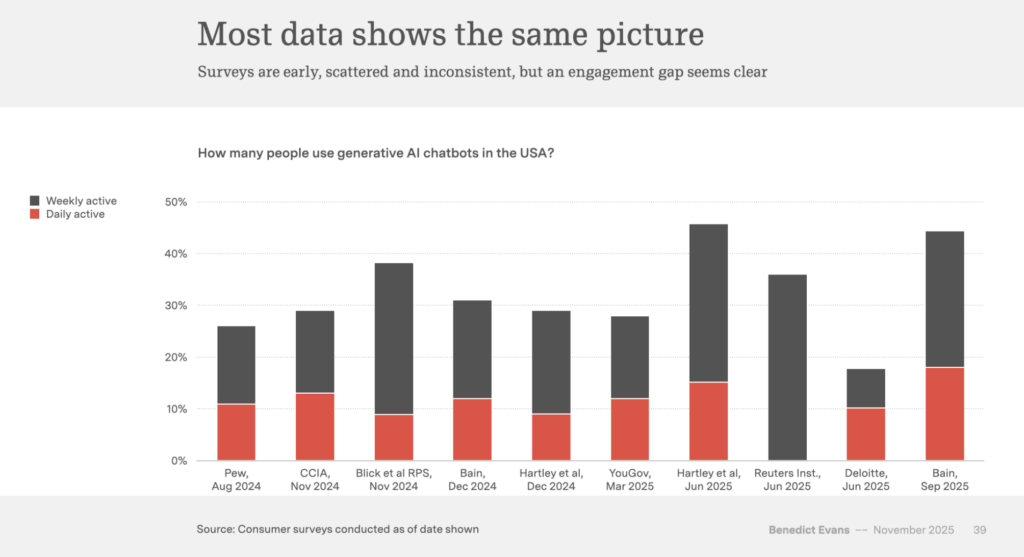
This is your “AI engagement gap.” Awareness is high, real dependency is low. Inside your company, assume the same pattern. There’s lots of experimentation, very few people whose work has truly changed. Your job is to design tools, workflows, and incentives that move people from dabbling with AI to not wanting to work without it. More so, your job is to provide a vision of what’s possible and the role people play in bringing that vision to life. In this sense, it’s not about using AI or “working with AI” as much as it is showing, demonstrating, and empowering people to use it in new ways, often unintuitive ways, to augment work, to employ AI as a cognitive amplifier, to accomplish previously impossible and unimaginable outcome
“Is this just early? Or a harder problem?”
Here, Ben asks whether low usage is simply early-stage adoption… or whether most people struggle to integrate a chatbot into their work. The line about “if you want everyone else, do you need to wrap this in tooling and product?” points to the need for better UX, integration, and workflow design.

Most people don’t wake up wanting a “large language model” and none of these LLMs came with a user instructional manual. Even with all the experts offering guidance out there, people would benefit from 1:1 coaching. Employees, and their managers, want to get their job done with less friction and more impact.
The opportunity for leaders is to move from “AI as a blank chat box” to “AI as an invisible and omnipresent AI collaborator and coach embedded in tools, workflows, and moments that matter.” If you want the whole organization to come along, you have to productize the magic and sanction it.
“What’s our AI strategy? Well, what’s the pattern?”
Here, Ben zooms out. Every major tech wave follows a pattern.
First, we absorb it into existing products and processes (make it a feature). Then we innovate with new products and bundles. Eventually, we disrupt and restructure industries. Now apply that model to your business, especially if you’re not in the AI product business. The point is that AI is not an exception to this pattern.
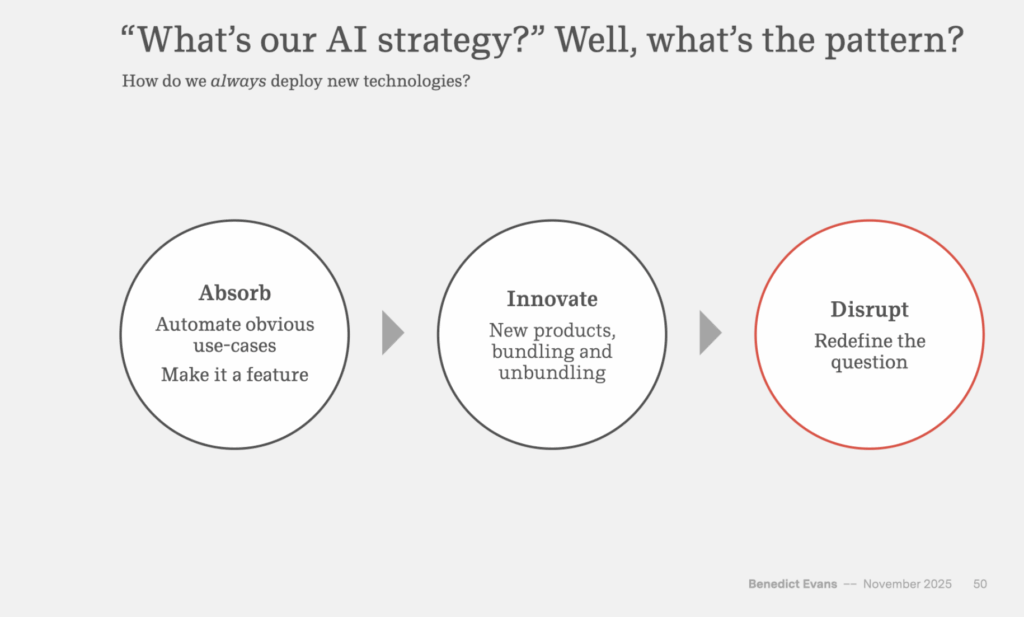
Executives keep asking for “the AI strategy,” but the better question is, “Where are we in the pattern?” If you’re still arguing about everyday use cases and pilots while your competitors are using AI to invent new offerings and new economics, you’re playing a finite game with disruptive technology. AI strategy is not a slide; it’s a roadmap from absorb to innovate to disrupt, with clear bets at each stage.
This is a model to…
- Optimize processes
- Create processes that unlock new value
- Make old processes obsolete
“So far, most successful use-cases are ‘absorb’”
This slide highlights where gen AI is easiest to deploy today: coding, customer automation and marketing support (and, implicitly, adjacent content-heavy workflows). These are classic “feature” spaces where AI makes existing tasks faster and cheaper.
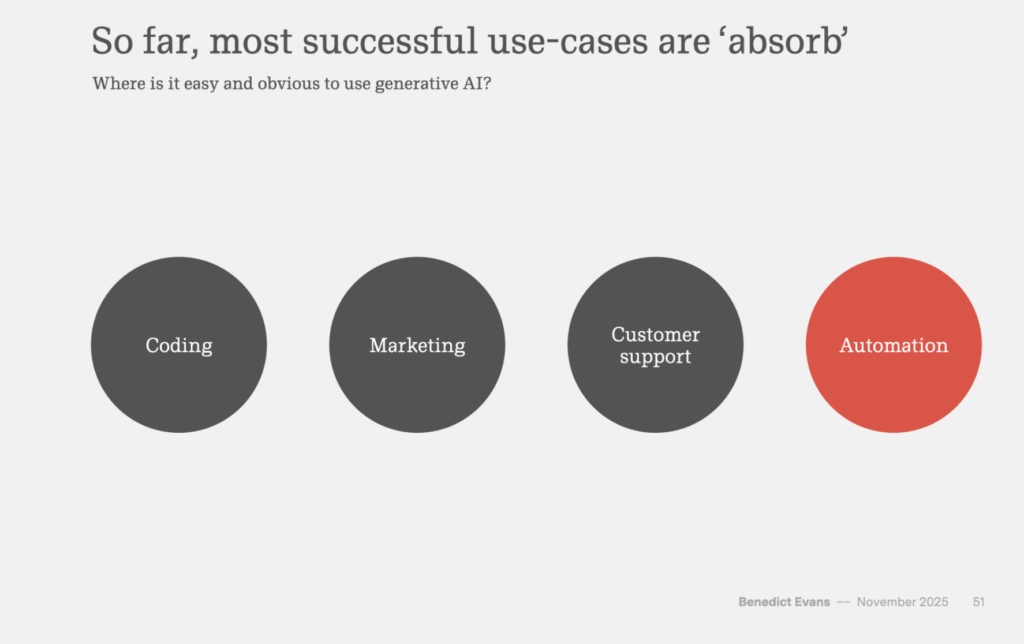
AI’s first light houses will be places where you can throw tokens at text and see immediate ROI, i.e. quick wins a la FAQs, copy, campaigns, support flows. But these are also the easiest use cases for your competitors to copy. There’s no moat here.
Leaders should treat this phase as training wheels: use it to build AI literacy, data pipelines, and trust, while quietly designing the next wave of AI-native experiences that others won’t be able to clone overnight.
Pilots vs deployment across functions
Here we see a chart of AI agent usage by business function: experiment, pilot, deploying, deployed.
Functions such as customer service, marketing, knowledge management, product/UX, engineering, data/analytics, finance, HR, supply chain, and manufacturing span the curve. The headline? Pilots are increasingly common, i.e. status quo. Full deployment is rare and slow and likely a moat in development.

This is the classic pattern of corporate innovation or, innovation there…pockets of excellence, disparate pilots, very few masses of concentration of scaled change. Leaders obsess over the pipeline from experiment to standard operating procedure. Everyone else seems to celebrate how many experiments we have. Ask each function: which AI agents own a real outcome today, and what stands between that and 10x (read: exponential, not just linear) scale?
“Not everything works? Welcome to tech”
Why do AI pilots fail? It’s not because the model is bad. Take that MIT! It’s of vision and boldness. It’s also because of the lack of intentional assembly of building blocks including security, privacy, IP, legal, data integration, and people/process issues. In other words, the usual suspects when deploying any new enterprise technology.

Too many AI conversations die in the gap between the demo and the domain. It’s easy to blame “AI hype,” but most failures are old problems wearing new branding: brittle data, legacy systems, risk-averse governance, misaligned incentives. Instead of asking “Did the AI work?” leaders should ask, “Did we design the organization to let it work?” The hard part of AI is not intelligence; it’s infrastructure and intent.
“The future can take time” (CIO LLM adoption)
This slide uses a Morgan Stanley CIO survey to show where enterprises really are with LLMs: some already in production, some planning, some exploring, and a meaningful chunk with “later or no plan.” Adoption is happening, but as you can see, it’s uneven.

Think of this as your competitive x-ray. If you are already in production while your peers are still forming a task force, you have a window to build compounding advantage. If you’re in the “later/no plan” quadrant, you’re, to be honest, behind. You’r also behind on learning. Accelerate knowledge and experimentation before the curve steepens.
“But the future always takes time”
Here Ben compares “today vs expected in 3 years” for enterprise workloads in public cloud across multiple years. After a decade plus of cloud evangelism, only ~30% of workloads actually made it there. The future arrived, slowly and unevenly. And you can see that it’s still arriving.

This is the ghost of “transformation” past, though there’s little transformation apparent and more of the digitization of yesterday’s work. We’ve seen this movie before. Big predictions with every major technological wave…cloud, mobile, and SaaS. The response though is always slower movement, extended reality, then sudden tipping points. AI will likely follow the same S-curve… but with more pressure and an accelerated timeline. Leaders should treat this as a lesson.
Don’t overestimate what happens in one year, and don’t underestimate what happens in three-to-five years. Build for the long arc, but start moving now. And think beyond optimization and automation. You’re literally building the business of the future right now.
“But…”
A Fortune 100 retailer CMO says, in effect: we’ve seen all the AI decks. We get it! AI! AI! AI! We’re piloting, but we’re not proving value. Is that it?
This statement captures executive fatigue with AI incrementalism.

AI theater is no longer enough. Was it ever though?
Executives are asking, “Where is the step-change, not just slightly better search, deflection, and more efficient, albeit, dated workflows?”
This is the inflection point where AI stops being a shiny object and becomes a strategy question. The next wave belongs to leaders who stop optimizing the current journey and start redesigning the entire customer and employee experience with AI built in, not bolted on.
There’s AI Darwinism, or a Cognitive Darwinism, at play here. The future is about cognitive elevation and augmented performance. If everyone is funding the same use cases, then AI is accelerating a “more intelligent” status quo. So, “think different.” Dream bigger. Ask bolder questions.
Why are we automating yesterday’s work and logic. What are we not doing? What’s next?
“What next?”
We return to the absorb/innovate/disrupt framing to answer the questions asked above. After we automate the obvious and the quick wins, what comes next? New products, new bundles, and potentially industry-level disruption. That’s what. It’s a prompt to redefine the AI question at a higher level. You have to ask and answer bolder questions.
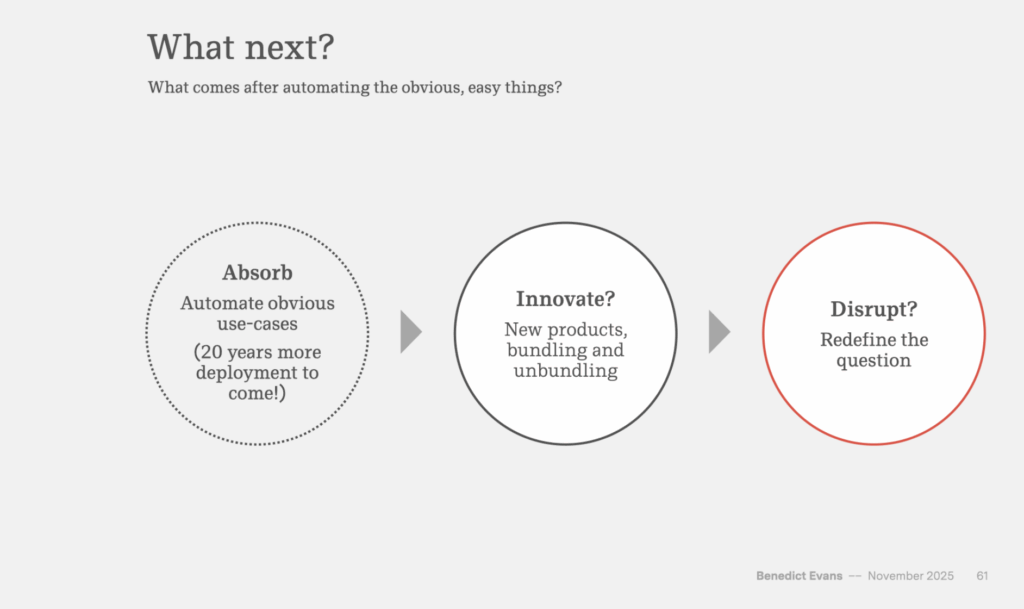
Most companies are still using AI to automate yesterday’s digitization…doing the same things, just a bit faster.
When I was writing Mindshift, I took a break to read Rick Rubin’s, The Creative Act: A Way of Being. There are many memorable quotes, but one in particular applies to this moment in time.
“Beware of the assumption that the way you work is the best way simply because it’s the way you’ve done it before.”
Yet, that’s what is driving today’s AI investments by and large. And that’s why we’re not seeing ROI in AI.
The real upside is in asking, “What could we do now that was impossible before?” That’s where value creation lies dormant awaiting leaders who poke it enough to awaken. As a result, AI-powered exponential companies will emerge. It won’t be from incremental, linear efficiency and productivity gains, but instead from entirely new value propositions, pricing models, and markets that only make sense in a world of abundant intelligence and automation.
That’s how you thrive in an era of cognitive Darwinism.
“What’s our AI strategy?”
Question for you…who owns AI strategy? I don’t mean technology evaluation and implementation. I mean the actual North Star and the plan to get there?
Ben explores a list of possible owners of “AI strategy”: CIO, CMO, CFO, CHRO, Head of Data, Head of Product, or external consultants like Bain, BCG, McKinsey.
It ends with the question: is AI just a new tool, or the foundation of a new industry structure?
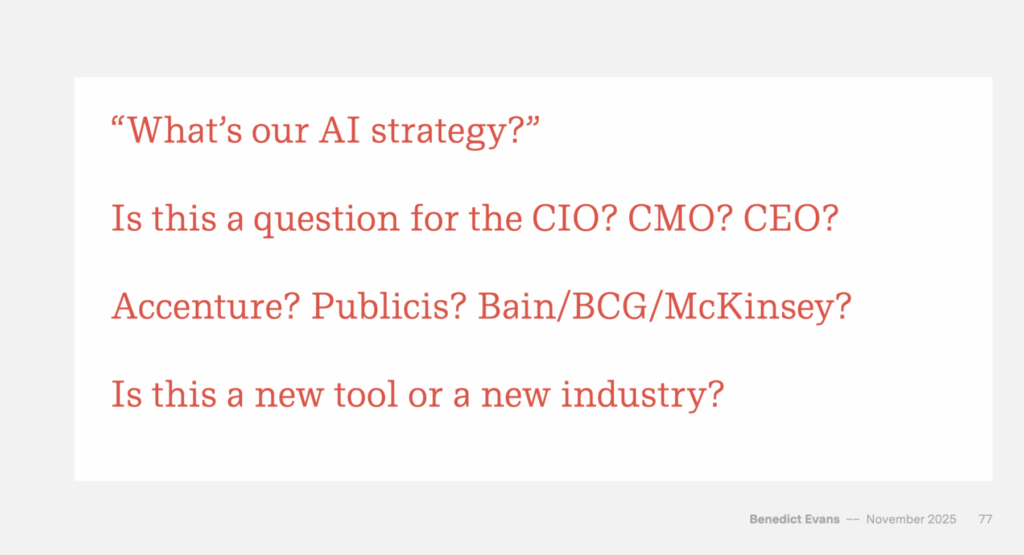
If everyone owns AI, no one owns AI. Treating AI as a functional add-on guarantees fragmented pilots and political turf wars, which protects and fortifies a siloed organization. For AI to deliver ROI beyond cost-takeout, AI becomes a board-level and CEO-level mandate that cuts across technology, talent, operations, and business design. Growth is on the table for those willing to take it.
The right framing for this moment shouldn’t be “Who runs AI?,” but “How do we lead a company that is increasingly run by humans and AI together?”
Value creation requires integration of departments, workflows, data, and AI. Metrics should be updated to drive that integration. Otherwise, you’re doing what you did yesterday, just with AI now.
When automation works, it disappears”
Ben shows a chart of elevator operators in the US from 1900–1990, peaking and then effectively going to zero after Otis launched automatic elevators. When automation succeeds, the job disappears and the technology becomes invisible infrastructure.

This is a history lesson with a warning label. Nobody today thinks about “elevator UX” (though I’ve always wondered why you can’t unpress a button…though I’m sure there’s a logical reason). Instead, we just press a button, step back, and look at our phones until we arrive at our floor.
In the same way, many of the AI debates we’re having today will vanish into the fabric of work. Roles will merge, new ones will appear, and some will fade into the footnotes of economic history. The leadership responsibility is to make that transition humane and intentional. While some cut jobs, others will create the jobs of the future, now, and empower people to lead the way.
Steve Jobs: “Start with the experience”
Executives don’ know what they don’t know. Sounds like an excuse, right? I think of it as an invitation for curiosity to inspire imagination.
Steve Jobs famously said, “People don’t know what they want until you show it to them.” He also said, “You’ve got to start with the experience and work backwards to the technology.” It’s a call to explore the unknown, beyond cost-takeout and efficiency and productivity gains. AI can do more if you let it.
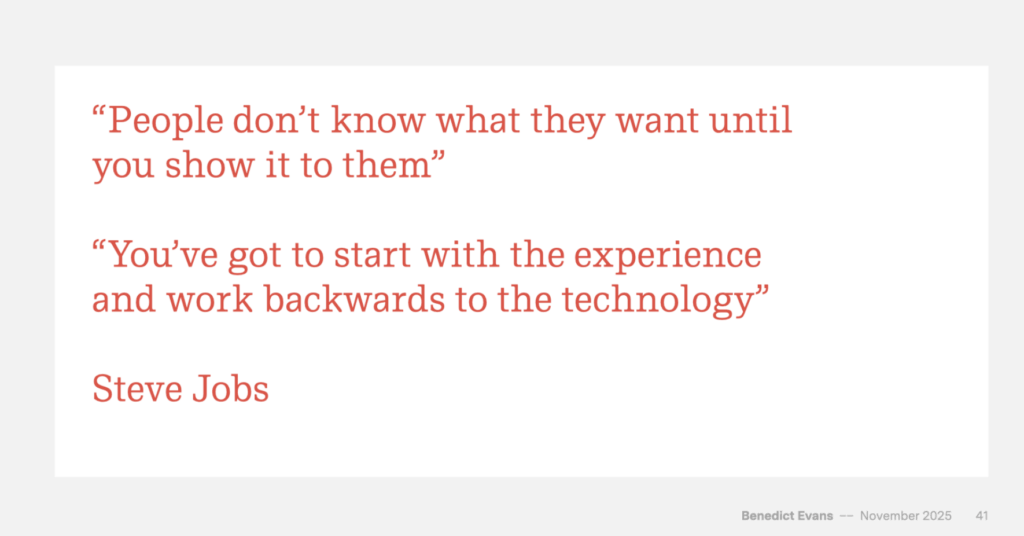
Executives don’t know what they don’t know until they see it. Then they can’t unsee it. That’s the management becomes leadership.
AI is not the story hero in this story. That’s you!
The winners in this wave will be the leaders who can imagine new experiences and outcomes that people don’t yet know how to ask for, and then use AI as the engine behind them. If you start with models, you’ll get use cases. If you start with experience innovation, you’ll get movements.
In the end, that’s what I love about Ben’s work. It’s not just benchmarking where we are and aren’t with AI. It’s a subtle challenge to decide who you want to be in the story that comes next.
Some see friction, slow adoption, and organizational drag. Others open an unprecedented window to redesign how your company learns, decides, creates, and serves.
AI will keep “eating the world” with or without you. That’s cognitive Darwinism. The real question is whether you’re willing to rethink your assumptions, question yesterday’s business logic, re-architect your workflows, and reimagine experiences before they’re reimagined for you. That’s the invitation, and it’s the one I hope more leaders accept before the next report arrives.
#AIorDie!
—
Read Mindshift | Subscribe to a Quantum of Solis | Book Brian as a Speaker


Leave a Reply