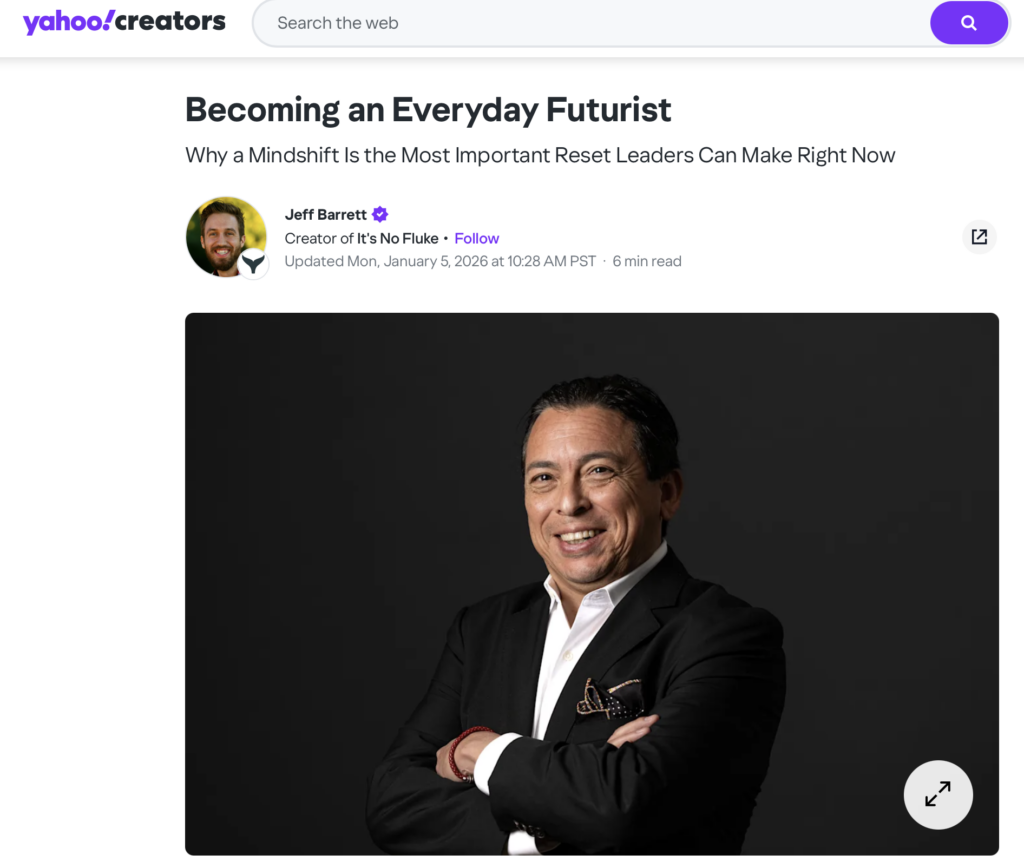
Right before the break, I spent time with Jeff Barrett (It’s No Fluke/Shorty Awards). We explored why leaders keep making the same mistakes and why it’s a good idea for every leader to become an “everyday futurist” right now. Barrett’s takeaways from our conversation were published on Yahoo Creators. Our live conversation was just published on his podcast (Spotify).
Every January I convince myself this is the year I will finally “think more strategically.” I buy a new notebook. I reorganize my apps. I promise to read more books and scroll less. Audible counts. By mid-February, I’m back to reacting to emails, chasing headlines, and convincing myself that being busy counts as progress. It’s not a personal failure. It’s a leadership pattern.
According to futurist Brian Solis, it’s exactly why so many smart, experienced leaders feel like they’re constantly behind, even when they’re doing everything right. The biggest risk facing organizations today is not disruption itself. It is the habit of reacting to disruption without ever changing the mindset that led to being disrupted in the first place. That distinction matters more now than at any other moment in modern business history. I interviewed Solis, the 9x best-selling author and Head of Global Innovation for Service Now, this week for the podcastabout his latest book, Mindshift.
Over the past decade, leaders have navigated political instability, a global pandemic, forced digital transformation, supply chain shocks, and the rapid acceleration of artificial intelligence. Each time, organizations scrambled to adapt, often framing the moment as temporary, a new normal, a bridge back to business as usual.
But the disruptions did not slow down. They stacked.
What Solis argues, and what many leaders are now feeling, is that today’s business climate no longer rewards reactive leadership. It rewards those who can see signals early, interpret what they mean for human behavior, and make thoughtful decisions before change becomes unavoidable.
That is where the idea of becoming an “everyday futurist” or a “digital anthropologist” makes sense.
The Problem With Expertise
One of the hardest truths for experienced leaders to confront is that the skills and instincts that helped them succeed can eventually work against them.
Career success reinforces patterns. If a particular way of thinking has delivered results, promotions, and credibility, it becomes difficult to question it. Over time, leaders operate inside familiar guardrails. Decisions are filtered through past wins, existing metrics, and institutional expectations.
Solis describes this as a cognitive trap. Leaders do not fail because they are uninformed. They fail because they are operating with blind spots they do not recognize. Research cited in his work shows that while nearly everyone believes they are self-aware, only a small fraction consistently practice it.
This is why many organizations experience disruption as shock rather than evolution. Signals appear early. New behaviors emerge. Technologies mature quietly. But without curiosity and openness, those signals are dismissed as noise, fads, or problems for later.
Ignorance can feel efficient until it isn’t.
Why a Mindshift Is Necessary Now
What makes the current moment different is not any single technology or trend. It is the pace and depth of change happening simultaneously.
Artificial intelligence alone illustrates the challenge. Generative AI did not arrive unexpectedly. It has been developing for years. Yet its mainstream adoption triggered another wave of reactive behavior, with leaders scrambling to deploy tools without fully understanding how work, decision-making, or value creation might fundamentally change.
This pattern is familiar. COVID forced overnight digital transformation. Remote work scaled faster than any strategic roadmap predicted. Social platforms reshaped media, commerce, and politics before many institutions understood the implications.
The common thread is not technological surprise. It is leadership inertia.
A mindshift, as Solis defines it, is not about predicting the future perfectly. It is about changing how leaders relate to uncertainty itself. Instead of asking how to return to normal, everyday futurists ask what is emerging and how it might alter behavior, expectations, and opportunity.
That shift is no longer optional. It is foundational.
Becoming a Digital Anthropologist in Your Own Work
The phrase “digital anthropologist” sounds academic, but in practice it is deeply pragmatic.
Anthropology is the study of how humans behave within systems. Applied digitally, it means paying attention to how people adapt to new tools, platforms, and environments. Not just what technology can do, but how it actually gets used. Solis began applying this lens decades ago, studying how emerging technologies reshaped consumer behavior, workplace norms, and social dynamics. The goal was not prediction for prediction’s sake. It was relevance.
Everyday futurists do the same thing at a smaller, repeatable scale. They notice how customers, employees, and communities change their habits. They observe friction, workarounds, and unintended consequences. They ask better questions.
Why are people using this tool differently than expected? What behavior is being rewarded by this system? What feels easier now that didn’t before?
These questions turn abstract trends into usable insight.
Curiosity Is a Leadership Skill
One of Solis’s core arguments is that curiosity is not a personality trait. It is a practice.
Most leaders are trained to project certainty. Saying “I don’t know” can feel risky, especially in environments driven by short-term performance metrics. But curiosity requires admitting uncertainty before it becomes unavoidable. In Solis’s framework, the first step of a mindshift is learning how to receive. That means creating mental space to notice signals instead of filtering them out. Without openness, trends pass unnoticed. With it, leaders begin to perceive meaning.
From there, leaders can organize what they are seeing. Not every new development deserves equal attention. Some are fads. Others are foundational. The discipline is learning to tell the difference. This process does not eliminate uncertainty. It replaces anxiety with agency.
One of the most practical challenges leaders face is time. Immediate goals crowd out long-term thinking. Urgency replaces importance.
Solis acknowledges this tension directly. Even futurists miss signals when they are consumed by execution. The difference is not perfection, but intentionality. Everyday futurists make thinking part of the job, not a luxury. They allocate time to explore ideas without immediate ROI. They maintain a “parking lot” for trends that are interesting but not yet actionable. They revisit assumptions regularly. This habit prevents both overreaction and complacency. It allows leaders to act with context rather than panic.
The New Year Reset That Actually Matters
As organizations enter another year of planning cycles, the temptation is to focus on tools, tactics, and timelines. But the deeper reset is cognitive. The most important question leaders can ask is not what they plan to do differently, but how they plan to think differently.
Becoming an everyday futurist does not require a title, a crystal ball, or perfect foresight. It requires humility, curiosity, and the willingness to challenge one’s own assumptions. In a world where disruption is constant, mindset is the only sustainable advantage.
The future is not something that happens to leaders. It is something they either engage with thoughtfully or encounter unprepared.
And that choice begins with a mindshift.
E296 Brian Solis: Why a Mindshift is Needed
Forbes has called Brian Solis “one of the more creative and brilliant business minds of our time.” ZDNet heralded him as “one of the 21st century business world’s leading thinkers,” and Entrepreneur Magazine described him as “a world’s top superforecaster.”
Check out his latest bestseller, Mindshift: Transform Leadership, Drive Innovation and Reshape The Future.
Brian is a world-renowned digital futurist, 9x best-selling author, and international keynote speaker. He has published over 70 widely read research reports that explore the future of business and industries, disruptive technologies, and shifts in markets and consumer behaviors.
Brian serves as the Head of Global Innovation at ServiceNow. In his role, Brian leads a global network of Innovation Officers and Futurists who study emerging technologies and micro and macro trends, business transformation patterns, and customer insights to understand important shifts affecting organizations and the markets they serve.
The Innovation team produces original research and thought leadership and delivers presentations and workshops that help leaders anticipate shifts, capitalize on trends, and drive resilience and long-term growth.
He is published in industry publications such as Harvard Business Review, Fast Company, CIO, Forbes, and Worth. And he has consistently been recognized as one of the world’s leading thinkers in innovation, business transformation, and leadership for almost three decades.

Playing Retro Bowl 26 feels like managing a real football franchise, from drafting players to making clutch decisions during matches. It keeps me hooked for hours.
Great post on becoming an everyday futurist! I love the idea of a mindshift as a reset for leaders. The part about buying a new notebook to think strategically really resonated with me.