The biggest risk in 2026 is leaders using 2016 mindsets to lead…but mistaking it as a 2026 mindset.
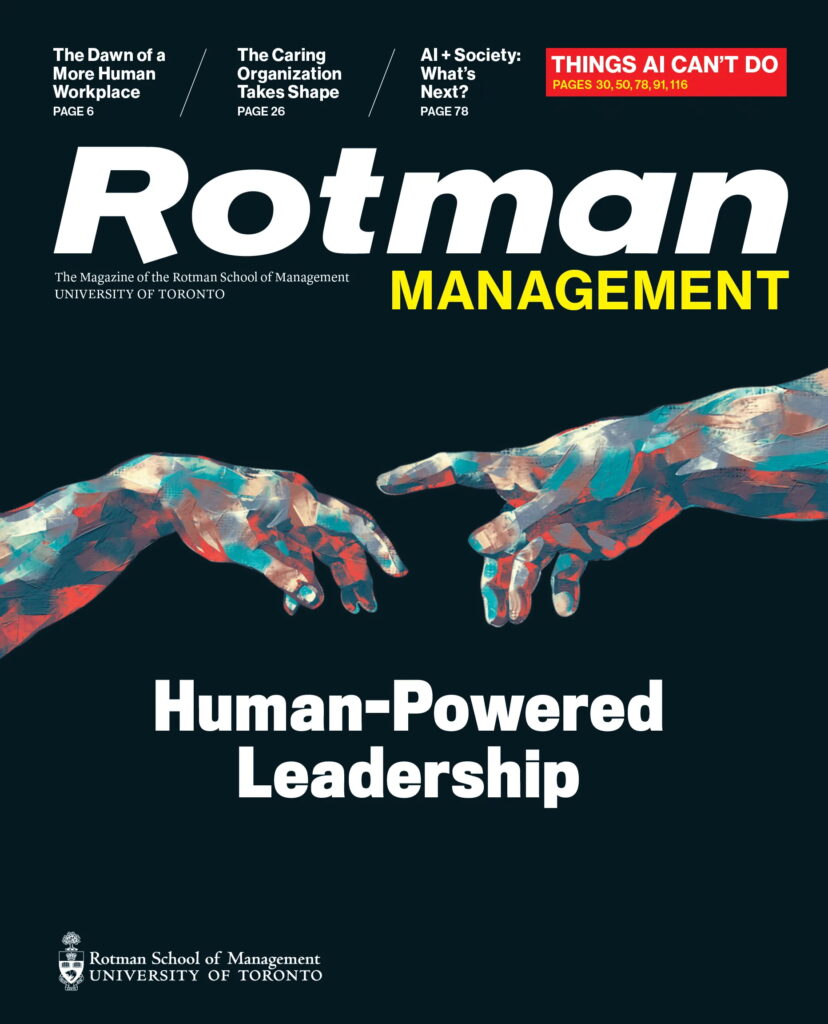
I’ve been meaning to share my interview with University of Toronto – Rotman School of Management Magazine.
This is a “Novel Economy,” where disruption is constant, compounding, and *always* novel (AI, climate, geopolitics, quantum, spatial intelligence… all evolving, emerging, and colliding). And when leaders talk about a “new normal,” it’s often a tell: they’re trying to steer back to business as usual instead of translating change into opportunity.
That’s why I wrote Mindshift.
A few takeaways you can apply immediately:
1) Reframe disruption (and opportunity).
The question shouldn’t be “How do we protect what we built?” It’s “What is this disruption inviting us to rethink, redesign, and reimagine?”
2) Build trend literacy across 3 layers:
• Microtrends = early signals in niche communities
• Macrotrends = broader movements across industries
• Megatrends = seismic forces that reshape society
The opportunity is in connecting the dots between them.
3) Self-awareness is a business advantage.
A self-aware mind is a shiftable (and growable) mind. It helps you escape “default thinking” (like reflexively cutting costs or automating away people) and see growth paths others miss.
4) Innovation = experience + speed + reinvestment.
The disruptors I’ve studied obsess over frictionless experiences *and* fast, decisive execution. Momentum matters.
5) Use the 6-stage mindshifting framework:
1) Receive, 2) Perceive, 3) Weave, 4) Conceive, 5) Believe, 6) Achieve.
Signals become strategy. Strategy becomes action.
If you’re navigating AI and uncertainty right now, start here…be curious, listen deeply, and ask better questions before rushing to solutions.
Read the full Rotman Q&A + then go deeper with Mindshift! 💡
Please read my Q&A with Rotman here.

What impressed me about That’s Not My Neighbor was the feeling of working like a civil servant amidst a nightmare. No guns, just logic and observation. The game proves that horror can stem from suspicion.
This is a powerful and timely perspective on leadership in today’s constantly shifting environment. The idea of the “Novel Economy” Geometry Dash Lite really resonates, especially the warning about using old mindsets to navigate new realities.
Great insights shared here. Finding reliable Chartered Accountants in Slough can make a huge difference for businesses looking to stay compliant and grow with confidence. Citygate Account provides professional support, accurate financial guidance, and dependable accounting solutions tailored to business needs.
Really enjoyed this Q&A! Brian’s perspectives on what it takes to thrive in the novel economy are both insightful and relevant — especially his emphasis on adaptability, human-centered thinking, and continuous learning. It’s inspiring to see how forward-looking leadership practices are evolving in today’s complex business environment.
While this discussion focuses on innovation and strategy, it also reminded me how valuable expert insight is in other areas of life — including health and medical care. I recently came across a resource with helpful information that some readers might find informative too:
https://care.drlucasminig.com/
Really liked this Q&A! Brian’s perspectives on what it takes to thrive in the novel economy are both insightful and relevant — especially his emphasis on adaptability, human-centered thinking, and continuous learning. It’s inspiring to see how forward-looking leadership practices are evolving in today’s complex business environment.
Thanks a lot, flash games