There’s a familiar pattern that plays out in C-Suites and boardrooms in every industry around the world.
Something big happens…an economic shock, a geopolitical event, a climate disaster, a technological leap, like ChatGPT or tomorrow’s big quantum event, and for a moment, everything feels…different. Urgent. Unavoidable. “We need to do something!” becomes the prevailing mantra.
And then, almost quietly, we drift back into business as usual.
Not because leaders don’t care.
Not because they’re not paying attention.
But because the comfort of legacy thinking is powerful…and because it’s rewarded and profitable (until it isn’t)
The problem is, we don’t live in a business-as-usual world anymore.
We live in an era of perpetual disruption.
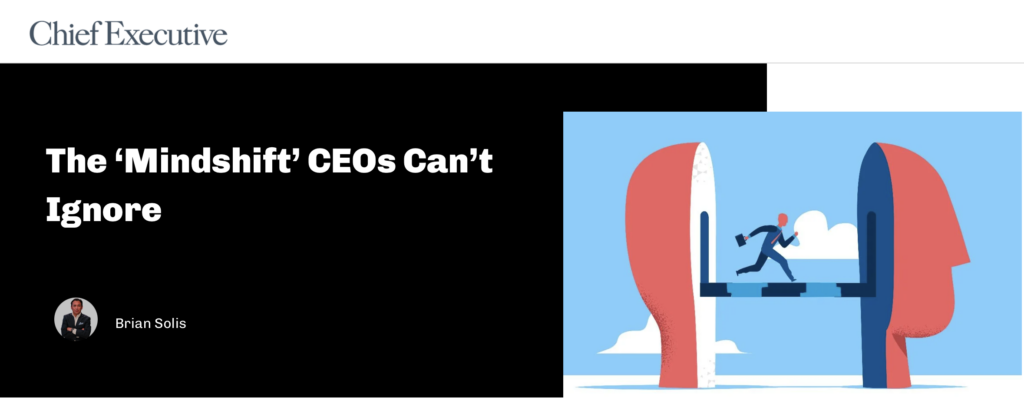
I had the opportunity to share my thoughts in an article for Chief Executive, “The ‘Mindshift’ CEOs Can’t Ignore.” It’s a lighthouse for leaders who know something’s different, but don’t yet realize how to move differently. Though the rules of leadership are changing faster than most operating models can keep up, the the path forward is hidden by cultures of quarter-to-quarter performance.
But it doesn’t change the reality that we’ve officially crossed into a new business reality: For now, AI isn’t a trend or tool. It’s a new baseline for thinking differently about why and how we work.
And that changes everything…at least it should.
Disruption isn’t the threat. Old thinking is.
What’s happening right now isn’t just “more change.”
It’s compounding change.
Geopolitics collides with supply chains.
Climate events reshape continuity planning.
Markets whip faster than strategy cycles.
And now generative AI accelerates decision-making, reinvents workflows, and rewires expectations at every level of the organization.
This is why so many transformation efforts stall:
Leaders try to solve next-era problems using last-era instincts.
Or said differently…
You can’t run tomorrow’s business with yesterday’s logic.
To quote Mr. Marshall Goldsmith, “what got you here, wont’ get you there.”
That’s where mindshift comes in.
A mindshift is a deliberate change in how you think, lead, and act, so you can intentionally shape change instead of spending your days reacting to it.
Mindshift turns disruption into advantage
Most executives experience disruption as pressure.
Something to defend against.
Something to mitigate.
Something to “get through.”
But the leaders who win next won’t just survive disruption.
They’ll use it.
Because disruption reveals opportunity that stability hides.
A mindshift reframes volatility as a leadership advantage and gives you a practical blueprint for building a company that can do three rare things at once:
- stay resilient
- innovate consistently
- move forward confidently…even without perfect clarity
That’s the work.
Not just forecasting the future. Designing for it.
The CEO blueprint for a mindshift (especially in an AI-first era)
Mindshift leadership isn’t abstract. It’s practiced. It’s built into how you show up.
Here are the behaviors that separate future-ready leaders from everyone else trying to keep up.
1) Lead with beginner’s mind (even when you’re the expert)
Success has a sneaky side effect: it hardens beliefs.
We start to treat past wins like permanent truths.
We start protecting “how things work here.”
We start optimizing systems, even if they’re holding performance and potential back.
A beginner’s mind is the discipline of keeping an open mind.
What if, instead of optimizing or automating the past, we asked…
“If we started today, how would we design this?”
It sounds like one deceptively simple question. But it’s a a question that challenges strategy and it challenges identity.
And that’s where reinvention begins.
2) Make curiosity a leadership strategy (not a personality trait)
Curiosity is not a soft skill. It’s a critical skill.
In an AI-first world, curiosity is signal detection and imagination.
It’s how leaders catch weak signals before competitors feel them.
It’s how you see patterns before they become pressure or worse, disruption.
It’s how you develop the capacity for awe — the kind of openness that keeps you from becoming rigid at the exact moment you need to evolve.
This is also why CEOs can’t delegate AI literacy.
You can’t lead what you don’t understand.
You can’t shape what you don’t explore.
AI can’t be something you “support.” It has to be something you experience…then you can lead.
3) Build psychological safety on purpose
Innovation doesn’t thrive in fear. It just doesn’t. And iteration isn’t the same as innovation. As the old saying goes, the lightbulb isn’t the result of the continuous improvement of candles. The same is true for streaming. Netflix isn’t the result of the coninuous improvement of VHS tapes or DVDs.
And AI transformation , actual business reinvention, requires breaking free from conventional trajectories. That takes curiosity, experimentation, questions, mistakes, debate, challenge, and learning in public.
People need space to say:
“I don’t know yet.”
“This doesn’t make sense.”
“We’re missing a risk.”
“What if we tried something different?”
Psychological safety a system…part of your culture.
And when you build it intentionally, you get the one thing every organization says it wants and very few can actually create:
truth at speed and scale.
4) Lead the change visibly (or don’t expect anyone else to)
Most transformations fail because leaders communicate change…and then keep behaving the same. Or they’ll hire outside consultancies to lead change management, but innovation, and people, really, don’t thrive in change or management environments.
Mindshift leadership needs to be visible because a mindshift starts with you. People have to see and believe that youchanged and what’s in it for them to follow.
It’s modeling the behaviors you want others to adopt:
experimenting openly
learning out loud
retiring outdated processes (and outdated mindsets)
showing what adaptation looks like in real time
If you want a culture of innovation, your team has to see you practice it.
5) Reward growth mindset behaviors, not just outcomes
If your incentives only reward certainty and perfection, your culture will avoid the very experimentation it needs to survive.
The organizations that become future-ready reward:
unlearning and learning
smart experimentation
progress and iteration
initiative and ownership
and intentional momentum.
6) Redefine success beyond quarterly metrics
Quarterly performance matters. But resilience is a performance signal too.
Adaptability is a performance signal.
Innovation capacity is a performance signal.
If you only measure what’s easy to track, you’ll miss what matters most when markets shift.
Mindshift expands the definition of “winning” to include the qualities that make growth sustainable in the next era.
7) Scale the mindshift across teams
The mistake too many leaders make is that they try to treat transformation as a project. But transformation cannot survive as a leadership initiative.
It has to become a cultural capability.
You have to set the vision…the future motivating state. And people have to see themselves in the future you’re building. That’s why there are several chapters dedicated to the art and science of real storytelling.
When people feel connected to the story, the journey, and the outcome…
They stop waiting for change.
They start creating it.
Why now is the time to read this
We’re not facing a single wave of change. We’re facing stacked disruption with more waves on the horizon.
Right now, CEOs are making a choice, whether they realize it or not:
Will you keep reacting to change? Or will you develop the mindset to shape it?
That’s what this is really about.
A mindshift is a CEO-level Ctrl+Alt+Delete.
It’s a reset of leadership itself.
How do you want to reboot?
If you’re ready to lead what’s next…
Please read my Chief Executive article: “The ‘Mindshift’ CEOs Can’t Ignore” and share it with C-Suites, boards, and leaders who influence them.
Then go deeper with the book: Mindshift: Transform Leadership, Drive Innovation, and Reshape the Future and please share copies with leaders at every level.
The future isn’t waiting. And if you’re waiting to see what others do first or for the use cases that others prove out, you’re on the wrong side of innovation.
The leaders who will thrive learn to prepare for what’s coming, and they prepare to create what comes next.
—
Read Mindshift | Book Brian as a Speaker | Subscribe to Brian’s Newsletter

The simple yet deep design prevents the game from becoming boring. Each level requires improved control skills. This is a strong point of Poly Track.
Great insights snow rider— this really reframes disruption as opportunity instead of something to just survive. The focus on curiosity, psychological safety, and redefining leadership for an AI-first world is refreshing and much needed.
Your post on such an teresting subject has left me speechless. I regularlyly check out your blogs and stay current by reading the material that you offer; nevertheless, the blog that you have posted today is the one that I appreciate the most.