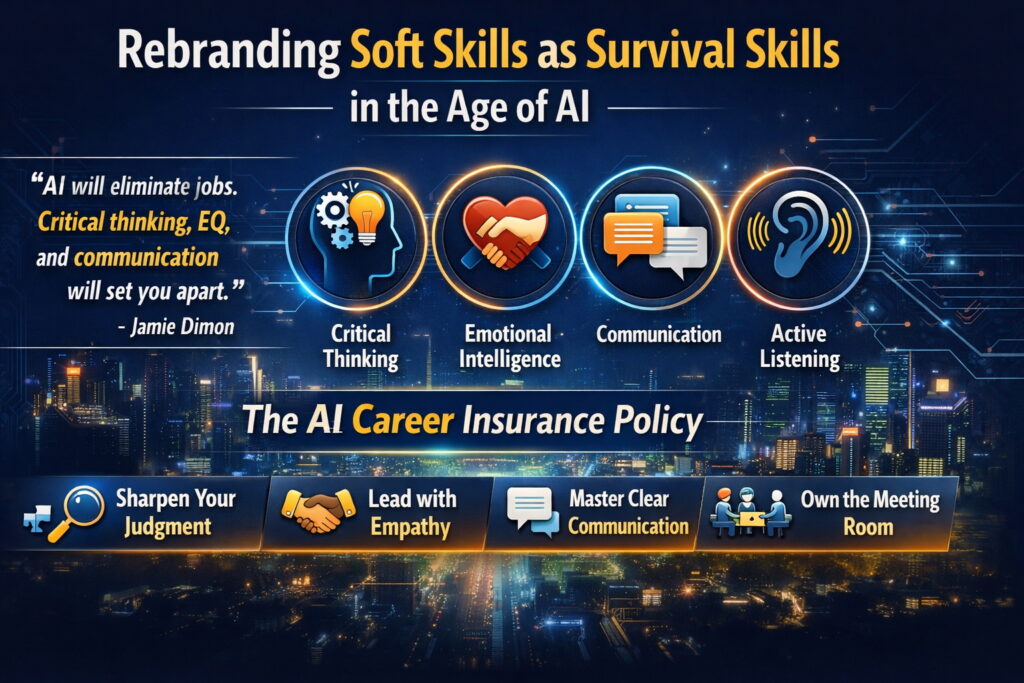
I recently watched an interview with JPMorganChase CEO Jamie Dimon, where he admitted that AI will eliminate jobs. At the same time, he shared his ideas for how employees can stay relevant and resilient with AI.
Double down on the skills AI can’t reliably replicate: critical thinking, emotional intelligence, creativity, communication, and writing.
What’s interesting is how consistent this executive chorus is becoming.
Walmart CEO Doug McMillon has said AI will change “literally every job.”
Amazon Web Services (AWS) CEO Matt Garman underscores that while AI can execute tasks, it still struggles with nuanced judgment. This makes creativity, flexibility, and learning agility more valuable. You’re going to want to be creative. You’re going to want to be [good at] critical thinking. And you’re going to want to be flexible,” Garman observed. “I think the ability to learn new things and adapt is going to be just as important as any particular skill that you learn.”
With this advice, Soft skills just got rebranded as AI survival skills. In an era when intelligence s abundant, these human skills are power skills, and they’re scarce. And scarce becomes valuable. And valuable becomes insurance.
1) Critical thinking becomes your differentiator.
AI can generate answers. You have to generate judgment. Learn to question assumptions, spot patterns, and make decisions when data and AI-generated insights are everywhere..
2) EQ becomes your multiplier.
As automation rises, trust, empathy, and leadership become the true competitive edge. Collaboration is still very human.
3) Communication becomes your currency.
If you can’t explain or articulate it, you can’t lead it. Clear writing and clear speaking are how ideas travel, and how influence builds. At the same time, listening is an essential skill. See #5.
4) Meetings become your stage.
Dimon advised to “be good in a meeting.” Don’t just show up. Add value. It’s about presence: framing, facilitation, decisioning, and momentum.
5) Listening is the underrated superpower.
Harvard’s Alison Wood Brooks nails it: most people perform listening. Few people probe. If you listen and ask the next smart question, you become unforgettable.
“Listening to somebody’s answer then probing for more information is a superhero move, and a shockingly low number of people think to do it,” Wood Brooks revealed. “You should show [you’re listening] by saying [you are] out loud.”
The future belongs to people who treat AI as a multiplier, not their voice or brain. Learn the tools, yes. But invest even more in the human capabilities that make tools meaningful.
If AI is changing every job, then the most important reskilling is behavioral. It’s learning how to think, connect, and lead in a world where “average output” is automated…a new AI status quo.
Train to compete more effectively with AI. Train to excel at what AI can’t do.
AI does not feel empathy. AI is not you.
–
Read Mindshift | Book Brian as a Speaker | Subscribe to Brian’s Newsletter



This really hits home and reframes soft build now gg skills in a way that feels urgent and practical. If average output is automated then judgment empathy and clear thinking become the real edge that keeps people indispensable.
Strong take—and it rings true. What stands out is the reframing of “soft skills” as scarce, high-leverage skills in an AI-saturated world.
When output is cheap, judgment, trust, and clarity become the real differentiators. The point about listening is especially sharp—most people wait to talk; very few actually probe, and that alone can set someone apart. Treating AI Sprunki as a multiplier rather than a replacement feels like the right mindset shift for resilience, leadership, and long-term relevance.
This is such a timely and important post, Brian. I’ve been thinking about this a lot in my own work, and the point about listening being an underrated superpower really resonates—it’s something I’ve found makes all the difference when I’m helping someone navigate a complex issue. Speaking of which, when I was recently trying to help a family member figure out a complicated insurance claim, we hit a wall until I remembered that sometimes you just need to talk to a real person. That’s when I found the Encompass customer service number and, honestly, just having that direct line to ask follow-up questions and explain the situation in detail turned a frustrating process into a solution in minutes. It was a great reminder that no matter how smart technology gets, the ability to genuinely connect and communicate with another human being is what truly solves problems and builds trust. I’m walking away from your article feeling even more motivated to keep nurturing those very human skills.
Thank you, Brian, for shedding light on the rebranding of soft skills to AI survival skills. As someone in tech, I see firsthand how adaptability and emotional intelligence are vital in our evolving landscape. Your insights resonate deeply, reminding us that human connection will always be essential. For those navigating platforms like Geometry Dash, these skills truly make a difference in fostering collaboration and innovation.